

Why your rights matter
Every time you buy a share, you are not just placing a bet on a price. You are entering a legal relationship with a company, a broker, a depository and an exchange. Each of them owes you specific duties, and Indian law spells those duties out in detail.
Yet most new investors never read them. They learn about stop-losses and P/E ratios but not about what happens when a broker delays their payout, a company skips a dividend it declared, or a “tip” on Telegram turns out to be a pump-and-dump scheme. That gap is costly. An investor who knows their rights spots trouble early, complains to the right body, and usually gets results.
This guide explains, in plain language, the rights you hold as a stock market investor in India, who enforces them, and exactly how to use them when something goes wrong. It is educational, not legal advice, but it should leave you far more confident about your place in the market.
Who protects you in the market
India’s securities market runs on a layered system of oversight. Knowing who sits where tells you whom to approach when you have a problem.
Body | Role | When it matters to you |
SEBI (Securities and Exchange Board of India) | The regulator, set up under the SEBI Act, 1992, with the mandate to protect investors and regulate the market | Sets the rules every company and intermediary must follow; final review of complaints |
Stock exchanges (NSE, BSE) | Run trading and supervise their member brokers and listed companies | Complaints against brokers, arbitration, Investor Protection Fund |
Depositories (NSDL, CDSL) | Hold your shares in electronic (demat) form | Complaints against Depository Participants, statement issues |
Registrars and Share Transfer Agents (RTAs) | Keep shareholder records for companies | Dividend, transfer, transmission and certificate issues |
Ministry of Corporate Affairs / IEPF Authority | Administers company law and unclaimed dividends and shares | Recovering old dividends or shares moved to IEPF |
The exchanges and depositories are called Market Infrastructure Institutions. They act as the first line of supervision, while SEBI sets policy and steps in when lower levels fail.
A simple rule follows from this: only deal with SEBI-registered entities. Every legitimate broker, depository participant, investment adviser and research analyst carries a SEBI registration number you can verify on SEBI’s website. If someone offering you advice or a trading service has no such number, none of the protections below apply to your dealings with them.
Your core rights as an Stock Market Investor
SEBI requires brokers, depositories and other intermediaries to publish an Investor Charter that lists what you are entitled to. The details vary by intermediary, but these rights run through all of them.
Your core rights as an investor
SEBI requires brokers, depositories and other intermediaries to publish an Investor Charter that lists what you are entitled to. The details vary by intermediary, but these rights run through all of them.
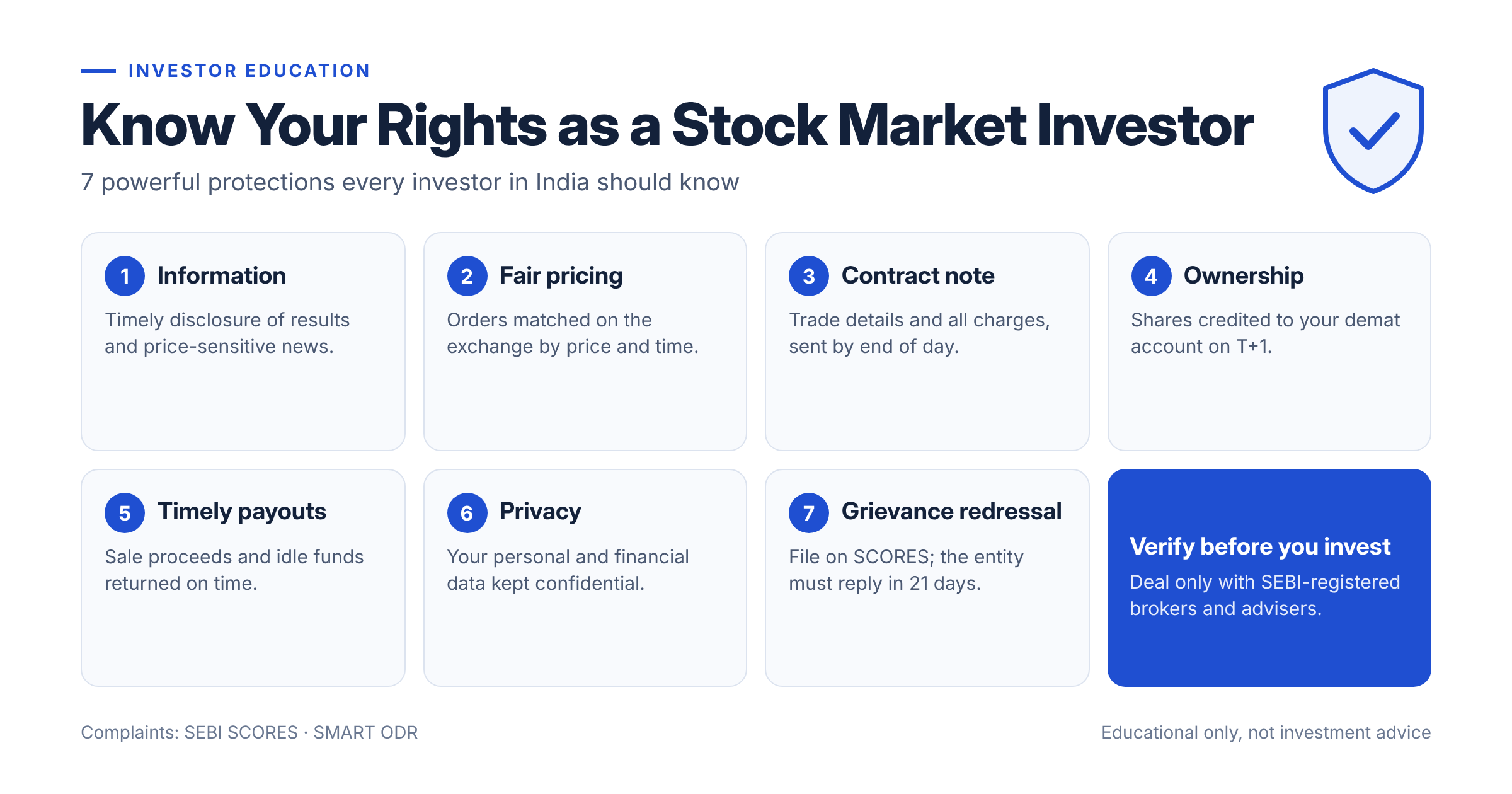
1. The right to accurate information. Listed companies must disclose quarterly results, annual reports, shareholding patterns and any price-sensitive event, such as a merger, a large order or a default, to the exchanges promptly. You are entitled to the same information at the same time as every other investor. Selective leaking of such news to insiders is insider trading, which is illegal.
2. The right to fair and transparent pricing. Trades happen on an exchange’s screen-based system, where every order is matched on price and time priority. Your broker must execute your order at the price the exchange delivers and cannot quietly add a markup.
3. The right to know what you paid. For every trade, your broker must send you a contract note, normally by the end of the trading day, showing price, quantity, brokerage, taxes and other charges. Check it every time. It is your primary evidence if a dispute arises.
4. Ownership and receipt of your securities. Indian equities are settled on a T+1 basis, which means that shares bought today should be credited to your demat account on the next working day. The securities you hold in your demat account are yours, not your broker’s.
5. The right to get your money on time. You are entitled to the funds from sales after settlement.Also, brokers are required to return unused funds lying in your trading account from time to time and not hold them forever.
6. Right to privacy.Your personal and financial information will not be shared or misused by intermediaries beyond what the law and your consent permit.
7. The right to complain and be heard. Every registered entity must have a grievance mechanism, and if it fails you, SEBI’s systems take over. More on this below.
Your rights as a shareholder
Owning even one share makes you a part-owner of the company. The Companies Act, 2013 and SEBI’s listing rules give you a set of ownership rights that are easy to overlook.
- Right to vote.You can vote on key decisions at general meetings, including electing directors, approving accounts, mergers and large related-party deals. Listed companies must offer e-voting, so you can vote online without attending the meeting.
- Right to attend meetings.You can attend the Annual General Meeting, in person or virtually where allowed, and ask questions of the board.
- Right to dividends.Once a company declares a dividend, it must pay it to eligible shareholders within 30 days. Dividends go straight to the bank account linked to your demat account, so keep it updated.
- Right to reports.You are entitled to the annual report, including audited financial statements and the directors’ report.
- Right to corporate benefits.You can take part in bonus issues, stock splits, rights issues and buybacks in proportion to your holding.
- Right to fair treatment in takeovers.If an acquirer crosses certain ownership thresholds, SEBI’s takeover rules require an open offer, giving minority shareholders a chance to exit at a fair price.
- Right to reclaim unclaimed money.Dividends unclaimed for seven consecutive years, and the underlying shares, move to the Investor Education and Protection Fund (IEPF). They are not lost. You can apply to the IEPF Authority to get them back.
- Right to nominate.You can name a nominee for your demat account, so your holdings pass smoothly to your family if something happens to you.
Minority shareholders also have remedies against oppression and mismanagement under company law, though these typically require a group of shareholders and involve the National Company Law Tribunal.
Your rights when dealing with a broker
Most investor complaints in India involve brokers, so this relationship deserves a closer look. A SEBI-registered stockbroker must:
- Disclose all charges upfront.Brokerage, account maintenance fees, and any other charges must be stated in a tariff sheet before you open the account. Changes need prior notice.
- Execute only authorised trades.A broker cannot place a trade in your account without your instruction. If you see a trade you did not place, report it immediately; unauthorised trading is a serious violation.
- Keep your money and shares separate.Client funds and securities must be segregated from the broker’s own. Your shares cannot be pledged or used to fund other clients’ positions without your explicit, authenticated consent.
- Send regular statements.Beyond daily contract notes, you should receive periodic statements of funds and securities. Your depository also sends you a consolidated account statement, which lets you cross-check holdings independently.
- Return idle funds.Under SEBI’s running-account settlement rules, brokers must settle unused client funds at regular intervals unless you have chosen otherwise.
- Provide the Risk Disclosure Document.Before you trade, especially in derivatives, you must be told plainly about the risks involved.
You also have the right to close your account. A broker cannot hold your shares or money hostage. Once dues are settled, your securities should be transferred to a demat account of your choice and your funds returned.
In IPOs, your money is protected by ASBA (Application Supported by Blocked Amount). The bid amount is only blocked in your bank account, not debited, and is released if you do not get an allotment.
How to file a complaint when something goes wrong
Having rights is only useful if you can enforce them. India has a clear escalation path, and most investors who follow it get a resolution.
- Go to the entity first.Write to the broker, company, depository participant or RTA through its grievance email or investor-relations desk. Keep copies of everything: emails, contract notes, screenshots and statements.
- Escalate on SCORES.If you are not satisfied, file a complaint on SEBI’s SCORES portal (sebi.gov.in). Under SCORES 2.0, your complaint is automatically sent to the entity, which has 21 days to respond.
- Ask for a review.If the response does not satisfy you, you have 15 days to request a first-level review by the designated body, such as the exchange or depository. A second-level review by SEBI is available within a further 15-day window.
- Use Online Dispute Resolution (ODR).For disputes that need a binding outcome, such as a money claim against a broker, use SEBI’s SMART ODR portal. It routes your case to an independent ODR institution for online conciliation and, if needed, arbitration. Opening an ODR case closes the matter on SCORES.
SCORES receives thousands of complaints a month; in June 2025, for example, SEBI disposed of 4,415 complaints through it. The system works, but only if you use it.
The Investor Protection Fund (IPF). Each stock exchange maintains an IPF. If a broker is declared a defaulter and cannot repay what it owes clients, eligible investors can claim compensation from this fund, subject to limits set by the exchange. It is a safety net, not insurance against market losses.
Rights come with responsibilities
The regulator protects you from unfair treatment. It does not protect you from your own carelessness or from ordinary market losses. Your side of the bargain includes:
- Keeping your KYC, mobile number, email and bank details current, so alerts and dividends reach you.
- Never sharing passwords, OTPs or your demat login with anyone, including your broker’s staff.
- Reading every contract note, account statement and exchange SMS alert, and raising discrepancies at once.
- Understanding a product before you buy it, especially futures and options, where SEBI’s own studies show most individual traders lose money.
- Acting promptly. Complaints filed long after the event are harder to prove and may fall outside time limits.
Red flags to watch for
- Guaranteed returns.No legitimate market product guarantees profit. Anyone promising fixed monthly returns from trading is a warning sign.
- Unregistered tipsters.WhatsApp and Telegram groups selling “sure-shot” calls usually lack SEBI registration. Paid investment advice is legal only from registered Investment Advisers and Research Analysts.
- Requests to hand over your account.Never let anyone trade on your behalf using your login, however friendly the offer.
- Pressure to act fast.Urgency is the oldest tool of fraud. Real opportunities survive a day of checking.
- Fake apps and look-alike websites.Download trading apps only from official stores and verify the broker’s name and registration.
Conclusion
India’s stock market has become far safer for ordinary investors over the past decade. Faster T+1 settlement, ASBA for IPOs, segregation of client assets, e-voting and a digital complaint system have shifted power toward the individual. But these protections only work for people who know they exist.
So take a few practical steps today. Verify that your broker is SEBI-registered. Read its Investor Charter. Confirm your nominee and bank details in your demat account. Bookmark the SCORES and SMART ODR portals. And the next time a contract note or statement looks wrong, do not shrug it off; you now know exactly where to go. Markets will always carry risk. Being treated unfairly should not be one of those risks.