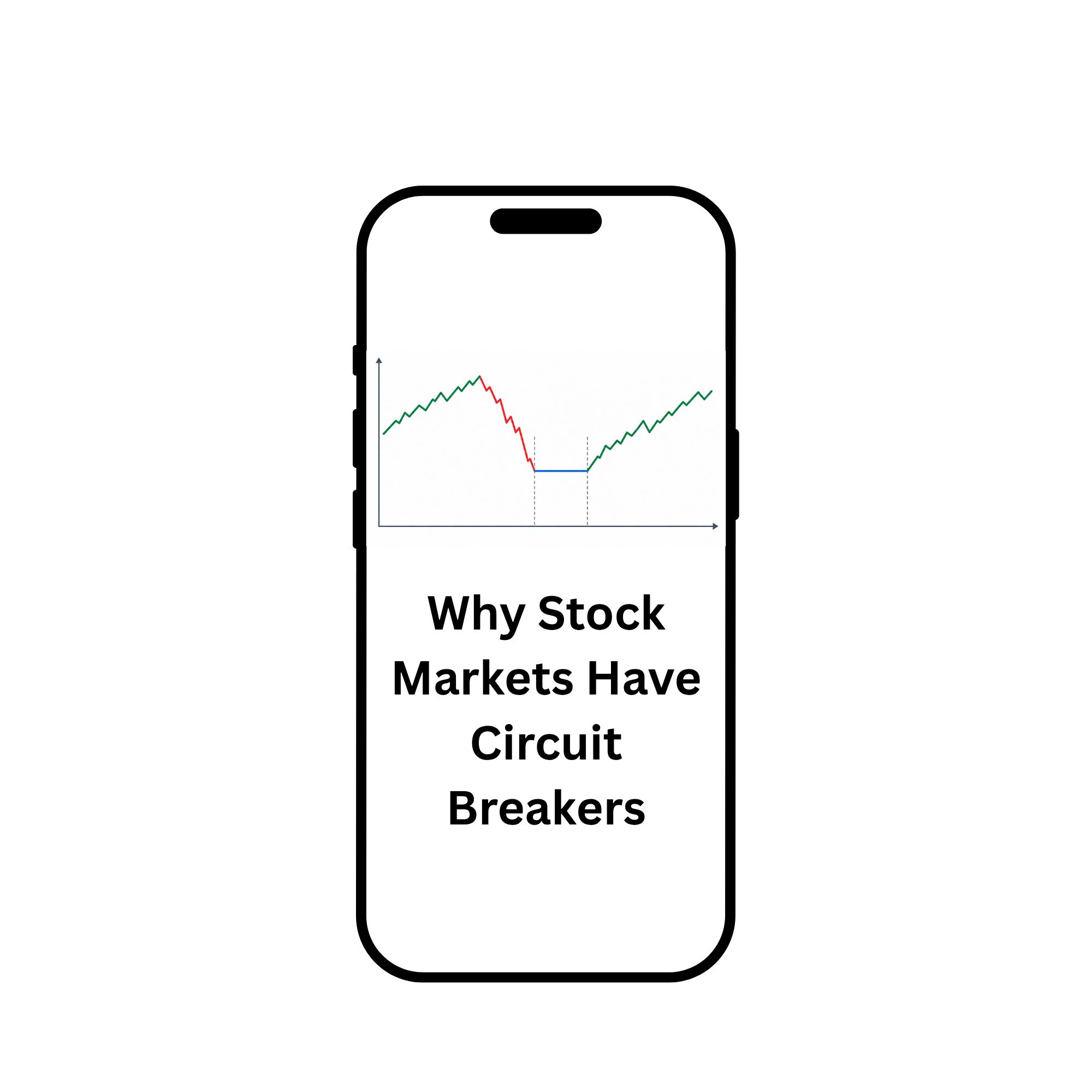
Stock Market Circuit Breakers is an automatic trading halt that pauses buying and selling when a market index moves too far, too fast. In India, the market-wide circuit breaker trips when the Nifty 50 or BSE Sensex moves 10%, 15% or 20% (up or down) from the previous day’s close. Trading then stops across all equity and equity derivatives markets for 15 minutes to the rest of the day, depending on the size of the move and the time it happens.
Key takeaways
- India’s market-wide circuit breaker has three levels: 10%, 15% and 20%, in either direction.
- It is triggered by Nifty 50 or Sensex, whichever breaches the level first.
- A halt applies to all equity and equity derivatives segments on NSE and BSE at the same time.
- Limits are based on the previous trading day’s closing level and converted into index points daily.
- After a halt, trading resumes with a 15-minute pre-open call auction.
- Individual stocks have separate price bands (2%, 5%, 10% or 20%), known as upper and lower circuits.
- SEBI introduced the index-based market-wide circuit breaker in 2001.
- The last market-wide halts in India happened in March 2020, during the COVID-19 crash.
What is a stock market circuit breaker?
A stock market circuit breaker is a regulatory safeguard that temporarily stops trading during extreme price swings. It does not set prices, place stop-losses or prevent a market from falling. It simply creates a pause so investors, traders and liquidity providers can reassess news, orders and risk before trading resumes.
The name comes from the circuit breaker in your home’s electrical panel. When the load gets too high, the breaker trips and cuts power. It doesn’t fix the fault, but it stops damage from spreading and gives you time to check what went wrong. A market circuit breaker does the same for prices.
What does a circuit breaker do?
A trading halt is designed to:
- Slow down very fast price moves
- Give investors and trading firms time to digest new information
- Let market makers and liquidity providers reset their orders and risk limits
- Support orderly price discovery
- Stop a temporary order imbalance from turning into market disorder
Every country sets its own rules. US markets, for example, use 7%, 13% and 20% levels on the S&P 500. This guide focuses on India.
What are the circuit breaker rules in India?
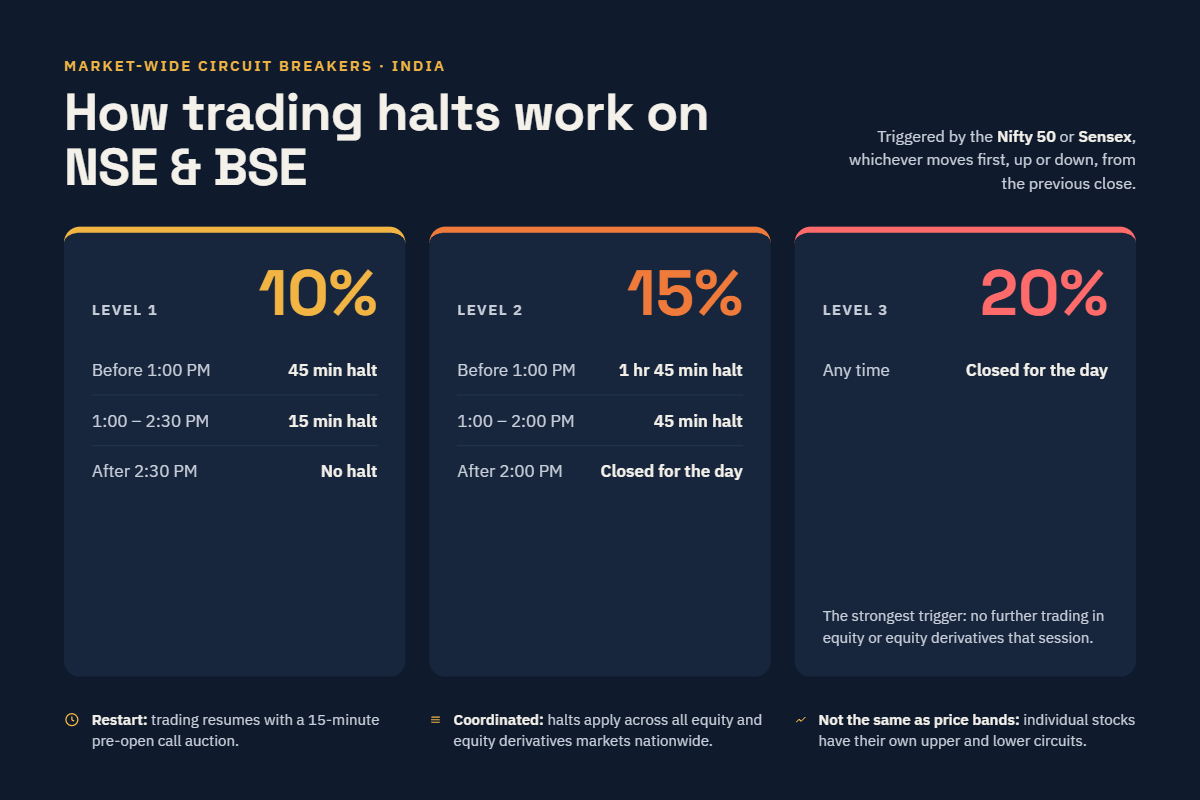
In India, circuit breaker rules are set by the Securities and Exchange Board of India (SEBI) and implemented by the National Stock Exchange (NSE) and BSE. The market-wide circuit breaker is triggered at 10%, 15% or 20% moves in the Nifty 50 or Sensex. How long trading stops depends on the trigger level and the time of day.
Circuit breaker limits and trading halt duration (NSE and BSE)
Index move (up or down) | Time the limit is hit | Trading halt duration |
|---|---|---|
10% | Before 1:00 PM | 45 minutes |
10% | 1:00 PM to 2:30 PM | 15 minutes |
10% | At or after 2:30 PM | No halt |
15% | Before 1:00 PM | 1 hour 45 minutes |
15% | 1:00 PM to 2:00 PM | 45 minutes |
15% | At or after 2:00 PM | Rest of the day |
20% | Any time | Rest of the day |
Every halt is followed by a 15-minute pre-open call auction, except when trading is closed for the rest of the day.
How are circuit breaker limits calculated?
The 10%, 15% and 20% limits are measured from the index’s closing level on the previous trading day. Each day, NSE and BSE convert these percentages into exact index points.
Example: If the Nifty 50 closed at 24,000 yesterday, today’s trigger points would be:
- 10%: a move of 2,400 points (Nifty at 21,600 or 26,400)
- 15%: a move of 3,600 points (Nifty at 20,400 or 27,600)
- 20%: a move of 4,800 points (Nifty at 19,200 or 28,800)
You can check the day’s exact trigger points on the NSE circuit breakers page.
How does trading restart after a circuit breaker halt?
Trading does not snap straight back to normal. The market reopens with a 15-minute pre-open call auction. During this window, buy and sell orders are collected and matched, and a single opening price is discovered. Continuous trading starts only after that.
The goal is orderly price discovery instead of a sudden flood of pent-up orders hitting the market at once.
What is the difference between a circuit breaker and an upper or lower circuit?
A market-wide circuit breaker halts the whole market when an index moves sharply. An upper or lower circuit is a price band on a single stock that limits how far that stock can move in one day. For most retail investors in India, stock price bands matter far more, because they are hit far more often.
Feature | Market-wide circuit breaker | Stock price band (upper/lower circuit) |
|---|---|---|
Applies to | Entire equity and equity derivatives market | One individual stock |
Triggered by | Nifty 50 or Sensex move | That stock’s own price move |
Limits | 10%, 15%, 20% | Commonly 2%, 5%, 10% or 20% |
Effect | All trading stops for a set time | Stock can’t trade beyond the band that day |
How often | Very rare | Common, especially in small caps |
How do stock price bands work?
Exchanges assign each stock a daily price band based on the previous close. When a stock hits the top of its band, it is in the upper circuit; when it hits the bottom, it is in the lower circuit. It cannot trade beyond that level for the rest of the day.
Stocks in the F&O (futures and options) segment don’t have a fixed band. Instead, exchanges use dynamic price bands that can be widened based on volatility. Index derivatives have their own operating ranges.
Why price bands matter to retail investors
- You may not be able to sell. In a lower circuit, sell orders pile up with no matching buyers.
- The freeze can last days. Some stocks stay locked in the lower circuit for several sessions in a row.
- Small caps are most at risk. Illiquid stocks in 2% or 5% bands can lock quickly.
- Delivery holdings stay stuck until buyers return.
- Margin calls don’t pause. If you hold leveraged positions, your broker can still demand more margin while the stock is frozen.
Tip: Before you invest, check the stock’s current price band on the NSE or BSE website. Exchanges revise bands regularly through circulars, so never rely on an old number. Avoid holding an outsized position in a stock with a 2% or 5% band.
When was the circuit breaker last hit in India?
The market-wide circuit breaker was last triggered in March 2020, during the COVID-19 sell-off. It tripped twice that month.
Case study: the March 2020 COVID-19 crash
- March 13, 2020: Both the Sensex and Nifty crashed more than 10% minutes after the open, triggering a 45-minute halt. Markets then recovered sharply after trading resumed.
- March 23, 2020: The Sensex fell 10% in morning trade, triggering another 45-minute halt (the Nifty was down about 9.63% at that point). Selling continued after reopening. By the close, the Sensex had fallen 13.15% and the Nifty 50 had fallen 12.98%, their biggest one-day percentage falls on record at the time.
The lesson: a circuit breaker creates a pause, not a floor. If bad news keeps coming, or buyers won’t step in at earlier prices, the market can keep falling once trading restarts. The 20% level has never been triggered in India.
Why do stock markets need circuit breakers?
Liquidity can vanish in a crash
Normally, an electronic order book works like a continuous auction: buyers bid, sellers offer, and the exchange matches them. In extreme volatility, liquidity providers may:
- Quote smaller sizes
- Widen bid-ask spreads
- Cancel existing orders
- Step away from the market entirely
This thins out the order book. With few bids near the current price, a single large sell order can sweep through several price levels and move the price sharply. The problem is usually not a total lack of buyers, but too little buying interest close to the last traded price.
Market makers pull back because of higher inventory risk, the risk of trading against better-informed traders, rising hedging costs, uncertainty about fair value, and capital limits. Risk models such as Value-at-Risk (VaR) influence these decisions. A halt breaks the direct link between incoming orders and price changes, giving everyone time to reset.
Algorithmic trading moves at machine speed
Much of today’s trading is automated. High-frequency and algorithmic strategies react in microseconds. Some provide liquidity, some arbitrage, some follow trends, and some execute large institutional orders. In a crash, these strategies can interact in ways that speed up price moves. A halt pauses all of them at once.
Fear creates a feedback loop
Loss aversion means people feel losses more strongly than equal gains. In a steep fall, this creates a loop:
- Fear increases selling.
- Liquidity falls.
- Prices fall further.
- Falling prices create more fear.
A circuit breaker can interrupt this loop for a while, but it cannot remove fear or guarantee a recovery.
Clearing systems need time
Clearing corporations act as central counterparties (CCPs), standing between buyers and sellers and managing risk through margins and default procedures. In a crash, margin requirements and collateral values change fast. A halt doesn’t remove this risk or provide emergency funding, but it slows the pace of change so participants and market infrastructure can manage it.
Cash and derivatives markets are linked
Hedging and arbitrage tie stocks, index futures and options together. That’s why India halts equity and equity derivatives markets together, so closely linked markets don’t react to a crash in completely different ways. The US adopted the same coordinated approach after 1987.
Where did circuit breakers come from? (Black Monday, 1987)
Modern circuit breakers trace back to Black Monday, October 19, 1987, when the Dow Jones Industrial Average fell about 22.6% in a single day, its largest one-day percentage drop in modern history.
No single factor caused the crash. Program trading, portfolio insurance, investor psychology, poor liquidity and links between markets all played a part. The Presidential Task Force on Market Mechanisms, led by Nicholas Brady, recommended circuit breakers coordinated across stocks, options and index futures. US pilot programs began in 1988.
India introduced its index-based market-wide circuit breaker in 2001. SEBI later moved to daily calculation of trigger points and added the 15-minute pre-open call auction after halts (effective October 2013).
Do circuit breakers actually work?
Economists still debate this.
Arguments for circuit breakers:
- Slow down disorderly price moves
- Give people time to process information
- Let liquidity providers reassess risk
- Support better price discovery during temporary imbalances
Arguments against circuit breakers:
- Magnet effect: As prices near a trigger level, traders may rush to sell before the halt, which can speed up the fall.
- Delay, not cure: A halt may only postpone the price adjustment if the underlying news is still bad.
Bottom line: a circuit breaker can make price discovery more orderly, but it does not change what an asset is actually worth.
What should investors do when trading is halted?
- Don’t panic. A halt is a planned market control, not a sign that a company or the financial system has failed.
- Find out why. Identify the news driving the move.
- Avoid market orders when trading resumes. A market order guarantees execution, not price. Use a limit order to set the most you’ll pay or the least you’ll accept, knowing it may not fill.
- Reassess your risk. Ask: Has the situation really changed? Am I reacting to price or to new information? What happens to my portfolio if volatility continues?
- Know your stocks’ price bands. A single stock’s lower circuit is far more likely to trap you than a market-wide halt.