Hustle culture means maximising income through long hours, side gigs and sacrifice. Soft saving means saving a steady, comfortable amount while still spending on things you enjoy. Neither is right on its own. The approach that works best for most people is a hybrid: automate a meaningful savings rate, invest it for growth, spend the rest guilt-free, and use intense “hustle” only in short, goal-driven bursts.
Key takeaways
- Hustle culture raises income and builds skills, but it risks burnout, comparison and diminishing returns when it becomes an identity.
- Soft saving is sustainable and kinder to mental health, but it can slide into under-saving if the amount is too small or the money is left idle.
- Compounding rewards time and consistency more than intensity. Starting early with a modest SIP can beat starting late with a large one.
- Your savings rateand income growth are the two biggest levers in your financial life.
- Use hustle in seasons, with an end date, and let automation do the steady work in between.
Two friends graduate in the same year. One wakes at 5 a.m., runs a side business, freelances on weekends and posts about “the grind.” The other keeps a steady job, automates a modest monthly SIP, spends deliberately on what she enjoys and logs off at six. Five years later, who is better off?
The honest answer is: it depends. That “it depends” sits at the heart of one of the most talked-about debates in personal finance. On one side is hustle culture, the belief that relentless work, side income and sacrifice are the route to wealth. On the other is soft saving, a gentler philosophy that puts balance, wellbeing and sustainable habits ahead of extreme frugality and constant striving.
This article explains what each approach means, where each shines and stumbles, the maths that settles many arguments and how to build a hybrid that fits your life rather than someone else’s highlight reel.
What Is Hustle Culture?
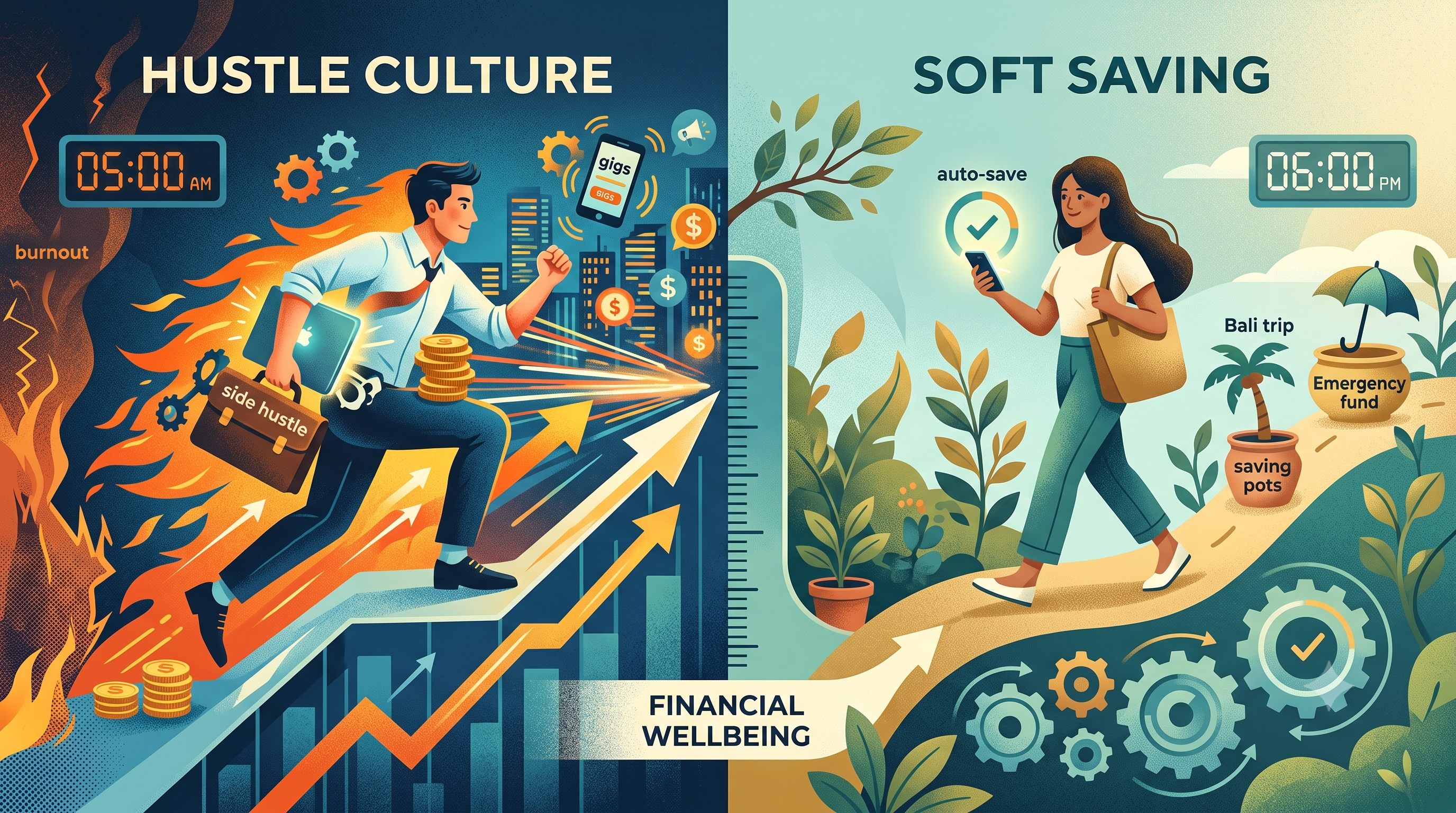
Hustle culture is the belief that success comes to those who outwork everyone else, through long hours, multiple income streams, aggressive saving and treating rest as something you haven’t yet earned. Its slogans are familiar: “rise and grind,” “sleep is for the weak,” “if you’re not building your dream, you’re building someone else’s.”
The movement grew alongside social media, startup mythology, the gig economy and rising living costs. For many people, it also grew out of necessity. When rent, education and healthcare costs outpace salaries, earning more feels less like ambition and more like survival.
What does hustle culture get right?
- It increases income.Your earning power is often your most powerful financial lever. Side businesses, freelancing and skill-building can meaningfully raise it.
- It builds skills and resilience.Pitching clients or launching a product teaches lessons no classroom can.
- It creates optionality.Multiple income streams reduce dependence on one employer, which is valuable when layoffs happen.
- It works in short bursts.A focused sprint to clear debt, fund a down payment or launch a business can be very effective when it has an end date.
Where does hustle culture fall short?
The problems appear when hustle stops being a season and becomes an identity.
- Chronic overwork erodes health, focus and relationships. The World Health Organization recognises burnout as an occupational phenomenon caused by chronic workplace stress that has not been successfully managed.
- Diminishing returns.Beyond a point, extra hours produce less value and quality suffers.
- Comparison and pressure.Social media shows the wins and hides the failures, so ordinary progress feels like falling behind.
- A narrow definition of success.If worth equals productivity, rest feels like guilt and money becomes the only scoreboard.
- Survivorship bias.We hear from people whose hustle paid off, not the many who worked just as hard without the same result. Luck, timing and privilege matter more than hustle stories admit.
What Is Soft Saving?
Soft saving is an approach to money that prioritises steady, sustainable saving without sacrificing present-day happiness or mental health. The term has been popularised largely by younger people who watched earlier generations burn out or postpone life for a future that never quite arrived.
Instead of extreme frugality, soft savers make room for experiences, hobbies, travel and comfort while still setting money aside regularly. The philosophy says: life is happening now, and money should support living, not just future security.
In practice, soft saving might look like:
- saving a realistic percentage of income rather than an aggressive, unsustainable one;
- automating a monthly SIP or recurring deposit so saving needs no willpower;
- budgeting for fun, such as meals out, trips and small treats, without guilt;
- choosing work-life balance over a higher-paying but draining job;
- setting flexible goals that can bend when life changes.
What does soft saving get right?
- A plan you can follow for years beats a punishing one you abandon in three months.
- Mental wellbeing.Less money-related anxiety and guilt makes for a healthier relationship with finances.
- Enjoying life now.Nobody is promised a long, healthy retirement. Experiences and relationships have real value.
- For people with lower incomes or heavy family responsibilities, extreme targets feel impossible. A small, consistent habit beats none.
- Less burnout.Rest and boundaries protect your long-term earning ability.
Where can soft saving go wrong?
- Under-saving.“Saving softly” can slide into not saving enough for retirement, emergencies or major goals.
- Money that isn’t invested loses purchasing power. Gentle saving in a savings account can fall behind rising prices.
- Justifying overspending.“Treat yourself” can become an excuse for lifestyle creep.
- Ignoring the maths.Compounding rewards early, consistent contributions. Delaying serious saving has a real cost.
- Privilege blind spots.Soft saving assumes enough income and stability to choose balance. For those working just to cover essentials, it may not be a choice at all.
Soft Saving vs. Hustle Culture: Side-by-Side Comparison
Factor | Hustle culture | Soft saving |
Core belief | Success comes from maximum effort | Wellbeing and sustainability come first |
View of time | Sacrifice now for reward later | Balance the present and the future |
View of rest | A reward or a distraction | A necessity |
Money focus | Earn and accumulate more | Save enough while living well |
Main strength | Raises income and skills | Builds lasting habits |
Main risk | Burnout, comparison, regret | Under-saving, drifting |
Best suited for | Short, goal-driven sprints | Long-term consistency |
Neither is inherently right. Each answers a different question. Hustle asks, “How much can I build?” Soft saving asks, “How can I build without breaking myself?” A healthy financial life needs both questions.
Why Is This Debate Happening Now?
The rise of soft saving isn’t random. Several forces feed it:
- Burnout awareness. After years of talk about overwork, many younger workers won’t trade their health for a promise.
- Economic reality.When property prices and living costs outpace wages, the old formula of “work hard, save hard, buy a house” feels out of reach. Some respond by hustling harder; others step off the treadmill and focus on quality of life.
- Remote and flexible work.More control over time has changed how people think about productivity and freedom.
- Mental health conversations.People increasingly recognise how financial stress and overwork affect sleep, anxiety and relationships.
- Social media on both sides.Hustle influencers sell financial freedom through discipline, while lifestyle creators promote slow living. Both narratives can be curated and commercial, so be sceptical of each.
The Maths That Settles Many Arguments
Feelings aside, some numbers matter regardless of philosophy.
1. Compounding rewards time more than intensity
Consider two investors earning an illustrative 12% a year in an equity SIP:
Investor | Monthly SIP | Years invested | Total invested | Approximate value at 60 |
Starts at 25 | ₹5,000 | 35 | ₹21 lakh | about ₹3.2 crore |
Starts at 35 | ₹10,000 | 25 | ₹30 lakh | about ₹1.9 crore |
The early starter invests less money but ends up with far more, simply because the money has ten extra years to grow. This is a strong point in favour of soft saving’s steady, automated approach, as long as the money is actually invested, not parked in a savings account. Returns are illustrative and not guaranteed; equity returns vary from year to year.
2. Your savings rate drives outcomes
For someone earning ₹50,000 a month, saving 5% (₹2,500) for 30 years at 12% grows to roughly ₹88 lakh. Saving 20% (₹10,000) grows to roughly ₹3.5 crore. Soft saving shouldn’t mean saving so little that goals become unreachable.
3. Income growth beats cost-cutting at the margin
There is a floor to how much you can trim expenses, but no ceiling on how much you can earn. This is the strongest argument for the hustle mindset, ideally applied to raising skills and pay rather than simply adding hours.
4. Emergency funds prevent setbacks
Without a cash buffer, one unexpected bill can push you into high-interest credit card debt or a personal loan, undoing months of saving. Both camps need this foundation.
How to Build a Hybrid: Sustainable Ambition in 8 Steps
1. Start with a foundation
Before optimising anything, cover the basics: an emergency fund of three to six months of essential expenses, adequate health insurance, term life insurance if others depend on you, and a plan to clear high-interest debt.
2. Automate the non-negotiable
Set up automatic transfers on payday, such as an SIP or recurring deposit. Automation is the soft saver’s best friend because it removes willpower and guilt. Start with an amount that feels comfortable, then step it up by 10% every year or whenever your income rises.
3. Save first, then spend guilt-free
Decide what you’ll set aside, then allow yourself to spend the rest without shame. A simple guide is the 50/30/20 rule: about 50% of take-home pay for needs, 30% for wants and 20% for savings and investments. Adjust the split to your situation. A built-in “fun money” category is more sustainable than restriction that eventually snaps.
4. Use hustle in seasons, not forever
Treat intense effort as a tool with a purpose and an end date. Sprint for six months to clear a credit card, fund a down payment or launch a side project, then return to a calmer rhythm. Defining the finish line stops hustle becoming a permanent way of life.
5. Invest in earning power
Put extra energy into what raises your income over time: in-demand skills, certifications, salary negotiation, strategic job changes or something that scales. This is smarter than adding more hours to an already full week.
6. Put your money to work
Whichever style you prefer, don’t leave long-term savings idle. Diversified, low-cost investments, such as index funds and diversified equity funds, have historically grown faster than cash over long periods, though they carry risk and should match your timeline. Keep short-term money safe and long-term money invested.
7. Protect your health and relationships
Treat sleep, exercise and social connection as financial assets. They shape your energy, decisions and career. A plan that wrecks your health is not a good financial plan.
8. Review and adjust every year
A promotion, marriage, a child, a health issue or a job loss should prompt a review. Revisit your goals and savings rate at least once a year.
Which Approach Fits Which Life Stage?
Situation | Leaning | Why |
Early career, few obligations | More hustle | Low expenses and a long horizon make skill-building and aggressive saving powerful, as long as health is protected |
Carrying high-interest debt | Short hustle sprint | Clearing a heavy drag frees cash flow quickly |
Supporting family or caring for others | More soft saving | Time and energy are limited, so steady automation works better |
Nearing burnout | Soft-saving reset | Lower targets and more rest protect long-term earning ability |
Approaching retirement | Balanced | Priority shifts to protecting wealth and generating reliable income |
On a tight income | Small, steady steps | Build a tiny buffer, avoid costly debt and look for gradual income growth |
Common Mistakes to Avoid
- Copying someone else’s numbers. A savings rate that suits a high earner with no dependents may be unrealistic for you.
- Treating rest as laziness.Recovery is part of productivity.
- Treating “balance” as permission to drift. Soft saving still needs intention and a plan.
- Measuring yourself against social media. Online success stories are edited. Compare yourself with your own past.
- Ignoring the long term. Future you will still need income, security and choices.
- Falling for get-rich-quick promises. Both hustle and lifestyle spaces attract sellers of courses, schemes and risky trading products. If it sounds too good to be true, it usually is.
Final Thoughts
Soft saving and hustle culture aren’t enemies. They are two answers to a shared problem: how to build a secure, meaningful life in an expensive, uncertain world. Hustle reminds us that effort, skills and income growth matter. Soft saving reminds us that health, happiness and sustainability matter too.
The wisest path lies between them. Work hard when there’s a clear reason and an end in sight. Save consistently, automatically and at a level you can maintain. Invest for the long term. Spend on what genuinely improves your life without apology. Rest as seriously as you work. Financial success isn’t a race won by whoever sacrifices most; it is a long journey best completed by someone still healthy, engaged and motivated when they get there.
Source
- SEBI Investor Website: https://investor.sebi.gov.in/
- AMFI Investor Corner: https://www.amfiindia.com/investor-corner
- AMFI “Mutual Funds Sahi Hai”: https://www.mutualfundssahihai.com/