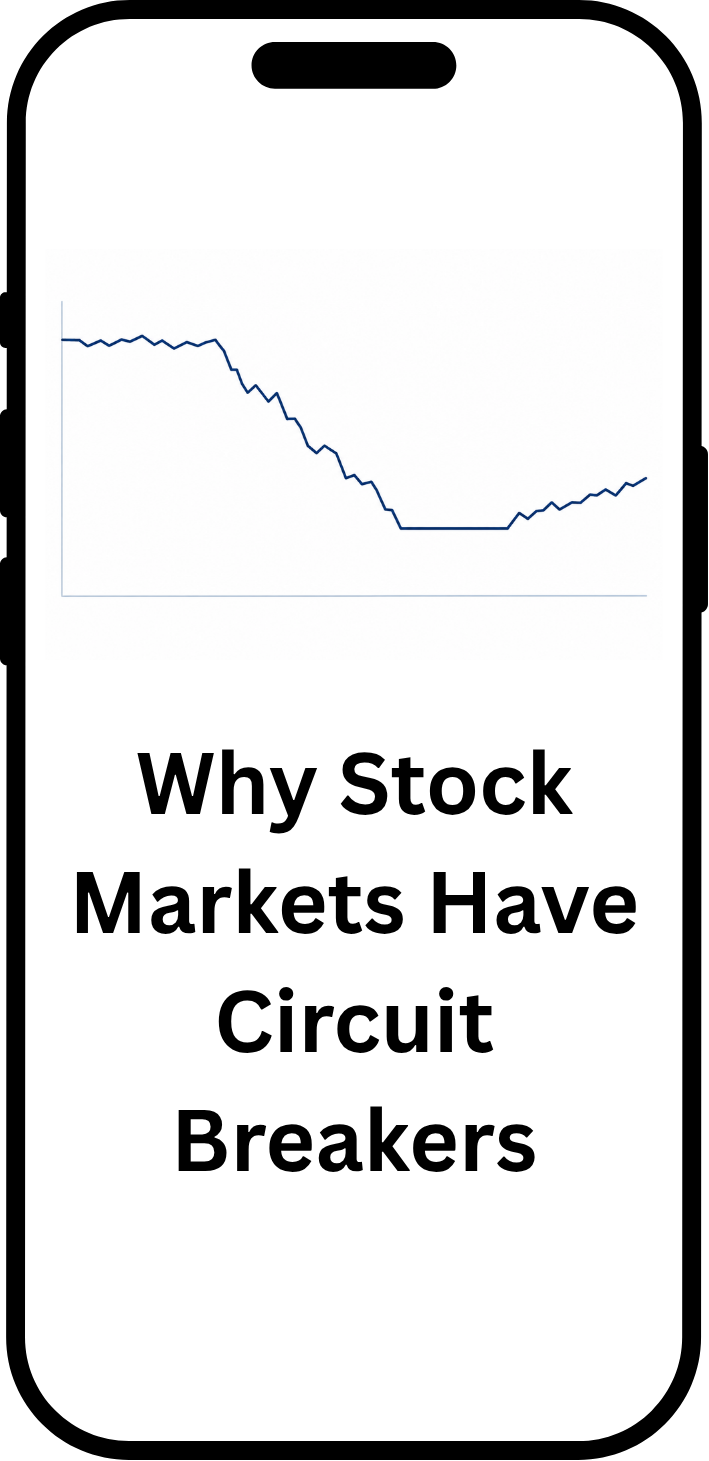
Ever watched the stock ticker when investors are panicking? Prices tumble, everyone rushes to trade, and then everything just stops. “Trading Halts.“
This is not a technical glitch. It is a market safeguard called a circuit breaker.
What are Circuit Breakers?
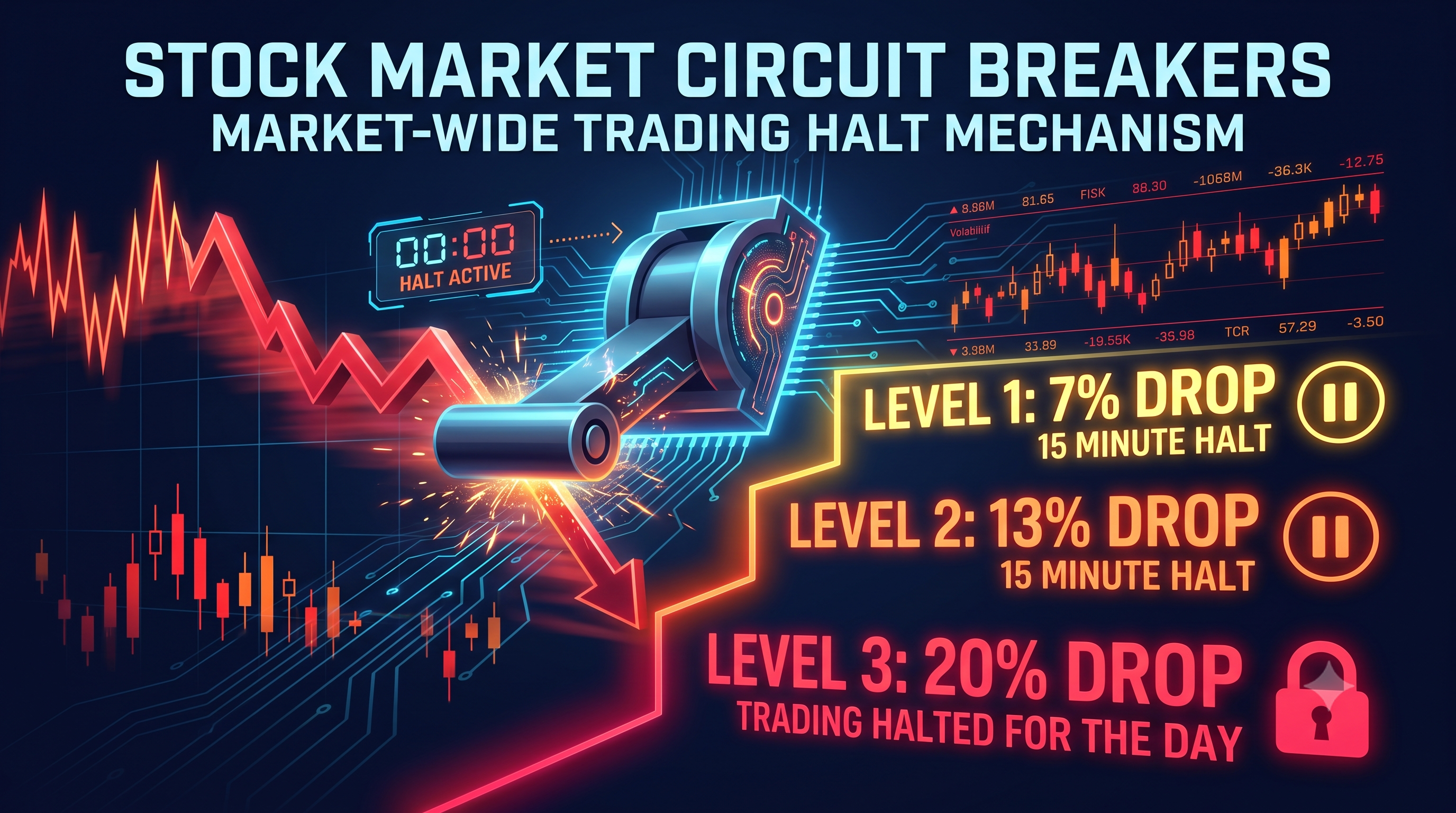
Circuit breakers halt trading temporarily when prices move sharply. They do not put in stop-losses and they do not decide where prices ought to end up. They simply provide a pause in very high volatility so traders and investors can re-evaluate information, orders and liquidity before trading resumes.
Think of the circuit breaker in your home’s electrical panel. If the demand for electricity is too high, the breaker will trip and cut the circuit .It doesn’t solve the problem, but it keeps it from getting worse and buys you time to check what went wrong.
This is also the case with stock market circuit breakers. When a market index moves beyond a set limit, trading is paused temporarily.
The goal is not to stop markets from falling. The pause can:
- Slow down very fast price moves
- Give investors and trading firms time to review information
- Let liquidity providers adjust their orders and risk
- Improve price discovery
- Reduce the chance of a fast-moving imbalance turning into disorder
Each country has its own circuit breaker rules, limits and procedures.
How Circuit Breakers Are Triggered
India’s market-wide circuit breaker has three trigger levels: 10%, 15% and 20%, in either direction. The trigger is based on the Nifty 50 or the BSE Sensex, whichever crosses the level first. Once triggered, trading halts at the same time across India’s equity and equity derivatives markets.
10% trigger
Before 1:00 PM: trading halts for 45 minutes
From 1:00 PM up to 2:30 PM: trading halts for 15 minutes
At or after 2:30 PM: no halt
15% trigger
Before 1:00 PM: trading halts for 1 hour 45 minutes
From 1:00 PM to 2:00 PM: trading halts for 45 minutes
After 2:00 PM: trading halts for the rest of the day
20% trigger
At any time during the day: trading halts for the rest of the day. These limits are measured from the index’s closing level on the previous trading day. The exchange converts the percentages into actual index levels.
How Trading Restarts
After a market-wide halt, trading does not simply return to normal. The market reopens with a pre-open call auction. Orders are entered and matched and the opening price is set before continuous trading begins. NSE rules require a 15-minute pre-open session after a market-wide circuit breaker. The aim is orderly price discovery, not a sudden flood of stored-up orders.
Price Bands on Individual Stocks
Market-wide circuit breakers are different from price bands on individual stocks. A stock may also be limited in how far it can move in a day. The limit is determined by the stock and the market category. Special-featured stocks may be subject to different rules.These bands reduce the volatility of extreme moves in individual stocks and add a layer of protection.
History: Black Monday, 1987
Black Monday, the crash of October 19, 1987, is the origin of modern circuit breakers in the United States. The Dow Jones Industrial Average fell nearly 22.6%, its second-worst one-day percentage drop. The speed of the fall exposed weaknesses in market structure and liquidity.
No single cause explains the crash. Program trading, portfolio insurance strategies, investor psychology, poor liquidity and links between different markets all played a part.
A government group led by Nicholas Brady, the Presidential Task Force on Market Mechanisms, suggested ways to make markets more stable. One idea was circuit breakers coordinated across stocks, options and stock index futures. Pilot programs began in the US in 1988, and the rules have changed many times since as markets and technology have evolved.
India introduced its index-based market-wide circuit breaker in 2001.
Liquidity and Order Books in Extreme Volatility
Normally, an electronic order book works like a continuous auction. Buyers bid, sellers offer, and the exchange’s matching system executes orders that match.
In extreme volatility, available liquidity can change quickly. Market participants can:
- Quote size smaller
- Widen the bid-ask spreads
- Cancel current orders
- Less trade
- Demand more pay for risk
- Stop providing liquidity for some time
This makes the order book thin. If the book has few bids then one large sell order can jump down several levels and move the price sharply. The problem is usually not that there are no buyers at all, but that there is not enough buying interest near the current price.
A trading pause breaks the direct link between incoming orders and price changes. It gives participants time to reassess liquidity and risk.
Cash Markets and Derivatives
Financial markets are connected. Hedging, arbitrage and portfolio management link stocks, index futures and options. How halts in the cash and derivatives markets relate to each other depends on the country and the product.
In India, market-wide circuit breakers are coordinated across equity and equity derivatives markets. The US made the same move after 1987, coordinating stocks, options and index futures. The aim is to stop closely linked markets from reacting to extreme volatility in completely different ways.
Case Study: The March 2020 COVID-19 Crash
The market turmoil of March 2020 shows circuit breakers in action. As COVID-19 spread around the world, markets fell quickly and sharply.
On March 23, 2020, India saw one of its most dramatic trading days. The BSE Sensex fell 10% in morning trade, which triggered the market-wide circuit breaker. Trading stopped for 45 minutes. At that moment, the Nifty 50 was down about 9.63%.
When trading restarted, the selling continued. By the end of the day:
- the Sensex had fallen 13.15%
- the Nifty 50 had fallen 12.98%
At the time, these were the biggest one-day percentage falls on record for both indices.
This shows an important point: a circuit breaker does not always stop a market from falling further. It only creates a temporary stop when a threshold is reached. If bad news continues, or investors are unwilling to buy at earlier prices, the market can keep falling after the halt.
How Markets Behave Under Extreme Stress
- Liquidity Drains Off
Market makers and other liquidity providers have limits on how much risk they can take on. They may widen spreads, reduce quote sizes or pull some liquidity when volatility spikes. This can happen due to:
- Elevated inventory risk
- The danger of trading with more informed traders
- Greater hedging costs
- Uncertainty of fair value
- Capital needs overall portfolio risk
Firms use risk models like Value-at-Risk (VaR) but these models do not require all market makers to widen or withdraw quotes. When liquidity is thin, even fairly large orders can move prices a lot. A circuit breaker gives participants time to review their positions, orders and risk settings.
- Stress in markets and clearing systems
Extreme moves can also put pressure on the broader financial system. Clearing corporations in many markets function as central counterparties (CCPs). They stand between buyers and sellers and reduce counterparty risk through margin requirements and default procedures.
During steep declines, margin requirements and collateral values can change very quickly for clearing members and their clients. A trading halt does not remove these risks, and it is not designed to arrange emergency funding. But it slows trading for a while, which can slow the pace of change in prices and exposures. That gives participants and market infrastructure providers extra time to assess positions, manage risk and prepare for trading to resume.
Why Markets Use Circuit Breakers
Circuit breakers deal with both market mechanics and human behavior.
Algorithmic Trading and Speed
Much of today’s trading is automated. Some high-frequency and algorithmic strategies react to price changes in microseconds or milliseconds. These strategies differ. Some provide liquidity, some look for arbitrage, some follow trends, and some execute large orders for institutions. In extreme volatility, though, they can interact in ways that make fast price moves even faster. A halt stops trading for a moment and lets participants reassess the situation.
Psychology and Loss Aversion
Human psychology matters too. Loss aversion means people experience a loss of money more deeply than a similar gain. In a steep decline, fear can cause some investors to sell and others to hold off on buying because they don’t know where prices will bottom out.
And this can lead to a feedback loop:
- Fear increases more selling liquidity falls prices fall further prices fall
- This loop can be interrupted for a while by a circuit breaker. But it cannot remove fear or promise that prices will recover.
Do Circuit Breakers Really Work?
How effective are circuit breakers? Economists and market experts are still debating it.
Supporters say temporary suspensions may:
- Slow very quick price changes
- Give people time to digest information
- Let liquidity providers re-assess risk
- Support better price discovery
- Temper disorderly trading caused by temporary imbalances
The aim is not to block genuine price discovery, but to make the process more orderly in exceptional situations.
The Case Against
Critics say circuit breakers can sometimes delay price discovery.
Magnet effect: When prices approach a trigger level before a halt is initiated, some traders may rush to trade. If enough people do this, the trigger level itself can speed up the fall.
Delay, not cure: A halt may only postpone the price adjustment. If the underlying news is still bad, trading can restart with prices continuing to fall.
So a circuit breaker should not be seen as a tool that changes the true value of an asset.
What This Means for Investors
Don’t panic when trading halts. A halt is a market control tool. It does not necessarily mean a company or the financial system has failed. Instead, find out why the halt happened and what news is moving the market.
Be careful with market orders in extreme volatility. Spreads can widen and liquidity can dry up. A market order guarantees execution, not price. A limit order lets you set the highest price you will pay (when buying) or the lowest price you will accept (when selling), but it may not be filled.
Use the halt to reassess.
If you trade actively, a short pause is a chance to step away from the screen and think. Ask yourself:
What news triggered the move?
- Has the situation really changed?
- Am I reacting to the price move, or to new information?
- If volatility continues after trading reopens, what happens to my risk?
An additional point Indian investors should know is that the market-wide 10%, 15% and 20% triggers are rarely the ones that affect you directly. Far more often, the limit you run into is the daily price band on an individual stock. SEBI and the exchanges assign each stock a band, commonly 2%, 5%, 10% or 20% of the previous close, and the stock cannot trade beyond it on that day. Stocks in the F&O segment generally have no fixed band, but the exchanges apply dynamic price bands to them, which they can adjust based on the stock’s volatility, and index derivatives have their own operating ranges. The practical consequence is significant for retail investors: when a stock hits its lower circuit, sell orders can pile up with no matching buyers, and you may be unable to exit at any price that day, and sometimes for several days in a row. This is especially common in small-cap and illiquid stocks, where bands of 5% or 2% can lock a stock quickly. Delivery-based positions are stuck until buyers return, and if you hold leveraged positions, your broker’s margin calls do not pause just because the stock is frozen. Before investing in a stock, check its assigned band on the NSE or BSE website, and avoid holding an outsized position in a stock that has been placed in a 5% or 2% band, since your ability to sell is limited by the band rather than by your decision. As the exchanges revise bands periodically through circulars, always verify the current band for the specific stock rather than relying on a fixed number.
The Bigger Picture
Even well-regulated electronic markets can see extreme volatility, sudden loss of liquidity and disorderly price moves. Circuit breakers exist to help manage such episodes. They do not stop markets from falling. They do not judge whether a stock is fairly valued. And they cannot calm investor fear. What they do is create a temporary pause when markets are moving at an unusual pace, giving participants time to reassess information, liquidity and risk. The next time you see a trading halt on your screen, remember what it means. It is not a guarantee that prices will bounce back. It is a deliberate pause that gives the market time to absorb an extraordinary event.