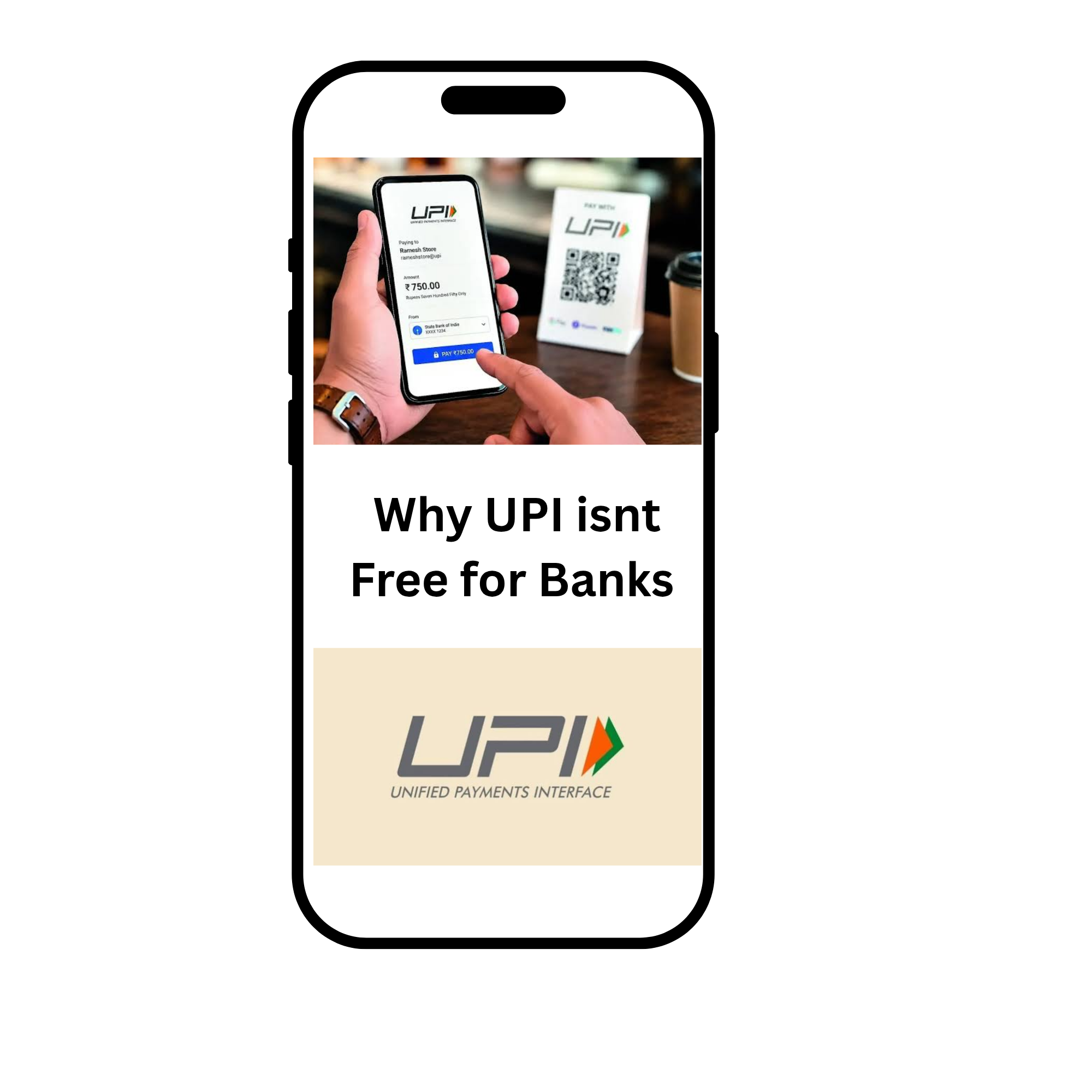
UPI is free for you as a user, and it will stay free for personal transfers and small merchant payments. It is not free to run. Banks, payment apps and NPCI spend heavily on technology, security and compliance. Until now, those costs have been covered by government incentives and banks’ wider business. From 15 October 2026, a new 0.4% merchant fee applies to some larger merchant payments. Customers are not meant to pay it.
What Is UPI and Why Does It Feel Free?
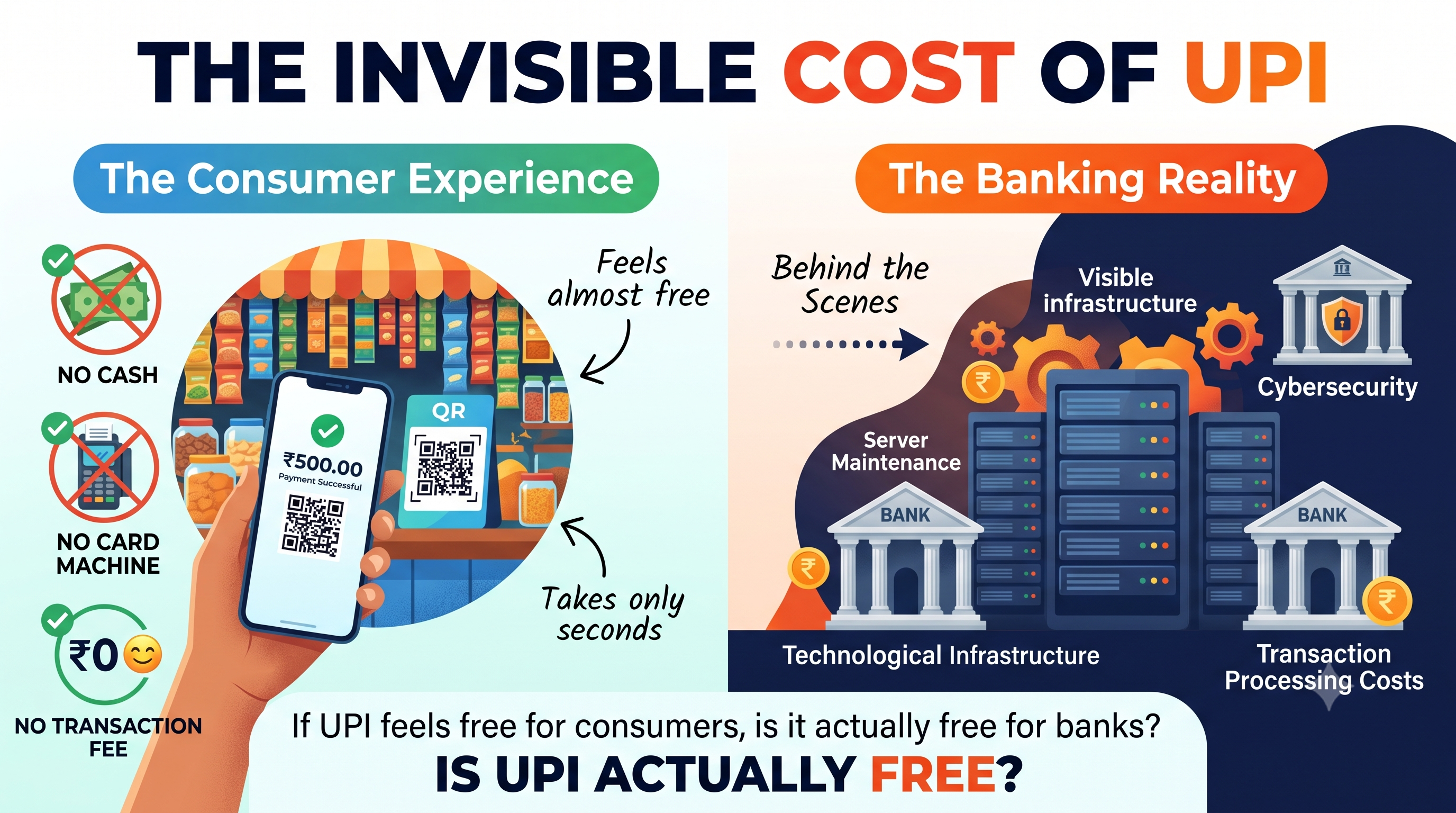
The Unified Payments Interface (UPI) is an instant payment system built and operated by the National Payments Corporation of India (NPCI), under the oversight of the Reserve Bank of India (RBI). You scan a QR code, enter an amount, authenticate, and the money moves between bank accounts in seconds.
For most people there is no fee, no card machine and no cash. That is why UPI has become India’s default way to pay.
How Big Is UPI ?
The scale explains why even small costs matter:
- UPI processed 24.07 billion transactions worth ₹29.37 lakh crore in September 2026, averaging about 802 million transactions a day.
- In FY26, UPI handled over 24,162 crore transactions worth around ₹314 lakh crore, a nearly 13,000-fold rise in volume since FY17.
- UPI’s share of retail payment volumes reached 86.8% in the first quarter of FY27, according to CareEdge.
What Does It Take to Run UPI?
Every “Payment Successful” message depends on several parties working together:
- The customer’s bank, which maintains the account and payment systems.
- The UPI app (PhonePe, Google Pay, Paytm, BHIM and others), which provides the interface.
- NPCI, which operates the network that connects banks.
- The merchant’s bank or payment provider, which receives and settles the money.
- Security and fraud systems, which authenticate payments and flag suspicious activity.
Banks must keep these systems running around the clock. That means servers, cybersecurity, fraud monitoring, compliance, customer support and engineering teams. A QR code costs almost nothing to print, but the network behind it is expensive.
Even a tiny cost per transaction adds up at this volume. A parliamentary panel noted the industry’s estimated operating cost at ₹20,700 crore.
What Is MDR and Why Was It Removed?
The Merchant Discount Rate (MDR) is a fee that a merchant pays to the bank or payment processor for accepting a digital payment. Card payments have long carried MDR. UPI has carried zero MDR since January 2020. Before that, merchant transactions could attract up to 0.30%. The government removed it to push people away from cash and help small shopkeepers go digital. If a vegetable seller had to pay a fee on every ₹50 sale, many would have stayed with cash.
Removing MDR did not remove the cost. It moved the cost elsewhere.
Who Has Been Paying for Free UPI?
- The government.Under a scheme introduced in Budget 2021-22, the government reimburses banks for processing RuPay debit card and low-value BHIM-UPI transactions, so customers and small merchants pay little or nothing. This covers small transactions of up to ₹2,000.
The amount has changed a lot over time:
- ₹1,389 crore was paid in 2021-22, rising to ₹3,631 crore by 2023-24.
- ₹437 crore was budgeted for FY26.
- ₹2,000 crore has been provided in the Budget for FY26-27.
- Banks and payment companies.The same parliamentary panel found that the government incentive covers only about 11% of the industry’s actual costs and around 14% of potential MDR collections. Banks and other participants absorb the rest.
- The wider banking relationship.A bank may not earn a fee on a UPI payment, but a customer who uses UPI keeps a deposit account and may later buy a loan, credit card or investment product. Deposits are a source of funds for lending. Banks also cannot afford to be the one that fails to offer UPI.
What Is Changing From 15 October 2026?
This is the biggest shift in UPI’s economics since 2020.
- From 15 October 2026, eligible person-to-merchant (P2M) payments above ₹2,000 attract a 0.4% MDR, capped at ₹300 per transaction. P2M payments of ₹2,000 or less stay at zero MDR.
- The cap applies to payments of ₹75,000 and above.
- The merchant pays the fee, not the customer. P2P transfers remain free.
- Small merchants who receive up to ₹1 lakh a month through QR payments into their own accounts remain exempt, even on a single payment above ₹2,000.
- The government says MDR is not a tax. It is not collected by the government or NPCI and is distributed within the payment ecosystem, including banks and app providers.
Examples of what merchants will pay:
Merchant payment | MDR | Fee |
₹1,500 | None (₹2,000 or below) | ₹0 |
₹2,000 | None (the fee applies only above ₹2,000) | ₹0 |
₹5,000 | 0.4% | ₹20 |
₹50,000 | 0.4% | ₹200 |
₹1,00,000 | 0.4% would be ₹400, but capped | ₹300 |
Why this threshold? Government data indicates that transactions of up to ₹2,000 make up more than 96% of UPI merchant transaction volume. Higher-value payments are around 4% of merchant volume but about 67% of value. So the fee touches a small share of payments but a large share of money.
Legal backdrop. Parliament recently passed the Taxation and Other Laws (Amendment) Bill, 2026, which amended the Payment and Settlement Systems Act, 2007. The government can now specify which electronic payment modes keep statutory protection from charges.
Pushback. Around 20 trade representatives from various states met the Finance Minister to raise concerns about the proposed 0.4% fee. Details and exemptions may still be clarified, so merchants should check the latest NPCI circular.
Why Not Simply Charge Customers?
A ₹2 fee on a ₹50 payment is 4% of its value, and on a ₹20 payment it is 10%. That would push people back to cash. Policy has therefore focused on keeping everyday payments free while looking for revenue from larger, commercial payments.
Is a Sustainable Model Possible?
The debate is ongoing. A parliamentary committee has called for a structure that does not depend so heavily on government subsidy. The Finance Ministry told the panel it was examining a targeted MDR on high-value transactions or merchants, and a tiered incentive structure that would phase out government support over the next few years. The October rollout is the first step in that direction.
The goal is to keep UPI affordable while paying for security, uptime and innovation.
What Does This Mean for You?
- Consumers:Your UPI payments remain free. If a shop adds a “UPI surcharge”, question it. The MDR is meant to be borne by the merchant.
- Small merchants:Everyday sales of ₹2,000 or less stay free, and eligible small merchants stay exempt entirely.
- Larger merchants:Check whether you fall under the specified category and plan for the 0.4% cost on payments above ₹2,000.
Conclusion
UPI is free at the point of use, but it has never been free to run. For years, government incentives and banks’ wider business absorbed the costs. With a ₹20,700 crore operating cost against ₹2,000 crore of support, the system needed a new model. The new 0.4% MDR on larger merchant payments is the first step. Consumers and small merchants remain protected for now.