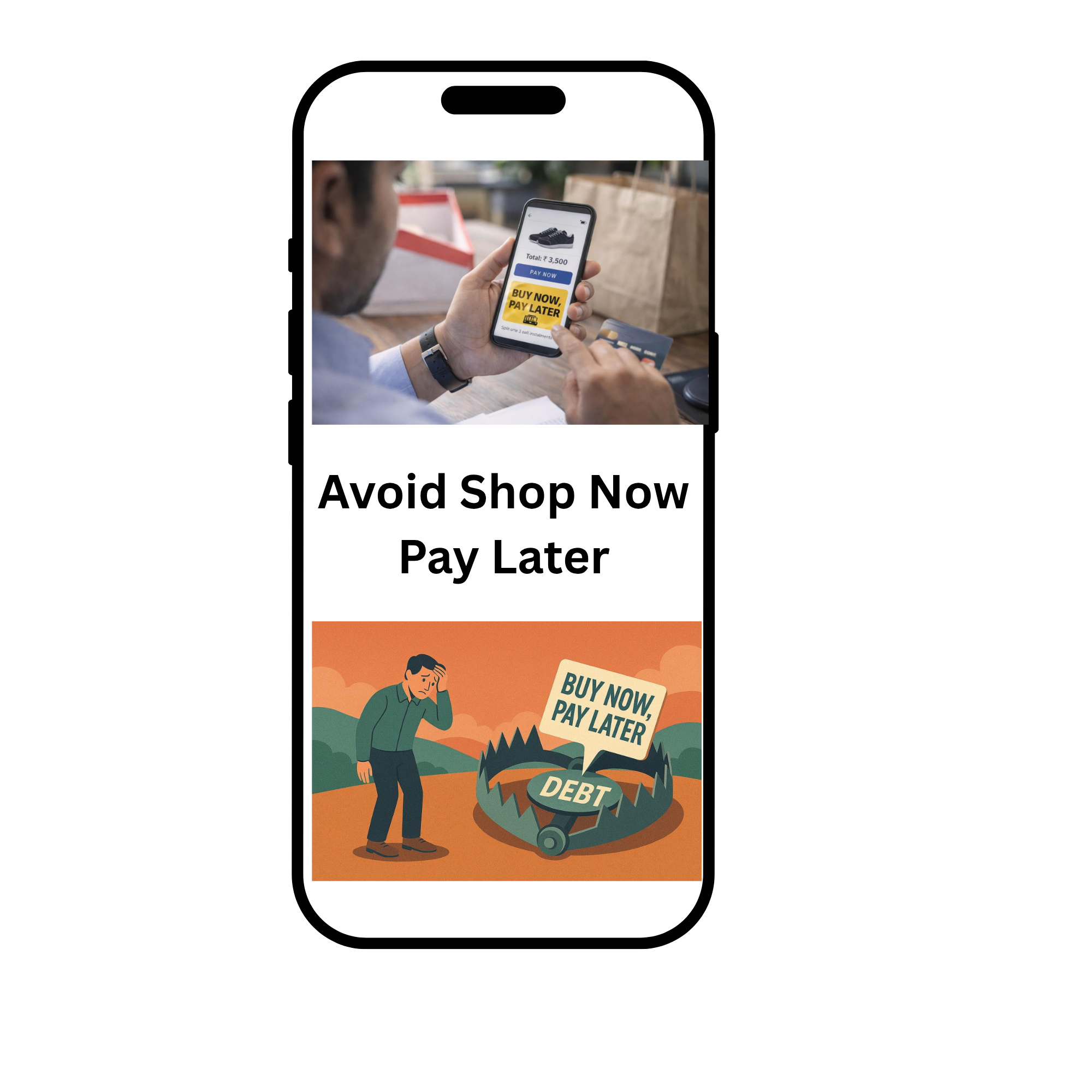
Suppose You’re checking out online. The total is ₹12,000 , more than you planned to spend. Then a button appears: “Pay in 4 interest-free installments.” No credit check, no upfront cost, and the item ships today. That is the appeal of shop now, pay later, better known as Buy Now, Pay Later (BNPL). It has grown quickly because it feels painless. But painless in the moment doesn’t mean painless overall. This blog explains how BNPL works, why it’s riskier than it looks, and how to get what you need without the downsides. If you’ve ever wondered whether you should avoid shop now pay later, here’s the honest breakdown.
What is Shop Now Pay Later?
Shop now, pay later is a short-term financing option available at checkout for in-store and online purchases. You pay for the purchase in smaller installments rather than paying the full price. Usually 4 payments in 6 weeks or monthly payments spread over a few months.
Popular providers include Klarna, Afterpay, Affirm, Sezzle and in India, services such as Simpl, LazyPay, ZestMoney and “pay later” features built into major shopping and payment apps.
The pitch is straightforward:
- No (or low) interest if you pay in time
- Fast approval, often within seconds
- Less paperwork
- Immediate Gratification
Part of this is true. The problem is what the marketing leaves out”
How BNPL Really Makes Money
- BNPL businesses are not nonprofits. Understanding their business strategy clarifies the nature of the product.
- Merchant charges.
- Retailers give the BNPL provider a portion of every sale, which is typically higher than regular card fees. Because BNPL boosts sales, merchants embrace this.
- Flexible payment choices lead to larger baskets and more impulsive purchases, according to studies on checkout behavior.
- Penalties and late fees. Fees can quickly mount up if a payment is missed.
- Interest in long-term strategies. short-term agreements with no interest, but longer or larger purchases frequently incur interest, sometimes at rates akin to those of credit cards.
- Data and interaction. Many apps use in-app marketplaces and promotions to entice you to make more purchases.
In other words, when you buy more than you normally would, the firm does its best. Your financial interests are not being served by it.
9 Reasons to Avoid Shop Now, Pay Later
- It promotes overspending
This is the greatest danger. Your brain will feel like it lost ₹3,000 instead of paying ₹12,000, paying ₹3,000 now. This reduces the “pain of paying,” say behavioral economists. It costs less, so it’s easier to say yes.
It makes you add “just one more thing” to your cart, upgrade to more expensive versions and purchase things you hadn’t planned to purchase. A budget that’s going well starts to drip. Cash or debit.
- It is difficult to remember multiple plans
“One BNPL plan is easy to run. But BNPL is rarely a one-time usage. One app has a flight, another a pair of shoes, and another a phone accessory. And next thing you know, you have five or six schedules going on at once, with different deadlines.
Each payment is so small, it’s easy to underestimate the total commitment. Often referred to as ‘phantom debt’ — debts that don’t seem like debts because they’re fragmented.
- Late fees can eat into your savings.
“Interest-free” is only as good as your ability to consistently make your payments on time. Did you miss a payment because of a bank holiday, a low balance, or some other reason? A late fee will be assessed. For a small transaction, these costs can be an astonishingly large portion of the initial cost.
Some providers can also block additional purchases if you have past-due balances, trapping you in an endless cycle if you keep falling behind.
- Your Credit Score Could Drop
Until recently, buy now, pay later was ignored in credit reporting. That’s changing. Credit bureaus and lenders in a handful of countries are weighing BNPL activity in their assessments. There is some official credit reporting associated with some pay-later products and licensed lenders are reporting to credit bureaus in India.
This can result in late or missed payments being recorded on your credit file. Even if it’s not officially reported, lenders may see recurring BNPL payments on your bank statements as a sign of financial hardship when you apply for a home or auto loan.
- It could hide a real budget problem.
But if something is unaffordable now, breaking the payment into smaller amounts doesn’t change the math underlying that.” It simply transfers the cost to your future earnings.
Beware of BNPL for everyday purchases like groceries, restaurant delivery or gas, that’s a red flag. BNPL is hiding the gap between your normal income and your normal expenses.
- Refunds and Returns are Tricky
Returning an item you bought on BNPL can be a bit tricky. You might still have to pay in instalments and it might take longer for your refund to show up, while the merchant processes your return. If you and the merchant have a dispute about a faulty product, you are in the middle between the merchant and the BNPL company and they blame each other.
Dispute and chargeback procedures are generally more developed with a credit or debit card.
- Absence of Consumer Safeguards
In many countries, credit cards provide legal protection on matters like fraud, billing disputes and disclosures. BNPL has historically been loosely regulated, but regulations are tightening globally. You may also have less protection until protections everyplace catch up if something goes wrong.
Read the terms and conditions carefully, especially the fees, default and data sharing sections.
- There’s a Debt Spiral
There is an ongoing pattern here:
- You buy a small item using BNPL.
- You use it for bigger ones because it works well.
3.A handful of installments are sent within a week.
- If you can’t pay one off, you either take another loan or use a credit card.
- You will be charged interest and fees.
And one type of credit card can be used to pay off another which can create a long term problem with debt.
- Undermines sound financial practices
Saving is a matter of delayed pleasure. Every time you buy now and pay later you are training yourself to expect instant gratification without the cash in your wallet. This makes it more difficult over time to save for retirement, a down payment on a house or an emergency fund.
Who Is Most at Risk?
- Anybody can be harmed by buy now, pay later, however certain groups are particularly at risk:
- Young adults and first-time earners who are still developing financial self-discipline Freelancers and gig economy workers with inconsistent income
- Anyone with outstanding personal loan or credit card debt
- Impulsive buyers, especially on special occasions like Diwali, Black Friday, or seasonal sales
- A strict “no BNPL” policy is frequently the best course of action if you fit into one of these groups.
Is BNPL ever correct?
To be fair, BNPL isn’t bad. Some people utilize it responsibly. If you do, two things are important: BNPL is only a convenience, and you already have the whole amount saved.
- There are no hidden fees and the plan is genuinely 0% interest.
- You only utilize one plan at a time.You intended to purchase the thing because it is truly necessary.
- You have set up automatic payments from a buffered account.
- It is preferable to leave it blank if you are unable to check every box. Most people don’t need to have the discipline required to utilize BNPL safely.
Where to Go If You Shop Now and Pay Later?
- Use the 48-hour rule
Wait two days if you don’t actually need it. Purchase it using your own funds if you still desire it and have the funds. BNPL is dependent on the impulse moment, and the majority of impulse urges disappear within hours.
- Remove Options for Saved Payments
BNPL should no longer be used in shopping applications as a saved payment option. If you don’t use any pay-later apps, uninstall them. Impulsive purchases are less likely when there is friction.
- Turn off marketing alerts
“You’ve been pre-approved” and “exclusive offer” messages are pushed by BNPL apps and merchants in an effort to boost sales. Disable push alerts. Unsubscribe from email subscriptions.
- Perform the “Cash Test”
Before you buy anything, ask yourself, “If I had to pay full price out of my bank account today, would I buy this?” If the answer is no, BNPL is just delaying a decision you should not be taking.
- Make a Simple Budget
There is no complicated system. A good rule of thumb is to spend 50% of your income on needs, 30% on wants and the remaining 20% on savings and debt repayment. Have a monthly budget for “fun money” and when it’s gone, it’s gone.
- Establish a Sinking Fund
A sinking fund is money set aside each month for a specific future expense such as a new laptop, festival shopping or travel. You pay up front instead of later. Save ₹2,000 per month for 6 months and you can buy an item worth ₹12,000 with no interest and no worry.
- Create an Emergency Fund
A lot of people will use BNPL to cover unexpected costs like repairs, emergency travel or medical bills. Having an emergency fund to cover three to six months’ worth of costs removes that pressure. You can start with a small sum, say ₹500 a week. and keep it in another account.
Purchase Now, Pay Later Options
Here are some suggestions for the really serious, dispersed buyer:
- Save early, spend later. The easiest and cheapest way. You sell a lot and you don’t have any costs.
- Make the payment using UPI or a debit card. There is an automatic restraint on overspending because you can only spend what you have.
- A credit card with very low interest that is paid off in full. If you pay your account balance in full by the due date, you will avoid interest, win prizes, and help improve consumer protections. This only works if you pay on time and in full, consistently.
- Layaway or retailer saving plans. Some retailers will allow you to set aside the money, pay it off, and then reclaim it without credit risk.
- Purchase reconditioned or used goods. With the price reduction, financing is no longer necessary.
- Negotiate or wait for a deal. Seasonal deals, coupon codes and cashback offers let you save 10-30% without financing.
A planned and controlled personal loan for significant requirements. However, a transparent loan with a clear interest rate may be safer than stacking several BNPL plans for large, essential expenses.
Are You in BNPL Today? Next Steps
Don’t panic if you have lots of plans. The following are the steps to be taken:
- Get it all in writing. Provider. Remaining balance. Due dates and cost of each plan
- Order by cost: Pay the plans with the highest late fees or interest first.
- Stop planning new plans. Don’t do any new BNPL purchases until you’re clear.
- Payments Automation Arrange for reminders or auto-debit with a small buffer, so you avoid additional late fees.
- Deleting a category temporarily. Cut back on eating out, shopping and subscriptions for a few months to give you some cash.
- If you experience any problems, contact the provider. Some offer hardship or modified schedules. Better to ask than loose a payment.
- Ask for help when you need it. With the help of a nonprofit credit counseling service or licensed financial counselor, you can perhaps set up a payment plan.
BNPL Warning Signs of Potential Problems
Be aware of these signs:
- One BNPL plan is paid for with funds from four others;
- You use BNPL to pay bills or buy essentials like groceries;
- You have often been late with your fines
- You don’t know what the full balance of your BNPL is.
When the deadlines come, you begin to feel nervous. You bought things that you later regretted or forgot about.
Frequently Asked Questions
NCDs from highly rated issuers (AAA or AA) are generally considered safe. Secured NCDs offer additional protection through asset backing. However, all investments carry some level of risk, so it’s important to assess the issuer’s financial health.
Yes, if the NCD is listed on a stock exchange (NSE or BSE), you can sell it in the secondary market. Keep in mind that market prices may vary based on interest rate movements and demand.
Interest earned from NCDs is taxed as per your income tax slab. If you sell the NCD before maturity, capital gains tax may apply—short-term or long-term depending on the holding period.
It varies by issuer, but most public issues allow retail investors to start with as little as ₹10,000 to ₹25,000.
NCDs are suitable for investors looking for fixed returns, such as retirees, conservative investors, or those seeking to diversify beyond equities and mutual funds
The offer document or prospectus will mention whether the NCD is listed. You can also check on NSE or BSE platforms using the ISIN or company name.
It can. Missed or late payments may be reported to credit bureaus in some regions, and lenders may also view heavy BNPL use negatively. Even when it isn’t reported, it can influence how lenders judge your financial stability.
Many short-term plans are, if you pay on time. But late fees, and interest on longer plans, can make the true cost much higher. Always check the fine print.
Not necessarily. A credit card paid in full each month typically offers better protections and builds credit history in a more established way. BNPL can be easier to overuse because of how fragmented the payments feel.
No financial product is risk-free. If you have the full amount saved, pay on time, and use only one plan at a time, the risk is lower, but the temptation to overspend remains.
Delete saved payment options, uninstall apps, build a sinking fund, set a spending limit, and apply a waiting period before buying. Replace “pay later” with “save first.”