
Open any financial news app or channel today, and you’ll be met with an unending stream of urgent-sounding headlines:
“Markets Plunge on Fed Comments,”
“Rupee Hits New Low Against Dollar,”
“Global Recession Fears Mount,” “
This Sector Is About to Explode.”
The velocity and intensity of financial news has increased dramatically over the past two decades, driven by 24-hour business channels, real-time market data, and social media amplification. Yet there’s a crucial, often overlooked distinction between the pace at which financial news moves and the pace at which sound personal financial planning should actually operate — and confusing the two is one of the most common, costly mistakes individual investors make.
Why News and Financial Planning Operate on Fundamentally Different Timescales
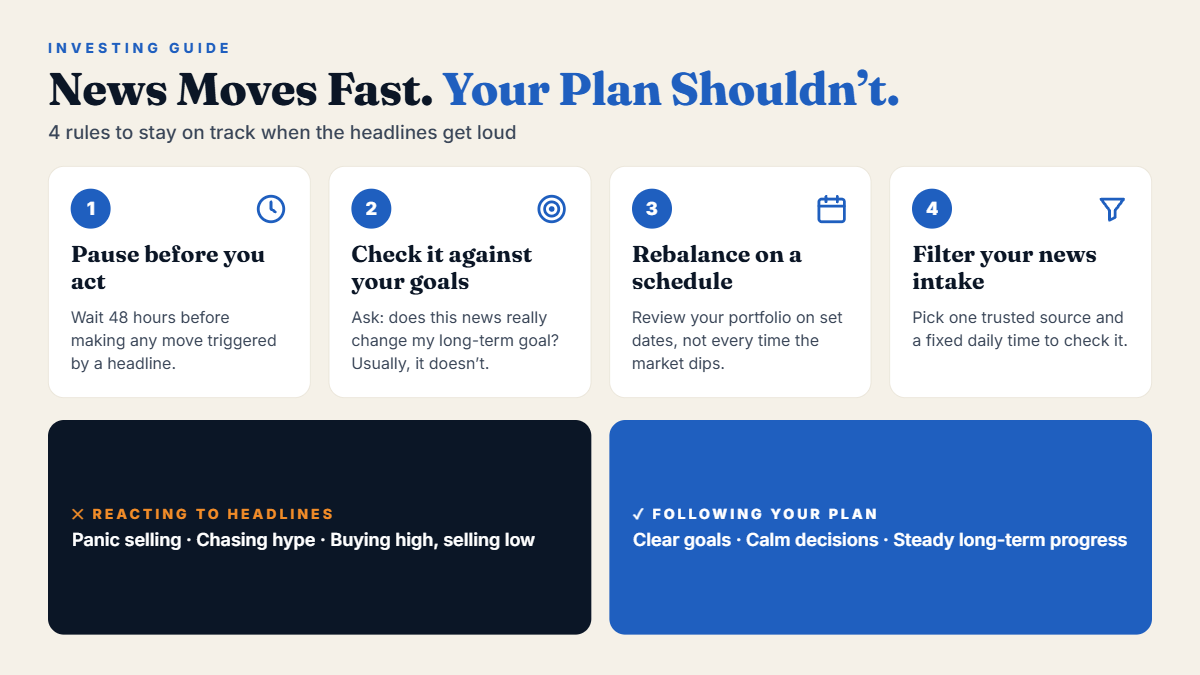
- Financial news, by its very nature, is optimized for immediacy and attention — it exists to report what’s happening right now, often with a framing that emphasizes urgency, drama, and the sense that today’s development is uniquely significant and demands an immediate response.
- This isn’t necessarily a criticism of financial journalism itself; reporting on genuinely significant, timely developments is a legitimate and valuable function. The issue arises when individual investors mistake this news cycle’s inherent pace and framing for a signal about how frequently they should be reassessing and adjusting their own long-term financial plans.
- Sound personal financial planning, by contrast, is built around your specific, multi-year goals like retirement, a child’s education, a home purchase — goals that are, by their very nature, largely insulated from the significance of any single day’s or week’s market movement or economic headline.
- A financial plan constructed around a 20-year retirement horizon shouldn’t meaningfully change based on a single quarter’s GDP print, a central bank’s most recent rate decision, or a particular week’s market volatility, because the entire premise of long-term investing is that these short-term fluctuations, however dramatic they feel in the moment, tend to average out and matter far less than the discipline of staying invested toward your actual long-term goal.
The Mismatch: Why Following News Closely Often Leads to Worse Decisions
There’s a genuinely counterintuitive but well-supported finding in behavioral finance research: investors who monitor their portfolios and financial news more frequently often make worse investment decisions than those who check in less frequently, precisely because of this timescale mismatch.
- More frequent monitoring exposes you to more short-term volatility, which triggers more emotional reactions. If you check your portfolio’s value daily, you’ll witness considerably more day-to-day fluctuation than if you check monthly or quarterly. This more frequent exposure to volatility — including inevitable down days and weeks — creates more frequent opportunities for loss aversion and anxiety to trigger impulsive, poorly timed decisions, like selling during a temporary dip that, from a longer-term vantage point, would have been better simply ignored.
- News is disproportionately weighted toward dramatic, attention-grabbing framing. Financial media, like all media, faces commercial incentives to capture attention, which naturally favors dramatic, urgent-sounding framing over calm, measured analysis. A modest, unremarkable market fluctuation can be, and frequently is, presented with language (“plunge,” “crash,” “meltdown,” “bloodbath”) that implies far greater significance than the underlying data actually warrants — creating a systematically distorted sense of how urgent or unusual any given development actually is relative to normal, everyday market variability.
- Following news closely can create an illusion of control and predictive ability that doesn’t match reality. Closely tracking every piece of financial news can create a psychological sense that you’re gaining a meaningful information or timing advantage — when in reality, the information contained in widely reported financial news is, almost by definition, already reflected in current asset prices (a core insight of efficient market theory), meaning reacting to news that’s already public and widely known rarely provides a genuine, exploitable edge for an individual retail investor, and more often simply increases the frequency of emotionally-driven trading decisions.
What Actually Deserves a Response — And What Doesn’t
This isn’t an argument for ignoring financial news and developments entirely some genuine, structural developments do warrant a thoughtful review of your financial plan. The key is distinguishing between developments that are genuinely relevant to your specific, personal financial plan versus developments that are simply part of the normal, ongoing texture of financial news, interesting to follow but not actually actionable for your particular goals and timeline.
- Genuinely warrants review: A significant, lasting change in your own personal circumstances a major change in income, a new financial goal, a significant life event like marriage, a child, or a career change — these are the developments that should genuinely trigger a deliberate review and potential adjustment of your financial plan, since they directly affect your actual goals, timeline, and risk capacity.
- Generally does not warrant a reactive change: Day-to-day or week-to-week market movements, individual economic data releases, central bank commentary, geopolitical headlines, or general macroeconomic speculation. These are worth being aware of as part of general financial literacy and understanding of the broader economic environment, but they rarely justify an immediate, reactive adjustment to a well-constructed long-term plan that was built with the expectation that exactly this kind of short-term volatility and uncertainty would occur along the way.
- A genuine, structural shift worth reviewing: Occasionally, a development is significant enough a major, lasting change in interest rate regimes, a structural shift in an industry central to your investments, a genuine change in your risk tolerance following a sustained period of reflection — to warrant a deliberate, unhurried review of your asset allocation or broader plan. Even here, the operative approach should be careful, considered review over a reasonable timeframe, not an immediate, reactive adjustment made in the heat of a single day’s news cycle.
The Discipline of “Set It and Review It Periodically” vs. “Constantly Monitor and React”
- The most effective approach for most individual investors is to build a financial plan deliberately, with a clear understanding of your goals, time horizon, and genuine risk tolerance, and then commit to a structured, periodic review cadence — perhaps annually, or at most quarterly rather than continuous, reactive monitoring driven by the news cycle’s pace.
- This periodic review approach offers several advantages over constant monitoring: it reduces your exposure to the emotional volatility of day-to-day market noise, it forces a more deliberate, less reactive evaluation process, and it frees up considerable mental energy and attention that would otherwise be consumed by the largely unproductive activity of tracking short-term market movements that have little genuine bearing on your long-term outcomes.
A Useful Mental Model: Separate “Interesting” From “Actionable”
- A practical habit worth developing is explicitly categorizing financial news and information you encounter into two mental buckets: genuinely interesting versus genuinely actionable. Most financial news, even genuinely well-reported, accurate news, falls into the “interesting” category rather than the “actionable” one for the average individual investor pursuing a long-term financial plan — and consciously recognizing this distinction can help you consume financial media in a way that satisfies genuine curiosity and general literacy without triggering unnecessary anxiety or impulsive plan changes.
Why This Matters More in the Social Media Era
- This distinction has become considerably more important in recent years, as the velocity and reach of financial content has expanded well beyond traditional news outlets into social media, investing forums, and short-form video content channels that often further amplify urgency and dramatic framing, are frequently produced by individuals without formal financial expertise or fiduciary accountability, and are algorithmically optimized for engagement rather than for genuinely calibrated, useful financial guidance.
- Navigating this considerably louder, faster information environment while maintaining a calm, long-term-oriented financial plan requires more deliberate discipline today than it might have a generation ago, when financial information moved through fewer, generally slower-paced channels.
The Bottom Line
- The pace of financial news and the pace at which your financial plan should actually evolve are fundamentally different, and conflating the two — treating every dramatic headline as a signal demanding an immediate response — is one of the most reliable ways to undermine an otherwise sound long-term financial strategy through frequent, poorly timed, emotionally-driven adjustments.
- The discipline worth cultivating isn’t ignorance of financial news, but a clear-eyed recognition that a well-constructed plan, built around your genuine long-term goals and reviewed periodically and deliberately, should remain largely stable through the ordinary, daily churn of financial headlines — because that plan was built, from the outset, with the expectation that exactly this kind of short-term noise would occur along the way to your actual long-term destination.