
During nearly every major sale season in India — Diwali, Republic Day, the Amazon Great Indian Festival, Flipkart’s Big Billion Days — you’ll encounter one particular phrase splashed across product listings for smartphones, appliances, and electronics: “No-Cost EMI.” The promise sounds almost too good to be true: buy a ₹60,000 television today, pay it off over six or twelve months, and pay not a single rupee more than the sticker price. It’s a phrase engineered to sound like a pure convenience with zero downside. The reality, once you look closely at how “no-cost EMI” is actually structured, is considerably more complicated — and understanding the mechanics reveals one of the more subtle pieces of financial sleight-of-hand in Indian retail today.
What “No Cost EMI” Claims to Offer
An EMI, or Equated Monthly Installment, is simply a fixed periodic payment used to repay a loan over time. Under a standard EMI arrangement, the total amount you repay includes both the principal (the actual cost of the item) and interest charged by the lender for extending you credit. “No-Cost EMI” is marketed as an arrangement where you pay the exact same total amount as the product’s listed cash price, split into equal monthly installments, with no additional interest charged — as if the lender is extending you an interest-free loan purely as a customer acquisition gesture.
On the surface, this seems like an unusually generous arrangement. Banks and NBFCs are not, generally speaking, in the business of lending money for free. So the natural question — and the right one to ask — is: if the interest genuinely isn’t being charged to you, where does it actually go?
The Mechanics: Interest Isn’t Waived, It’s Reallocated
The core truth behind most “no-cost EMI” schemes is this: the interest that would ordinarily be charged on the loan doesn’t disappear — it’s absorbed and repackaged, typically through one or both of these mechanisms.
Mechanism 1: The seller (or manufacturer) subsidizes the interest. In many no-cost EMI arrangements, the retailer or brand offering the promotion effectively pays the bank or NBFC the interest amount on your behalf, as a marketing cost to drive sales volume. This isn’t fundamentally dishonest — it genuinely can mean you’re paying no additional interest out of your own pocket, similar to how a car dealership sometimes offers a manufacturer-subsidized low-interest auto loan to move inventory. The catch, however, is where this subsidy cost is recovered from.
Mechanism 2: The “discount” you would have received is silently removed. This is the mechanism that generates the most legitimate criticism of no-cost EMI schemes, and it’s worth understanding in detail. Many products sold under a “no-cost EMI” banner would otherwise have been available at a meaningful discount if paid for in full, upfront, in cash. When you opt for no-cost EMI instead, retailers frequently price the product at its full, undiscounted MRP for the EMI calculation — meaning the “interest” you’re not being charged is effectively being recovered by denying you the cash discount you would otherwise have received. In other words: the “interest” doesn’t disappear; it’s simply hidden inside a higher effective principal amount than you would have paid in cash.
A Concrete Example
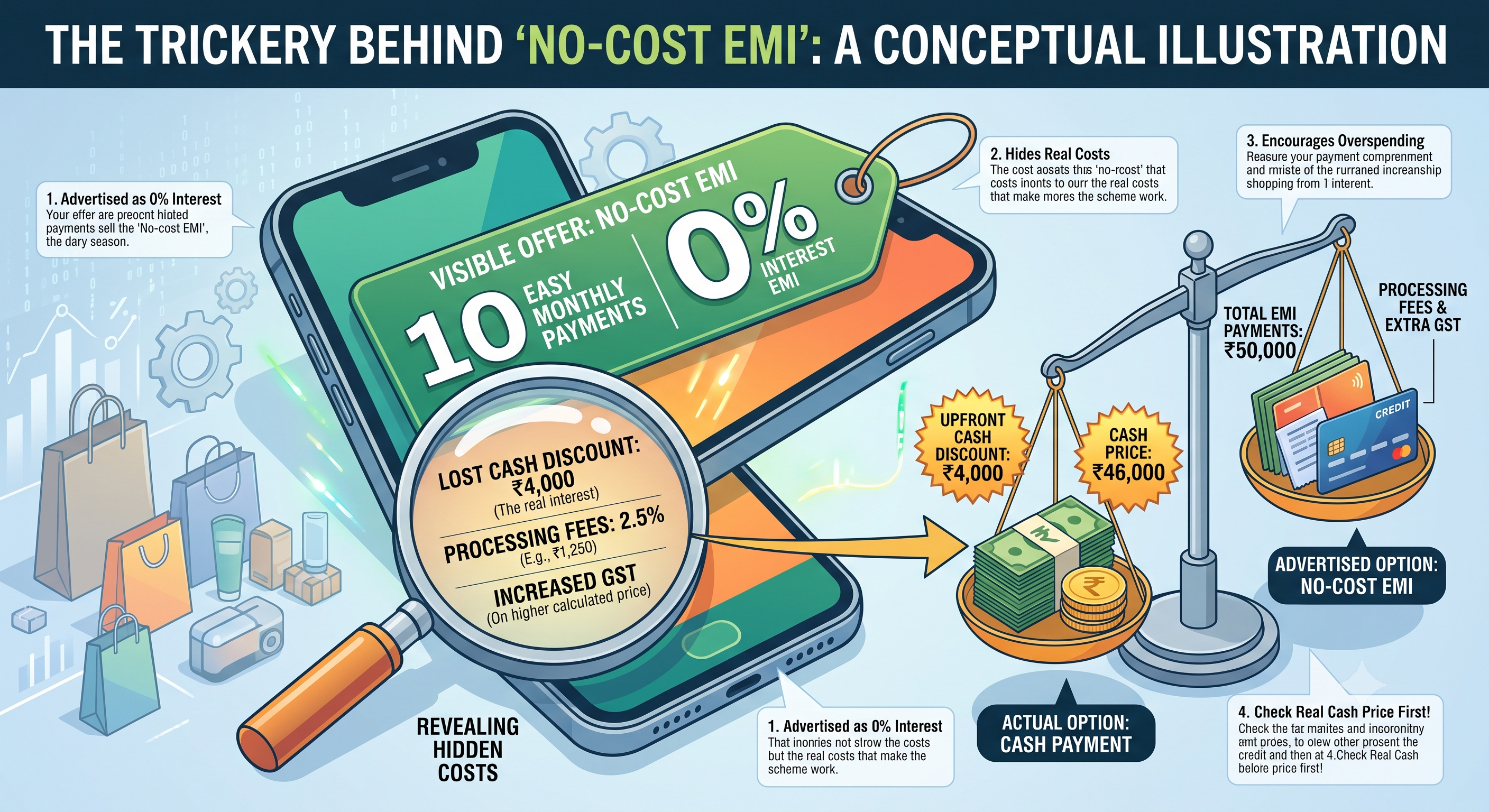
Imagine a smartphone with an MRP of ₹50,000, but which is commonly available for ₹46,000 if paid in cash, reflecting typical retailer margins and discounting. Under a “no-cost EMI” scheme advertised for this phone, you might be offered 10 equal monthly installments of ₹5,000 — totaling exactly ₹50,000, with “no interest.”
At first glance, this looks like a fair, interest-free deal. But compare it to the cash price: by choosing EMI, you’ve effectively paid ₹4,000 more than you would have paid in cash (₹50,000 vs. ₹46,000) — an amount that functions exactly like interest, even though it’s technically not labeled as such. Spread across 10 months on a declining principal balance, this ₹4,000 “hidden cost” typically works out to an effective annual interest rate somewhere in the range of 15–20%, depending on the exact tenure and amounts involved — comparable to, or sometimes even higher than, a standard personal loan or credit card interest rate, despite the “no-cost” label.
This is precisely why financial regulators and consumer advocates have repeatedly flagged no-cost EMI schemes as potentially misleading: the label focuses attention on the absence of a separately itemized interest charge, while obscuring the fact that the effective cost of choosing to pay over time, relative to paying in cash, is often very real.
Processing Fees: Another Layer of Real Cost
Beyond the discount-forfeiture mechanism, many no-cost EMI arrangements also involve a processing fee charged by the bank or NBFC facilitating the loan — often ranging from 1% to 3% of the loan amount. While sometimes waived as part of a promotional offer, this fee, when present, represents another genuine cost that isn’t always prominently disclosed alongside the headline “no-cost” claim, and can meaningfully add to the effective cost of the arrangement when it does apply.
GST on the “Discount” You Didn’t Get
There’s a further wrinkle specific to how GST interacts with no-cost EMI pricing. Under Indian tax rules, GST is typically calculated on the actual transaction value — meaning if a retailer inflates the EMI price relative to the cash price to fund the “no-cost” structure, the GST charged is calculated on this higher, inflated base price, rather than the lower cash price you would have paid otherwise. This means you may end up paying not just a higher effective principal, but also proportionally higher GST on that inflated principal — a subtle additional cost layer that most consumers never explicitly notice or calculate.
Why Retailers and Brands Love This Structure
From a business perspective, no-cost EMI is an extremely effective sales tool, and it’s worth understanding why retailers and brands invest so heavily in offering it, particularly during major sale events.
It lowers the psychological barrier to a big-ticket purchase. Breaking a ₹50,000 purchase into ten ₹5,000 installments makes an otherwise significant purchase decision feel dramatically more manageable, encouraging purchases that a consumer might otherwise hesitate over or delay.
It removes the explicit “cost of credit” objection. Consumers are generally wary of paying interest — it feels like an obvious, avoidable cost. By removing the explicit interest line item, no-cost EMI sidesteps this natural consumer resistance, even when an equivalent cost is present in a less visible form.
It drives incremental sales volume during competitive sale periods. E-commerce platforms and brands are willing to absorb the cost of subsidizing these schemes (funded through the discount-forfeiture mechanism described above, or genuinely out of marketing budgets) because the resulting sales volume increase, especially during high-competition sale events, is worth the cost from a business perspective.
How to Evaluate a No-Cost EMI Offer Properly
The single most important discipline when evaluating any no-cost EMI offer is this: always, explicitly, check what the cash price (including any available discount, cashback, or coupon) would be for the same product, at the same time, from the same seller — and compare that cash price directly against the total sum of all EMI installments you’d be committing to.
A few practical steps:
- Look for the cash discount explicitly. Many e-commerce platforms display both a cash price and an EMI price for the same product; if they don’t display both, ask, or check the payment options page carefully before finalizing your purchase method.
- Calculate the total EMI outflow and compare it directly to the cash price. If the total of all installments exceeds the cash price you could have secured, that difference is your real, effective interest cost — regardless of what the marketing label says.
- Factor in the processing fee, if any. Add any processing fee to your total cost comparison, since it’s a genuine cash outflow associated with the loan.
- Consider your actual need for the EMI structure. If you can genuinely afford the cash price today, and the no-cost EMI doesn’t offer a lower total cost than the cash price, there’s no financial benefit to spreading the payment — you’re just accepting the psychological convenience of smaller installments at no real discount, while a bank or NBFC now has a lending relationship, and a credit record, tied to your name for a purchase you could have simply paid for outright.
When No-Cost EMI Genuinely Makes Sense
None of this means no-cost EMI is always a bad choice. There are legitimate scenarios where it can make sense:
- When the EMI total genuinely matches the best available cash price, and spreading the payment helps you manage cash flow without any meaningful cost penalty.
- When you have a specific, disciplined reason to preserve liquidity for instance, keeping cash available for an emergency fund or another higher-priority use — and the EMI cost differential is small enough to be worth that flexibility.
- When the alternative would be using a high-interest credit card cash advance or a more expensive personal loanto fund the same purchase, making a modestly-priced no-cost EMI scheme the least expensive option among realistic alternatives.
The Bottom Line
“No-cost EMI” is one of the clearest examples in Indian retail of a technically true claim that can nonetheless be functionally misleading if taken at face value. The interest you’re not being explicitly charged is very often being recovered through a different channel usually the forfeiture of a cash discount you would otherwise have received meaning the arrangement is frequently not as free as its name suggests. The discipline that protects you isn’t distrust of EMI as a financing tool in general; it’s the simple habit of always comparing the total EMI cost against the actual best cash price available, every single time, before assuming that “no-cost” genuinely means no cost to you.