

Fixed Deposits (FDs) remain one of the most trusted and widely used savings instruments in India, prized for their simplicity and perceived safety. Yet a surprisingly large number of FD investors, even experienced ones, misunderstand what their advertised “interest rate” actually delivers in real terms. Between compounding conventions, tax treatment, and inflation, the gap between an FD’s headline rate and its true, real-world return can be considerably wider than most people appreciate. That gap determines whether your savings are actually growing or quietly losing purchasing power over time. Understanding it is essential to making sound decisions about where your money truly belongs.
The First Trap: Nominal Rate vs. Effective Yield
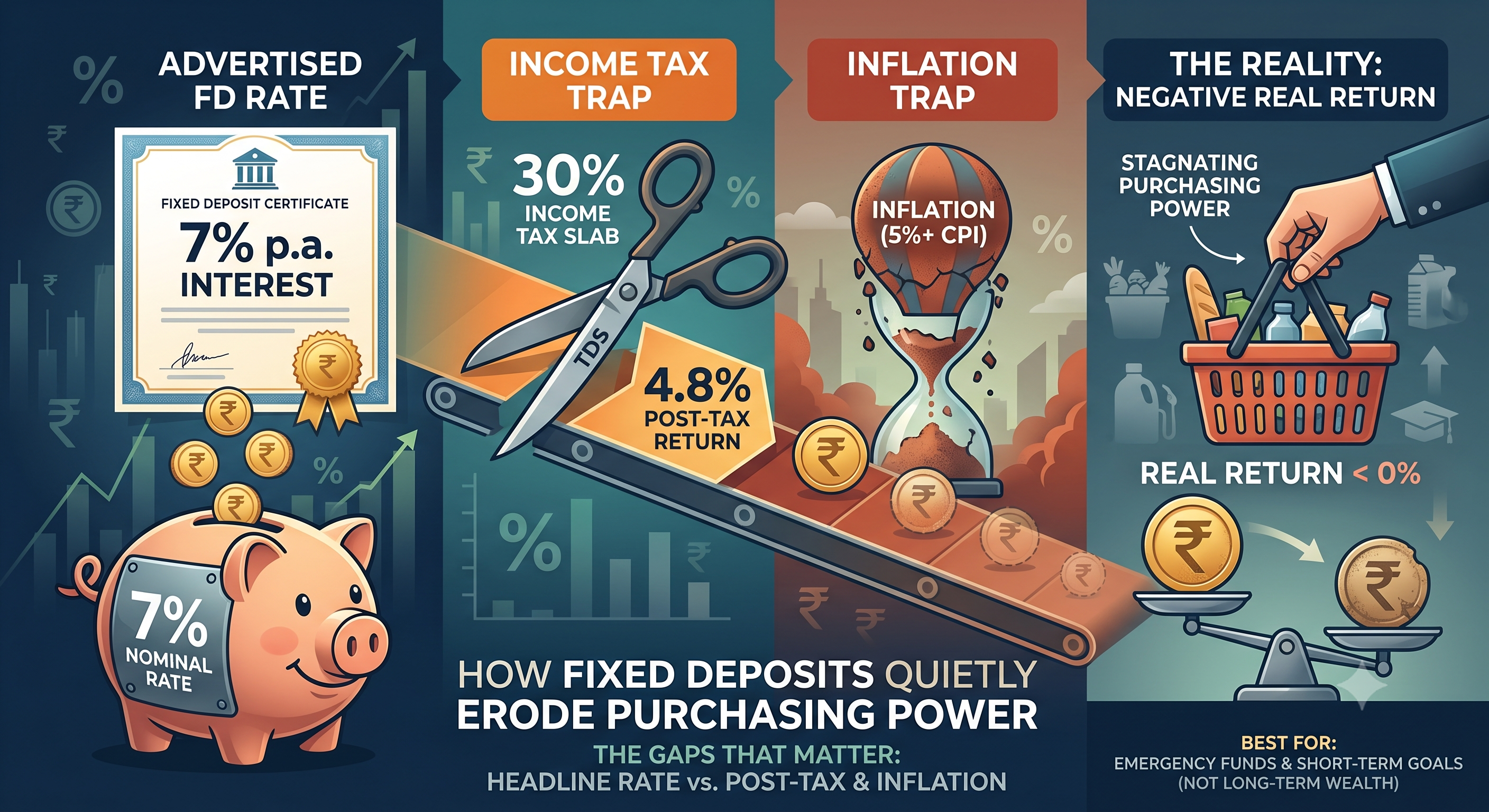
When a bank advertises an FD rate of, say, 7% per annum, many depositors assume this means their money grows by exactly 7% over a year. In reality, this quoted rate is typically the nominal annual interest rate, and the actual amount you earn depends heavily on the compounding frequency specified in the FD’s terms.
Most Indian bank FDs compound interest quarterly, meaning interest earned in one quarter is added to the principal, and the next quarter’s interest is calculated on this slightly larger base. This compounding effect means the effective annual yield is actually slightly higher than the nominal rate — a 7% nominal rate compounded quarterly works out to an effective annual yield closer to 7.19%. This particular direction of the gap (effective yield being slightly higher than nominal) isn’t the dangerous trap; the more important traps lie elsewhere, described below.
The Second, Bigger Trap: Taxation Erodes Your Real Return Significantly
This is where most FD investors substantially overestimate what they’re actually earning. Interest income from FDs is fully taxable in India, added to your total income and taxed at your applicable income tax slab rate — there’s no special concessional tax treatment for FD interest, unlike certain other investment instruments.
For someone in the 30% tax bracket (plus applicable cess, pushing the effective marginal rate higher), a 7% nominal FD return doesn’t actually deliver anything close to 7% in your pocket. After accounting for roughly 31.2% effective tax (30% plus 4% cess) on the interest earned, your post-tax return drops to approximately 4.8%. For someone in the 20% bracket, post-tax return falls to roughly 5.5%. Only those in the lowest tax brackets, or those who fall below the taxable income threshold entirely, come close to actually realizing the full headline rate.
This is a genuinely underappreciated point: two investors looking at the identical FD offering the identical 7% rate can end up with meaningfully different real returns purely based on their income tax bracket — a dimension that FD advertisements, quite naturally, never mention, since the bank’s advertised rate is pre-tax by definition.
TDS: The Additional Friction
Banks are required to deduct Tax Deducted at Source (TDS) on FD interest once it crosses a specified threshold in a financial year (₹40,000 for most individuals, ₹50,000 for senior citizens, as per current rules, though these thresholds are periodically revised). TDS is typically deducted at 10% if you’ve submitted your PAN details, or at a higher rate if you haven’t.
Crucially, TDS is not the final tax liability — it’s merely an advance deduction. If your actual applicable tax slab is higher than the TDS rate, you owe the balance when filing your tax return. If it’s lower (or if your total income is below the taxable threshold), you can claim a refund by filing Form 15G or 15H (for those below the taxable threshold) to avoid TDS deduction altogether, or by claiming the excess back through your income tax return. Many depositors either forget to submit these forms when eligible, resulting in unnecessary TDS deduction and a cash flow inconvenience until refund, or fail to account for the additional tax owed if their slab exceeds the TDS rate, leading to an unpleasant surprise at tax filing time.
The Third, Most Overlooked Trap: Inflation
Even after accounting for tax, there’s a further, more fundamental erosion to consider: inflation. The “real return” on any investment — what actually matters for your purchasing power over time — is your nominal return minus the inflation rate during the same period.
If India’s CPI inflation runs at around 5% (roughly the RBI’s target band), and your post-tax FD return (following the earlier example, for someone in the 30% bracket) works out to around 4.8%, your real, inflation-adjusted return is actually slightly negative — meaning your money’s purchasing power, in real terms, has essentially stagnated or even slightly declined over the year, despite the FD showing a positive nominal balance growth on your bank statement.
This is a crucial and often deeply counterintuitive realization for many conservative savers: an FD can feel completely safe in nominal terms (your principal is never at risk, and the stated interest is reliably paid) while still quietly losing you purchasing power in real terms, once tax and inflation are both properly accounted for. This doesn’t make FDs a bad instrument — capital preservation and predictability have genuine value, especially for short-term goals or emergency funds — but it does mean FDs are a poor primary vehicle for long-term wealth creation, particularly for investors in higher tax brackets.
Special FD Types and Their Own Nuances
Tax-saving FDs (5-year lock-in, eligible for Section 80C deduction up to ₹1.5 lakh) offer an upfront tax deduction on the principal invested, which can meaningfully improve the effective return calculation for that specific investment, but the interest earned remains fully taxable as usual, and the mandatory 5-year lock-in reduces liquidity considerably compared to a standard FD.
Senior citizen FDs typically offer a rate premium (often 0.25% to 0.75% higher than standard rates) and benefit from a higher TDS threshold (₹50,000) and, under the old tax regime, a deduction under Section 80TTB for interest income up to ₹50,000 — making FDs comparatively more tax-efficient for senior citizens than for working-age, higher-income earners.
Cumulative vs. non-cumulative FDs differ in whether interest is paid out periodically (non-cumulative, useful for those needing regular income, like retirees) or compounded and paid at maturity (cumulative, generally delivering a marginally higher effective yield due to compounding, but no interim cash flow).
Comparing FDs to Alternatives on a Fair, Post-Tax Basis
The critical discipline, when evaluating whether an FD is genuinely the right instrument for a given financial goal, is to always compare alternatives on a consistent, post-tax, real-return basis, rather than comparing headline nominal rates directly.
For instance, debt mutual funds (subject to their own tax treatment, which has itself evolved with recent tax law changes and is worth verifying against current rules) or other fixed-income instruments may offer different tax treatment that changes the comparative attractiveness relative to an FD, depending on your specific tax bracket and holding period. Similarly, for genuinely long-term goals — retirement, a child’s education many years out — comparing a purely fixed-income instrument like an FD against equity-oriented instruments (which carry more volatility but have historically delivered meaningfully higher long-term real returns) requires thinking explicitly about your time horizon and risk tolerance, not just comparing headline rates.
What FDs Are Genuinely Good For
None of this is an argument against FDs altogether — they remain an excellent instrument for specific purposes:
- Emergency funds: where capital preservation and easy liquidity matter far more than maximizing return.
- Short-term goals : (under 2-3 years), where market volatility from equity or other growth-oriented instruments could jeopardize your ability to meet the goal on time.
- Very risk-averse investors : particularly those near or in retirement, for whom capital preservation genuinely outweighs the goal of growth.
- Laddering strategies : where FDs of staggered maturities provide both some yield and regular liquidity access points.
The Bottom Line
The headline interest rate on an FD is only the starting point of the calculation, not the end of it. The real, meaningful number — what actually matters to your long-term financial health — is the post-tax, inflation-adjusted return, and for many investors, particularly those in higher income tax brackets, this real number is considerably lower, and sometimes even negative, compared to what the advertised rate implies. This doesn’t mean avoiding FDs altogether, but it does mean using them deliberately, for the specific purposes they genuinely serve well, while directing longer-term wealth-building goals toward instruments better suited to outpacing tax and inflation over time. The discipline of always asking “what’s my actual post-tax, real return here?” — rather than being satisfied with the number printed on the bank’s rate card — is one of the simplest, highest-value habits a saver can develop.