Car leasing vs buying for investors: a capital-allocation decision
When it comes to car leasing vs buying, most people only ask which monthly payment is lower. A stock market investor asks a sharper question: every rupee that goes into a car is a rupee that is not in my portfolio, so which choice leaves my investments larger?
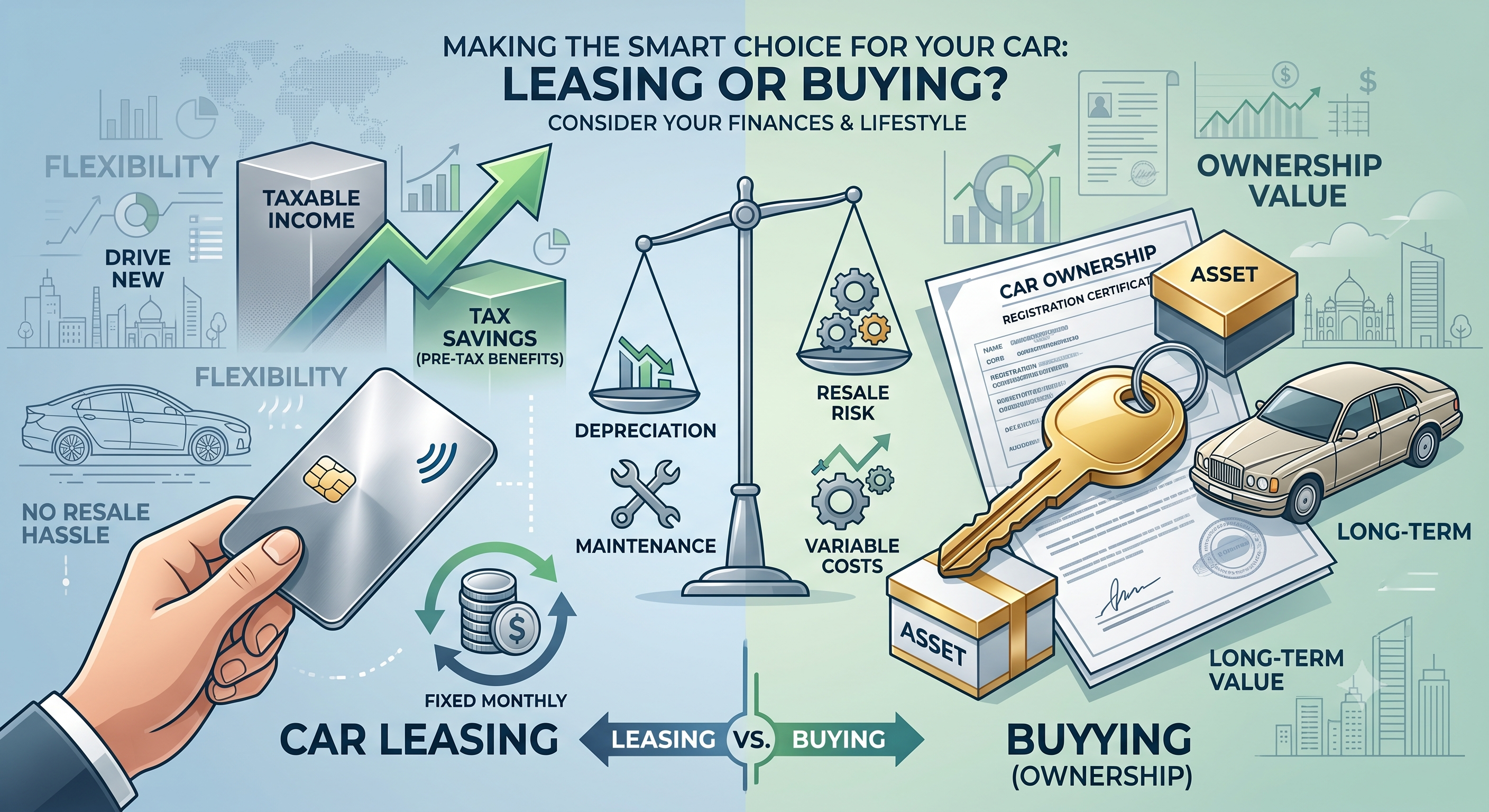
A car is often the biggest purchase an Indian professional makes after a home. Yet while equity mutual funds and stocks can compound over time, a car loses value from the day it leaves the showroom. That turns the lease-versus-buy choice into a lesson in four ideas every market investor uses:
- Compounding vs depreciation— money in the market can grow; money in a car shrinks.
- Opportunity cost— the returns you give up when cash leaves your portfolio.
- Hurdle rate— the loan interest your investments must beat to justify borrowing.
- Tax efficiency— paying with pre-tax rupees is like earning a guaranteed return.
This guide to car leasing vs buying for investors explains each idea with simple numbers, so you can treat your car the way a fund manager treats any capital outflow: by its effect on long-term wealth, not by how the EMI feels this month.
A car is a depreciating asset; investments compound
The core financial fact behind this decision: a car loses value every year, while invested money can grow. Every rupee locked into a car is a rupee that is not compounding for you.
Illustrative assumptions, not market data · ₹12 lakh over 8 years
This does not mean you should never own a car; you need transport, and the market gives no guarantees. It means a car belongs on the expense side of your plan, not the investment side. On your personal balance sheet, a car is an asset that shrinks every year, and a car loan is a liability that sits against it until it is repaid.
How car leasing works in India
In a lease, you rent the use of a car for a fixed term, usually 2 to 4 years, for a fixed monthly rental. You never own it. Leasing companies such as ALD Automotive, ORIX and LeasePlan often work through employers.
At the end of the term you can usually:
- Return the car.
- Extend the lease.
- In some plans, buy the car at a pre-agreed residual value.
The most popular form in India is the salary-structured (corporate) car lease. Your employer carves part of your cost-to-company (CTC) out for the lease rental. Because that slice is paid before income tax is worked out, your taxable salary falls. Only a much smaller notional “perquisite value” for the car is added back to your income under the tax rules.
In finance terms, a lease converts a capital expense (buying an asset) into an operating expense (paying for its use). Many companies prefer this for their own fleets, and the same logic can apply to your personal balance sheet.
How buying works: cash vs car loan
When you buy, the car is your asset from day one. With a loan, the bank holds a hypothecation lien until the last EMI is paid. You pay the on-road price, insurance and maintenance, and you keep whatever resale value is left at the end.
Paying cash avoids interest but ties up a large lump sum. That money can no longer compound in your portfolio, and it is no longer available as an emergency buffer.
Taking a loan keeps more cash invested, but you pay interest, typically in the high single digits per year for a new-car loan. The investor’s rule of thumb: borrowing makes sense only if your money can reliably earn more, after tax, than the loan costs. For most people a guaranteed saving on loan interest beats an uncertain market return, so avoid stretching the tenure just to invest the difference.
Unlike a home loan, a personal car loan gives a salaried person no tax deduction on EMIs or interest. Every EMI comes out of post-tax income.
Car leasing vs buying: a worked example over 4 years
In this illustrative example, both routes cost roughly ₹9.5–10 lakh over four years, so the tax bracket decides the winner, not the monthly payment.
Assumptions: a car with an on-road price of ₹12 lakh, kept for 4 years. Buying uses ₹2.4 lakh down and a ₹9.6 lakh loan at 9% for 5 years (EMI about ₹19,930). Leasing uses a full-service corporate lease of ₹28,000 a month, including insurance and maintenance. The employee pays tax at a marginal rate of 31.2% (30% plus 4% cess).
Cost item (4 years) | Buy with loan | Corporate lease |
Down payment | ₹2.40 lakh | — |
EMIs or lease rentals (48 months) | ₹9.57 lakh | ₹13.44 lakh |
Insurance and maintenance | ₹1.60 lakh | Included |
Loan balance paid off at sale | ₹2.28 lakh | — |
Resale value received | −₹7.17 lakh | — |
Income tax saved (pre-tax payment) | — | −₹4.19 lakh |
Tax on the car’s perquisite value | — | about +₹0.3 lakh |
Lost returns on the down payment (12% a year) | ₹1.38 lakh | — |
Net cost | about ₹10.0 lakh | about ₹9.5 lakh |
Three lessons stand out for an investor:
- The gap is small.A ₹50,000 difference over four years can flip with a slightly different resale price, interest rate or lease quote.
- Tax is the swing factor.At a 15% marginal rate, the lease’s tax saving falls to about ₹2 lakh and buying becomes cheaper.
- Opportunity cost is real money.The ₹1.38 lakh the down payment could have earned is invisible on any EMI statement, yet it belongs in the comparison.
All figures are illustrative. Get actual quotes, your employer’s lease policy and your own tax rate before deciding.
Car leasing vs buying for investors: the SIP math
A monthly car payment is the mirror image of a monthly SIP: one drains your wealth at a fixed rate, the other builds it. Putting the two side by side shows the real price of your car choice.
Using the EMI and lease figures from the example above, and an assumed equity return of 12% a year:
If this monthly amount went into an equity SIP instead | For | Approximate value at the end |
Car loan EMI of ₹19,930 | 3 years | ₹8.7 lakh |
Car loan EMI of ₹19,930 | 5 years | ₹16.4 lakh |
Lease rental of ₹28,000 | 4 years | ₹17.3 lakh |
This is where the long-term buyer gets an edge. When the 5-year loan ends, the ₹19,930 EMI disappears. An owner who keeps the car for 10 years can redirect that EMI into a SIP for the last 5 years and build roughly ₹16 lakh. A person who leases car after car never reaches that point, because the payment never ends.
The lesson for investors: the cheapest car is often the one you keep long after the loan is gone, as long as the freed-up cash is actually invested and not spent.
Should you sell stocks or mutual funds to buy a car?
Redeeming investments to pay cash for a car is usually the most expensive route for a long-term investor, because you lose both the money and its future compounding.
Before you sell, weigh these points:
- Capital gains tax : Selling shares or equity funds at a profit triggers short-term or long-term capital gains tax, which raises the real cost of the car.
- Broken compounding: Money taken out of the market loses years of growth that are hard to rebuild. As the chart above shows, ₹12 lakh left invested at an assumed 11% could grow to about ₹27.7 lakh in 8 years.
- Market timing risk: If you sell during a market fall, you lock in losses on money you may never have needed to withdraw.
- Asset allocation drift: A large withdrawal can leave your portfolio unbalanced and short of your long-term goals.
A better plan for most investors is to save for the car in a separate goal. If the purchase is 1–3 years away, park the money in lower-risk options such as debt funds or fixed deposits, so a market crash cannot delay your purchase. Leave your long-term equity holdings for long-term goals like retirement.
Five stock market lessons from car leasing vs buying
The lease-versus-buy question uses the same thinking that good investors apply to stocks and funds every day.
- Every decision has a hurdle rate.Before borrowing to keep money invested, compare the loan interest with the after-tax return you realistically expect. A 9% loan is a certain cost; a 12% equity return is only an expectation.
- Hedging has a price.A lease’s fixed residual value protects you from a steep fall in the car’s resale price, just as a hedge protects a portfolio. You pay for that protection in the rental, and you give up any upside.
- Depreciation is a capital loss you cannot recover.Unlike a stock that falls and may rebound, a car’s value moves only one way. Treat it as consumption, not an investment.
- Guaranteed savings beat uncertain returns.A tax saving of 31% through a corporate lease is risk-free, which is why it often outweighs the expected return of the market.
- Behaviour drives results.Investors who chase stocks because a price “feels cheap” make the same mistake as buyers who choose a car because the EMI “feels affordable”. Judge the total cost, not the small number.
Depreciation risk: who carries it?
A new car typically loses 15–20% of its value in the first year and keeps falling after that. Whoever owns the car carries that loss.
- When you buy, you hold the depreciation risk. Your resale price depends on the market, the model’s popularity, fuel-policy changes and the car’s condition when you sell. It can surprise you on the downside, or occasionally the upside.
- When you lease, the leasing company holds it. The expected depreciation is already priced into your rental through the residual value. You are protected if the car loses value faster than expected, but you get nothing if it holds value unusually well.
Investors will recognise this as a hedge. A lease is like paying a fixed premium to remove price risk from your balance sheet. Whether that premium is worth it depends on how much uncertainty you are willing to carry, exactly as with any hedging decision in a portfolio.
The tax angle: pre-tax rupees vs post-tax rupees
For salaried professionals in high tax brackets, a corporate car lease works like an instant, risk-free return equal to their marginal tax rate.
Here is the mechanism. Under a salary-structured lease, the rental is paid out of your CTC before tax. Your taxable salary falls by the rental amount, and only a small perquisite value for the car is added back. With a car loan, by contrast, every EMI comes from salary that has already been taxed.
Think of it in investment terms. If your marginal rate is 31.2%, every ₹100 of lease rental costs you only about ₹69 in take-home pay. No equity fund can promise a guaranteed 31% saving on the same rupee.
Points to check before relying on this benefit:
- Your tax bracket.The saving scales with your marginal rate, so it shrinks sharply in lower brackets.
- Old vs new tax regime.The lease benefit comes from salary structuring, not a deduction, so it can apply under either regime. Confirm how your employer handles it.
- Perquisite rules.Tax rules value a company-provided car using set amounts that depend on engine size and whether a driver is provided. These amounts can change, so check the current rules each year.
- Self-employed professionals.They follow a different route: depreciation and running costs on a car used for business can often be claimed as business expenses. A chartered accountant can confirm what applies to you.
Cash flow, liquidity and predictability
Leasing keeps your cash invested and your costs fixed; buying gives you a paid-off asset later but exposes you to lumpy expenses.
- A lease usually needs little or no down payment. That keeps your emergency fund intact and your SIPs running, which matters more than most people admit.
- Predictable outflows.A full-service lease bundles maintenance and often insurance into one fixed number. That is ideal for budgeting, much like a fixed-income instrument.
- Variable repair costs.An owned car gets more expensive to run after the warranty ends. Big repair bills tend to arrive at the worst time and may force you to pause investments.
- Mileage caps.Leases usually limit kilometres per year and charge for extra use. Heavy drivers should treat the excess-km charge as a hidden cost and include it in the comparison.
- Exit costs.Ending a lease early usually carries a penalty. Selling an owned car is flexible but involves negotiation and paperwork.
Car leasing vs buying: who should lease and who should buy
Your situation | Better fit | Why, in finance terms |
Salaried, 30% bracket, employer offers a car lease | Lease | Pre-tax payment works like a guaranteed saving at your marginal rate |
You change cars every 2–4 years | Lease | Avoids the steepest early depreciation and the hassle of resale |
You want fixed monthly costs | Lease | Bundled maintenance removes variable repair risk |
You keep cars for 7 years or more | Buy | Once the loan ends, you use the asset with no payment, which lowers the cost per year |
Self-employed or business owner | Buy (often) | Depreciation and running costs can be claimed as business expenses |
You drive very long distances | Buy | Lease mileage caps and excess-km charges erode the benefit |
Lower tax bracket, no corporate lease | Buy | The tax advantage of leasing is small or absent |
A quick test: if you would sell the car within four years anyway, run the lease numbers seriously. If you plan to drive it until it is old, buying usually wins.
Beware the affordability illusion
The biggest risk with either route is buying more car than you can afford because the monthly number looks small.
Behavioural finance calls this anchoring: we judge a purchase by the EMI or rental rather than its total cost. A ₹5,000 jump in the monthly payment feels minor, yet over five years it adds up to ₹3 lakh. Invested in a SIP at 12% a year, the same ₹5,000 a month would grow to roughly ₹4 lakh.
A widely used guideline is the 20/4/10 rule:
- Put down at least 20%of the price.
- Finance for no more than 4 years.
- Keep total car costs (EMI, fuel, insurance, maintenance) under 10%of your gross monthly income.
For a lease, apply the third test to the rental plus fuel. If the car fails the test, choose a cheaper model rather than a longer tenure.
The bottom line
- In car leasing vs buying for investors, neither option is always better; the right choice is the one that leaves your net worth highest after tax, depreciation and opportunity cost are counted.
- For salaried professionals in the top tax bracket with access to a corporate lease, leasing often comes out ahead because of the pre-tax payment. For people who keep a car for many years, drive a lot or are self-employed, buying usually wins.
- Whichever you choose, treat the car as a cost of living, not an investment. Keep the total cost within your budget, protect your emergency fund and keep your SIPs running. That discipline will matter far more to your long-term wealth than the lease-versus-buy decision itself.