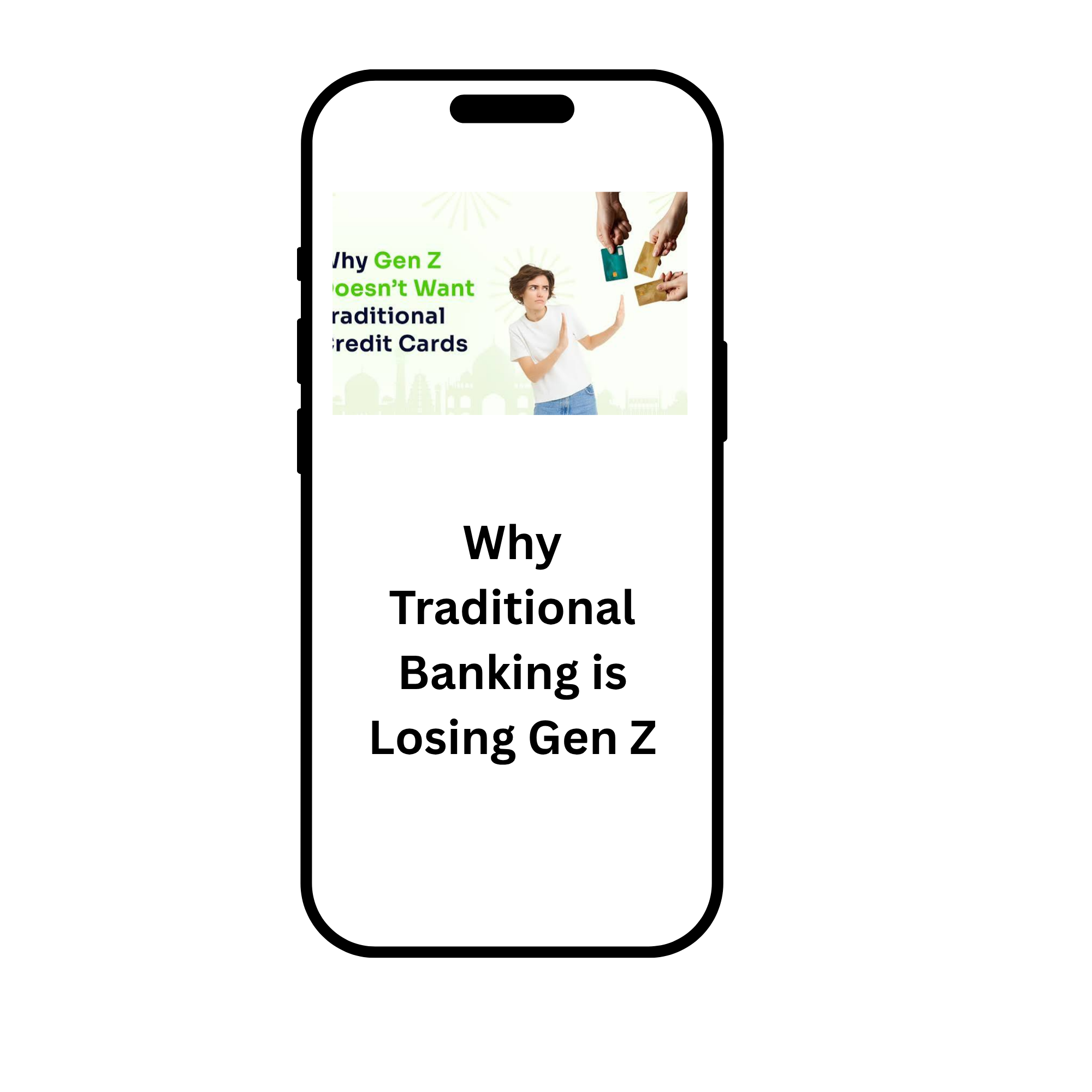
Traditional banks are losing Gen Z because their experience doesn’t match how young people live. Gen Z expects instant, app-first, transparent and low-fee services, while many banks still rely on branches, paperwork, minimum balances and dated apps. Fintech apps and neo-banks fill that gap, but the smartest young customers use a hybrid: a regulated bank for security and fintech tools for everyday convenience.
Key takeaways
- Gen Z, broadly those born between 1997 and 2012, is the first generation to reach adulthood entirely in the smartphone era.
- Their expectations centre on speed, self-service, transparent pricing and good design.
- The biggest pain points with traditional banks are branch visits, slow onboarding, fees and minimum balances, low savings returns and poor support.
- Fintech apps and neo-banks offer instant accounts, real-time insights, savings tools and easy UPI payments. In India, most neo-banks operate in partnership with RBI-licensed banks.
- Safety still matters.Deposits in RBI-regulated banks are insured by DICGC up to ₹5 lakh per depositor, per bank.
- Banks that win Gen Z will treat digital as the core of the business, not just a channel.
A 22-year-old opens her phone, splits last night’s dinner bill over UPI, checks her weekly spending, freezes a lost card with one tap and moves some savings into a goal she named “Goa trip.” It takes under two minutes, and she has never set foot in a bank branch.
For her generation, this isn’t a novelty. It is the baseline. Gen Z expects financial services to feel like the other apps they use every day: fast, intuitive, transparent and available at any hour. Traditional banks, built around branches, paperwork and business hours, often fall short.
This article explains why so many young people are drifting away from traditional banks, what they are choosing instead and what it means for the future of banking.
Who Is Gen Z and How Do They Bank?

Gen Z is the generation born roughly between 1997 and 2012. They have never known a world without smartphones, social media and instant messaging. They order food, book rides, stream entertainment and shop online in a few taps.
In India, Gen Z also grew up alongside UPI, Aadhaar-based e-KYC and video KYC. Many made their first digital payment as teenagers. When every other part of life is on demand, waiting days for an account to be approved, or queueing at a branch to update a phone number, feels absurd.
This shapes three core expectations:
- Speed: If something can be done instantly elsewhere, it should be instant at a bank too.
- Self-service: Young users would rather solve problems in an app than call a helpline or visit a branch.
- Design: Clean, simple interfaces are assumed. A clunky app signals that a company doesn’t respect their time.
Banks that were built decades ago around physical infrastructure, then added digital layers on top, often feel like old machinery with a fresh coat of paint. Gen Z notices.
Why Is Traditional Banking Losing Gen Z? The 7 Main Reasons
1. The branch has lost its central role
For older generations, a bank branch signalled trust and permanence. For Gen Z, it often signals inconvenience. Branches keep limited hours that overlap with college or work, and they involve travel, queues, forms and sometimes staff unfamiliar with digital-first needs.
Many young people rarely handle cash, so the classic reasons to visit a branch, depositing cheques or withdrawing money, matter less. Physical banking isn’t dead: taking a home loan or resolving a complex issue can still benefit from a face-to-face conversation. But for everyday banking, the branch is no longer the centre.
2. Onboarding is slow and paperwork-heavy
First impressions matter. Opening an account with a fintech app often takes minutes: Aadhaar-based e-KYC or video KYC, a selfie, a few confirmations and you’re in. Opening an account with some traditional banks can still involve multiple documents, physical signatures and days of waiting.
Young customers, especially students and first-jobbers without a credit history, face extra hurdles. Minimum balance requirements, documentation demands and rigid eligibility can feel like a message that they aren’t the bank’s target customer.
3. Fees and minimum balances feel unfair
Gen Z came of age during economic disruptions, including the pandemic and rising living costs. Many entered the workforce with education loans, unstable jobs or gig income. They are highly sensitive to money leaking away through avoidable charges, such as:
- minimum average balance penalties,
- debit card annual fees,
- charges for SMS alerts, cheque books or card replacement,
- ATM charges beyond free limits,
- foreign currency markups on international payments.
When a rival offers a zero-balance account, free UPI transfers and transparent pricing, the comparison is stark. Young customers aren’t unwilling to pay for value; they resent charges that feel hidden or arbitrary.
4. Savings returns look poor
Savings account interest rates at many large banks are modest, often below inflation. Gen Z, raised on financial content online, is more aware of this than earlier generations were at the same age. Many know that idle money loses value and would rather put it to work through higher-rate small finance bank deposits, liquid funds, SIPs in index funds or digital FDs. When a fintech app shows how to earn more in a few taps, a low-interest account looks like a bad deal.
5. Financial education has moved to social media
Previous generations learned about money from parents, bank staff or advisers. Gen Z learns from short videos, podcasts, newsletters, Reddit threads and creators who explain budgeting, investing, credit scores and side hustles in plain language.
This makes young customers more curious and better informed about options. It also shifts trust away from institutions and towards peers and personalities. A bank’s brochure now competes with a 60-second reel explaining why another app is better. That comes with a caution: not all online advice is reliable, and some creators promote products for commissions.
6. Values, ethics and transparency matter
Gen Z is often described as values-driven. Surveys frequently suggest that younger people care about data privacy, ethical practices, environmental impact and honest communication. Traditional banks can carry reputational baggage, from mis-selling controversies to opaque fee structures. Some have made real progress, but perception lags. Newer brands market themselves with plain language and purpose, and that resonates. For this generation, trust is earned through transparency, not inherited from a century-old logo.
7. Customer service is slow when it matters
Gen Z doesn’t dislike human service. It dislikes bad service: long IVR menus, scripted replies and transfers between departments. The ideal is a mix of instant in-app help for simple issues and fast access to competent people for complex ones. Many fintechs invest heavily in in-app chat and quick resolution, which builds loyalty.
Pain point with traditional banks | What Gen Z expects instead |
Branch visits for routine tasks | Everything in the app |
Days to open an account | Minutes, via e-KYC or video KYC |
Minimum balance penalties | Zero-balance accounts |
Hidden or unclear charges | Transparent, upfront pricing |
Low savings returns | Easy access to better-yielding options |
Slow phone support | Instant chat, quick human escalation |
Generic products | Personalised insights and goals |
What Are Gen Z Choosing Instead?
Digital-only banks, payment apps, budgeting tools, investment platforms and credit apps have built products around how young people actually live.
What is a neo-bank?
A neo-bank is a digital-only banking service with no physical branches, operated entirely through an app. In India, the RBI does not issue a separate “neo-bank” licence, so most neo-banks partner with licensed banks that hold customer deposits. The neo-bank provides the app and experience; the partner bank provides the regulated account.
What do fintech apps offer?
- Instant, mobile-first experiences: Accounts open in minutes, virtual cards are issued immediately and limits can be changed in the app.
- Real-time notifications and insights: Every transaction triggers an alert and spending is categorised automatically.
- Built-in savings tools: Round-ups, named goals, automated transfers and separate “pots” make saving feel easy.
- Low or no fees: Many compete by removing common charges.
- Easy UPI and peer-to-peer payments: Splitting bills takes seconds.
- Integrated investing: Moving from saving to SIPs, digital gold or FDs in the same app.
- Personalisation: Budgets and alerts adapt to the individual.
None of these features is revolutionary on its own. Together, they create an experience that feels designed for young people rather than adapted for them.
Is Fintech Safe? The Case for Traditional Banks
- It’s worth being fair. Traditional banks retain real advantages, and Gen Z isn’t blindly abandoning them.
- Regulation and deposit insurance. Banks licensed by the RBI are closely supervised, and deposits are insured by the Deposit Insurance and Credit Guarantee Corporation (DICGC) up to ₹5 lakh per depositor, per bank, covering principal and interest. Money in a prepaid wallet is not a bank deposit and is not covered in the same way.
- Full product range. Banks offer home loans, education loans, business credit, lockers and wealth management that many apps can’t match.
- Grievance redressal. Customers of regulated entities can escalate unresolved complaints to the RBI Integrated Ombudsman through the RBI’s complaint management system.
- Durability. Not every startup survives. App-based services have faced outages, partner-bank changes, frozen features and shutdowns.
- Smart young customers increasingly use a hybrid approach: a traditional bank account for security and major products, alongside fintech apps for everyday spending, budgeting and investing.
How Are Traditional Banks Responding?
Banks aren’t standing still. Many are:
- Upgrading their apps with better design, instant account opening and budgeting tools;
- Launching digital-only sub-brandsaimed at younger customers;
- Partnering with or acquiring fintechsto speed up innovation;
- Offering zero-balance student and salary accounts;
- Investing in financial educationand youth-focused content;
- Using AI-driven supportto cut response times and personalise services;
- Joining the Account Aggregator framework, which lets customers share financial data securely with consent.
The challenge is culture as much as technology. Legacy systems, regulatory obligations and cautious decision-making make it hard to move at startup speed, and a redesigned app doesn’t help if the processes behind it are still slow. Banks that succeed will treat digital as the core of the business.
What Should Banks Learn From This?
- Make it effortless : Every unnecessary step, form or delay is a reason to leave.
- Be transparent : Clear pricing, plain language and no surprise fees build trust with a sceptical audience.
- Value small balances : Young customers may not have much today, but they will earn more over time.
- Educate, don’t just sell : Useful content about budgeting, credit and investing builds credibility.
- Blend digital and human : Excellent self-service backed by knowledgeable people.
- Show your values and back them with action.
How Should Gen Z Choose a Bank or Fintech App?
- Compare fees and features. : Check minimum balance rules, card charges, interest rates and transfer limits.
- Check who holds your money : Confirm it sits with an RBI-regulated bank and is covered by DICGC.
- Use a hybrid setup : Keep your main savings and emergency fund with a regulated bank and use apps for convenience.
- Build your credit history early : Responsible use of a starter credit card or secured card, paid in full each month, helps when you later need larger loans.
- Be careful with easy credit : BNPL, pay-later lines and instant loans are convenient but easy to overuse. Check that any lender is RBI-regulated.
- Verify online advice : Ask who is paying for a recommendation and whether it suits your situation.
- Secure your accounts : Use app locks and two-factor authentication, never share OTPs or UPI PINs and remember that you only enter your UPI PIN to send money, never to receive it.
What Does the Future of Banking Look Like?
The gap between traditional banking and Gen Z’s expectations is unlikely to close on its own. As this generation earns more, buys homes and starts families, its financial needs will grow, and the institutions that earned its loyalty early will be best placed to serve it for life.
The line between bank and technology company may blur entirely. Embedded finance, where financial services sit inside everyday apps, could make banking almost invisible. Artificial intelligence may deliver personalised guidance at scale. The Account Aggregator system and open-banking-style frameworks may make it easier to move data and switch providers. In that world, loyalty will belong to whoever offers the best experience, the fairest terms and the greatest trust.
Final Thoughts
Traditional banking isn’t losing Gen Z because young people are reckless or disloyal. It is losing them because the experience often doesn’t match how they live, what they value or what they’ve come to expect from every other service. Slow onboarding, unfair-feeling fees, low returns, dated apps and impersonal service push them towards alternatives that feel built for them.
Yet this isn’t a story of simple replacement. Regulation, deposit insurance and full-service offerings still matter, and the smartest approach for most young people is a blend of old and new. For banks, the path is clear: meet customers where they are, treat them with transparency and respect, and build digital experiences that are genuinely useful. The customer who opens an account today is the one who will later need a home loan, a business loan or a retirement plan, and they will remember who made their first steps easy.
Source
- DICGC, Guide to deposit insurance: https://dicgc.org.in/sites/default/files/2025-02/dicgc-information-booklet.pdf
- Reserve Bank of India, Integrated Ombudsman Scheme, 2021: https://www.rbi.org.in/Scripts/BS_PressReleaseDisplay.aspx?prid=52549 (complaints portal: https://cms.rbi.org.in)
- Reserve Bank of India, Account Aggregator Directions: https://www.rbi.org.in/Scripts/BS_ViewMasDirections.aspx?id=12936
- Reserve Bank of India, Digital Lending Directions, 2025: https://www.rbi.org.in/Scripts/NotificationUser.aspx?Id=12848
- NPCI, UPI product statistics: https://www.npci.org.in/what-we-do/upi/product-statistics
- NPCI, UPI safety tips (UPI Safety Shield): https://www.npci.org.in
- Pew Research Center, Defining generations: https://www.pewresearch.org/short-reads/2019/01/17/where-millennials-end-and-generation-z-begins/