To beat inflation, your investments must earn a positive real return, meaning returns higher than the rate at which prices rise. The most reliable way is smart asset allocation: holding quality equities for long-term growth, debt for stability, a modest share of gold or real estate as a hedge, and only as much cash as you need. Diversify, keep costs low and rebalance once a year.
Key takeaways
- Inflation quietly reduces what your money can buy. At 6% inflation, prices nearly double in 12 years.
- India’s retail inflation rose to 54% in September 2026(MoSPI), above the RBI’s 4% target.
- What matters is your real return: investment return minus inflation, and ideally after tax.
- Equitieshave historically been the most consistent long-term inflation beater; gold and real estate help as hedges; cash loses value beyond your emergency needs.
- Your asset allocation, not individual stock picks, drives most of your long-term results.
- Rebalancing keeps risk in check without needing to predict markets.
You get a 5% raise and feel good about it. Then you notice that groceries, rent, school fees and fuel have all gone up by more than that. Your salary rose, yet life didn’t get any easier. That is inflation at work, and it is one of the most persistent threats to your long-term financial health.
Inflation works quietly. Nothing dramatic happens on any single day. Prices simply rise a little each year, and idle money buys a little less each time. Over a decade or two, the damage is enormous. The good news is that inflation can be beaten. The most reliable weapon isn’t a hot stock tip. It is smart asset allocation: deciding how to divide your money across different investments so that your wealth grows faster than prices.
What Is Inflation and How Does It Erode Wealth?
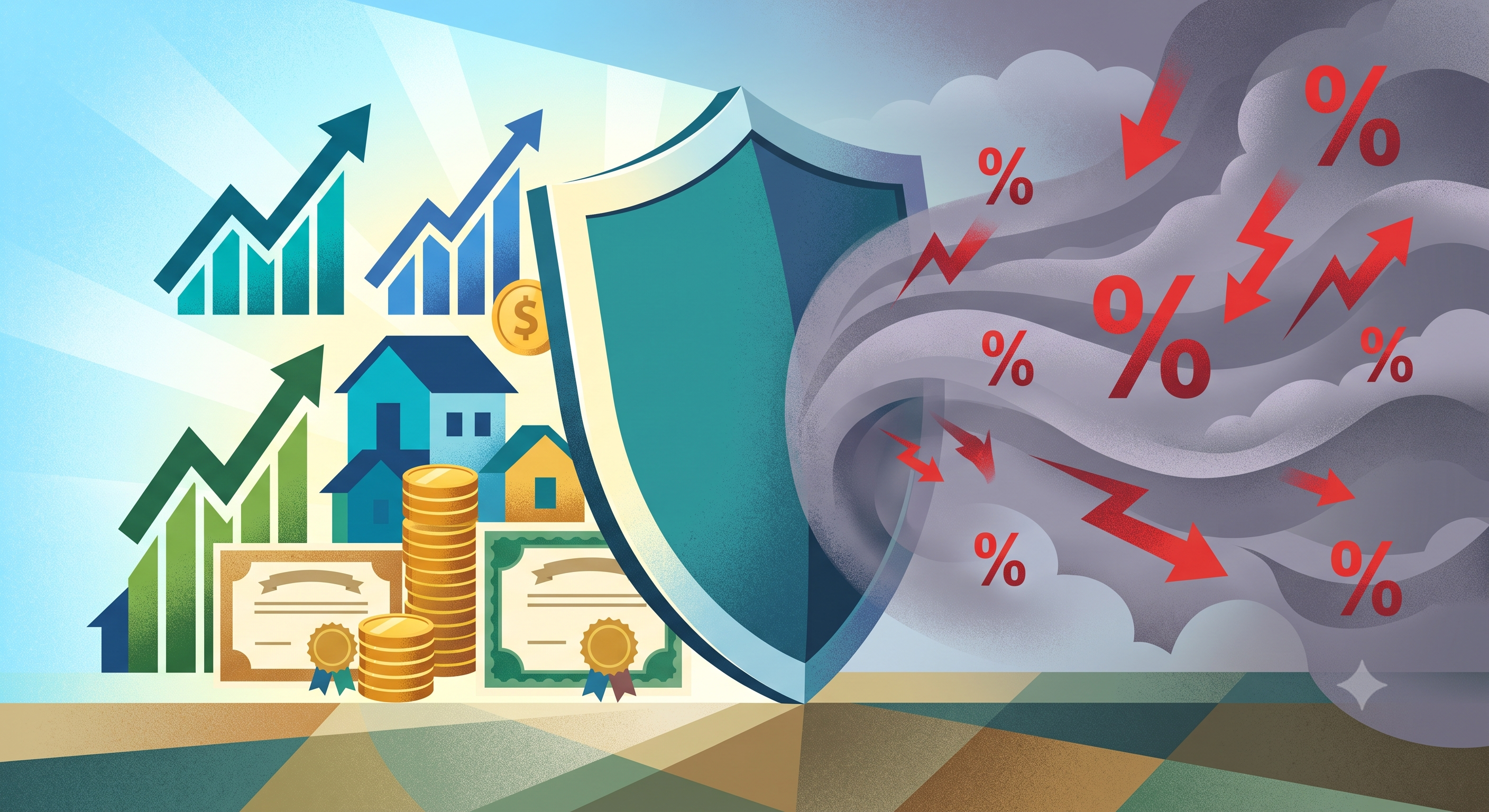
Inflation is the general rise in prices over time, which reduces the purchasing power of money. In India, it is measured mainly by the Consumer Price Index (CPI), published monthly by the Ministry of Statistics and Programme Implementation (MoSPI). The RBI aims to keep CPI inflation at 4%, within a band of 2% to 6%.
Here is how inflation compounds. At 6% a year, something that costs ₹100 today will cost about ₹106 next year and roughly ₹179 in ten years. Put another way, your money loses about 44% of its purchasing power over that decade.
Annual inflation | Cost of ₹100 item after 10 years | After 20 years | Years for prices to double |
4% | ₹148 | ₹219 | about 18 |
6% | ₹179 | ₹321 | about 12 |
8% | ₹216 | ₹466 | about 9 |
A quick way to estimate how fast prices double is the Rule of 72: divide 72 by the inflation rate. At 6%, prices double in about 12 years.
What Is a Real Return?
Your real return is your investment return minus inflation. It tells you how much your purchasing power actually grows.
- A savings account paying 3%with inflation at 6% gives a real return of minus 3%.
- An FD paying 5%with inflation at 5.5% gives a real return of about 1% before tax. If you are in the 30% slab, the post-tax return is about 4.5%, which means a negative real return of about 1%.
This is why “safe” doesn’t always mean safe. Keeping all your money in low-yield accounts feels secure because the balance never drops, but over long periods it is one of the surest ways to lose wealth in real terms. The goal of investing isn’t just to grow money. It is to grow it faster than the cost of living.
Why Does Inflation Hurt Some People More?
Inflation isn’t felt equally.
- Retirees on fixed incomes are most exposed, because expenses keep rising while income doesn’t.
- Savers who hold mostly cash lose ground steadily.
- Salaried workers fall behind if raises don’t keep pace.
- Families facing education and medical costs often experience inflation well above the headline CPI. Education and healthcare costs in India are frequently estimated to rise by 10% or more a year.
That is why it helps to think about your personal inflation rate: the rate at which your basket of expenses rises. A family with school-going children and elderly parents may face effective inflation well above the official figure.
What Is Asset Allocation?
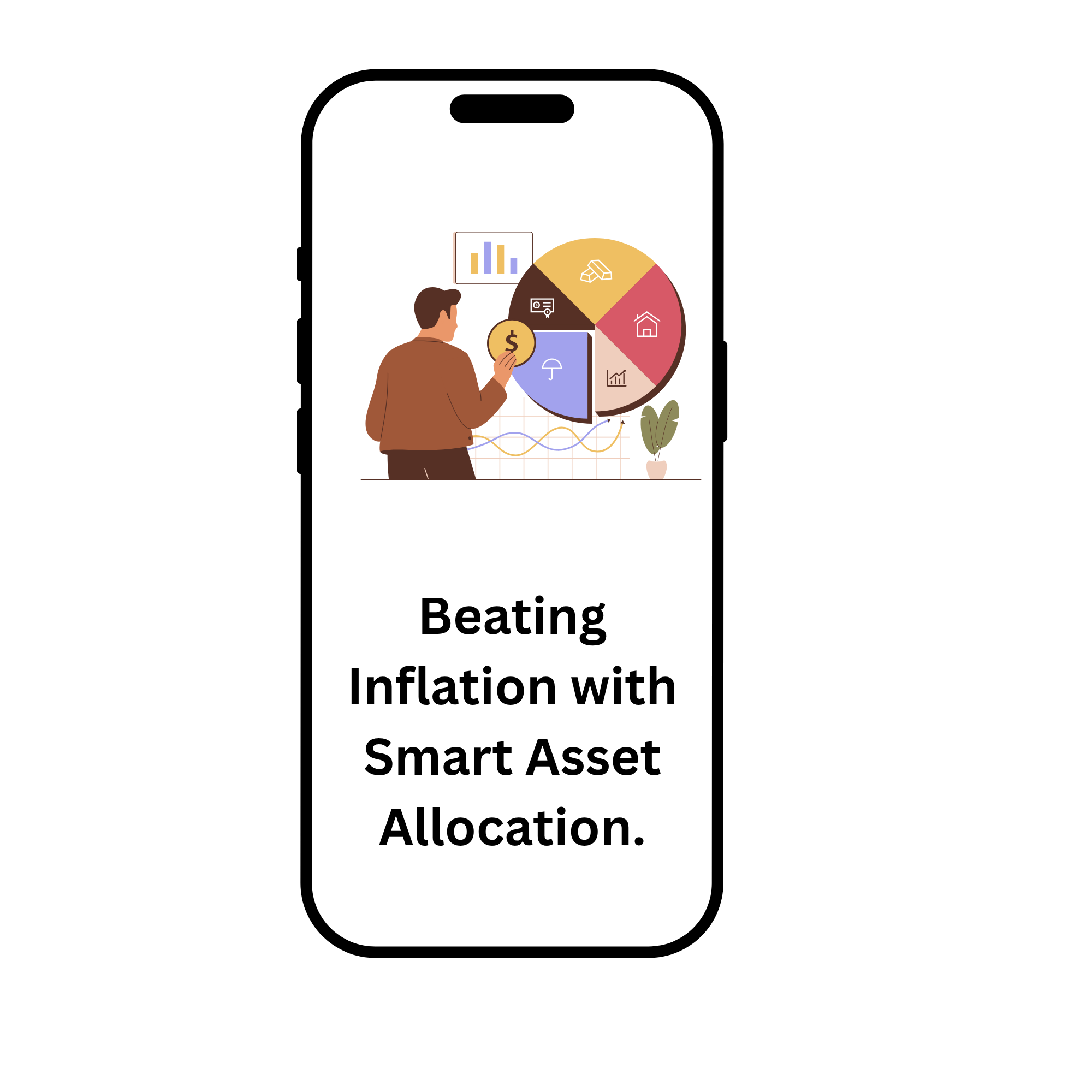
- Asset allocation is the process of dividing your investments among major asset classes, such as equities, debt, real assets (gold and property) and cash. Each class behaves differently as economic conditions change. Some do well when inflation rises, others suffer and a few barely react.
- Research over many decades, including the well-known study by Brinson, Hood and Beebower, has shown that the mix of asset classes explains a large share of the variation in a portfolio’s returns over time, often more than the choice of individual securities. That makes allocation the most important investment decision you will make, and the one you have the most control over.
- The logic is simple. Nobody can perfectly predict inflation, growth or interest rates, so you spread money across assets that respond differently. If one lags, another may pick up the slack. A well-allocated portfolio is not designed to win in one scenario; it is designed to survive and grow in many.
Which Assets Beat Inflation?
Equities: the long-term growth engine
Stocks are ownership stakes in businesses, and businesses can raise prices. Companies with strong brands, pricing power and efficient operations pass higher costs to customers, protecting profits. Over long periods, Indian equities have delivered returns well above inflation, though with sharp ups and downs along the way.
Stocks don’t always cope well in the short run. A sudden burst of inflation can push interest rates up and hurt valuations, and companies with thin margins or heavy debt can struggle. So the type of equity exposure matters as much as the amount. Look for businesses with:
- pricing power, where customers keep buying even when prices rise,
- strong balance sheets and manageable debt,
- consistent cash flow and healthy margins,
- essential products or services, such as consumer staples and healthcare.
For most investors, diversified equity mutual funds and low-cost index funds are the simplest way to get this exposure. Dividend-paying companies that grow payouts also provide income that rises over time.
Debt: useful, but handle with care
Traditional bonds and FDs pay fixed interest, which is exactly why they are vulnerable to inflation. If an FD pays 6% and inflation runs at 6.5%, you are losing ground. Rising inflation also tends to push yields up and existing bond prices down.
That doesn’t make debt useless. It provides stability, predictable income and a cushion when stock markets fall. An inflation-aware investor should be selective:
- Shorter-maturity debt funds are less sensitive to rate swings and reinvest at higher rates as holdings mature.
- Floating-rate instruments, such as floating-rate debt funds and RBI Floating Rate Savings Bonds, reset payments as rates change.
- Long-term fixed-rate bonds are best held only when they match a specific future need.
Real estate: a tangible hedge
Property has long been seen as an inflation hedge. Rents tend to rise with prices, and property values often track land and construction costs. With a fixed-rate loan, inflation can even work in your favour, because you repay with money worth less. In India, most home loans are floating-rate, which reduces that advantage when rates rise.
Real estate also has drawbacks: it needs large capital, is hard to sell quickly and comes with maintenance, taxes and vacancy risk. Location matters enormously. For smaller amounts, REITs and InvITs listed on Indian exchanges offer property and infrastructure exposure with better liquidity, though they remain sensitive to interest rates.
Gold: insurance, not income
Gold has a long reputation as a store of value. It tends to hold purchasing power over very long periods and often does well during economic stress, currency weakness or falling real interest rates. For Indian investors, rupee depreciation against the US dollar has added to gold’s returns over time.
Gold produces no income and can stay flat for years. Treat it as insurance: a modest allocation, often 5% to 15%, through gold ETFs, gold mutual funds or existing Sovereign Gold Bonds traded on the exchange, rather than the foundation of your portfolio.
Cash: the necessary compromise
Cash and short-term deposits provide liquidity and safety, and you need them for emergencies. But every rupee beyond your needs is quietly losing value when real returns are negative. Hold enough for security, typically three to six months of expenses, and keep it in higher-yielding safe options such as liquid funds, sweep-in FDs or money market funds rather than an idle savings account.
Asset class | Role in an inflation-aware portfolio | Main risk |
Equities | Long-term growth above inflation | Short-term volatility |
Debt | Stability and income | Loses to high inflation; rate risk |
Real estate / REITs | Tangible hedge, rental income | Illiquidity, concentration, rate sensitivity |
Gold | Crisis and currency insurance | No income; long flat periods |
Cash | Liquidity and emergencies | Negative real returns |
How to Build an Inflation-Beating Asset Allocation: 6 Steps
Step 1: Define your goals and time horizons
Group your goals by when you’ll need the money:
- Short term (0–3 years):emergency fund, upcoming expenses. Prioritise safety and liquidity.
- Medium term (3–10 years):a home down payment, a child’s higher education. Balance growth and stability.
- Long term (10+ years):retirement, long-term wealth. Emphasise growth, because you have time to ride out volatility.
The longer your horizon, the more inflation matters and the more growth assets you can hold. Money you need next year shouldn’t be exposed to stock market swings, however tempting the returns.
Step 2: Assess your risk capacity and risk tolerance
Risk capacity is how much loss you can financially afford, based on income stability, savings and obligations. Risk tolerance is how much volatility you can stomach without panicking and selling at the bottom. A portfolio that looks perfect on paper but makes you sell in a downturn will underperform a slightly more conservative one you can stick with.
Step 3: Choose a core allocation
There’s no universal formula. These illustrative frameworks show how the balance shifts. They are examples for understanding, not personal recommendations.
Profile | Equities | Debt | Real assets (gold, property) | Cash |
Conservative | 30% | 45% | 15% | 10% |
Moderate | 50% | 25% | 20% | 5% |
Growth-oriented | 70% | 10% | 15% | 5% |
A common rule of thumb is to subtract your age from 100 to estimate your equity share. Treat it only as a starting point: your income stability, other assets, EPF and NPS balances, and goals matter more than any formula.
Step 4: Diversify within each asset class
- Diversification shouldn’t stop at the asset-class level. Within equities, spread across sectors, company sizes and geographies. Within debt, mix maturities and issuers. Within real assets, avoid concentrating everything in one property.
- International diversification matters for inflation too. If the rupee weakens, holding some global equity, through international funds or the RBI’s Liberalised Remittance Scheme, can protect purchasing power. Be aware of currency risk, costs and current limits on overseas fund investments.
Step 5: Keep costs low
Fees compound just as returns do. A fund charging an extra 1% a year can consume a large share of your lifetime gains. Direct plans of mutual funds and low-cost index funds are efficient ways to build diversified exposure. When fighting inflation, every fraction of a percent saved in costs adds directly to your real return.
Step 6: Consider taxes
Inflation and taxes work together against you, because you are often taxed on nominal gains, including the part that simply reflects inflation. In India, equity gains held over 12 months are taxed at 12.5% above ₹1.25 lakh a year, while FD interest and gains on debt funds bought on or after 1 April 2023 are taxed at your slab rate. Use tax-efficient options such as PPF, EPF and NPS where they suit you, and hold equity long enough for long-term rates. Rules change, so consult a qualified tax adviser.
How Should You Adjust for Different Inflation Environments?
Environment | What tends to work | What to be careful with |
Mild, stable inflation (2–4%) | Diversified portfolios with a strong equity core | Holding too much cash |
High or rising inflation | Equities with pricing power, short-duration and floating-rate debt, modest gold | Long-term fixed-rate bonds |
Stagflation (high inflation, weak growth) | Real assets, quality dividend payers, some cash for flexibility | Both stocks and bonds can struggle |
Disinflation or deflation | High-quality, longer-duration bonds; growth stocks recover | Overweighting inflation hedges |
No one can reliably forecast which environment comes next. Keep your core allocation robust, with only modest tilts as conditions change.
Why Is Rebalancing Important?
- Markets push your allocation off course. A strong equity rally can move stocks from 50% of your portfolio to 60% or more, quietly increasing risk. Rebalancing means bringing the portfolio back to its target by trimming what has risen and adding to what has lagged.
- Rebalance on a schedule, such as once a year, or when an asset class drifts by about five percentage points. Either method enforces the discipline of buying low and selling high without relying on prediction. Directing new SIPs towards underweight assets is a low-cost way to rebalance without triggering taxes.
Beyond Investing: Other Ways to Protect Purchasing Power
- Grow your income.Your earning power is often your biggest asset. Skills, timely job moves and negotiated raises are powerful inflation defences.
- Manage debt smartly.Prepay costly variable-rate debt first, such as credit card balances and personal loans.
- Control lifestyle inflation.If spending rises faster than income, beating inflation becomes much harder.
- Automate investing.Monthly SIPs smooth out market timing and build the habit of steady wealth creation.
- Step up your SIPs.Increasing your SIP by 10% each year helps your savings keep pace with rising incomes and prices.
Common Mistakes to Avoid
- Staying too conservative for too long, which locks in a slow erosion of purchasing power.
- Chasing the latest inflation hedgeafter it has already surged.
- Ignoring real returns.A 7% yield sounds good until you realise inflation and tax take most of it.
- Overconcentrationin gold, property or a single stock because it “beats inflation.”
- Never reviewing.An allocation set five years ago may no longer fit your life.
Final Thoughts
Inflation is a slow, steady tax on idle money, and it can’t be ignored. But it can be beaten, without complicated tactics or perfect forecasts. Aim for positive real returns, hold quality equities for the long term, use debt for stability and gold or real estate as ballast, keep only the cash you need, diversify widely, control costs and rebalance with discipline. Start by defining your goals and time horizons, choose an allocation you can stick with through good and bad markets, and review it every year. Over time, consistency matters far more than cleverness.
Source
- https://www.mospi.gov.in/uploads/latestreleasesfiles/1791801549227-Press%20Release%20for%20the%20month%20of%20September,%202026.pdf
- https://website.rbi.org.in/web/rbi/-/publications/chapter-ii-the-goals-of-monetary-policy-20343
- https://doi.org/10.2469/faj.v42.n4.39
- https://investor.sebi.gov.in
- https://www.mutualfundssahihai.com/en
- https://www.incometaxindia.gov.in