

Central Bank Independence in India: Why RBI’s Autonomy Matters
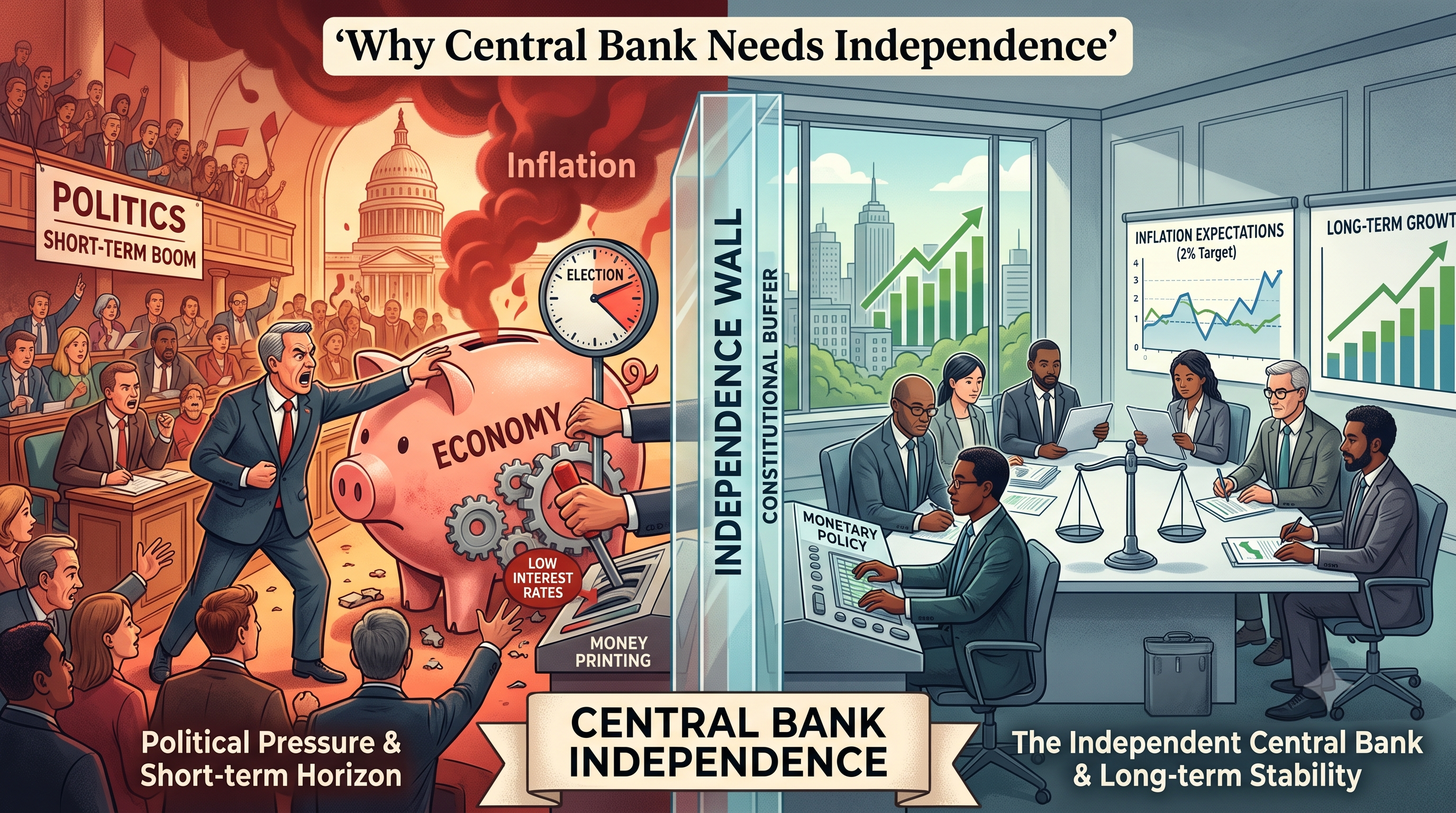
Central bank independence is a notion that a central bank is in a position to make monetary policy decisions to achieve a particular objective such as price stability without being unduly subjected to short-term political pressures. The Indian central bank, Reserve Bank of India (RBI) has limited or ‘accountable’ independence because the government sets the inflation target and the Monetary Policy Committee (MPC) sets the policy interest rate to achieve the target. This affects your EMI, fixed deposits returns and investments.
A hypothetical situation: The economy slows down but inflation is high What would a government do if the economy slows down?
Firms would want cheaper loans, home buyers would want lower interest rates as EMIs rise, firms desire easy funding for investment and expansion. The government itself may want to lower borrowing costs as it funds public spending and has to service its debt. Now suppose inflation is already high. Cheaper borrowing would lead to more borrowing and spending, pushing inflation higher. The central bank may have to keep rates high to tame inflation, despite hurting borrowers and slowing down growth in the short term.
This brings us to the important question:
Should monetary policy be determined by the government of the day or an autonomous body with a longer-term view of the economy?
- This is one reason nations give their central banks autonomy. It does not mean they are unaccountable but that monetary policy is shielded from being used as a political tool, enabling the central bank to pursue its mandate, free from short-term political considerations.
- This is especially important for India which has the RBI as the central bank, the regulator of financial systems and markets and a key player in the functioning of the financial system. Monetary policy since 2016 is undertaken in a statutory flexible inflation targeting framework with a Monetary Policy Committee (MPC) with the mandate of price stability as the objective with growth considerations.
Why monetary policy needs a long-term view ?
- Monetary policy affects the economy, and the interest rate as the main policy instrument has a delayed impact on the cost of credit, deposit rates, investments, consumer spending, market liquidity and inflation. Monetary policy measures usually have a delayed impact. If the central bank of a country raises interest rates to curb rising prices, the cost of loans and deposits and, as a result, the money supply will react later.
- The same applies to cuts in key rates, which should stimulate the economy, but several months will go by before the results of this policy move become apparent. This delay is the reason why central banks are naturally inclined to take a broad and considered view of the economy.
- The short-sighted exploitation of monetary policy instruments involves serious risks for future generations. In other words, there is a conflict between the interests of voters in the short term and the long-term goals of policymakers. Central bank independence helps to solve this problem. The problem of political pressure Let’s say the economy is slowing down – companies are experiencing demand shortages, layoffs, and rising unemployment, but inflation is still high.
- Everything is logical here: the lower the demand for goods and services, the lower the prices for them should be. However, the government may decide to stimulate the falling economy by lowering interest rates. The central bank, on the other hand, wants to reduce prices and is ready to sacrifice growth in the short term to achieve this goal. Such a scenario demonstrates how difficult the central bank’s independent action can be in practice, despite having the best intentions.
Why inflation is more than just higher prices?
- Inflation is often described simply as rising prices. But persistent inflation is a serious economic problem because it erodes the value of money.
- Assume a family has savings of ₹10 lakh. If prices rise sharply over the coming years, those ₹10 lakh will buy fewer goods and services. This hits hardest for households whose incomes or savings do not grow as fast as prices.
Inflation also creates uncertainty:
- Businesses find it harder to forecast costs.
- Consumers find it harder to budget for household expenses.
- Investors demand higher returns to compensate for inflation risk.
- Lenders demand higher interest rates.
Price stability is not just about defending an economic statistic. It is about maintaining faith in the value of money.
What if policy is driven by short-term pressure? If monetary policy is dominated by short-term political considerations, interest rates may be kept below the level that economic fundamentals justify. The short-term effect is attractive: borrowing costs fall, spending rises and economic activity picks up.
But if demand for goods and services outgrows the economy’s capacity to produce them, inflationary pressure builds. And if people begin to expect higher inflation, their behaviour changes:
- Workers ask for bigger pay rises.
- Businesses raise prices in advance.
- Consumers bring forward purchases.
- Lenders demand higher returns.
These responses can make inflation sticky and hard to bring down. This is why credibility is so valuable in monetary policy.
Inflation expectations
Central banks do not react only to current inflation. They also watch what households, businesses and financial markets expect inflation to be in the future.
Suppose people believe inflation will stay high for several years. A worker may ask for a bigger raise. A business may raise prices because it expects higher costs. A lender may charge a higher interest rate because it expects inflation to reduce the value of future repayments. Together, these decisions can make inflation persistent.
This creates a feedback loop:
Higher expected inflation → higher wages and prices → higher actual inflation → higher expected inflation
A credible central bank can help break this cycle by signalling a firm commitment to price stability. That is why credibility matters so much.
Inflation targeting in India
India moved to a flexible inflation targeting framework in 2016 through amendments to the RBI Act, 1934. The main goal of monetary policy is price stability, keeping growth in mind. Inflation is measured by the Consumer Price Index (CPI).
The Central Government, in consultation with the RBI, sets the target every five years. In March 2026, the Department of Economic Affairs notified that the target would stay at 4% CPI inflation, with a tolerance band of 2% to 6%, for the five-year period from 1 April 2026 to 31 March 2031. The same target and band applied in the two earlier periods.
Here is an important distinction: the target is 4%, not 6%. The upper and lower limits create a band of tolerance around the target. The framework does not expect inflation to be exactly 4% every month, because economic conditions are too unpredictable:
- Food prices can rise suddenly.
- Oil prices can swing sharply.
- Global supply chains can be disrupted.
- Weather can affect agricultural output.
The band provides flexibility while keeping a clear medium-term objective. If inflation stays outside the band for three consecutive quarters, the law requires the RBI to report to the government, explain why, and describe the remedial action it will take.
Who sets monetary policy in India?
The RBI Governor does not decide monetary policy alone. The statutory Monetary Policy Committee has six members, as provided in the RBI Act:
- The RBI Governor (chair)
- The RBI Deputy Governor in charge of monetary policy
- One RBI officer nominated by the Central Board
- Three members appointed by the Central Government
The MPC sets the policy rate needed to achieve the inflation target. A committee is useful because monetary policy involves uncertainty, and there is rarely a single mechanically correct interest rate. Members weigh inflation, growth, demand, financial conditions, global developments and other data. The committee structure also adds transparency, since decisions and voting positions are published.
Is the RBI completely independent?
No, and this is one of the most important points to understand.
Independence does not mean the RBI can set its own objectives without reference to the government or Parliament. India has a legally defined monetary policy framework. The inflation target and the MPC have a statutory basis in the RBI Act. The Central Government fixes the target once every five years in consultation with the RBI, and the MPC then sets the policy rate to achieve it.
Legally, this is best described as operational (or instrument) independence, not unlimited institutional independence. In simple terms:
- The government sets the legal framework and the general objective.
- The monetary policy institution conducts policy within that framework.
Why accountability matters
Independence without responsibility would create a different problem. Central banks make decisions that affect millions of people. A change in interest rates can affect:
- Home loan EMIs
- Business borrowing costs
- Fixed deposit rates
- Bond prices
- Investment choices
- Exchange rates
- Overall economic activity
Yet central bank officials are not elected. Why should they hold such power? The answer is accountability. A central bank should explain its decisions, communicate its assessment of inflation and growth, release relevant information, and work within the legal framework set for it.
India’s MPC system supports this through a formal decision-making process and by publishing the committee’s decisions and voting records. The aim is a balance: independence from undue political influence, combined with accountability to the public and the law.
Independence and economic growth
- A common misconception is that an independent central bank cares only about inflation. That is not how India’s system is designed. The RBI’s statutory mandate is price stability while keeping the objective of growth in mind, which is why the framework is called flexible inflation targeting.
- Consider two cases. If inflation rises because of a temporary food price shock, the right response may differ from the response to persistent demand-driven inflation. And if growth is slowing sharply while inflationary pressures ease, monetary policy has more room to support economic activity. This takes judgement, and no simple mechanical formula can replace it.
What is time inconsistency?
- Time inconsistency is the idea that a policy that looks good today can create problems later. It helps explain why institutional independence matters.
- Say policymakers want to boost activity and prefer easier monetary conditions. If people come to expect that policy will always favour short-term growth over price stability, their expectations change. In the end, the costs of inflation remain while the benefits of surprise easing disappear.
- A government may want stimulus in the short term, but the economy needs long-run monetary credibility. Central bank autonomy is one institutional mechanism designed to ease this conflict.
What is fiscal dominance?
- Fiscal dominance is a situation in which a government’s borrowing needs start to dictate monetary policy. Governments borrow to fund spending. When debt is very large, higher interest rates raise the government’s interest burden, which can create pressure to keep borrowing costs artificially low.
- If monetary policy is mainly concerned with the cost of government borrowing, it becomes less effective at controlling inflation. That is why monetary and fiscal policy need clearly defined responsibilities. The central bank must be able to focus on inflation and financial stability without subordinating them to the government’s financing needs.
Does central bank independence guarantee low inflation?
No. Independence is not a cure-all. Central banks cannot control every factor that drives prices:
- A jump in global crude oil prices raises energy costs, which ripple through transport, manufacturing and other sectors.
- Poor harvests can push up food prices.
- Geopolitical conflicts can disrupt supply chains.
- Currency movements affect the cost of imports.
These factors can generate inflation even under well-designed monetary policy. What independence provides is an institutional structure that can respond to such developments without being driven mainly by short-term political incentives.
The COVID-19 case
- The COVID-19 crisis showed how complex monetary policy can be. Economic activity collapsed, financial stress rose and uncertainty was extreme, while inflation was also shifting.
- The RBI took monetary and liquidity measures to support financial markets and the recovery while staying within its mandate. Its communications explicitly acknowledged the need to support growth while anchoring inflation within the target framework.
- The episode shows that independence does not mean sticking to a single objective regardless of circumstances. A credible framework must allow the central bank to respond to extraordinary shocks.
Why investors care about credibility
- Financial markets are sensitive to central bank independence because asset prices partly reflect expectations. If investors believe inflation will be kept under control, they may demand a lower inflation risk premium, which can lower long-term interest rates and the cost of capital.
- If they begin to believe monetary policy is driven mainly by short-term political considerations, they may demand higher returns to compensate for inflation and policy uncertainty. That can make borrowing more expensive across the economy. So central bank credibility has effects well beyond the policy rate announced after an MPC meeting.
What it means for your home loan, FD and investments
Your home loan
If you have a floating rate home loan, tighter monetary conditions may eventually raise lending rates, depending on your loan benchmark and your lender’s transmission. This could increase your EMI or loan tenure. When conditions ease, borrowing costs may eventually fall. Transmission is rarely immediate or one-for-one, but the principle holds: monetary policy influences the cost of borrowing. That is why an RBI policy announcement matters to households that never deal with the central bank directly.
Your fixed deposit
Interest rates matter to savers too. When rates rise, banks may eventually offer better deposit rates, and when rates fall, deposit rates may eventually decline. Borrowers generally prefer low rates and savers prefer high rates, so no single rate level suits everyone. The central bank has to think about the economy as a whole.
Your investments
Interest rates affect many asset classes:
- Bonds: Interest rates and bond prices usually move in opposite directions.
- Equities: Rates affect valuations, as investors compare expected stock returns with returns available elsewhere, and higher borrowing costs can hurt corporate profits.
- Real estate: Borrowing costs influence housing demand.
- Currencies: Interest rate differentials can influence capital flows and exchange rate expectations.
Investors should not assume that every rate move signals a clear win for one asset class. Markets react not only to what the central bank does, but also to what investors expect it to do.
Why central banks can’t keep interest rates low forever
Suppose interest rates stay very low for a long time. Borrowing becomes attractive, asset prices may rise, and consumption and investment may increase. But if inflation starts to drift up persistently, it becomes harder to justify very easy monetary conditions, and at some point the central bank may have to tighten.
A policy that helps in one phase of the business cycle can hurt in another. Central banks therefore need the flexibility to change direction.
The bigger picture
- The point of central bank independence is not to give unelected officials a free hand. It is to build an institutional structure that lets monetary policy focus on long-term economic stability rather than short-term political incentives.
- India’s system illustrates this. The government, in consultation with the RBI, sets the inflation target. The statutory MPC sets the policy rate needed to achieve it. The RBI conducts monetary policy within that framework, with transparency and accountability.
- This reflects a basic fact of economics: interest rate decisions can have effects long after the political environment that produced them has changed. A government may be focused on the next election, a business on the next quarter, a family on the next EMI. A central bank has to consider the purchasing power of money, inflation expectations, financial stability and economic conditions over a much longer horizon.
- Independence does not guarantee that every decision will be correct, and it does not promise low inflation in all circumstances. It does not mean ignoring growth, and it does not mean acting without accountability. What it offers is a framework in which hard decisions can be made on the basis of a mandate, economic evidence and longer-term considerations.
- Ultimately, central bank independence is about protecting the credibility of monetary policy. The goal is not to remove the central bank from democratic control, but to ensure that decisions with consequences lasting years are not made on short-term political considerations.
- Whenever the RBI changes or holds its policy stance, the decision can affect your EMI, fixed deposit return, investment portfolio, borrowing cost and purchasing power. Central bank independence is not just an economists’ issue. It is part of everyday financial life.