
2.1 Introduction

The risk of an investment can be seen as the probability that the actual return will be different from what the investor expects. Every financial decision is made under uncertainty and that uncertainty can arise from many sources, whether it is government policies, changes in the world economy or events in a particular industry. Therefore, investors need to understand that risk is not the same everywhere. It can be broadly or narrowly based.
Systemic Risk
Systematic risk is risk that cannot be diversified away by factors impacting the entire market. For instance, you might say:
- Interest Rate Changes : When interest rates are raised by central banks, borrowing becomes more expensive. It impacts companies across all industries .
- Inflation: When inflation is high, there is less purchasing power and it affects the consumer demand in the economy.
- Global recessions : When big economies such as the U.S. or China slow down, the impact can ripple through international markets and affect all industries.
These risks come from macro-economic or political forces which affect the whole financial system. You can’t get away from them.
Unsystematic Risk
Unsystematic risk, however, is specific to a company or industry. It can often be reduced by diversification. For example:
- Management decisions : Poor management decisions (for example overexpansion or misallocation of resources) can negatively affect a company’s profitability.
- Industry disruptions : For example, the rise of electric vehicles is a threat to traditional fossil-fuel powered car companies.
- Product recalls : If a drug has safety problems, the pharmaceutical company that produces the drug can lose money even if the overall market is doing well.
Political Risk
Political risk can span both categories depending on scope. If a government imposes sweeping tax reforms or trade restrictions, the whole market may feel the impact – a systemic risk.
But if the new rules apply only to a particular industry, such as stricter environmental rules for mining companies, then it is an unsystematic risk.
2.2 Types of Investment Risk
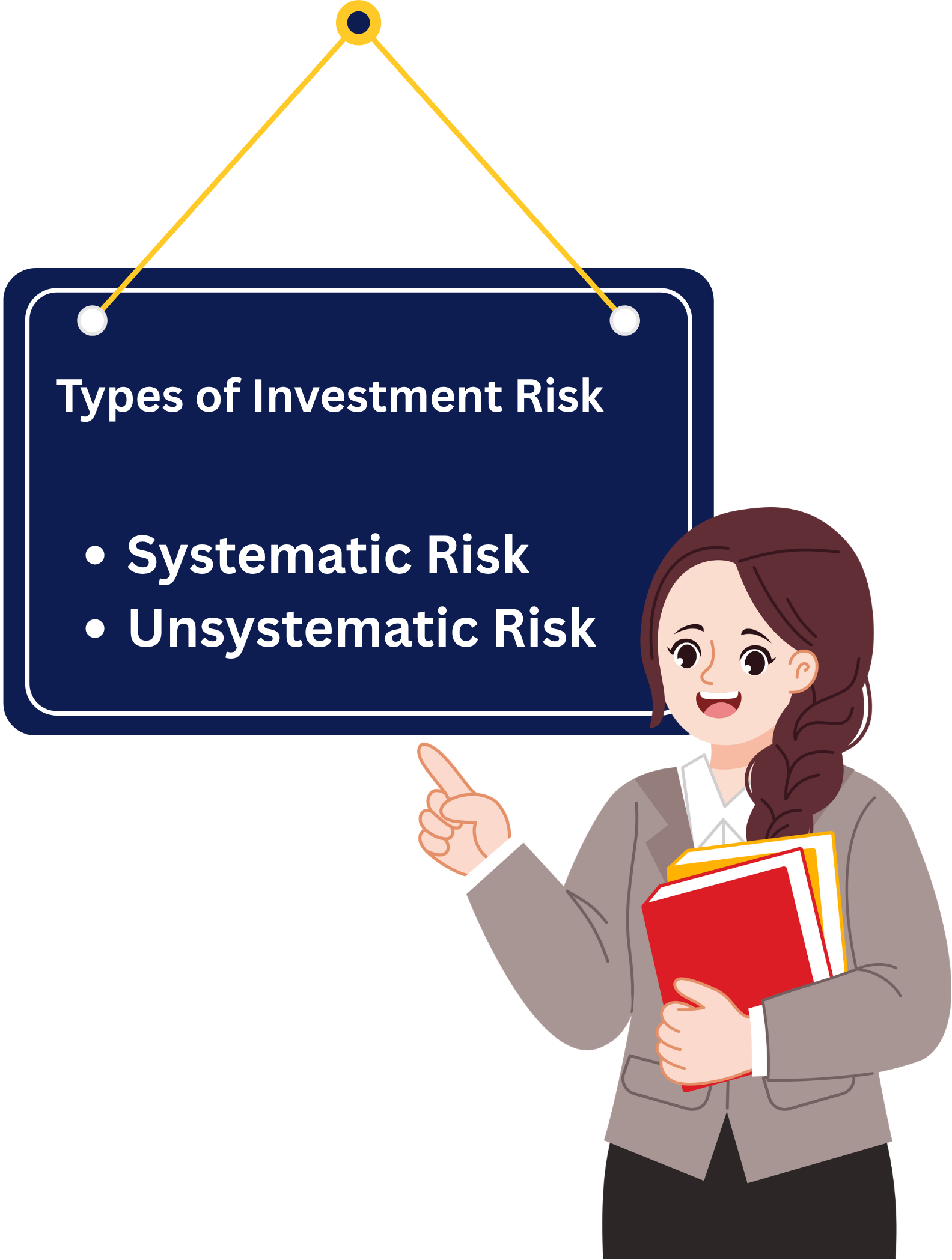
In modern finance, the total uncertainty surrounding a security’s return is split into two broad categories: risk that affects the entire market and economy, and risk that is specific to one company or industry. This split matters because it tells an investor exactly how much of their exposure can be reduced through diversification — and how much simply has to be lived with.
Total Risk = Systematic Risk + Unsystematic Risk
or, in variance terms:
σ²(Total) = σ²(Systematic) + σ²(Unsystematic)
1. Systematic Risk (Market Risk / Non-Diversifiable Risk)
Systematic risk is the portion of risk that cannot be eliminated by holding more securities, because it stems from macroeconomic and structural forces that move the entire market in the same direction at once — interest rates, inflation, currency movements, fiscal and monetary policy, and geopolitics. A portfolio of 5 stocks and a portfolio of 500 stocks are equally exposed to it.
|
Driver |
Recent India Example |
|
Monetary policy swings |
Between February 2025 and the December 2025 meeting, the RBI cut the repo rate by a cumulative 125 basis points to 5.25% — its lowest since July 2022 — to support growth as inflation cooled. Rate-sensitive stocks (banks, NBFCs, real estate, autos) moved almost in lockstep with each policy announcement, regardless of individual company fundamentals. |
|
Global spillovers / trade tensions |
The RBI’s December 2025 Financial Stability Report flagged that a sharp correction in US equities, coupled with tariff-related trade friction, could trigger foreign portfolio outflows and rupee volatility — a risk facing every listed Indian company simultaneously, not just exporters. |
|
Currency depreciation |
The rupee depreciated roughly 4.75% through 2025, driven by tariff impacts on India’s terms of trade and slowing capital inflows — a macro shock that raised import costs and input prices across sectors from oil marketing companies to airlines. |
|
Inflation and growth surprises |
GDP printing at 8.2% in the September 2025 quarter, alongside inflation undershooting the RBI’s tolerance band, moved the entire Sensex and Nifty on the release date — an example of a single data point re-pricing the whole market at once. |
2. Unsystematic Risk (Specific Risk / Diversifiable Risk)
Unsystematic risk originates inside a single company or industry — management decisions, governance failures, competitive disruption, or sector-specific shocks. It does not spill over to unrelated businesses, which is precisely why spreading capital across companies and sectors can reduce or even neutralize it.
|
Driver |
Example |
|
Corporate governance / accounting failures |
IndusInd Bank disclosed a series of accounting discrepancies through 2025 — first ~₹1,960 crore in its derivatives portfolio, then ₹674 crore in its microfinance book — causing the stock to crash over 27% in a single session at one point. Rival private banks like HDFC Bank and ICICI Bank were largely unaffected, confirming this was firm-specific, not systemic. |
|
Regulatory action against a single firm |
The RBI’s 2024 directive barring Paytm Payments Bank from accepting fresh deposits hit Paytm’s stock hard, while other fintech and payments companies such as PhonePe and Razorpay continued operating normally. |
|
Industry disruption |
India’s aviation sector saw Go First file for bankruptcy in 2023 amid engine-supply and cash-flow problems specific to that carrier, while IndiGo and Air India expanded capacity and market share in the same period. |
|
Operational/business-model risk |
Byju’s, once India’s most valuable edtech firm, collapsed under governance and cash-flow issues starting 2023–24, while peers in the broader ed-tech and internet space were not dragged down with it. |
|
Sector-specific labour or input shocks |
IT services firms faced margin pressure through 2024–25 from slower US/EU tech discretionary spending and visa-cost uncertainty — a shock concentrated in IT, largely absent in FMCG or pharma stocks over the same period. |
Quick Comparison
|
Aspect |
Systematic Risk |
Unsystematic Risk |
|
Source |
Economy-wide (rates, inflation, geopolitics, currency) |
Firm- or industry-specific |
|
Diversifiable? |
No |
Yes |
|
Recent India signal |
RBI rate cuts, rupee depreciation, US tariff spillovers |
IndusInd Bank accounting lapse, Paytm Payments Bank ban, Go First bankruptcy |
|
Investor response |
Asset allocation, hedging (gold, bonds, derivatives) |
Diversification across stocks/sectors |
2.3 Types of Systematic Risk
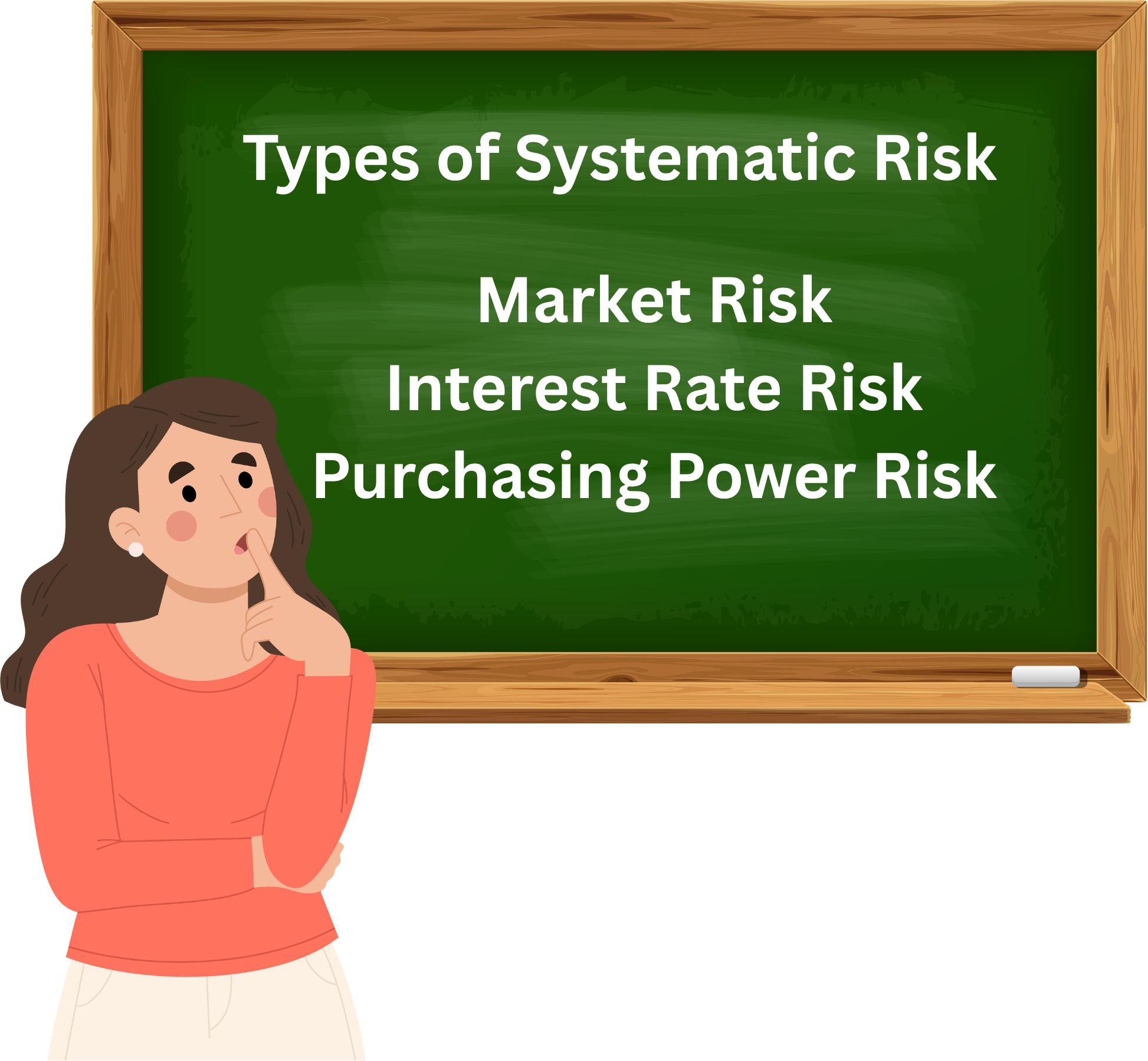
Systematic risks are those broad, economy-wide forces that affect nearly all securities in the market. They cannot be eliminated through diversification, though investors may attempt to manage their exposure. Let’s explore the major types with updated examples.
Market Risk
Market risk refers to the fluctuations in security returns caused by overall movements in the financial markets. These swings are often triggered by large-scale events—both tangible (real-world developments) and intangible (investor sentiment or expectations).
- Tangible events: The global pandemic in 2020 caused widespread panic selling, leading to sharp declines across stock exchanges worldwide. Similarly, the Russia–Ukraine war disrupted energy supplies, pushing markets into volatility.
- Intangible events: Investor psychology plays a huge role. For example, when AI stocks surged in 2023 due to optimism about generative AI, valuations rose sharply—even beyond fundamentals—driven by confidence rather than hard data.
Investors tend to react more strongly to losses than to gains. A sudden drop in indices like the S&P 500 or NIFTY often sparks panic selling, while upward movements generate optimism but less intense reactions. Diversification can soften the blow, but since all stocks move broadly together, market risk cannot be eliminated.
Interest Rate Risk
Interest rate risk arises when changes in interest rates affect the value of securities. Bond prices, in particular, move inversely to interest rates: when rates rise, bond prices fall, and vice versa.
- Bond markets: In 2022, as the U.S. Federal Reserve aggressively raised rates to combat inflation, long-term Treasury bond prices dropped significantly, hurting bondholders.
- Corporate impact: Higher borrowing costs reduce profitability for companies reliant on debt financing. For instance, real estate developers in India faced challenges when RBI raised repo rates, as housing loans became more expensive and demand slowed.
- Investor strategies: Conservative investors often prefer government securities during high-rate periods, as they provide stability and tax benefits. Speculators, however, may hedge by shifting into financial institution stocks, which benefit from higher lending margins.
While investors can attempt to manage exposure by timing purchases or choosing securities less sensitive to rate changes, interest rate risk remains a persistent challenge.
Purchasing Power Risk
Also known as inflation risk, this arises when rising prices erode the real value of investment returns. Even if nominal returns look attractive, inflation can reduce their actual purchasing power.
- Inflationary pressures: In India, food and fuel inflation in 2023–24 significantly raised household expenses, reducing disposable income and affecting demand for consumer goods.
- Example: Suppose an investor earns a 7% return on a fixed deposit, but inflation runs at 6%. The real return is only 1%, meaning the investor’s purchasing power barely grows.
- Deflationary scenario: Though less common, deflation can also pose risks. For example, Japan’s prolonged deflationary period reduced corporate earnings and discouraged investment.
Investors must always adjust expected returns for inflation. Tools like the Consumer Price Index (CPI) or Wholesale Price Index (WPI) help estimate the erosion of value. For instance, if CPI rises from 100 to 110 in a year, inflation is 10%. A bond yielding 8% would effectively deliver a negative real return of –2%.
2.4 Types of Un Systematic Risk
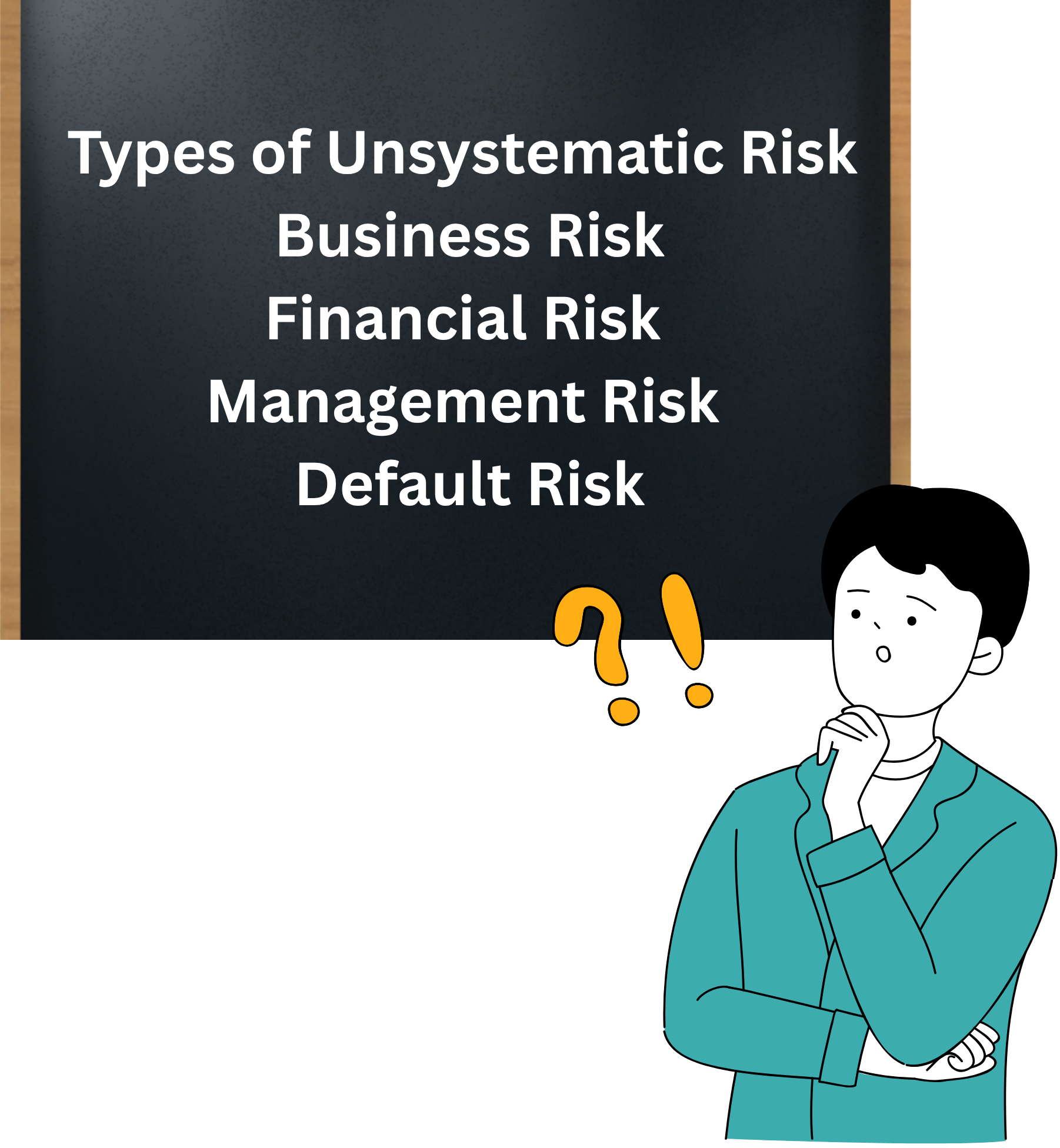
A. Business Risk
Business risk in India reflects the uncertainty in achieving expected operating profits due to both internal and external factors.
- Internal Business Risk: Companies with high fixed costs face greater vulnerability. For example, Air India before privatization struggled with heavy fixed expenses like aircraft maintenance and employee salaries. Even when passenger demand rose, the burden of fixed costs limited flexibility. Similarly, textile firms in Tiruppur often face risks when raw material costs rise, as their margins are thin and fixed overheads remain high.
- External Business Risk:
- Business cycles: The automobile industry in India is highly cyclical. During economic slowdowns (like 2019–20), car sales dropped sharply, while in boom years demand surged.
- Demographics: The rise of India’s young population boosted demand for smartphones, benefiting companies like Reliance Jio and Xiaomi India, but also created risks for traditional landline service providers.
- Political policies: Sudden bans, such as the 2016 demonetization, disrupted retail and real estate sectors, showing how government decisions can alter industry fortunes overnight.
- Monetary policy: RBI’s repo rate hikes in 2022–23 made loans costlier, slowing housing demand and hurting developers like DLFand Godrej Properties.
Firms reduce business risk by diversifying product lines. For instance, ITC Limited offsets declines in cigarette sales with growth in FMCG and packaged foods.
B. Financial Risk
Financial risk arises from how a company structures its debt and equity. Excessive borrowing magnifies earnings volatility.
- Example – Infrastructure Sector: Companies like IL&FS collapsed in 2018 due to unsustainable debt levels, triggering panic in debt markets.
- Telecom Industry: Vodafone Idea faces high financial risk because of massive debt and AGR (Adjusted Gross Revenue) dues. Its earnings are unstable, and debt servicing remains a challenge.
- Real Estate Developers: Many developers in India rely heavily on debt financing. When sales slow, interest obligations strain cash flows, increasing default probability.
Moderate debt can be beneficial, as seen in HDFC Bank, which uses leverage prudently to expand lending while maintaining strong profitability. But excessive debt, especially in cyclical industries, raises the risk of financial instability.
C. Management Risk
Management risk stems from poor decisions, weak governance, or conflicts between owners and managers.
- Satyam Computers (2009): The accounting scandal revealed how mismanagement and fraudulent practices destroyed shareholder wealth.
- Yes Bank (2020): Aggressive lending decisions under previous leadership led to rising NPAs, forcing RBI intervention.
- Reliance Industries: On the positive side, strong leadership under Mukesh Ambani minimized management risk by aligning executive decisions with shareholder interests, especially through diversification into telecom and retail.
Investors often prefer companies where promoters hold significant stakes, as this ensures management decisions are aligned with shareholder value creation.
D. Default Risk
Default risk reflects the possibility that a company may fail to meet its debt obligations.
- IL&FS Crisis (2018): The infrastructure giant defaulted on debt repayments, shaking investor confidence and triggering liquidity issues across NBFCs.
- DHFL (2019): The housing finance company defaulted on bond payments, leading to a collapse in its stock and bond prices.
- Kingfisher Airlines (2012): Mounting debt and operational losses led to defaults, eventually grounding the airline.
- Punjab & Maharashtra Co-operative Bank (PMC Bank, 2019): Misreporting of loans to HDIL led to defaults, eroding depositor trust.
In India, defaults often occur before formal bankruptcy filings. Prices of securities fall sharply once investors suspect financial weakness, even before official announcements.