

3.1 Market Intermediaries -Definition

After hanging out with Vedant, Nirav couldn’t stop thinking about everything he’d just learned about the securities market. It just stuck in his brain—one of those things that won’t leave you alone. Vedant had promised to explain market intermediaries next time, but Nirav couldn’t wait. He fired off a message, itching to dive in.
Vedant replied right away. The very next day, they met again.
Nirav: Vedant, glad you could make it! Last time you really opened my eyes. I want to go deeper. We talked about securities, how the market runs, who regulates all this, and we just started on intermediaries. Can we dig into that?
Vedant: Absolutely, Nirav. I love when someone is genuinely interested. So, let us break down what market intermediaries actually do.
What exactly are market intermediaries?
Imagine market intermediaries as your guides through the financial jungle—brokers, advisors, custodians, and a few others. These are the people (or companies) who keep checking everything along: matching buyers with sellers, protecting assets, reducing risks, managing records, and making sure nobody is breaking rules.
It’s not lawless, either. Regulators are everywhere. In India, SEBI keeps a tight grip on brokers, exchanges, mutual funds, and depositories. The RBI looks after banks, making sure credit is fair and loans go where they’re supposed to.
So, intermediaries aren’t just middlemen who takes your commissions. They’re necessary to make the market work—moving money, sharing information, and standing by investors.
Nirav: So who are we actually talking about? You mentioned banks, investment banks, insurance companies, mutual funds, AMCs, venture capital, stock exchanges, microfinance… Can you explain me all these? Or is there more?
Vedant: Now you’re asking the good stuff. Let us understand this.
Nirav: This is way bigger than I had thought.
Vedant: Definitely. So here’s how it all comes together.
3.2 Who are Market Intermediaries and What are Stock Exchanges

Let us tell a story, just to keep it real:
- Ravi – He is the Farmer
- Ramesh – He is the Broker
- Brew & Bean – This is a Coffee Chain
- Amit –He is aRich Investor
- Jack – He also is an Investor
- Neha – She also is an Investor
- GreenTech – It is a Company
- Stock Exchanges
Earlier in Venice somewhere in 1300s, merchants used to trade debts. By 1531, Antwerp already had a full-on exchange for government debts. But the real action kicked off in the 1600s when Dutch and British East India Companies started selling shares to the public. That is how equity markets began. Over centuries, paper trades have turned into fast, massive online platforms.
Why are stock exchanges at the center of everything?
Say Jack wants to sell his Tata Motors shares and Neha wants to buy some. Without an exchange, how would they even find each other, or trust the deal? Messy, risky, and honestly, a nightmare. But the NSE or BSE lets them put in their buy or sell orders, matches them up, and enforces rules so no one gets scammed. Trades happen almost instantly. Exchanges make things transparent and fair.
What do they actually do day-to-day?
- Buyers and sellers always know they will find each other—liquidity.
- Prices are real-time. You know exactly where things stand.
- Companies can create and sell shares to raise money.
- Exchanges monitor the market for fairness.
- Main stock market indices give a quick pulse on the entire economy.
And in India?
Going back to 1800s: Under a banyan tree in Mumbai, traders would meet and swap shares. That spot eventually became the Bombay Stock Exchange—the oldest in Asia, founded in 1875. NSE came in 1992, bringing modern, online trading. These two BSE and NSE are still the market makers, but there are others too.
Here’s the main list:
- Bombay Stock Exchange (BSE) : It was established in the year 1875.
- National Stock Exchange (NSE): Launched in 1992, it changed the face of electronic trading.
- Multi Commodity Exchange (MCX) :Here you can trade in commodities like energy and metals.
- National Commodity & Derivatives Exchange (NCDEX): Agriculture oriented.
- Metropolitan Stock Exchange of India (MSEI) – for shares, derivatives and currency.Now, on to brokers
3.3 Brokers

Ravi is a farmer. He needs help selling his crops in the city, so he goes to Ramesh, his broker. Ramesh’s job is simple: find buyers and get Ravi the best deal. Stock brokers do this for investors-connecting buyers and sellers and making trades happen.Brokers aren’t just in stocks, you see them in insurance, real estate, and pretty much anywhere assets change hands. The good ones do more than execute trades. They give you tips, research, real advice, and help manage your investments. Some are solo operators, others run big companies.
So, what do brokers actually do?
- Buy and sell on behalf of clients, chasing the best deal.
- Watch the market, pass on the important.
- Assist you in building and rebalancing your portfolio.
- Follow regulations and have your back.
- Many offer margin trading
Brokers are the market’s connectors. They keep things moving and honest, and they are pretty much the reason most people can get into the market at all.
3.4 Investment Bankers

Now, think about Brew & Bean—a coffee chain with big plans. They want to go global, but that takes cash—big cash. Now think about Investment Bankers. These guys raise money , help with big takeovers, and handle stuff that regular banks just don’t deal with.
The big names here?
Goldman Sachs, JP Morgan, Morgan Stanley—these firms are everywhere.
What do investment bankers actually do?
- Raise big money for companies and governments – in the form of shares or bonds.
- Working through difficult negotiations and all of the deal documentation in mergers and acquisitions.
- Underwrite stuff – make sure the new shares or bonds sell at the right price.
- Provide bold business plan advice.
- Act as market makers in times of turbulence buying and selling to add stability.
What is so important about investment banks?
They give money to everyone from small startups to large corporations.lThey know how to price and sell anything.lGovernments depend on them for things like infrastructure projects.lThey invent strategies to manage financial risk.Without them, the big moves—the IPOs, giant mergers, all of it, just wouldn’t happen.
A real-world example?
- When companies want to raise money, investment bankers set up the whole process.
- Behind every mega-merger, you’ll find investment bankers making the deal.
- Their underwriters make sure new shares and bonds actually bring in cash.
- Their advice shapes some of the biggest business strategies on the planet.
- And whenever markets get wild, theyare the ones who step in as market makers.
In India, investment bankers manage IPOs, push startup funding, and lead landmark deals (think Flipkart-Walmart), as well as big-ticket financing (like climate projects and fintech expansion).
3.5 Mutual Fund House

Now, look at Amit—he’s sitting on a pile of money. His custodian bank takes care of holding it and handling the details. For everyone else, mutual funds and Asset Management Companies (AMCs) are a lifesaver. They take small amounts from lots of people, pool all that money, and invest it in different places—stocks, bonds, or both. Whether you want high growth, steady returns, or a mix, there’s a fund out there for you.
So, what is the deal with mutual funds?
- Professional managers research, buy investments and keep an eye on the fund every day.l
- Shared money means we all share the risk.
- If you sell or buy your units, investing or withdrawing money is easy.l
- SEBI keeps the industry in check, making sure things run right and by the book.l
- There are regular reviews, so you know performance is always under the microscope.
Positive Aspects
- You don’t need a lot of money to get started or to diversify.l
- Expertise on your side, without having to lift a finger.l
- Options for just about any strategy or risk profile.
Take Jack, for example. He’s way too busy to track individual stocks. Instead, he invests in an equity fund for growth. The fund manager spreads his money across a bundle of companies. Later, he decides to play it safe and moves some cash into a debt fund. No spreadsheets required—his money’s working for him.
3.6. Clearing House

Ever wondered who actually makes sure a trade goes smoothly? That’s what clearing houses are for. When Jack sells the shares to Neha the clearing house makes sure that Neha gets the shares and Jack gets his money. If something goes wrong they step in and make it right.
What is the work of clearing-houses?
- They clear trades – making sure everybody gets what they signed up for.l
- Serve as a buffer between buyer and seller to protect both parties.l
- Collect “margin money” to limit risk if the deal gets shaky.l
- Bundle up trades to make everything work faster and smoother.l
- Keep perfect records.
Why do they matter?
Markets run smoother and with a lot less risk.lYou don’t have to worry about the other side backing out.lFast settlement ensures the flow of money and stocks.lThere is strong trust in the market.
3.7. Registrars & Transfer Agents

Suppose Jack buys mutual fund units online. He probably never thinks about who’s tracking his paperwork, but every mutual fund company has a registrar and transfer agent (RTA) on the job. They keep track of who owns what, send statements, pay dividends, handle redemptions—the unglamorous back-end stuff. If Jack ever has an issue, the RTA is his first call.
What do RTAs actually do?
- Keep clean records of all investors and transactions.
- Manage transfers, redemptions and admin hassles.
- Pay interest and dividends.
- Deal with investors’ queries and paperwork.
Ultimately, market intermediaries are the unsung heroes that keep the show going. They move money, facilitate buyers and sellers, simplify trading, manage risk and keep the market engine running smoothly – whether you are just starting out or you have already made it big.
3.8. Credit Rating Agencies

When GreenTech wants to expand and needs money, it turns to bonds. That’s when investors start wondering, “Will I really get my money back?” Enter the credit rating agency. They dig through GreenTech’s books, check the overall risk, and slap on a BBB rating. That’s basically “moderate risk”—not the worst, not perfect either. Some investors are cool with that and dive in. Others want a safer bet or a higher interest rate.
Credit rating agencies aren’t biased—they’re not on the side of companies or investors. Their job is to judge how likely it is that a borrower, whether it’s a company or a country, will actually pay back the money. They assign a rating, and the world takes notice. Those ratings help determine where the money goes, how much interest companies pay and help keep the financial markets steady.
What Credit Rating Agencies Do?
- They check creditworthiness– They review financial statements, look at how the company is doing and scan the big picture economy to see if repayment is realistic.
- Assign Ratings –You get those letter grades—AAA, AA, BBB, etc.—and each one spells out the level of risk.
- Make Things Clear – Investors don’t have to guess; the rating shows, right away, if something’s risky or safe.
- Regulatory Needs – These ratings are used by large financial institutions and governments to formulate rules and monitor the market.
- Affect Borrowing Costs– Better ratings mean cheaper loans. Higher risk? Prepare for higher interest payments.Why Credit Ratings Matter
- It gives investors a sense of security – It’s a common scale for risk so everyone knows what they are dealing with
- Help money flow: –A good rating helps a company or government get money. Spot trouble early: Risky ratings by a company give warning signs to help avoid major messes.lFoster growth : Good ratings help to grow the business and attract investment.
The Big Three Worldwide
1.Standard & Poor’s (S&P): This is the most well-known rating system.
2. Moody’s Investors Service: Specializes in Companies and Governments
3. Fitch Ratings:E specially active with banks and structured finance.
India’s Key Players
CRISIL, ICRA, CARE Ratings, and India Ratings & Research lead the way.
How Ratings Break Down
There are really two camps: investment grade (safer) and speculative or ‘junk’ grade (riskier).
Investment Grade (Lower risk)
– AAA: Top notch. Your money’s safe.
– AA+ / AA / AA-: Still rock solid.
– A+ / A / A-: Good but could be improved.
Speculative Grade (Higher risk)
– BBB+ / BBB / BBB-: Decent. Not the best, but fine.
– BB+ / BB / BB-: Now you’re taking chances.
– B+ / B / B-: Pretty risky.
– CCC / CC / C: Red flags everywhere.
– D: Already defaulted or basically collapsed.The plus or minus just tweaks the exact spot within each range.
BB+ is a bit better than BB, but not as good as BBB-.
3.9. Depositories
What’s a Depository?
Think of a depository like a digital vault for your stocks and bonds. If Jack wants to invest, he sets up a Demat account through a Depository Participant—basically an agent. His stocks are stored safely online. No lost paper certificates, no panic. Dividends appear automatically, trades go through smoothly, and it’s all hassle-free.In India, there are two big ones:
National Securities Depository Limited (NSDL) – Started in 1996, it brought in electronic trading.
Central Depository Services India Limited (CDSL) – Kicked off in 1999, keeps things secure and easy to use.
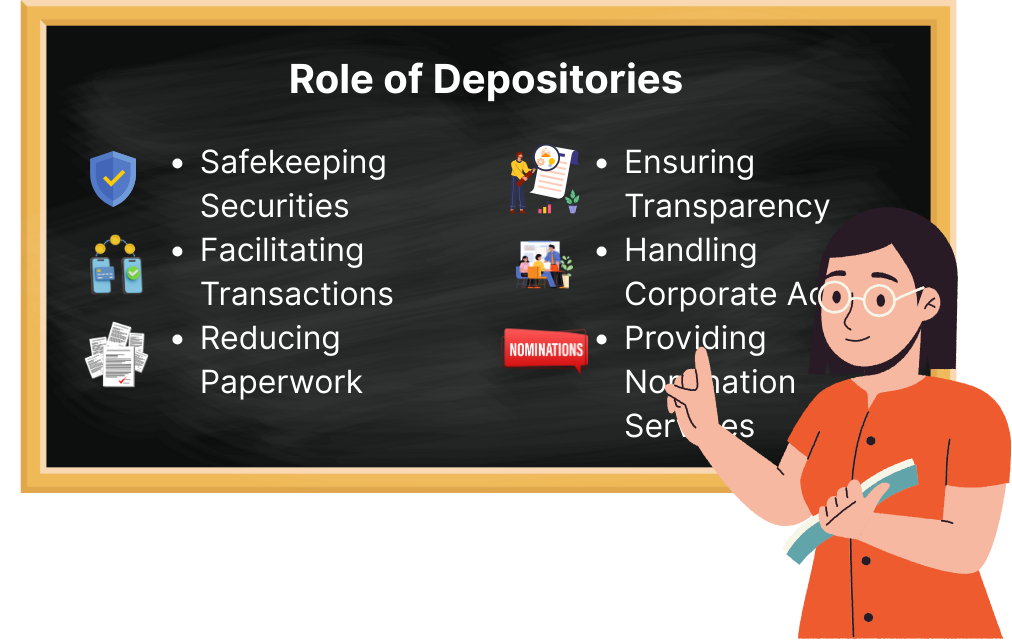
What Depositories Actually Do?
- Keep your investments safe—no more lost or stolen certificates, since it’s all digital.
- Trading Simplified – Buy & sell in your Demat account, let the depository do the hard work.
- Cut down the paperwork—everything’s electronic.
- Keep records clean – clean records beat fraud or ownership battles.
- Corporate actions – things like dividends or share splits are handled for you.
- Allow nominations—so you can name a beneficiary and make inheritance smoother.Why Depositories Matter
- More liquidity—fast transfer means a lively market.l
- Lower settlement risk – Digital transfers reduce errors and delays. l
- Confidence booster – Investing is less scary when you know your assets are safe. 10. Market expansion – Easy, safe investing means more people will invest.
Regulatory Framework
India has a tight grip on stock market rules. SEBI (Securities and Exchange Board of India), created by the SEBI Act of 1992 is the apex regulator. SEBI sets the rules for brokers, funds, advisors and companies and then checks up on them through audits and disclosures. SEBI works with heavyweights such as the RBI, Ministry of Finance and IBBI. Its rules cover everything: how companies share info (LODR), and chasing down insider trading (PIT). The whole system adapts as the market changes.Investor Protection
SEBI puts a big focus on keeping investors safe. Companies have to be upfront about risks. SEBI runs SCORES for complaints and pushes out investor education. There’s the Investor Protection Fund (IPF) and the Investor Education and Protection Fund (IEPF) if your broker goes bust or you need a crash-course in finance.Strict KYC rules make sure everything’s traceable—especially important in the fast-paced, digital trading world.How Regulations Shape Trading
Regulations set the pace in Indian trading.What is the change from T+2 to T+1? Moving to T+1 settlement has improved liquidity and reduced risk. Circuit filters stop stocks from swinging wildly. Algorithmic trading has audit trails to stop cheating. SEBI isn’t shy about moving quickly—like when it temporarily banned short-selling during the 2020 pandemic panic.There is always the argument that too many rules slow down innovation, especially in fintech and new types of trading. But it’s a tug-of-war between safety and letting new ideas thrive.
Fighting Fraud
SEBI keeps an eye out for scams—insider trading, price rigging, misuse of client accounts, you name it. Going digital, requiring IPOs through UPI, and using the IMSS surveillance system all help block shady activity. SEBI can freeze assets, ban people, and hand out tough penalties. It’s also made IPO rules much stricter to stop companies and bankers from misleading investors.
3.10 Historical Market Scams & Lessons

India’s markets have had some wake-up calls. The Harshad Mehta scam (1992) showed up cracks between banks and stock markets, leading to NSE’s launch and giving SEBI more powers. Ketan Parekh’s 2001 scandal exposed price rigging and led to tighter control. The NSEL blowup in 2013 revealed the danger of weak oversight, and the Karvy mess in 2019 forced stricter rules around managing client money and shares. Every time, regulators learned and became much more proactive. If you are investing, always stay alert, learn the basics, and don’t hesitate to ask experts for help.
So now you’ve seen the lay of the land—who’s who, how things run, and why it all works this way.
Want to dig into market segments? No problem. We will study primary markets next time. Let us understand Key Takeaways from this chapter.
3.11 Key Takeaways
- Market intermediaries are the link between buyers and sellers and help facilitate smooth and secure trades.They keep things moving – price discovery, investor protection and transparency all depend on brokers, exchanges and banks.
- Stock exchanges such as NSE and BSE are the heartbeat where transactions are conducted and all is transparent.
- Brokers make it easier to invest – they trade, advise and guide investors through the rules.lInvestment banks support company growth—fundraising, deal-making, and growth backing.
- AMCs pool money, build portfolios and help small investors access expert advice, democratizing investing.l Custodians and clearing houses hold assets safely and help to make sure that trades settle smoothly.
- Depositories like NSDL and CDSL digitised the markets, making everything faster, safer and out of fraudsters’ reach.l Credit rating agencies like CRISIL assess debt risk, rate debt and influence investment decisions and borrowing costs.
- India has become proactive with programs like SCORES, KYC and T+1 settlement, as regulators like SEBI work for the people by setting the rules, protecting investors and keeping the market fair and steady.
3.1 Market Intermediaries -Definition
After hanging out with Vedant, Nirav couldn’t stop thinking about everything he’d just learned about the securities market. It just stuck in his brain—one of those things that won’t leave you alone. Vedant had promised to explain market intermediaries next time, but Nirav couldn’t wait. He fired off a message, itching to dive in.
Vedant replied right away. The very next day, they met again.
Nirav: Vedant, glad you could make it! Last time you really opened my eyes. I want to go deeper. We talked about securities, how the market runs, who regulates all this, and we just started on intermediaries. Can we dig into that?
Vedant: Absolutely, Nirav. I love when someone is genuinely interested. So, let us break down what market intermediaries actually do.
What exactly are market intermediaries?
Imagine market intermediaries as your guides through the financial jungle—brokers, advisors, custodians, and a few others. These are the people (or companies) who keep checking everything along: matching buyers with sellers, protecting assets, reducing risks, managing records, and making sure nobody is breaking rules.
It’s not lawless, either. Regulators are everywhere. In India, SEBI keeps a tight grip on brokers, exchanges, mutual funds, and depositories. The RBI looks after banks, making sure credit is fair and loans go where they’re supposed to.
So, intermediaries aren’t just middlemen who takes your commissions. They’re necessary to make the market work—moving money, sharing information, and standing by investors.
Nirav: So who are we actually talking about? You mentioned banks, investment banks, insurance companies, mutual funds, AMCs, venture capital, stock exchanges, microfinance… Can you explain me all these? Or is there more?
Vedant: Now you’re asking the good stuff. Let us understand this.
Nirav: This is way bigger than I had thought.
Vedant: Definitely. So here’s how it all comes together.
3.2 Who are Market Intermediaries and What are Stock Exchanges
Let us tell a story, just to keep it real:
- Ravi – He is the Farmer
- Ramesh – He is the Broker
- Brew & Bean – This is a Coffee Chain
- Amit –He is aRich Investor
- Jack – He also is an Investor
- Neha – She also is an Investor
- GreenTech – It is a Company
- Stock Exchanges
Earlier in Venice somewhere in 1300s, merchants used to trade debts. By 1531, Antwerp already had a full-on exchange for government debts. But the real action kicked off in the 1600s when Dutch and British East India Companies started selling shares to the public. That is how equity markets began. Over centuries, paper trades have turned into fast, massive online platforms.
Why are stock exchanges at the center of everything?
Say Jack wants to sell his Tata Motors shares and Neha wants to buy some. Without an exchange, how would they even find each other, or trust the deal? Messy, risky, and honestly, a nightmare. But the NSE or BSE lets them put in their buy or sell orders, matches them up, and enforces rules so no one gets scammed. Trades happen almost instantly. Exchanges make things transparent and fair.
What do they actually do day-to-day?
- Buyers and sellers always know they will find each other—liquidity.
- Prices are real-time. You know exactly where things stand.
- Companies can create and sell shares to raise money.
- Exchanges monitor the market for fairness.
- Main stock market indices give a quick pulse on the entire economy.
And in India?
Going back to 1800s: Under a banyan tree in Mumbai, traders would meet and swap shares. That spot eventually became the Bombay Stock Exchange—the oldest in Asia, founded in 1875. NSE came in 1992, bringing modern, online trading. These two BSE and NSE are still the market makers, but there are others too.
Here’s the main list:
- Bombay Stock Exchange (BSE) : It was established in the year 1875.
- National Stock Exchange (NSE): Launched in 1992, it changed the face of electronic trading.
- Multi Commodity Exchange (MCX) :Here you can trade in commodities like energy and metals.
- National Commodity & Derivatives Exchange (NCDEX): Agriculture oriented.
- Metropolitan Stock Exchange of India (MSEI) – for shares, derivatives and currency.Now, on to brokers
3.3 Brokers
Ravi is a farmer. He needs help selling his crops in the city, so he goes to Ramesh, his broker. Ramesh’s job is simple: find buyers and get Ravi the best deal. Stock brokers do this for investors-connecting buyers and sellers and making trades happen.Brokers aren’t just in stocks, you see them in insurance, real estate, and pretty much anywhere assets change hands. The good ones do more than execute trades. They give you tips, research, real advice, and help manage your investments. Some are solo operators, others run big companies.
So, what do brokers actually do?
- Buy and sell on behalf of clients, chasing the best deal.
- Watch the market, pass on the important.
- Assist you in building and rebalancing your portfolio.
- Follow regulations and have your back.
- Many offer margin trading
Brokers are the market’s connectors. They keep things moving and honest, and they are pretty much the reason most people can get into the market at all.
3.4 Investment Bankers
Now, think about Brew & Bean—a coffee chain with big plans. They want to go global, but that takes cash—big cash. Now think about Investment Bankers. These guys raise money , help with big takeovers, and handle stuff that regular banks just don’t deal with.
The big names here?
Goldman Sachs, JP Morgan, Morgan Stanley—these firms are everywhere.
What do investment bankers actually do?
- Raise big money for companies and governments – in the form of shares or bonds.
- Working through difficult negotiations and all of the deal documentation in mergers and acquisitions.
- Underwrite stuff – make sure the new shares or bonds sell at the right price.
- Provide bold business plan advice.
- Act as market makers in times of turbulence buying and selling to add stability.
What is so important about investment banks?
They give money to everyone from small startups to large corporations.lThey know how to price and sell anything.lGovernments depend on them for things like infrastructure projects.lThey invent strategies to manage financial risk.Without them, the big moves—the IPOs, giant mergers, all of it, just wouldn’t happen.
A real-world example?
- When companies want to raise money, investment bankers set up the whole process.
- Behind every mega-merger, you’ll find investment bankers making the deal.
- Their underwriters make sure new shares and bonds actually bring in cash.
- Their advice shapes some of the biggest business strategies on the planet.
- And whenever markets get wild, theyare the ones who step in as market makers.
In India, investment bankers manage IPOs, push startup funding, and lead landmark deals (think Flipkart-Walmart), as well as big-ticket financing (like climate projects and fintech expansion).
3.5 Mutual Fund House
Now, look at Amit—he’s sitting on a pile of money. His custodian bank takes care of holding it and handling the details. For everyone else, mutual funds and Asset Management Companies (AMCs) are a lifesaver. They take small amounts from lots of people, pool all that money, and invest it in different places—stocks, bonds, or both. Whether you want high growth, steady returns, or a mix, there’s a fund out there for you.
So, what is the deal with mutual funds?
- Professional managers research, buy investments and keep an eye on the fund every day.l
- Shared money means we all share the risk.
- If you sell or buy your units, investing or withdrawing money is easy.l
- SEBI keeps the industry in check, making sure things run right and by the book.l
- There are regular reviews, so you know performance is always under the microscope.
Positive Aspects
- You don’t need a lot of money to get started or to diversify.l
- Expertise on your side, without having to lift a finger.l
- Options for just about any strategy or risk profile.
Take Jack, for example. He’s way too busy to track individual stocks. Instead, he invests in an equity fund for growth. The fund manager spreads his money across a bundle of companies. Later, he decides to play it safe and moves some cash into a debt fund. No spreadsheets required—his money’s working for him.
3.6. Clearing House
Ever wondered who actually makes sure a trade goes smoothly? That’s what clearing houses are for. When Jack sells the shares to Neha the clearing house makes sure that Neha gets the shares and Jack gets his money. If something goes wrong they step in and make it right.
What is the work of clearing-houses?
- They clear trades – making sure everybody gets what they signed up for.l
- Serve as a buffer between buyer and seller to protect both parties.l
- Collect “margin money” to limit risk if the deal gets shaky.l
- Bundle up trades to make everything work faster and smoother.l
- Keep perfect records.
Why do they matter?
Markets run smoother and with a lot less risk.lYou don’t have to worry about the other side backing out.lFast settlement ensures the flow of money and stocks.lThere is strong trust in the market.
3.7. Registrars & Transfer Agents
Suppose Jack buys mutual fund units online. He probably never thinks about who’s tracking his paperwork, but every mutual fund company has a registrar and transfer agent (RTA) on the job. They keep track of who owns what, send statements, pay dividends, handle redemptions—the unglamorous back-end stuff. If Jack ever has an issue, the RTA is his first call.
What do RTAs actually do?
- Keep clean records of all investors and transactions.
- Manage transfers, redemptions and admin hassles.
- Pay interest and dividends.
- Deal with investors’ queries and paperwork.
Ultimately, market intermediaries are the unsung heroes that keep the show going. They move money, facilitate buyers and sellers, simplify trading, manage risk and keep the market engine running smoothly – whether you are just starting out or you have already made it big.
3.8. Credit Rating Agencies
When GreenTech wants to expand and needs money, it turns to bonds. That’s when investors start wondering, “Will I really get my money back?” Enter the credit rating agency. They dig through GreenTech’s books, check the overall risk, and slap on a BBB rating. That’s basically “moderate risk”—not the worst, not perfect either. Some investors are cool with that and dive in. Others want a safer bet or a higher interest rate.
Credit rating agencies aren’t biased—they’re not on the side of companies or investors. Their job is to judge how likely it is that a borrower, whether it’s a company or a country, will actually pay back the money. They assign a rating, and the world takes notice. Those ratings help determine where the money goes, how much interest companies pay and help keep the financial markets steady.
What Credit Rating Agencies Do?
- They check creditworthiness– They review financial statements, look at how the company is doing and scan the big picture economy to see if repayment is realistic.
- Assign Ratings –You get those letter grades—AAA, AA, BBB, etc.—and each one spells out the level of risk.
- Make Things Clear – Investors don’t have to guess; the rating shows, right away, if something’s risky or safe.
- Regulatory Needs – These ratings are used by large financial institutions and governments to formulate rules and monitor the market.
- Affect Borrowing Costs– Better ratings mean cheaper loans. Higher risk? Prepare for higher interest payments.Why Credit Ratings Matter
- It gives investors a sense of security – It’s a common scale for risk so everyone knows what they are dealing with
- Help money flow: –A good rating helps a company or government get money. Spot trouble early: Risky ratings by a company give warning signs to help avoid major messes.lFoster growth : Good ratings help to grow the business and attract investment.
The Big Three Worldwide
1.Standard & Poor’s (S&P): This is the most well-known rating system.
2. Moody’s Investors Service: Specializes in Companies and Governments
3. Fitch Ratings:E specially active with banks and structured finance.
India’s Key Players
CRISIL, ICRA, CARE Ratings, and India Ratings & Research lead the way.
How Ratings Break Down
There are really two camps: investment grade (safer) and speculative or ‘junk’ grade (riskier).
Investment Grade (Lower risk)
– AAA: Top notch. Your money’s safe.
– AA+ / AA / AA-: Still rock solid.
– A+ / A / A-: Good but could be improved.
Speculative Grade (Higher risk)
– BBB+ / BBB / BBB-: Decent. Not the best, but fine.
– BB+ / BB / BB-: Now you’re taking chances.
– B+ / B / B-: Pretty risky.
– CCC / CC / C: Red flags everywhere.
– D: Already defaulted or basically collapsed.The plus or minus just tweaks the exact spot within each range.
BB+ is a bit better than BB, but not as good as BBB-.
3.9. Depositories
What’s a Depository?
Think of a depository like a digital vault for your stocks and bonds. If Jack wants to invest, he sets up a Demat account through a Depository Participant—basically an agent. His stocks are stored safely online. No lost paper certificates, no panic. Dividends appear automatically, trades go through smoothly, and it’s all hassle-free.In India, there are two big ones:
National Securities Depository Limited (NSDL) – Started in 1996, it brought in electronic trading.
Central Depository Services India Limited (CDSL) – Kicked off in 1999, keeps things secure and easy to use.
What Depositories Actually Do?
- Keep your investments safe—no more lost or stolen certificates, since it’s all digital.
- Trading Simplified – Buy & sell in your Demat account, let the depository do the hard work.
- Cut down the paperwork—everything’s electronic.
- Keep records clean – clean records beat fraud or ownership battles.
- Corporate actions – things like dividends or share splits are handled for you.
- Allow nominations—so you can name a beneficiary and make inheritance smoother.Why Depositories Matter
- More liquidity—fast transfer means a lively market.l
- Lower settlement risk – Digital transfers reduce errors and delays. l
- Confidence booster – Investing is less scary when you know your assets are safe. 10. Market expansion – Easy, safe investing means more people will invest.
Regulatory Framework
India has a tight grip on stock market rules. SEBI (Securities and Exchange Board of India), created by the SEBI Act of 1992 is the apex regulator. SEBI sets the rules for brokers, funds, advisors and companies and then checks up on them through audits and disclosures. SEBI works with heavyweights such as the RBI, Ministry of Finance and IBBI. Its rules cover everything: how companies share info (LODR), and chasing down insider trading (PIT). The whole system adapts as the market changes.Investor Protection
SEBI puts a big focus on keeping investors safe. Companies have to be upfront about risks. SEBI runs SCORES for complaints and pushes out investor education. There’s the Investor Protection Fund (IPF) and the Investor Education and Protection Fund (IEPF) if your broker goes bust or you need a crash-course in finance.Strict KYC rules make sure everything’s traceable—especially important in the fast-paced, digital trading world.How Regulations Shape Trading
Regulations set the pace in Indian trading.What is the change from T+2 to T+1? Moving to T+1 settlement has improved liquidity and reduced risk. Circuit filters stop stocks from swinging wildly. Algorithmic trading has audit trails to stop cheating. SEBI isn’t shy about moving quickly—like when it temporarily banned short-selling during the 2020 pandemic panic.There is always the argument that too many rules slow down innovation, especially in fintech and new types of trading. But it’s a tug-of-war between safety and letting new ideas thrive.
Fighting Fraud
SEBI keeps an eye out for scams—insider trading, price rigging, misuse of client accounts, you name it. Going digital, requiring IPOs through UPI, and using the IMSS surveillance system all help block shady activity. SEBI can freeze assets, ban people, and hand out tough penalties. It’s also made IPO rules much stricter to stop companies and bankers from misleading investors.
3.10 Historical Market Scams & Lessons
India’s markets have had some wake-up calls. The Harshad Mehta scam (1992) showed up cracks between banks and stock markets, leading to NSE’s launch and giving SEBI more powers. Ketan Parekh’s 2001 scandal exposed price rigging and led to tighter control. The NSEL blowup in 2013 revealed the danger of weak oversight, and the Karvy mess in 2019 forced stricter rules around managing client money and shares. Every time, regulators learned and became much more proactive. If you are investing, always stay alert, learn the basics, and don’t hesitate to ask experts for help.
So now you’ve seen the lay of the land—who’s who, how things run, and why it all works this way.
Want to dig into market segments? No problem. We will study primary markets next time. Let us understand Key Takeaways from this chapter.
3.11 Key Takeaways
- Market intermediaries are the link between buyers and sellers and help facilitate smooth and secure trades.They keep things moving – price discovery, investor protection and transparency all depend on brokers, exchanges and banks.
- Stock exchanges such as NSE and BSE are the heartbeat where transactions are conducted and all is transparent.
- Brokers make it easier to invest – they trade, advise and guide investors through the rules.lInvestment banks support company growth—fundraising, deal-making, and growth backing.
- AMCs pool money, build portfolios and help small investors access expert advice, democratizing investing.l Custodians and clearing houses hold assets safely and help to make sure that trades settle smoothly.
- Depositories like NSDL and CDSL digitised the markets, making everything faster, safer and out of fraudsters’ reach.l Credit rating agencies like CRISIL assess debt risk, rate debt and influence investment decisions and borrowing costs.
- India has become proactive with programs like SCORES, KYC and T+1 settlement, as regulators like SEBI work for the people by setting the rules, protecting investors and keeping the market fair and steady.