

11.1 What is the clearing and settlement process
Nirav: Vedant, I clicked “Buy” on a stock yesterday and saw it in my portfolio today. It felt instant. How does that work so fast?
Vedant: It feels instant, but there’s a whole system working behind the scenes. Every trade has to be cleared and settled.
Nirav: You mean paperwork?
Vedant: Not anymore! Today it’s all digital. India follows a T+1 settlement cycle, which means your trade is settled on the next working day. Clearing corporations and depositories make sure the money and shares move safely.
Nirav: So even though it looks quick on my app, there’s a well-managed process making sure I get my shares and the seller gets their money?
Vedant: Exactly. Think of it as a backstage crew. You don’t see them, but the show can’t run without them.
How clearing and settlement works
Think of ordering groceries online. You tap “Buy”, and it feels done. Behind the scenes, the store checks its stock, packs your order, and a delivery partner brings it to your door. It works because everyone in the chain does their job.
Buying shares works the same way, in two stages.
Clearing starts as soon as your trade is executed. The exchange sends the trade details to its clearing corporation: NSE Clearing Limited for NSE trades, or Indian Clearing Corporation Limited (ICCL) for BSE trades. The clearing corporation works out exactly what each broker owes, in shares and in money. It also steps in as the counterparty to both sides, becoming the buyer to every seller and the seller to every buyer. This means your trade is guaranteed to settle even if the other party defaults. To manage this risk, the clearing corporation collects margins from brokers and keeps a settlement guarantee fund.
Settlement is when shares and money actually change hands. On T+1, shares move through the depositories, NSDL and CDSL, which keep electronic records of who owns which shares, and are credited to the buyer’s demat account. Money moves through designated clearing banks to the seller. The system also uses netting: instead of settling every trade separately, it settles only each party’s net position, which cuts down the number of transfers and makes the process more efficient.
All of this happens automatically under SEBI’s supervision. It’s what allows millions of people to buy and sell shares every day with confidence. If clearing and settlement didn’t work reliably, people would stop trusting the market.
Nirav: I’ve heard people talk about “market structure”. What does that mean? Isn’t the market just people buying and selling shares?
Vedant: It’s more than that. The market is made up of several parts that work together to keep trading smooth and safe: the exchanges, brokers, clearing corporations, depositories, and SEBI as the regulator. Together, they form the market structure. Clearing and settlement is one of its most important parts, because it makes sure every share and every rupee ends up where it should.
11.2 What is Market Structure?
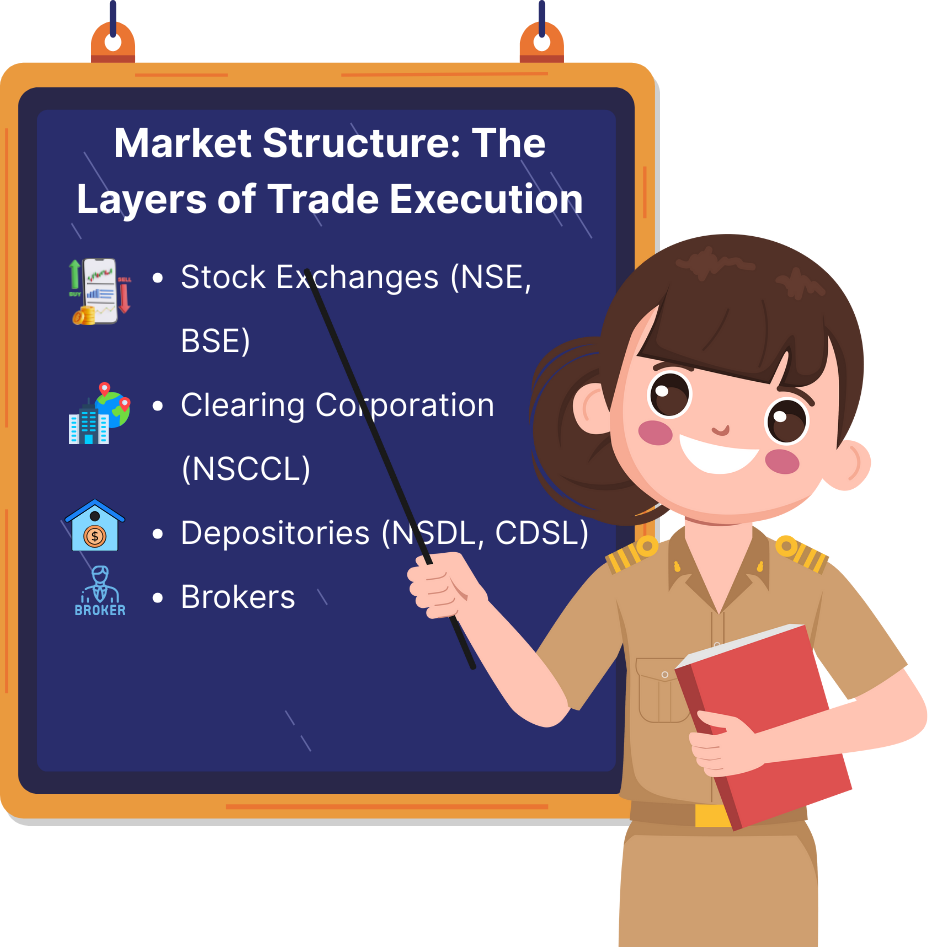
The stock market works like a team effort to make buying and selling smooth and safe. At the centre are stock exchanges like NSE and BSE, where buy and sell orders are placed and matched electronically. When a trade happens, a clearing corporation such as NSE Clearing Limited makes sure both the buyer and the seller meet their obligations. It acts as the central counterparty to both sides, guaranteeing that the trade will settle even if one party defaults. Depositories like NSDL and CDSL hold shares in electronic form and keep track of who owns what. Together, these parts make trading trustworthy, transparent, and efficient.
An example
Rohan wants to buy Infosys shares. He places an order through 5paisa, his broker, which sends it to NSE. The exchange finds a matching sell order and executes the trade. NSE Clearing Limited then steps in to guarantee that the deal goes through, even if one party fails to pay or deliver. On the next working day, the shares are credited to Rohan’s demat account with CDSL, showing that he now owns them. Each step, from broker to exchange to clearing corporation to depository, plays a part in completing the trade.
Nirav: Hey Vedant, when I tap “Buy” on my app, what really happens?
Vedant: It sets off a series of steps. Your broker sends the order to the exchange, where it’s matched with a sell order. Behind the scenes, the clearing corporation lines up the money and shares, and they’re exchanged on the next working day.
11.3 What Happens When You Buy a Stock?

When you buy a stock through your broker or trading app, your order is routed to the stock exchange. A trade happens when your buy order is matched with a sell order at a suitable price. But that’s only the beginning. The clearing corporation then guarantees that both sides meet their obligations by the next working day (T+1). On T+1, the depository, NSDL or CDSL, credits the shares directly to your demat account. The trade may look instant on your screen, but the backend process completes on the next working day.
Suppose Priya buys 100 shares of Reliance Industries at ₹1,220 per share, a total of ₹1,22,000. Her order is executed on the trade day, T. On T+1, the money is paid to the seller and the 100 shares are credited to her demat account. Priya now fully owns the shares, through a seamless digital transfer completed in just one working day.
Nirav: Selling feels just as easy. I tap “Sell” and the amount shows up soon after. What’s going on in the backend?
Vedant: When you sell, you first authorise the sale, and your shares are blocked in your demat account. The exchange then matches your order with a buyer, and the clearing process kicks in. On the next working day, your shares go out to the buyer and the money comes into your trading account. Every step is tightly tracked.
11.4 What Happens When You Sell a Stock?
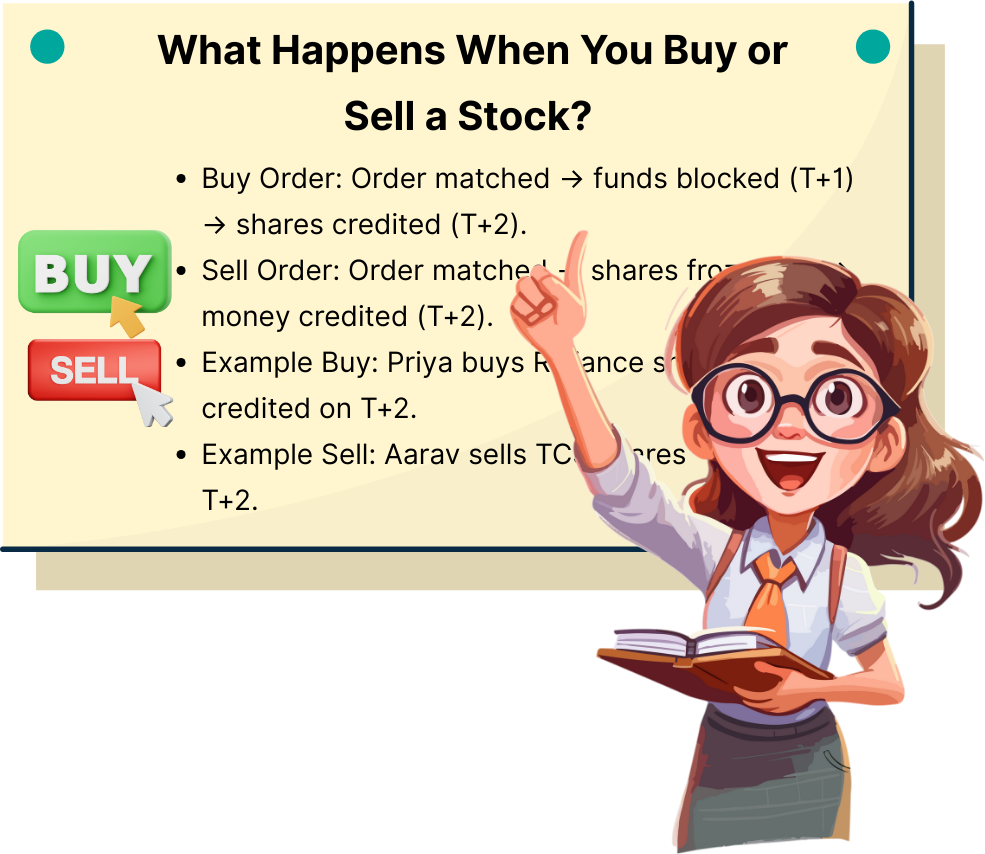
When you place a sell order, you first authorise the sale, and the shares you’re selling are blocked in your demat account so they can’t be used for anything else. Once your order is matched on the exchange, the clearing corporation makes sure the shares are delivered to the buyer and the money is paid to you. On T+1, the shares are debited from your demat account, and the sale proceeds, minus brokerage and other charges, are credited to your trading account. You can then withdraw the money to your bank account.
Suppose Aarav sells 50 shares of TCS at ₹2,300 per share, a total of ₹1,15,000. When he places the order, the 50 shares are blocked in his demat account. After the order is matched, NSE Clearing Limited (NCL) takes over settlement. On T+1, the shares are debited from Aarav’s demat account and delivered to the buyer, and about ₹1,15,000, less charges, is credited to his trading account. He can then transfer it to his bank account.
Nirav: Vedant, my app said “Shares earmarked for selling.” What does that even mean?
Vedant: It means those shares are blocked, or reserved, for your sell order. This stops you from selling or using them again while the trade is being settled. If your order doesn’t go through, the block is removed and the shares are free to use again.
11.5 What is Earmarking?

Earmarking refers to the setting aside of either cash or shares for a trade that has already been executed but not yet settled on T+1. For a seller, it locks the shares in your demat account so that they cannot be sold again or transferred elsewhere during the settlement window. It’s like putting a “SOLD” sign on something in the store—you own it still, but you can’t use it until the transaction lifecycle completes on T+1.
Nirav: Vedant I must say. I find it really interesting to know how trades are settled and how the system keeps everything balanced. It’s like there is a safety net that works behind every trade. I mean think about it every trade that happens it all gets settled properly. The system makes sure that everything is, in order.
Vedant: Exactly. Most traders don’t realize the effort that goes into making a simple “buy” or “sell” look effortless. Clearing, settlement, and market structure are the silent engines of trust.
Nirav: So now that the trade is done and settled, what’s next for a stockholder? Vedant: This is where corporate actions come in—dividends, bonus shares, splits, mergers. All these decisions made by companies directly affect stock prices and investor value.
Nirav: I’ve seen news flashes like “XYZ announces 1:2 bonus issue.” Does that mean I get extra shares?
Vedant: That’s right. These actions change the number of shares you hold or the value per share—but your overall investment stays balanced.
11.1 What is the clearing and settlement process
Nirav: Vedant, I clicked “Buy” on a stock yesterday and saw it in my portfolio today. It felt instant. How does that work so fast?
Vedant: It feels instant, but there’s a whole system working behind the scenes. Every trade has to be cleared and settled.
Nirav: You mean paperwork?
Vedant: Not anymore! Today it’s all digital. India follows a T+1 settlement cycle, which means your trade is settled on the next working day. Clearing corporations and depositories make sure the money and shares move safely.
Nirav: So even though it looks quick on my app, there’s a well-managed process making sure I get my shares and the seller gets their money?
Vedant: Exactly. Think of it as a backstage crew. You don’t see them, but the show can’t run without them.
How clearing and settlement works
Think of ordering groceries online. You tap “Buy”, and it feels done. Behind the scenes, the store checks its stock, packs your order, and a delivery partner brings it to your door. It works because everyone in the chain does their job.
Buying shares works the same way, in two stages.
Clearing starts as soon as your trade is executed. The exchange sends the trade details to its clearing corporation: NSE Clearing Limited for NSE trades, or Indian Clearing Corporation Limited (ICCL) for BSE trades. The clearing corporation works out exactly what each broker owes, in shares and in money. It also steps in as the counterparty to both sides, becoming the buyer to every seller and the seller to every buyer. This means your trade is guaranteed to settle even if the other party defaults. To manage this risk, the clearing corporation collects margins from brokers and keeps a settlement guarantee fund.
Settlement is when shares and money actually change hands. On T+1, shares move through the depositories, NSDL and CDSL, which keep electronic records of who owns which shares, and are credited to the buyer’s demat account. Money moves through designated clearing banks to the seller. The system also uses netting: instead of settling every trade separately, it settles only each party’s net position, which cuts down the number of transfers and makes the process more efficient.
All of this happens automatically under SEBI’s supervision. It’s what allows millions of people to buy and sell shares every day with confidence. If clearing and settlement didn’t work reliably, people would stop trusting the market.
Nirav: I’ve heard people talk about “market structure”. What does that mean? Isn’t the market just people buying and selling shares?
Vedant: It’s more than that. The market is made up of several parts that work together to keep trading smooth and safe: the exchanges, brokers, clearing corporations, depositories, and SEBI as the regulator. Together, they form the market structure. Clearing and settlement is one of its most important parts, because it makes sure every share and every rupee ends up where it should.
11.2 What is Market Structure?
The stock market works like a team effort to make buying and selling smooth and safe. At the centre are stock exchanges like NSE and BSE, where buy and sell orders are placed and matched electronically. When a trade happens, a clearing corporation such as NSE Clearing Limited makes sure both the buyer and the seller meet their obligations. It acts as the central counterparty to both sides, guaranteeing that the trade will settle even if one party defaults. Depositories like NSDL and CDSL hold shares in electronic form and keep track of who owns what. Together, these parts make trading trustworthy, transparent, and efficient.
An example
Rohan wants to buy Infosys shares. He places an order through 5paisa, his broker, which sends it to NSE. The exchange finds a matching sell order and executes the trade. NSE Clearing Limited then steps in to guarantee that the deal goes through, even if one party fails to pay or deliver. On the next working day, the shares are credited to Rohan’s demat account with CDSL, showing that he now owns them. Each step, from broker to exchange to clearing corporation to depository, plays a part in completing the trade.
Nirav: Hey Vedant, when I tap “Buy” on my app, what really happens?
Vedant: It sets off a series of steps. Your broker sends the order to the exchange, where it’s matched with a sell order. Behind the scenes, the clearing corporation lines up the money and shares, and they’re exchanged on the next working day.
11.3 What Happens When You Buy a Stock?
When you buy a stock through your broker or trading app, your order is routed to the stock exchange. A trade happens when your buy order is matched with a sell order at a suitable price. But that’s only the beginning. The clearing corporation then guarantees that both sides meet their obligations by the next working day (T+1). On T+1, the depository, NSDL or CDSL, credits the shares directly to your demat account. The trade may look instant on your screen, but the backend process completes on the next working day.
Suppose Priya buys 100 shares of Reliance Industries at ₹1,220 per share, a total of ₹1,22,000. Her order is executed on the trade day, T. On T+1, the money is paid to the seller and the 100 shares are credited to her demat account. Priya now fully owns the shares, through a seamless digital transfer completed in just one working day.
Nirav: Selling feels just as easy. I tap “Sell” and the amount shows up soon after. What’s going on in the backend?
Vedant: When you sell, you first authorise the sale, and your shares are blocked in your demat account. The exchange then matches your order with a buyer, and the clearing process kicks in. On the next working day, your shares go out to the buyer and the money comes into your trading account. Every step is tightly tracked.
11.4 What Happens When You Sell a Stock?
When you place a sell order, you first authorise the sale, and the shares you’re selling are blocked in your demat account so they can’t be used for anything else. Once your order is matched on the exchange, the clearing corporation makes sure the shares are delivered to the buyer and the money is paid to you. On T+1, the shares are debited from your demat account, and the sale proceeds, minus brokerage and other charges, are credited to your trading account. You can then withdraw the money to your bank account.
Suppose Aarav sells 50 shares of TCS at ₹2,300 per share, a total of ₹1,15,000. When he places the order, the 50 shares are blocked in his demat account. After the order is matched, NSE Clearing Limited (NCL) takes over settlement. On T+1, the shares are debited from Aarav’s demat account and delivered to the buyer, and about ₹1,15,000, less charges, is credited to his trading account. He can then transfer it to his bank account.
Nirav: Vedant, my app said “Shares earmarked for selling.” What does that even mean?
Vedant: It means those shares are blocked, or reserved, for your sell order. This stops you from selling or using them again while the trade is being settled. If your order doesn’t go through, the block is removed and the shares are free to use again.
11.5 What is Earmarking?
Earmarking refers to the setting aside of either cash or shares for a trade that has already been executed but not yet settled on T+1. For a seller, it locks the shares in your demat account so that they cannot be sold again or transferred elsewhere during the settlement window. It’s like putting a “SOLD” sign on something in the store—you own it still, but you can’t use it until the transaction lifecycle completes on T+1.
Nirav: Vedant I must say. I find it really interesting to know how trades are settled and how the system keeps everything balanced. It’s like there is a safety net that works behind every trade. I mean think about it every trade that happens it all gets settled properly. The system makes sure that everything is, in order.
Vedant: Exactly. Most traders don’t realize the effort that goes into making a simple “buy” or “sell” look effortless. Clearing, settlement, and market structure are the silent engines of trust.
Nirav: So now that the trade is done and settled, what’s next for a stockholder? Vedant: This is where corporate actions come in—dividends, bonus shares, splits, mergers. All these decisions made by companies directly affect stock prices and investor value.
Nirav: I’ve seen news flashes like “XYZ announces 1:2 bonus issue.” Does that mean I get extra shares?
Vedant: That’s right. These actions change the number of shares you hold or the value per share—but your overall investment stays balanced.