
1.1 What Is Investing & Why to Invest?
“Investing puts money to work. The only reason to save money is to invest it.” – Grant Cardone
Grant Cardone is a multi-millionaire entrepreneur, real-estate investor, motivational speaker, and writer. He said this because he thinks that investing can be extremely important to a person’s financial life. Money that is not invested tends to lose its value. Especially in the current changing economic environment where inflation rates are high, and the world economy is evolving in front of our eyes, making investments can be seen as almost a necessity. On the other hand, savings and investments are not mutually exclusive, and one should think of both when planning their financial future.
What Is Investing, and Why Should You Invest?
Investing refers to the act of allocating some idle money towards specific assets with the hope of earning profits in the long term. These assets can either be in the form of stocks, bonds, real estate, mutual funds, commodities, or even a business. On the other hand, saving refers to the act of putting some money aside in a secure place for future use. Usually, saving is a safer route compared to investing but it does not guarantee significant profits. In addition, cash in a savings account typically earns very little interest over time, which means it often fails to keep pace with inflation and can lose real value. Therefore, the main difference between the two terms lies in the risks incurred. Whereas investing entails putting money at risk to reap profitable dividends and/or stock yields, saving is a safer and more liquid option.
An Example: Nirav and Vedant are close friends. They are both in their early thirties and good working positions. However, the duo takes a different route when it comes to personal finance management. Let us briefly discuss the different perspectives of the two friends towards investing and saving.
Nirav : The Saver Nirav is quite a conservative person when it comes to finances. He prefers saving some money from his monthly salary to a savings account. His rationale is based on the fact that he has some money saved in a safe place to cater to any unforeseen expenses. Moreover, he is quite happy with the slow and steady growth of his saving account.
Vedant : The Investor Vedant prefers investing to saving. Like Nirav, he too puts some money aside from his salary to a safe savings account to cushion against any unexpected expenditures. However, he invests a significant proportion of his income in to the stock market, mutual funds, and real-estate. He is well aware that investing carries some risks like market fluctuation and the possibility of losing some of his initial capital. Nevertheless, Vedant is a long -term investor and he prefers reaping some substantial dividends from his hard-earned money.
Ten Years Later
Nirav has managed to save up a decent sum of money, but with the passage of time, the purchasing power of his savings has decreased due to inflation. Vedant had to face several challenges in this regard. He came across periods of fluctuation in the market and thus there were times when his portfolio faced losses. He had to reconsider his options, but eventually, it all paid off and he saw that his investment returns had overtaken inflation, leaving him better off than if he had only saved. The thing to be noted here is that Vedant’s experience can’t be considered a universal truth. The risk factor involved in such an undertaking can’t be ignored. Investing in the stock market has its pros and cons and one must consider both before getting inclined towards the latter. It’s true that investing carries a real risk of loss that saving does not, but one must also weigh this against the fact that inflation steadily erodes the value of money left uninvested, sometimes significantly over the long term.
What This Teaches Us ·
Savings accounts can be a reasonable choice for keeping money safe and accessible in the short term. The balance itself won’t shrink, but its real value can still erode — the steady, low growth of a savings account is often outpaced by inflation over time. Investments on the other hand entail risk and one has to be prepared to face losses as well, but in the long run, the risk is likely to pay off.
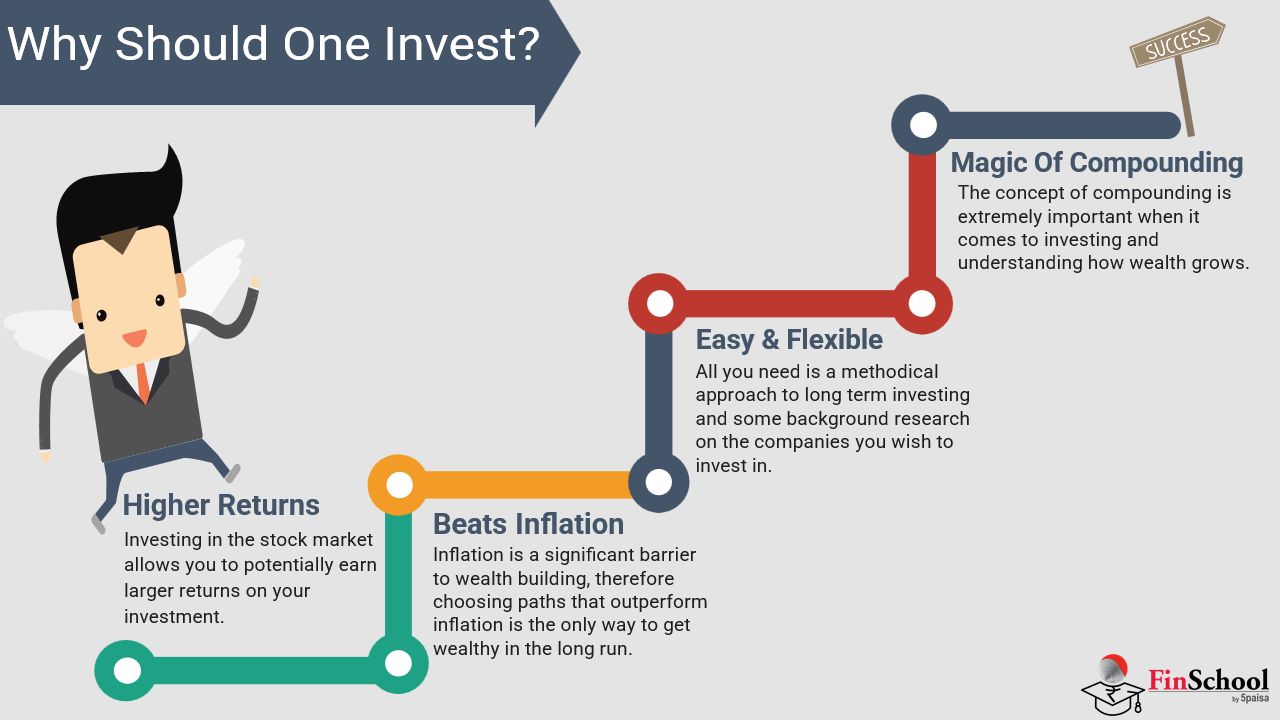
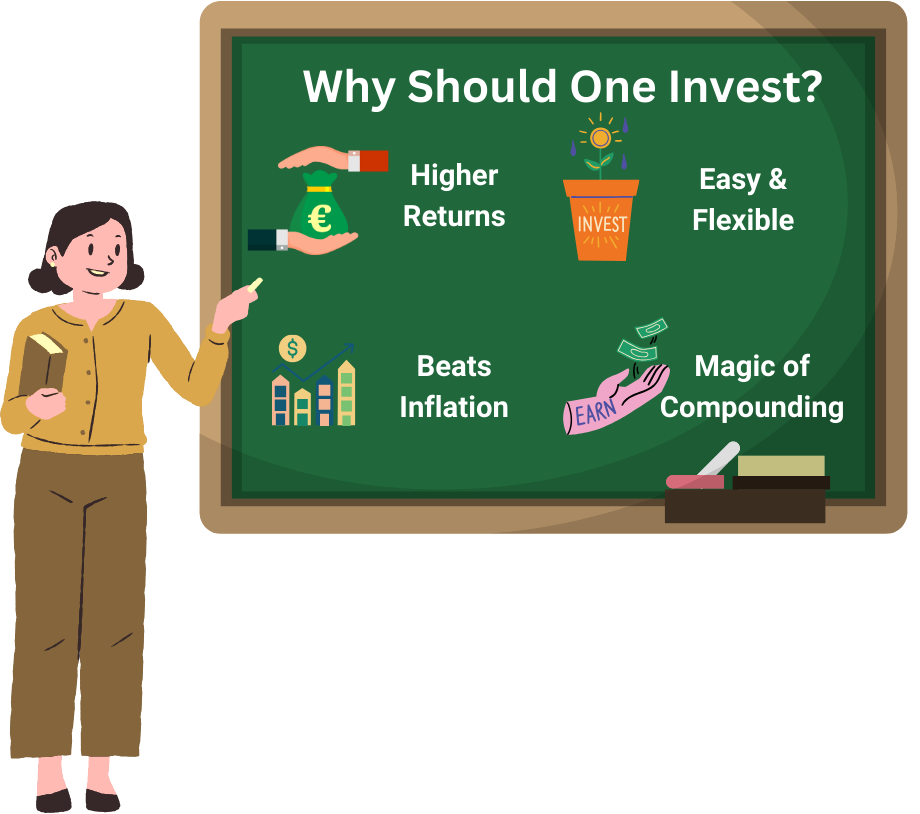
Why Should You Invest?
- To offset the effects of inflation and maintain the value of the cash.Money kept as cash loses its value over a period of time and thus, it is important to invest in order to protect purchasing power.
- To make the most of compounding gains.A portion of investment returns can be reinvested to compound the profit.
- To manage risk while pursuing growth. Diversification spreading investments across different assets is a technique investors use to balance risk and reward; it’s a means to invest more safely, not a goal of investing in itself
- The amount that should be invested and the type of investment that suits an individual depends on various factors such as the stability of cash flow, level of existing debt, financial goals, emergency fund, and risk appetite, among others.Therefore, it is advisable to consult a financial advisor before investing.
What to Do Now
Having discussed the definition and purpose of investing, the next set of discussion will revolve around the risks associated with different investment options. Although, it is important to consider investing as a tool for wealth creation and financial freedom, it is not without its challenges and shortcomings. In the next section, various risks associated with investing will be evaluated.
1.2 Risks Associated With Investing
“Risk comes from not knowing what you’re doing.” – Warren Buffett
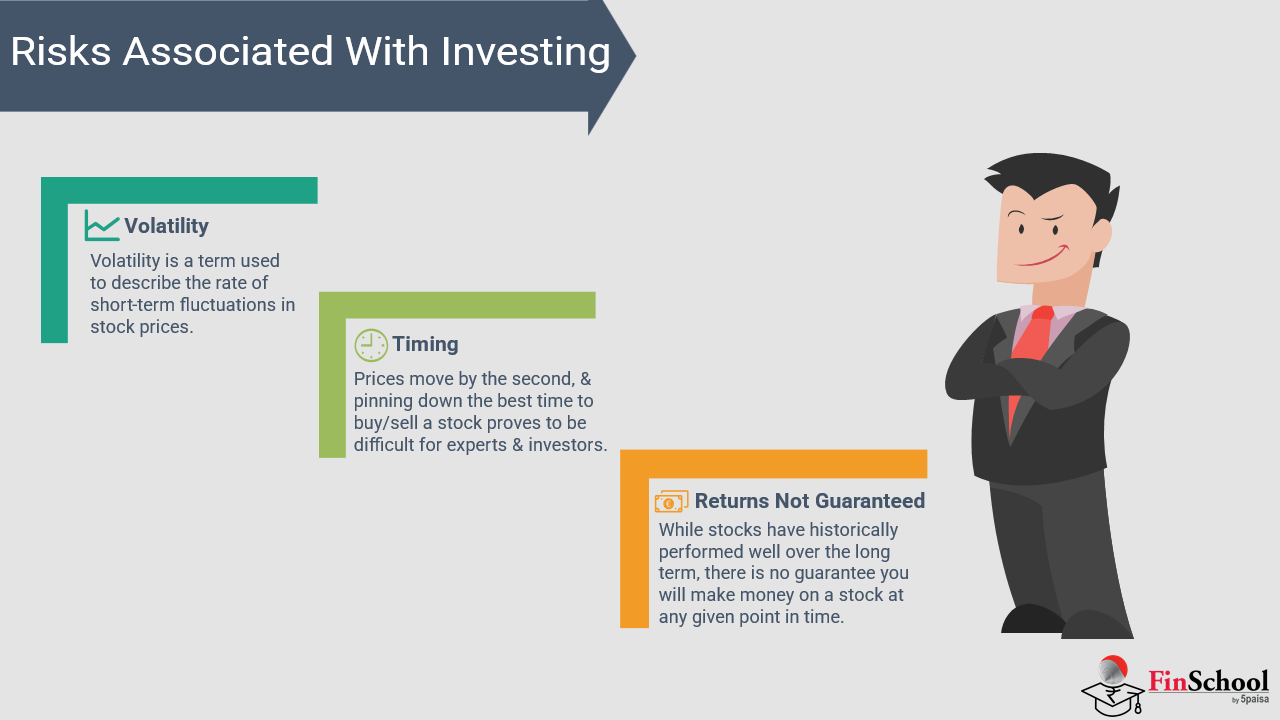
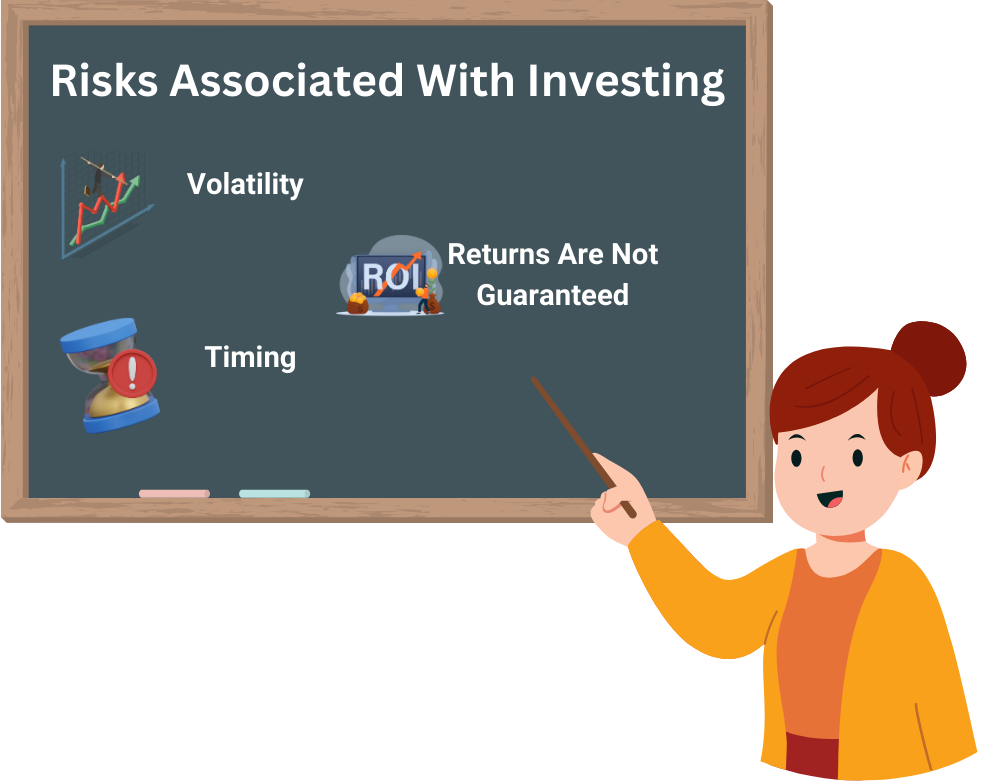
“The real risk of investing is not volatility, it is not knowing what you’re doing,” says Warren Buffett. Investors who invest based on emotion or tips without knowing what they are investing in are not really investing, they are gambling. Smart investors learn company fundamentals, know market cycles and diversify smartly. They are better able to cope with uncertainty, and to avoid losses. Investing is a great way to build wealth but it also has its own inherent dangers and understanding those dangers is essential to building sound strategies to protect capital and grow returns.
- Market Risk
Market risk is the potential for loss arising from broad market-wide fluctuations, driven by factors such as recessions, political instability, pandemics, or financial crises. A classic example of this is the 2008 Global Financial Crisis, when stock markets across the globe tanked, major financial institutions failed and the U.S. housing bubble popped, sending stocks, bonds and commodities alike down the drain, no matter how strong any single company was. Market risk affects the entire financial system and can not be eliminated completely however it can be managed through diversification.
2. Inflation Risk
Inflation risk is the risk that the value of money will fall over time, diminishing the real return on investments that do not keep pace with rising prices. For example, if you get 5% return on a fixed deposit every year, it is actually a loss in real terms if the inflation is at 6%. A historical example is the 1973 oil crisis, when rising oil prices led to inflation around the world, and the value of fixed-income assets like bonds and savings fell. You want to buy assets that generally grow faster than inflation (equities, real estate, inflation indexed bonds ) . This is how you keep your wealth over time .
3. Liquidity Risk
Liquidity risk is the risk of not being able to sell an asset quickly without a loss of value. Converting assets such as real estate, fine art and private equity into cash quickly can be much more difficult than trading stocks and mutual funds. The Yes Bank crisis of 2020 is a good example. When the bank was placed under a moratorium, depositors faced a bank run with many unable to access their own money, and financial instability spurred this run on deposits. The episode highlighted the necessity of assessing a financial institution’s balance-sheet health and liquidity position before parking money with it not just its brand name.
4. Interest Rate Risk
Interest rate risk primarily affects bonds and other fixed income securities. Bond prices and interest rates move in opposite directions . So , when interest rates rise , the market value of existing bonds falls as new bonds are issued at higher yields . Older bonds become less attractive and lose value if sold before maturity . In India, investors in fixed income securities closely follow central bank policy the Reserve Bank of India for clues about rate moves. For instance, when the RBI raised rates in 2022, bond prices fell correspondingly, hurting investors who needed to sell before maturity. This creates a similar risk for borrowers who have taken out floating-rate loans . As interest rates in the market rise, they will have to pay more interest, which puts even more financial pressure on them .
5. Credit Risk
Credit risk is the risk that a borrower whether a company or a government fails to meet its financial obligations, creating losses for investors in bonds, loans, or other debt instruments. This can be mitigated through prioritizing high credit rating securities and conducting thorough financial analysis before lending or investing. A well known case is Kingfisher Airlines. Under Vijay Mallya, the company was unprofitable, over-leveraged, and heavily indebted. Finally, it defaulted on loans. This led to heavy losses for Indian banks, highlighting the risks of lending to firms with weak financial fundamentals.
6. Business & Industry Risk
Business risk is the risk of loss from bad management, regulatory change, competition or disruption by technology. Kodak is a case in point. The photography giant fell in 2012, unable to make the digital revolution as its competitors Sony and Canon did. Similarly, Jet Airways went into insolvency in 2019 with its operations being suspended due to mismanagement, soaring fuel prices and fierce competition from IndiGo. These examples show why even large and established companies can fail when they do not adapt to evolving market dynamics and how diversification may reduce this type of risk.
7. Currency Exchange Risks
Exchange rate risk is important to investors holding foreign assets since changes in the currency exchange rate can directly impact on the returns when converted back into the home currency. An Indian investor with assets in US dollars would actually be a beneficiary of a fall in the rupee against the dollar. It is the rise in the rupee that would eat into returns. Depreciation of the rupee is bad news for importers, who have to pay more rupees for the same dollar-denominated goods. It is a good thing for exporters.” One example is the Covid-19 pandemic. Global uncertainty led to sharp currency volatility, squeezing importers but giving a competitive advantage to exporters. Understanding this dynamic is key to controlling volatility and safeguarding cross-border investment returns.
8. Emotional and Behavioural Risk
Investing is about numbers . It’s a game of psychology too.” Fear, greed and herd mentality are common triggers for poor decision-making, especially during moments of panic or euphoria, and often the result of a lack of fundamental knowledge. India’s crypto boom is a case in point. Many investors bought Bitcoin at inflated prices just because of FOMO (fear of missing out) and suffered steep losses when prices corrected. While avoiding these emotional traps is important, time in the market is also important. Starting early allows compounding to work for an investor, steadily building wealth over the years.
1.3 When To Start Investing?
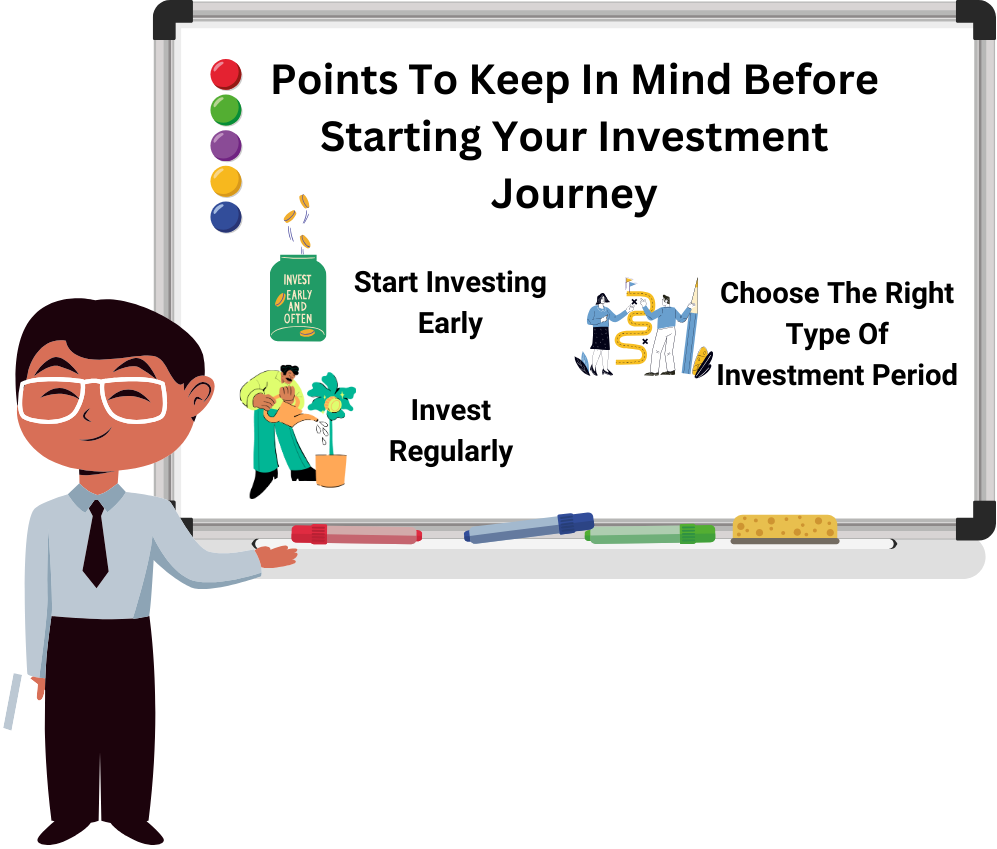
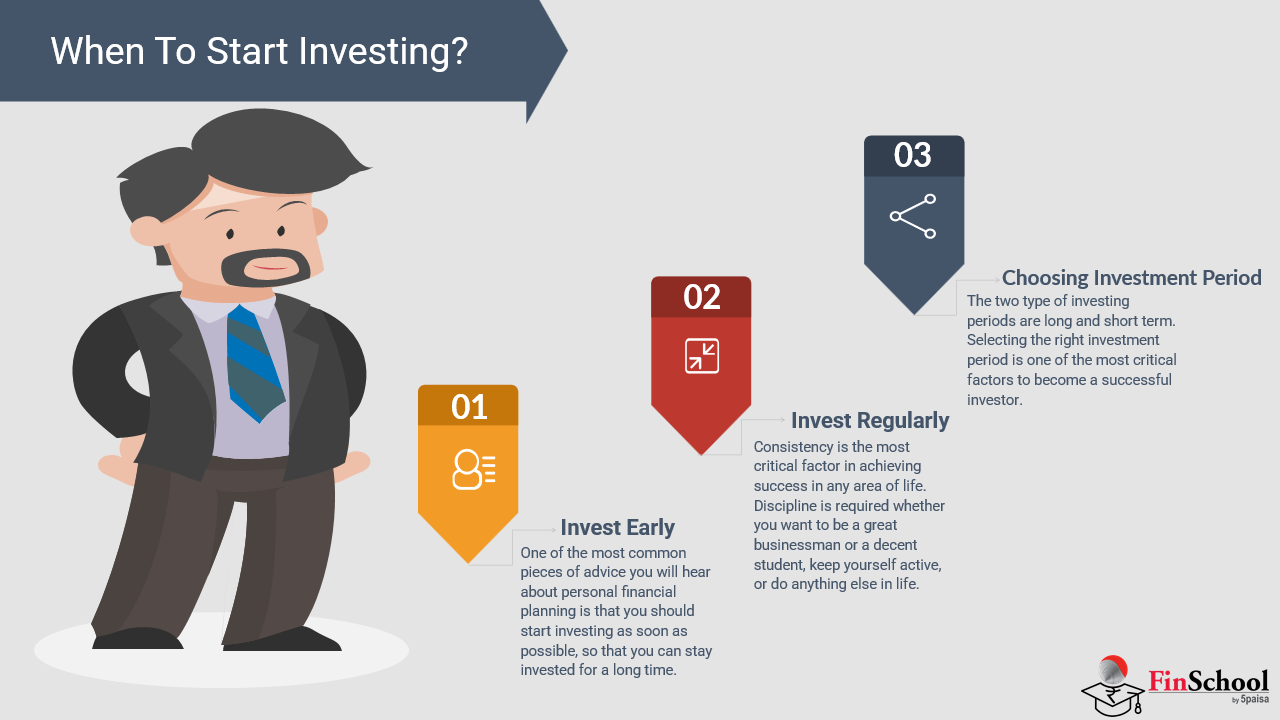
Often even before investing the first question that comes to our mind is When to Start Investing? What is the Right time and age to start investing?
Well the answer is quite simple – As Early As Possible!
When you start investing early, you have enough time for your money to grow due to the power of compounding. This is the process where earnings generate more earnings over time. However the right time to start investing depends on factors like financial stability , your risk tolerance levels and investment goals.
Let us understand this with the help of an example
The Power of Early Investing
Now Nirav and Vedant example
Vedant suppose started to make investment of ₹4,000 per month at age 25. Nirav delayed his investing until the age of 35. Assuming a 10% annual return, below we have a table which shows how their investments grow by the age of 55:
|
Age Started |
Monthly Investment |
Total Invested |
Value at 55 (10% return) |
|
Vedant(25) |
₹4,000 |
₹14.40 lakhs |
₹91.17 lakhs |
|
Nirav (35) |
₹4,000 |
₹9.60 lakhs |
₹30.62 lakhs |
CASE 1
Compounding Calculation for Vedant
| Age |
Amount |
Future Value |
|
25 |
₹48,000 |
₹ 50,681.12 |
|
26 |
₹ 96,000 |
₹ 1,06,669.23 |
|
27 |
₹1,44,000 |
₹ 1,68,520.01 |
|
28 |
₹1,92,000 |
₹ 2,36,847.38 |
|
29 |
₹ 2,40,000 |
₹ 3,12,329.52 |
|
30 |
₹ 2,88,000 |
₹ 3,95,715.63 |
|
31 |
₹ 3,36,000 |
₹ 4,87,833.35 |
|
32 |
₹ 3,84,000 |
₹ 5,89,597.01 |
|
33 |
₹ 4,32,000 |
₹ 7,02,016.64 |
|
34 |
₹4,80,000 |
₹ 8,26,208.08 |
|
35 |
₹5,28,000 |
₹ 9,63,403.99 |
|
36 |
₹5,76,000 |
₹ 11,14,966.10 |
|
37 |
₹6,24,000 |
₹ 12,82,398.75 |
|
38 |
₹6,72,000 |
₹ 14,67,363.78 |
|
39 |
₹7,20,000 |
₹ 16,71,697.06 |
|
40 |
₹7,68,000 |
₹ 18,97,426.71 |
|
41 |
₹8,16,000 |
₹ 21,46,793.21 |
|
42 |
₹8,64,000 |
₹ 24,22,271.64 |
|
43 |
₹9,12,000 |
₹ 27,26,596.26 |
|
44 |
₹ 9,60,000 |
₹ 30,62,787.64 |
|
45 |
₹10,08,000 |
₹ 34,34,182.65 |
|
46 |
₹ 10,56,000 |
₹ 38,44,467.58 |
|
47 |
₹ 11,04,000 |
₹ 42,97,714.69 |
|
48 |
₹ 11,52,000 |
₹ 47,98,422.71 |
|
49 |
₹12,00,000 |
₹ 53,51,561.39 |
|
50 |
₹12,48,000 |
₹ 59,62,620.92 |
|
51 |
₹12,96,000 |
₹ 66,37,666.38 |
|
52 |
₹13,44,000 |
₹ 73,83,397.91 |
|
53 |
₹13,92,000 |
₹ 82,07,217.28 |
|
54 |
₹14,40,000 |
₹ 91,17,301.30 |
The formula for compound interest is:
A=P(1+r/n)nt
Where:
- A= Future value of investment
- P= Monthly investment amount
- r= Annual interest rate (in decimal)
- n= Compounding frequency per year
- t= Number of years
For Vedant (Investing ₹4,000/month from Age 25 to 55)
- MonthlyInvestment (P): ₹4,000
- TotalYears (t): 30
- AnnualRate (r): 10% or 10
- CompoundedMonthly (n = 12)
- Monthly Rate : 0.10/12 = 0.008333
Using the SIP formula for monthly investments:
FV=P×(1+r/n)nt−1/r/n)×(1+r/n)
Using exponential method (1+i)= 1 + 0.008333 = 1.008333
(1.008333)360 = 19.92 (approx)
So as per formula = 4000 * 19.92-1/0.008333 * 1.008333
= 4000 * 18.92/0.008333 *1.008333
= 4000 * 2270.49*1.008333
= 4000*2289.40
= 91.17 lakhs approx
Click on the excel sheet to get the calculations –Link
CASE 2- For Nirav (Investing ₹4,000/month from Age 35 to 55)
Monthly Investment (P): ₹4,000
Total Years (t): 20
Annual Rate (r): 10% or 0.10
Compounded Monthly (n = 12)
FV=4000×((1+0.10/12)12×20−1/0.10/12)×(1+0.10/12)
Solve (1 + r/n) 1+0.10/12=1.0083333
Calculate the exponent 12×20 =240months (1.0083333)240
Using exponentiation: (1.0083333)240 ≈7.328
Solve the fraction inside the brackets (7.328−1)/0.0083333
=6.328/0.0083333
=759.39
Multiply by (1 + r/n) (1+0.0083333)=1.0083333
759.39×1.0083333=765.71
Multiply by the monthly investment FV=4000×765.71
FV=₹ 30.62 lakhs (Approx)
Compounding Table Showing Nirav’s Investment Growth-AGE- 35
|
Age |
Amount |
Future Value |
|
35 |
₹ 48,000 |
₹ 50,681.12 |
|
36 |
₹ 96,000 |
₹ 1,06,669.23 |
|
37 |
₹ 1,44,000 |
₹ 1,68,520.01 |
|
38 |
₹ 1,92,000 |
₹ 2,36,847.38 |
|
39 |
₹ 2,40,000 |
₹ 3,12,329.52 |
|
40 |
₹ 2,88,000 |
₹ 3,95,715.63 |
|
41 |
₹ 3,36,000 |
₹ 4,87,833.35 |
|
42 |
₹ 3,84,000 |
₹ 5,89,597.01 |
|
43 |
₹ 4,32,000 |
₹ 7,02,016.64 |
|
44 |
₹ 4,80,000 |
₹ 8,26,208.08 |
|
45 |
₹ 5,28,000 |
₹ 9,63,403.99 |
|
46 |
₹ 5,76,000 |
₹ 11,14,966.10 |
|
47 |
₹ 6,24,000 |
₹ 12,82,398.75 |
|
48 |
₹ 6,72,000 |
₹ 14,67,363.78 |
|
49 |
₹ 7,20,000 |
₹ 16,71,697.06 |
|
50 |
₹ 7,68,000 |
₹ 18,97,426.71 |
|
51 |
₹ 8,16,000 |
₹ 21,46,793.21 |
|
52 |
₹ 8,64,000 |
₹ 24,22,271.64 |
|
53 |
₹ 9,12,000 |
₹ 27,26,596.26 |
|
54 |
₹ 9,60,000 |
₹ 30,62,787.64 |
Click on the link to get Nirav’s Compounding Table Calculations
Nirav’s investment grows to ₹ 30.62 lakhs at age 55.
What did you Learn?
Now look at the numbers. Vedant began investing a decade before Nirav, and he invested only ₹ 5 lakhs more. But when you compare their final amounts, Vedant has earned more than twice as much as Nirav’s . This shows the power of starting early and letting your money grow on time. It is like a snowball effect. The earlier you start, the more time your money has to roll with interest and grow in to something big.
1.4 Impact of Not Investing
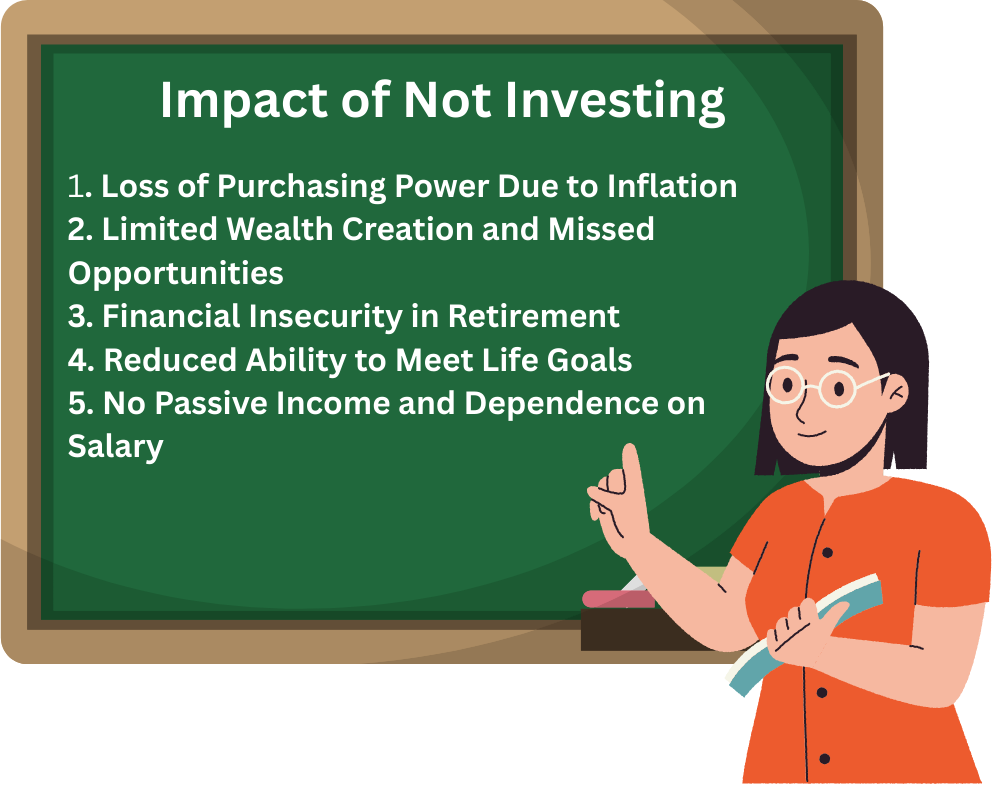
Not investing can impact your financial growth negatively, and at the same time it can impact your future opportunities and stability as well. Many people believe that saving alone is enough, but inflation makes it clear that something more is needed. Below are some points that help us understand the impact of not investing.
1. Loss of Purchasing Power Due to Inflation
As discussed earlier, inflation steadily erodes the purchasing power of idle cash — keeping ₹1,00,000 in a savings account earning 3% interest when inflation is running at 6% is a net loss in real value. Over time this gap widens, reducing financial stability and future opportunities. This is why active investing, not just saving, is needed to grow wealth and secure long-term well-being.
2. Limited Wealth Creation and Missed Opportunities
Investing is a powerful tool for building wealth — compounding grows your money and helps with asset appreciation, but only if the money is actually invested. Money that’s simply saved, with no growth, misses out on this entirely. Consider someone who sets aside ₹4,000 every month for 30 years: if they invest it at a 10% annual return, it grows to about ₹91.17 lakhs. If they instead just save the same amount in a low-interest account earning 3.5%, it grows to only about ₹25.49 lakhs. And if they simply set it aside with no growth at all, the total stays at exactly what was put in — ₹14.40 lakhs. Same discipline, same monthly amount, same 30 years — but the outcome ranges from ₹14.4 lakhs to over ₹91 lakhs depending on whether that money was invested. This is the real cost of not investing.
3. Financial Insecurity in Retirement
Depending entirely on savings without investing can create serious financial challenges in retirement, since idle, non-invested funds lose real value to inflation over time even though their nominal balance doesn’t shrink. Passive income from investments — mutual funds, stocks, or bonds offers long-term financial stability and helps preserve purchasing power. Someone who invests consistently throughout their working life can retire with a secured income stream, while someone who avoids investing may face retirement with limited resources and greater financial vulnerability.
4. Reduced Ability to Meet Life Goals
Investments play an important role in achieving life goals such as buying a home, funding education, or travel. Without investing, individuals may need to rely more heavily on loans or delay these goals. Investing in equity funds or real estate can help someone afford their dream home more easily than relying solely on savings.
5. No Passive Income and Dependence on Salary
Investments in dividend stocks, rental properties, or interest-bearing assets create passive income streams that reduce financial dependency. Someone who invests in dividend-paying stocks builds an additional income source, while someone who doesn’t invest remains reliant solely on their job and salary.
Once we understand the importance of both saving and investing, the next step is to explore the various avenues for investing and the strategies behind them. Investing is about discipline before committing your hard-earned capital, it’s essential to understand a few critical aspects that shape investment outcomes.
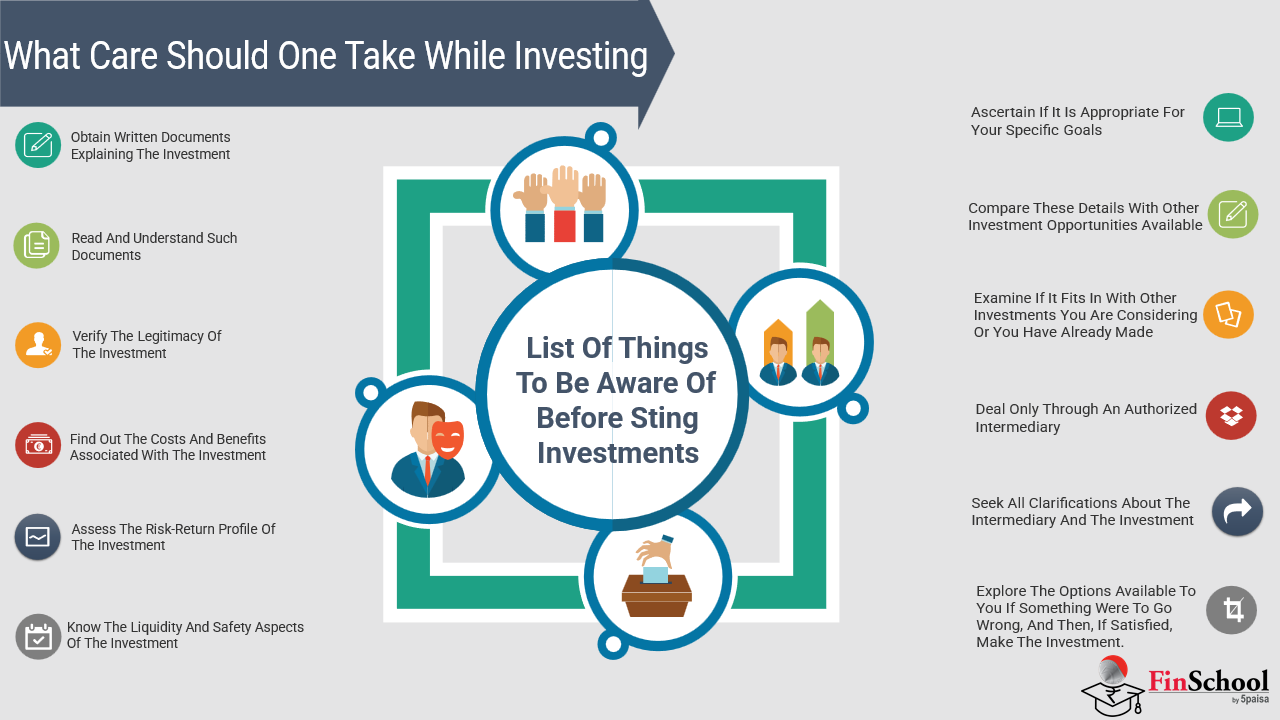
1.5 Things to know before investing

Trading is just like a skill. You need strategy , mental sharpness and the ability to make split second decisions based on your opponents decision. Just like you play one day cricket. Similarly traders must read the market signals manage risk and adjust position quickly as prices change. In contrast long term investing resembles planting a tree; you select the right seed , nurture it and allow to foster steady growth. Trading demand constant vigilance and emotional resilience. Before entering the financial markets as a trader it is very important that you understand the market behaviour and manage risks accordingly. Be mentally prepared for emotional ups and downs. This foundation is the key to take decisions than making costly mistakes.
-
Understanding Market Structure and Asset Classes
The trading world is not just about clicking buttons, the marketplace has its own structure , own rules and whole of mix asset classes. Consider Stocks, commodities like gold and oil, currencies and more complex instruments like derivatives. Each of them carry different characteristics and risk profile. Let us understand each one of them.Ok. So before we understand what exactly equities offer Let us first understand what are equities . Equities are stocks or shares and they represent ownership interest in any corporation where you are entitled to enjoy the future profits of the corporation. It offers opportunities for both short-term gains and long-term appreciation. In this case, you should be extremely cautious since they tend to be volatile and they depend on corporate profits, macro-economic policy and world events.The Commodities such as Gold, Oil and Agricultural Products vary according to factors such as supply and demand, geopolitical stability, and economic cycles. Forex trading deals with currency pairs which are effected by interest rate decisions, inflation, and international trade policies. Options and Futures allows room for leveraging and hedging opportunities which require advanced strategies to manage risks effectively.
2. Technical Fundamental Analysis
There are two ways to understand the market. One is technical analysis and the the other one is fundamental analysis.
Technical analysis : This method of analysis basically involves study of historical price movements. It basically involves analysing historical price movements, chart patterns, and market trends. The use of technical indicators like moving average, relative strength index (RSI), and Bollinger Bands helps in identifying entries and exits.
Fundamental analysis : Fundamental analysis is based on looking at financial statements, economic data, and corporate earnings. Reports on profits, interest rates, and economic trends are key to functioning the sentiments prevailing in the market.
3. Risk Management and Capital Protection
Have you ever drove a car without seatbelt and brakes? If Yes then its too risky!
Similarly in trading it is essential to use certain tools like stop loss to avoid huge losses. Knowing when to cut losses and when to book profit and how much risk should be taken is the key to stay in market.
- Position Sizing means Limiting exposure per trade prevents overcommitment and balances portfolio risks.
- Stop Loss and Take Profit Orders means setting predefined exit points ensures traders minimize losses while securing profits.
- Risk-Reward Ratio means a well-planned trade should offer a favorable risk-to-reward ratio to justify the investment.
- Leverage Control enhances profits, excessive use can magnify losses
4. Market Psychology and Emotional Discipline
What is FOMO?
Let us understand this concept in a better way. Trading isn’t just about numbers—it is about your mindset. Fear creates panic and then you sell , greed pushes you to over trade, and FOMO gets you into bad trades. Just like a villain in a movie. You expect good but FOMO spoils it . So a clear head and a disciplined plan is a must in trading. Emotion-led trading is a shortcut to regret. So here are three factors you should be careful about.
Fear of missing out (FOMO) forces the traders to chase trends and thus increasing the risk of buying at peak prices. Overtrading happens due to over confidence, resulting in poor decision-making and unnecessary losses. Panic selling at the time of market crisis can lead traders to exit profitable positions too early. Thus developing emotional discipline through structured strategies and rational decision-making enhances trading efficiency. You need to have well defined plan that will prevent you from taking impulsive decisions to market fluctuations.
-
Importance of Liquidity and Market Timing
Suppose You are trying to sell an expensive piece of art vs. selling a popular phone . Which one do you feel is easy ? Obviously it is way easier to find a buyer for the latter. That is liquidity. Trading in highly liquid markets like major stocks and forex makes easier entries and exits. Also, timing matters news releases and opening bells often bring price swings.That is why Liquid assets like major stocks and currency pairs, allow smooth transactions with minimal price slippage. Non liquid assets can experience extreme price fluctuations due to fewer buyers and sellers thus increasing risks. Additionally, market timing plays a very crucial role in trading profitability. Some strategies work best during market volatility, such as the opening and closing hours of stock markets.
-
Trading Strategies and Choosing the Right Approach
Different trading strategies suit personalities. Are you someone who likes action? You might like day trading. Prefer a more relaxed pace? Swing trading could be for you. Scalping is ultra-fast and intense. And if you are tech-savvy, algo trading lets you automate everything. Match your strategy to your style and risk comfort.
Day Trading: Short-term trading where positions are closed within the same day is known as Day Trading. It requires making decisions and constantly monitoring charts.
Swing Trading: Swing Trading means Holding assets for multiple days or weeks to capture short- to mid-term trends. It is suitable for traders who prefer moderate risk exposure.
Scalping: Scalping means extremely short-term trading where positions are opened and closed within minutes. It is designed for capturing small price movements with high frequency.
Algorithmic Trading: Automated trading using mathematical models and pre-defined conditions is known as algorithmic trading. It needs expertise in coding and market analysis. Choosing the strategy depends on a traders risk tolerance and time. Selecting the right strategy depends on a trader’s risk tolerance, time commitment, and expertise level.
-
Transaction Costs, Taxes, and Regulations
Every trade has hidden costs—brokerage fees, taxes, and compliance rules. If you neglect these your profits may shrink fast. Thus staying informed and organized helps you keep more of what you earn.
Brokerage Fees: Brokerage fess means frequent traders should account for commission costs, spreads, and exchange fees.
Taxes on Capital Gains: Taxes on capital gains depends on the country’s tax policies. Short- term trading profits may be subject to taxation.
Regulatory Compliance: Regulatory Compliance requires that traders are aware of the laws imposed by governing financial authorities to prevent fraud and penalties. Knowing one’s financial obligations is part of optimizing their overall profit while remaining within the regulations of the marketplace.
-
Continuous Learning and Adapting to Market Conditions
Markets change very quickly like technology. Something that works today may not work tomorrow. For example, a new phone model is released each year. Keep up-to-date by reading, trying out strategies, and learning from people around you. You will continue to be able to do so throughout your career as you develop and refine yourself as an individual.
So what should you do ?
Firstly you should read financial reports, economic forecasts, and regulatory changes as it enhances decision making. Secondly you should Back-test strategies using historical data verifies performance before implementing them in live markets. Third and most important is you should Learn from experienced traders through mentorship, courses, or trading communities that accelerates progress.
Here are some investment instruments and diverse tools available to shape your wealth- building journey.
1.6 Types Of Investment Instruments
Investment Instruments
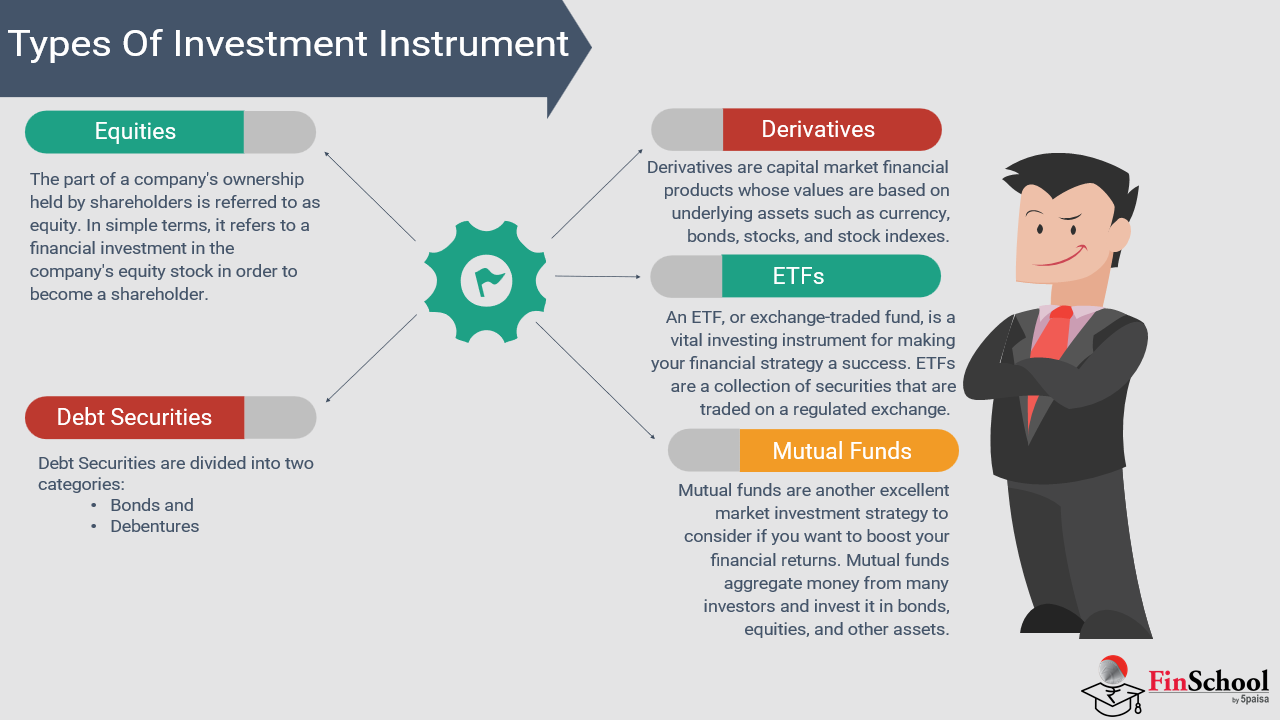
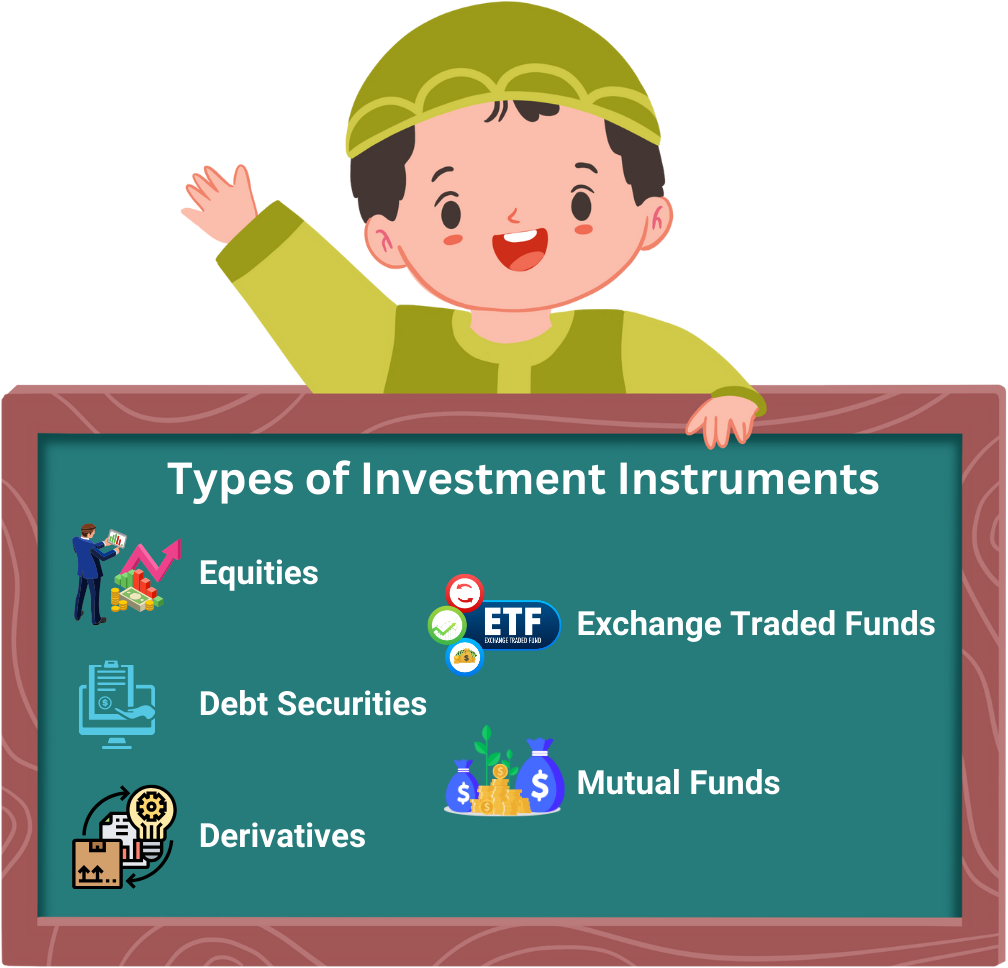
Investment instruments represent financial assets which can increase your net worth (i.e., value), provide income, and help you reduce risk. Each instrument has a different purpose, and choosing the right ones depends on your risk tolerance, time horizon, and knowledge of the market. By now you must be aware that investment can be done in instruments apart from a savings bank account. As mentioned earlier, investment instruments are financial assets such as equities, fixed income securities, mutual funds and ETFs, commodities and precious metals, derivatives, etc.
Let’s understand them in detail.
- Equities
These are investments in company shares. Such investments make investors a part-owner of the company, as they are entitled to a share of the company’s assets. This type of investment has scope for profit through capital appreciation which means that the value of the share increases, and the dividends distributed to shareholders. The risk factor is also associated with these types of investments as the prices of these shares depend on the market scenario. For example, an investor buys 100 shares of a company at Rs. 100 per share, his investment would be Rs. 10,000. In case the value of the share increases to Rs. 150, his profit would be 50%, on the other hand, if the price decreases to Rs. 80, his investment would lose 20% value.
There are two variants of equity investments namely,
- Common stocks
- Preferred Stocks
a) The most common form of equity investment is through common stocks.This type of equity investment offers voting rights to the shareholders regarding the company policies and decisions, such as the election of members in the Board of Directors. With regards to the returns, an investor can make money from common stocks in two ways, these are:
Capital appreciation: This is the growth of the stock values over time, especially when the firm is growing well. The profit margin for the investor is determined by the difference between the buying and selling price of the stock.
Income: This is generated through the dividends that are paid out to shareholders. For example, Infosys has been a company that regularly pays dividends while also building up its stock values. Thus, it becomes a good choice for investors who need income while also interested in capital appreciation.
b) Unlike common stocks, preferred stocks offer investors an opportunity to get a regular income stream through the dividend rates.These stocks also have a redemption value that is higher than the initial cost of buying the stock. What preferred stocks offer Income for preferred stockholders Limited voting rights since they do not have much say in the company policies.
Preferred Dividends: These are the regularly paid dividends to preferred stockholders. Claim on Income and Assets: Although they do not have voting rights, preferred stockholders have a claim on the company’s assets in the case of liquidation, which is higher than that of the common stockholders. For example, many financial institutions (mostly banks) have issues what is called the Preferred Stock Series A, which has a specified dividend, which does not dilute the common stock. This is a good way of generating income for the investors as they can demand the specified dividend, and it does not put much pressure on the earnings of the common stockholders. Thus, preferred stocks offer a good option for the conservative type of investor.
- Fixed Income
Securities Investment instruments that provide regular stream of income and repayment of the principal are generally known as fixed income securities. Just like Nirav lending some money to his friend, which is being returned to him in the form of regular installments along with some additional interest until the full amount of principal reaches him, fixed income securities assure some regular returns to the investor while safeguarding his principal investment from risks. While individual investors can provide loans to other people, fixed-income investors lend money to the government, corporations, and local authorities, which pay them periodic interest. For example, treasury bills and RBI bonds are completely risk-free government securities, but corporate bonds carry higher risk, offering better returns on the investment. There are also municipal and zero-coupon bonds that provide income with minimal risk. Municipal bonds provide tax-free income to investors for the development of local government projects, whereas zero-coupon bonds are purchased at a discount and offer higher profits at the time of maturity without paying any periodic interest. Fixed income securities are mostly preferred by conservative investors that seek stable income with low risk.
- Mutual Funds and ETFs
A good example for understanding mutual funds is that of organizing a party with neighbors, where everyone contributes some money, and Vedant, as a fund manager, purchases the best available items in the market to prepare a nutritious meal containing all the required food items for the guests. Another example is of Nirav’s cousin Arjun, who has opted for a combo meal, which is a ready-made combination of various items. Similarly, Mutual Funds and ETFs work, wherein the former involves investing some money in order to receive a basket of diversified stocks representing different market sectors, whereas the latter is an exchange-traded fund that performs similarly to a mutual fund but offers more flexibility and liquidity. Mutual funds can be further categorized into equity funds, debt funds, and hybrid or balanced funds, whereas index funds are used to invest in the market index, which represents a certain portion of the market, for instance, the Nifty 50. Both of these funds offer a convenient method of investing in the stock market with lesser risks.
- Commodities and Precious Metals
An example that can help understand commodities and metals is of organizing a get-together with friends and dividing the share of expenses with them to cover all the costs. Similarly, in commodities and precious metals, the investors’ money is allocated to meet the requirements of different goods, services, or products, such as gold, oil, and wheat, to balance out the risk and reward of a portfolio. Commodities include precious metals, energy, and agricultural products that are traded globally. Metals are generally used for diversifying the portfolio and as a hedge against inflation and economic instability. The prices of energy commodities are susceptible to fluctuations in political and economic factors and supply-demand dynamics, whereas agricultural commodities experience changes in their prices due to weather conditions and consumption trends. Commodities trading does require expertise, which helps minimize losses due to high volatility, but it offers substantial rewards and diversification benefits for investors with moderate to high risk appetites, including institutions, corporations, and investors.
- Derivatives (Futures and Options)
Derivative instruments derive their value from another financial asset, which can be stocks, commodities, bonds, currencies, indices, and other derivatives, and work on the principle of an agreement between a buyer and a seller. An example of a future contract is booking tickets to a sports event ahead of time and avoiding the risk of high prices or unavailability of tickets at the time of purchase. Similarly, an option contract can be explained by taking up an offer for an extra ticket for a concert for a small additional price, which can be cancelled in case of any emergency. A swap contract can be exemplified by taking a personal loan against a colleague for a relatively lower rate of interest with an agreement of re-swapping the terms after a certain period. This way, the risk associated with unpredictable market changes can be minimized by the use of derivatives. Futures, options, swaps, and forwards are the commonly used derivatives market instruments that can be used for hedging and speculative purposes and are operated by sophisticated investors due to their complexities and leverage. Equities, bonds, mutual funds, ETFs, derivatives, commodities, and precious metals are the basic financial tools and instruments that can be used for investing. They can be utilized individually or in combination with other instruments to make wiser investment decisions with a better risk and reward evaluation. However, even at this point, the most fundamental question of savings or investment still remains, which will be discussed in the following sections.
1.7 Saving Or Investment – The Better Option
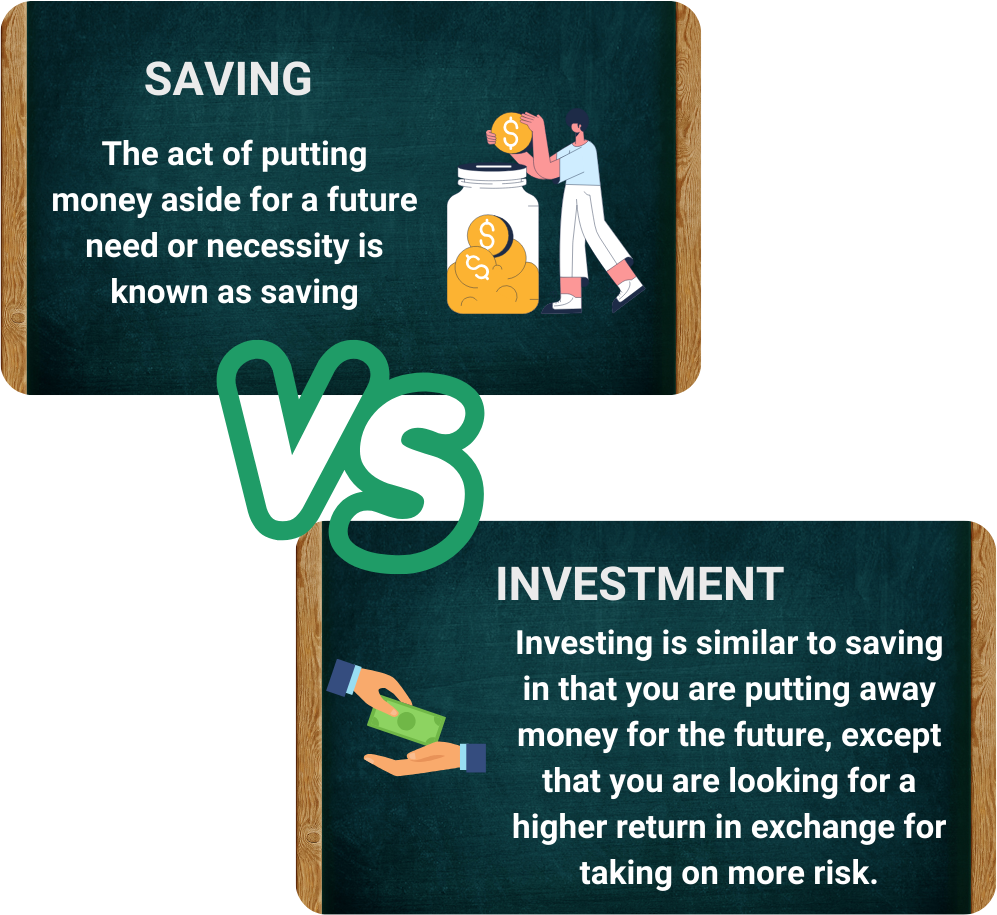
Now that we know that investing is always a better option rather than just saving. Both carry unique benefits , their impact on wealth creation differs significantly.
Traders and investors recognize that simply saving money may not be enough to build financial security. Investment is necessary for long term wealth creation.
Liquidity: Here Liquidity is readily available. Here Liquidity is variable—some investments have lock-in periods
Time Horizon: It is generally for Short-term focus It is Long-term wealth-building strategy
The Impact of Inflation on Savings vs. Investments
One of the biggest risks with relying solely on savings is inflation. If inflation averages 6% per year, a savings account earning 3% interest is losing purchasing power annually. Investing combats inflation by offering higher returns over time.
|
Year |
₹1 Lakh in Savings (3% Annual Interest) |
₹1 Lakh in Investments (10% Annual Return) |
|
1 |
₹ 1,03,000.00 |
₹ 1,10,000.00 |
|
2 |
₹ 1,06,090.00 |
₹ 1,21,000.00 |
|
3 |
₹ 1,09,272.70 |
₹ 1,33,100.00 |
|
4 |
₹ 1,12,550.88 |
₹ 1,46,410.00 |
|
5 |
₹ 1,15,927.41 |
₹ 1,61,051.00 |
|
6 |
₹ 1,19,405.23 |
₹ 1,77,156.10 |
|
7 |
₹ 1,22,987.39 |
₹ 1,94,871.71 |
|
8 |
₹ 1,26,677.01 |
₹ 2,14,358.88 |
|
9 |
₹ 1,30,477.32 |
₹ 2,35,794.77 |
|
10 |
₹ 1,34,391.64 |
₹ 2,59,374.25 |
|
11 |
₹ 1,38,423.39 |
₹ 2,85,311.67 |
|
12 |
₹ 1,42,576.09 |
₹ 3,13,842.84 |
|
13 |
₹ 1,46,853.37 |
₹ 3,45,227.12 |
|
14 |
₹ 1,51,258.97 |
₹ 3,79,749.83 |
|
15 |
₹ 1,55,796.74 |
₹ 4,17,724.82 |
|
16 |
₹ 1,60,470.64 |
₹ 4,59,497.30 |
|
17 |
₹ 1,65,284.76 |
₹ 5,05,447.03 |
|
18 |
₹ 1,70,243.31 |
₹ 5,55,991.73 |
|
19 |
₹ 1,75,350.61 |
₹ 6,11,590.90 |
|
20 |
₹ 1,80,611.12 |
₹ 6,72,749.99 |
To view the calculations click on the link
Risk vs. Reward Analysis
Traders and investors must assess the amount of risk they are willing to take on, in terms of the potential return as compared to the alternative. Savings accounts provide immediate access to cash, however, investing in stocks, bonds, mutual funds, commodities, and real estate can provide long-term growth.
Hierarchical View of Investment Instrument Risks:
- Low Risk: Fixed Deposits, Government Bonds, PPF are generally Considered low risk
- Moderate Risk: Mutual Funds, REITs, Corporate Bonds are considered moderate risk category
- High Risk: Equities, Derivatives, Cryptocurrencies are high risk investment instruments.
The Power of Compounding in Investment
We have already discussed this example but let us discuss again here
Example: ₹ 4,000 Monthly Investment vs. ₹4,000 Monthly Savings
Over 30 Years Investment Growth
(Assuming 10% Annual Return): FV=P×((1+r/n)nt−1)/r/n)×(1+r/n)
Where:
- P= ₹4,000
- r= 10%
- n= 12 (compounded monthly)
- t= 30 years
Using the formula, investing ₹4,000 per month would grow to about ₹91 lakhs, while saving the same amount at 3% interest would total only about ₹23 lakhs, a difference of about ₹68 lakhs over 30 years.
1.8 How Investing Helps for Retirement Planning?

Retirement planning involves not just saving but investment planning, it is crucial to have a good retirement planning so as to have a financially sound post-retirement life. Many people have the habit of saving money in the savings account, but with rising inflation, increased medical expenses and growing life expectancy it is essential that we start investing some part of our savings today for our future.
Let us take example of a person named Nirav, who is 30 years old and earns ₹75,000 per month, he wishes to retire at age 60 and have passive income at that point of time which would help him live a lifestyle of ₹1 lakh per month, if he were to save money from his monthly salary a big chunk of it would be lost due to inflation, and medical expenses as he grows older, to have a financially sound retirement Nirav needs to plan his investments so that there is sufficient money to support his retirement. So, the first step is to decide what kind of retirement we want and at what age we want to retire. Nirav needs to identify: His age at which he would want to retire The amount of money he would need every month to support his lifestyle after retirement
The following are some of the questions that Nirav needs to answer:
- At what age do I want to retire?
- For instance, retiring at 60.What kind of retirement do I want?
- Do I want to lead a luxury lifestyle, or a moderate lifestyle?
- Do I want to travel or do I have other hobbies post retirement?
Once, these questions are answered by Nirav, the next step is to calculate how much money Nirav needs to retire. Assuming, Nirav wants ₹1 lakh as his monthly income post retirement at the age of 60, so it would amount to ₹12 lakh per year, to calculate the required corpus we can use the simple rule below:
Corpus= Annual expenses÷4%
Corpus= 12,00,000÷0.04= ₹3,00,00,000
So Nirav would need ₹3 crore to generate a stable income stream of ₹1 lakh per month for the rest of his life after retirement. Now, to generate ₹3 crore, Nirav can create the following retirement portfolio:
- Equity Mutual Funds & Stocks(50%): Core to any retirement plan is equity mutual funds which are invested in blue chip companies and provide good returns over a period of time,
- Fixed Deposits(20%): The second component of the portfolio should be fixed deposits and bonds(20%) which give stable returns and protect the capital.
- Pension Plans(20%): Pension plans such as NPS and EPF help to build a steady income stream for post-retirement life.
- Real Estate(10%): Investment in real-estate can provide passive income in the form of rent on a regular basis which can be used as a contingency fund during any emergency.
With this retirement portfolio, Nirav would be able to create a balanced mix of stable and unpredictable sources of income during his retirement. Enhancing retirement planning with compounding Nirav starts making monthly investments of ₹10,000 in an equity mutual fund which is giving him returns of 12% annually, with the power of compounding, ₹10,000 invested every month would turn into around ₹3.5 crore at the age of 60, helping Nirav to achieve his goal of generating a passive income with some money to spare for contingencies. Retirement withdrawal planning for Nirav Nirav wants ₹1 lakh per month as passive income, so he will use the 4% rule and withdraw 4% of ₹3 crore which would be equal to ₹1,20,000 every year. To keep it simple, he can withdraw around ₹1 lakh every month from his investment corpus.
Additionally, Nirav can also take a steady stream of income from his dividend-bearing shares and rental income from his real estate holdings. Medical and contingency planning Nirav can also take care of his medical and contingency expenses by buying medical, life, and an emergency insurance policy to protect his retirement corpus and post-retirement life from any unfortunate event. With this well-thought retirement plan, Nirav has avert his dependency on a single source of income as he would be able to generate a passive income stream that would keep him financially independent and economically sound after retirement.
1.9 How does Indian Stock Market Function?
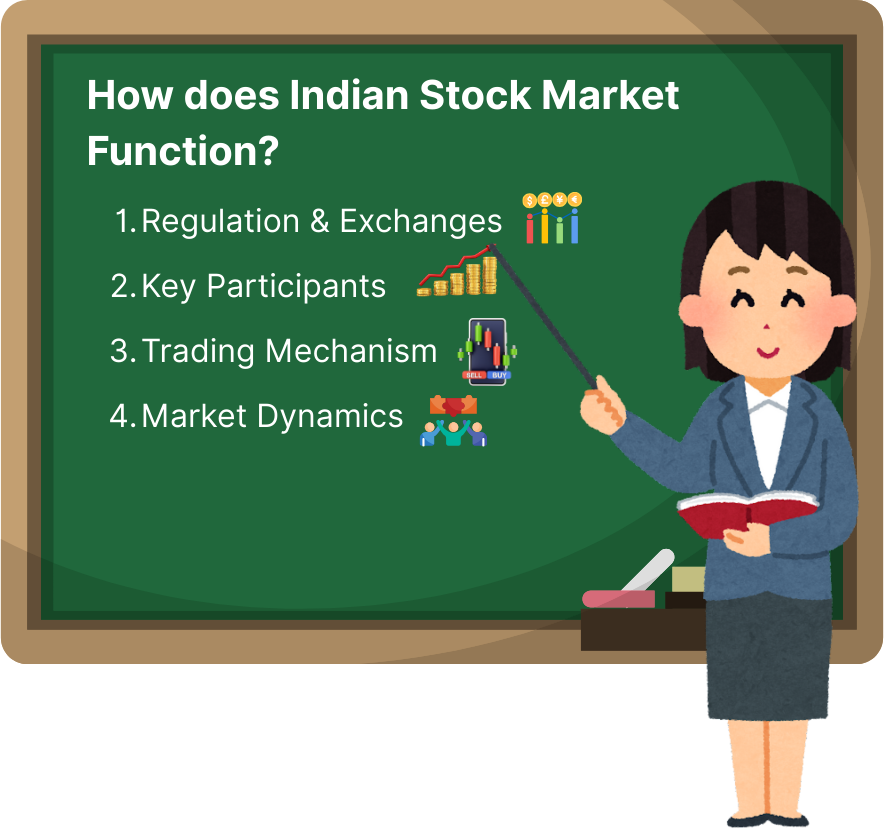
The Indian Stock Market is a place where people can invest their money by buying and selling types of financial products. These products include Stocks, Bonds, futures, options, Derivatives and Mutual Funds. The market is controlled by the Securities and Exchange Board of India or SEBI for short. SEBI makes sure that people who buy and sell stocks do it in a fair and transparent way. This helps protect people who invest in the Indian Stock Market.
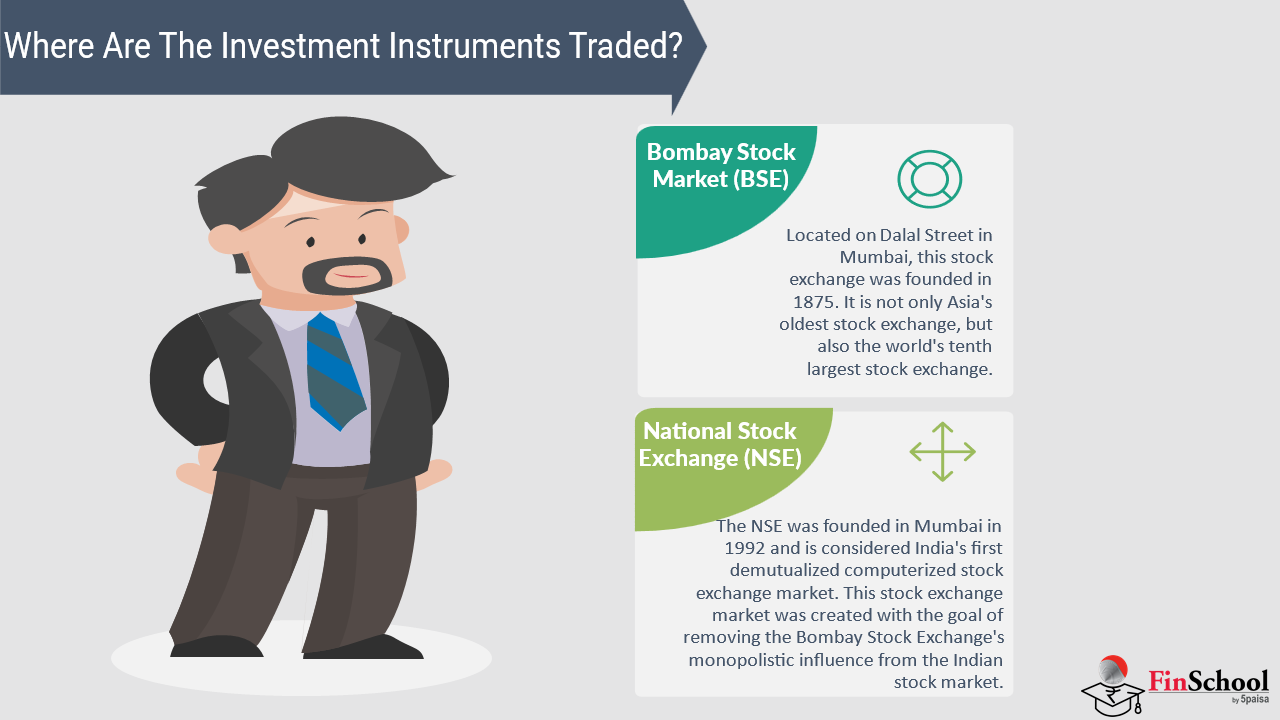
In India there are two places where people buy and sell stocks.
- The Bombay Stock Exchange, also called BSE
- The National Stock Exchange, also called NSE
The Indian Stock Market is very important for people who want to invest in Stocks, Bonds and other financial products. It is the place where people can buy and sell these products. SEBI regulates it to ensure everything is fair and transparent. It helps people invest their money.
The BSE and NSE are the two places, for buying and selling.
Key Entities Involved in Managing the Stock Market are Several participants facilitate stock market operations:
- Stock Exchanges: NSE and BSE . They provide the infrastructure for trading and settlement
- SEBI: SEBI Ensures fair practices and prevents frauds and malpractices
- Companies: Companies list their shares for public trading via IPO
- Brokers & Traders: Intermediaries executing trades on behalf of investors
- Retail & Institutional Investors: Individuals and large institutions participating in stock transactions.
Stock Trading Mechanism
The trading process in the Indian stock market follows a structured approach:
Pre-Open Session (9:00 – 9:15 AM): This time allows price discovery before market opening.
Regular Trading Session (9:15 AM – 3:30 PM): During this there is continuous electronic trading of stocks.
Post-Closing Session (3:40 – 4:00 PM): This time determines the closing price for stocks.
Shares are bought and sold through the order-matching system, ensuring liquidity and efficient transactions.
Market Index & Price Movement
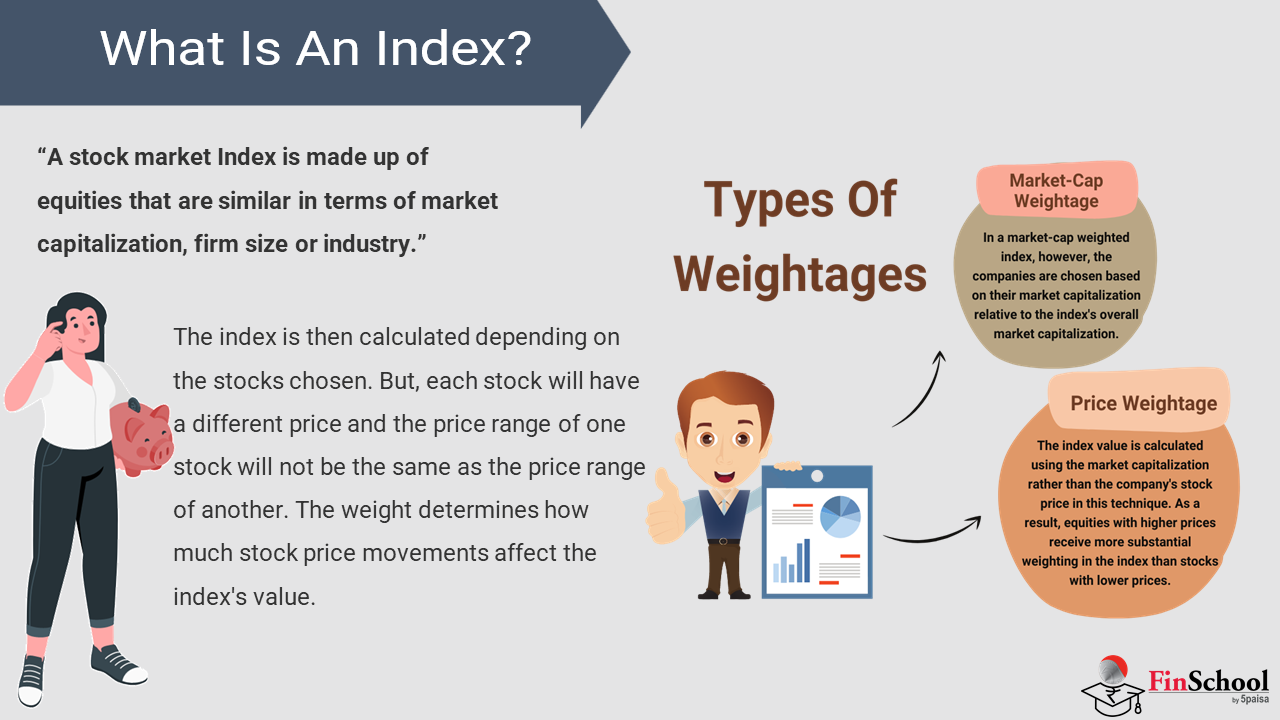
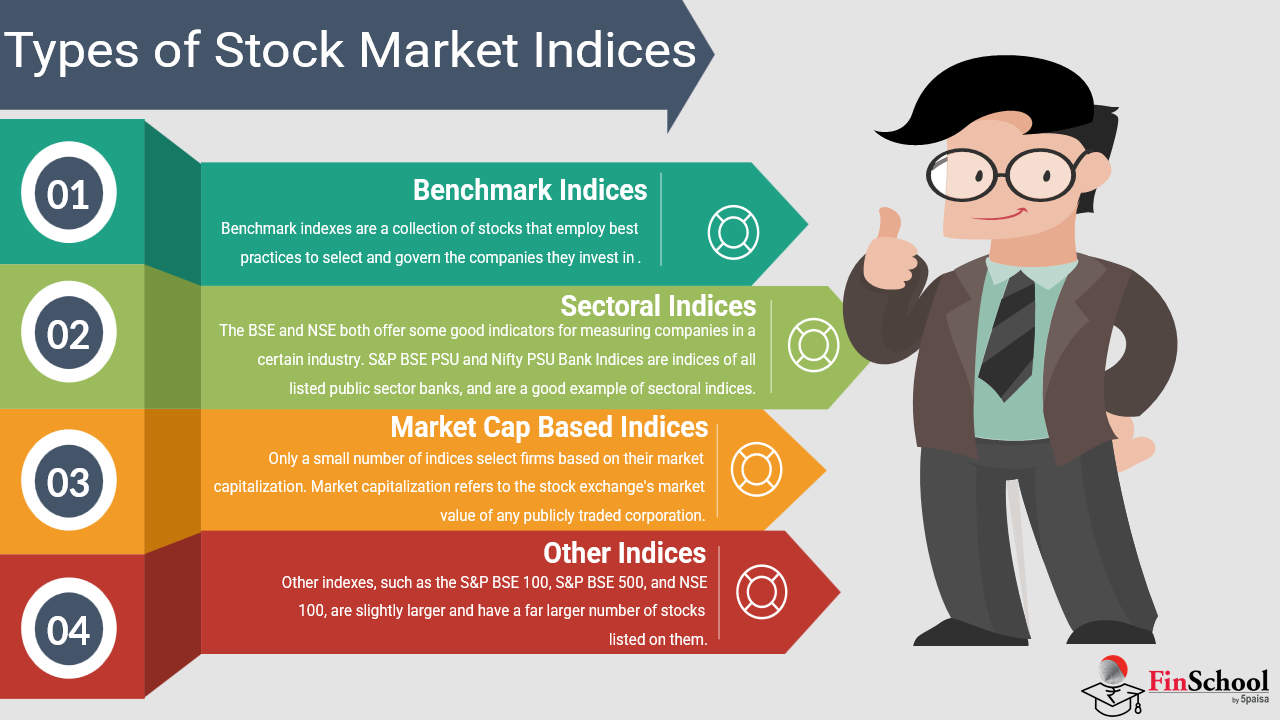
Stock Market Indices such as Nifty50 and Sensex serve as key benchmarks for the Indian financial system by tracking the performance of their top tier companies. This reflects the overall market trends. These induces are not static , rather their prices fluctuate based on the complex interplay of factors, including company-specific performance regarding earnings, revenue and management decisions. Additionally Indices are influenced by domestic economic policies such as RBI interest rates, inflation data and GDP growth metrics. Occasionally, global events such as international market trends, geopolitical developments and crude oil prices becomes major reasons for volatility along with the changing investor sentiment and demand supply dynamics.
Regulatory & Risk Management
Corporate governance and accountancy are regulated at a high level through SEBI in order to safeguard the rights and interests of investors.
1.10 Key Takeaways

- Investingis an Important aspect of financial security, particularly in a rising cost
- Savingsprovide safety while investments yield superior gains due to compounding interest and market appreciation.
- Startingearly results in substantial growth of wealth, evident from Nirav and Vedant example.
- Wise investments create diversified incomes and financial Market inflation and liquidity risks can be overcome using diversification and education.
- Failureto invest implies reduced savings, lost chances and inadequate retirement Traders should learn different asset classes , technical and fundamental analysis and emotional intelligence.
- Investmentinstruments include stocks, mutual funds, bonds and other Indian Equity market functions under SEBI Regulations through NSE and BSE Exchanges