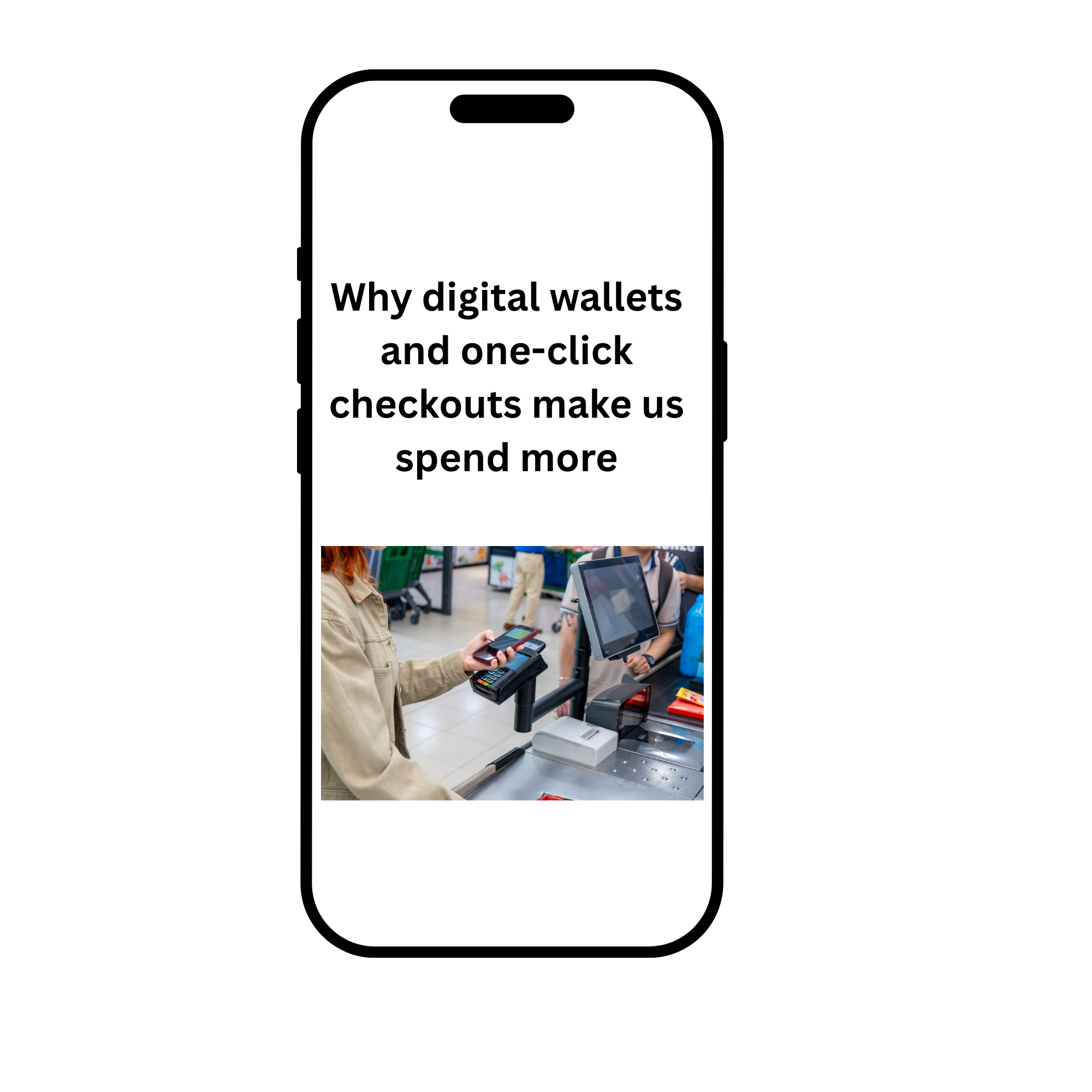
Digital wallets, UPI and one-click checkouts make us spend more because they remove the “pain of paying,” the small discomfort we feel when money leaves our hands. With no cash to count and no card details to type, the brain barely registers a purchase, impulses go unchecked and small payments add up unnoticed. Adding deliberate friction, such as waiting periods and removing saved cards, restores control.
Key takeaways
- The “pain of paying”is a natural brake on spending. Cash triggers it most; a tap, scan or fingerprint triggers it least.
- Classic research by MIT’s Drazen Prelec and Duncan Simester found people were willing to pay substantially more when using a credit card than cash.
- A 2024 IIIT-Delhi survey reported that about 74% of respondents felt they spent more after adopting UPI.
- Friction is protective.Every extra checkout step gives your rational mind time to catch up with your impulses.
- India’s Guidelines for Prevention and Regulation of Dark Patterns, 2023 ban tactics such as false urgency, basket sneaking and subscription traps.
- You can keep the convenience and regain control with 12 simple habits listed below.
It is 11 p.m. and you are scrolling on your phone in bed. A pair of headphones appears in your feed, discounted, with a countdown timer ticking beside the price. You tap once, rest your thumb on the fingerprint sensor, and it’s done. Before you have fully asked yourself whether you needed headphones, the confirmation arrives.
That smoothness is no accident. Digital wallets and one-click checkouts are engineered to remove every obstacle between wanting something and owning it. For businesses, that is a triumph of design. For your bank balance, it can be a quiet problem. This article explains the psychology behind frictionless payments, why they push us to spend more, and how to keep the convenience while taking back control.
What Is a Frictionless Payment?
- A frictionless payment is any payment method designed to complete a purchase with as few steps, as little thought and as little effort as possible. Examples include saved cards, one-click ordering, UPI payments with a PIN, UPI Lite for small amounts, contactless “tap to pay,” biometric approvals and auto-debit mandates.
- India has adopted frictionless payments faster than almost any country. UPI now processes more than 20 billion transactions a month, according to National Payments Corporation of India (NPCI) data, from street vendors to large e-commerce platforms.
How did checkout become so easy?
- Not long ago, buying something online was a small ordeal. You found your card, typed a 16-digit number, the expiry date and CVV, filled in your address, waited for an OTP and sometimes created an account first. Each step was an annoyance, and each annoyance lost sales.
- Retailers noticed. Cart abandonment became one of the most studied problems in e-commerce, and the industry responded with relentless simplification: saved cards, autofill, guest checkout and the single-tap purchase. Digital wallets and UPI went further, letting you approve a payment with a face scan, fingerprint or four-digit PIN.
- The goal was reasonable. Nobody wants a checkout so clunky that it defeats a purchase they truly wanted. But when you strip out every step, you also remove the moments in which people naturally reconsider.
What Is the “Pain of Paying”?
The pain of paying is the small psychological discomfort we feel when we part with money. Behavioural economists, including Drazen Prelec and George Loewenstein, use the term to explain why paying can feel unpleasant, and why that unpleasantness acts as a brake on spending.
Counting out cash makes a purchase feel real. You watch the notes leave your hand and your wallet gets visibly thinner. That discomfort makes you ask, “Is this worth it?”
Research on payment methods has repeatedly suggested that the less tangible the payment, the weaker the sting:
Payment method | How “real” it feels | Typical pain of paying |
Cash | You see and count it leaving | High |
Debit card | Money leaves, but invisibly | Medium |
Credit card | Money leaves later | Low to medium |
UPI / wallet tap | A gesture and a PIN | Low |
Saved card, one-click | A single tap | Very low |
Auto-debit subscription | No action at all | Almost none |
In a well-known experiment, MIT researchers Drazen Prelec and Duncan Simester found that people bidding for sports tickets were willing to pay substantially more when told they would pay by credit card rather than cash. Researchers sometimes say card and digital payments make money feel like “play money,” closer to points in a game than hours of your working life.
Digital wallets intensify this. There is no card to pull out, no number to read and no signature. The transaction is compressed into a gesture so small that the brain barely records it as spending.
Why Is Friction a Feature, Not a Bug?
- In product design, friction is any step that slows a user down. In personal finance, friction is a protective device. Every extra action between impulse and purchase, whether typing an address, finding your card or entering an OTP, works as a tiny cooling-off period.
- These pauses matter because the reasoning part of your brain is slower than the emotional part. Desire arrives instantly. Weighing the price against your budget, your needs and your other priorities takes time. A few seconds of friction can be enough for your rational side to say, “Actually, I already own something like this.”
- One-click ordering collapses that gap. The distance between “that looks nice” and “it’s on its way” shrinks to a second, and the deliberate part of your mind may never get to speak. This is the core reason frictionless checkout increases spending: it doesn’t change what you want; it removes the time you’d normally use to decide whether you really want it.
How Does Speed Fuel Impulse Buying?
- Impulse purchases are driven by emotion: excitement, boredom, stress, loneliness or the thrill of a bargain. Emotions are temporary. Wait an hour and much of the urge often fades. Wait a day and many purchases feel unnecessary.
- Fast checkout is designed to capture the purchase before the feeling passes. Add push notifications, flash sales, limited-time offers and “only 2 left in stock” banners, and you get a pipeline that turns fleeting desire into a completed transaction in seconds.
- Mobile shopping makes this stronger. Your phone is with you in bed, on the sofa, in a queue and at the dinner table, often when you are tired, distracted or looking for a small lift. Decision quality falls when we are fatigued. Late-night shopping with a saved card and biometric login is very different from sitting at a desk comparing options.
- There is also an emotional loop. Buying something gives a brief mood boost, and the easier the purchase, the easier it is to reach for that boost whenever you feel low. Over time, frictionless payment can turn shopping from an occasional decision into a habitual coping mechanism.
Why Is the Running Total So Easy to Miss?
- Digital payments don’t only weaken the pain of each purchase. They also blur your sense of the total. With cash, your wallet is a live gauge of what is left. With a phone, your balance sits in an app you may not open until the end of the month.
- Small payments are especially tricky: a coffee, an auto ride, a snack, an in-app upgrade, a delivery fee, a movie rental. Each feels too small to matter, so none triggers concern. But dozens of small, easy payments add up, and the end-of-month statement can be a shock. This is often called “death by a thousand taps.”
- Stored payment details make it worse. Once your card or UPI is saved across apps, spending takes no effort and habits run on autopilot. Free trials that convert to paid plans, auto-renewing subscriptions and wallet top-up reminders all exploit the same inertia. Cancelling takes effort; continuing takes none.
- India’s rules offer some protection. Under RBI’s e-mandate framework, banks must send a pre-debit notification at least 24 hours before a recurring charge, and larger recurring debits need additional authentication. Those alerts only help if you read them.
Which Design Tricks Work Alongside One-Click Payment?
Frictionless payment rarely works alone. It sits inside a checkout full of nudges that tilt you towards buying.
- Pre-selected defaults. Add-ons, express delivery, tips, donations or extended warranties are ticked for you. Opting out takes effort.
- Buy now, pay later (BNPL) and no-cost EMI. Splitting a price into instalments makes a large amount feel small, even though the total is the same.
- Rewards and cashback. Points and cashback make spending feel like earning, so people buy more to “save” more.
- Urgency and scarcity cues. Countdown timers and “3 people are viewing this” messages turn a calm decision into a race.
- Personalised recommendations. Algorithms show items matched to your browsing, making them harder to resist.
- Abandoned-cart reminders. Follow-up messages arrive when your resolve is weakest, often with a small discount.
Several of these are now regulated. In 2023, India’s Central Consumer Protection Authority (CCPA) notified the Guidelines for Prevention and Regulation of Dark Patterns, which list 13 prohibited practices, including false urgency, basket sneaking (adding items without consent), confirm shaming, forced action, subscription traps and drip pricing. If you spot one, you can report it through the National Consumer Helpline (1915).
Who Is Most Affected by Frictionless Spending?
Everyone is susceptible, but some people feel the effect more strongly:
- Young adults and teenagers who have grown up with UPI and may never have felt the physical sensation of spending cash.
- People under stress, for whom comfort spending becomes easier than ever.
- Those on tight budgets, where invisible leaks such as forgotten subscriptions and repeated delivery fees take a bigger share of income.
- Heavy app userswho see more prompts, offers and chances to tap.
Knowing where you fall helps. If you shop mostly when bored or tired, add pauses at those times. If you lose track of small payments, focus on visibility.
Is It All Bad? The Case for Digital Wallets
It would be unfair to paint digital wallets as villains. They offer real benefits:
- Many use tokenisation, so the merchant receives a token instead of your card number. Since October 2022, RBI rules have barred most merchants from storing actual card details. Biometrics and PINs protect against casual misuse.
- Every digital payment leaves a searchable trail, a powerful budgeting aid if you use it.
- Everyday convenience.Paying for transport, splitting bills, sending money to family and paying small merchants without handling cash.
- For people with disabilities or those who struggle with long forms, streamlined checkout can be genuinely enabling.
The problem isn’t the technology. It is that convenience and self-control pull in opposite directions, and companies have strong incentives to push convenience. The solution is not to abandon useful tools but to add back the friction that protects you.
How to Stop Impulse Buying Online: 12 Practical Habits
- Add a waiting period.Put non-essential items in your cart or wishlist and wait 24 hours. For larger purchases, wait a week.
- Remove saved cards from impulse-prone apps.Shopping, food delivery, gaming and streaming apps are the usual culprits.
- Turn on instant transaction alertsby SMS or app notification so every payment feels real again.
- Use a separate account for discretionary spending.Transfer a fixed “fun money” amount each month. When it’s gone, it’s gone.
- Set UPI and card limits.Most banking apps let you lower daily UPI, online and contactless limits.
- Audit subscriptions monthlyand manage active auto-debit mandates in your UPI app or bank app. Set reminders before free trials end.
- Be sceptical of BNPL and no-cost EMI. Ask: would I buy this if I had to pay the full price today?
- Check your spending weekly.Five minutes with your transaction history keeps the invisible total visible.
- Shop from a list.Decide what you need, buy it and close the app.
- Disable one-click orderingor require a confirmation step where the platform allows it.
- Turn off promotional notifications.If a retailer can’t reach you at 11 p.m., it can’t tempt you at 11 p.m.
- Make a rule for emotional states.Decide in advance not to buy anything non-essential when you are stressed, bored or tired, and review past purchases monthly to learn your triggers.
What Should Businesses Do Differently?
Companies have a part to play too. Ethical design means making it easy to buy and easy to see spending, cancel subscriptions and get refunds. Clear pricing, honest defaults, spending summaries and optional cooling-off features build long-term trust. Customers who feel respected stay loyal; those who feel tricked complain and leave.
Some banks and apps already offer spending limits, category budgets and instant card freezes. These show that the same technology that removes friction can add helpful friction back when the customer wants it. Regulators, including India’s CCPA, are paying closer attention to manipulative design, which should push the industry towards more transparency.
Rethinking Convenience
We tend to treat convenience as an unqualified good. Faster is better, easier is better, fewer steps are better. But convenience has a cost when it removes the moments in which we make wise choices. The better question isn’t “How can I make this easier?” but “Where do I want it to stay easy, and where do I want a pause?”
For routine, planned spending such as groceries, rent, transport and bills, frictionless payment is a gift. For discretionary, emotional or impulsive spending, a little friction is a form of self-care.
Final Thoughts
Digital wallets and one-click checkouts succeed because they remove friction, and friction is one of the ways our minds protect us from overspending. By making payment nearly invisible, they weaken the pain of paying, shorten the time for second thoughts and hide the running total. Combined with urgency cues, personalised offers and stored payment details, they make buying the path of least resistance.
You don’t have to give up the tools. Treat convenience as something that needs guardrails: add pauses where you’re vulnerable, make spending visible, remove saved cards from your weakest spots and set a budget the technology can’t quietly override. A little deliberate friction goes a long way towards making sure the things you buy are things you actually want.
Sources and Further Reading
- https://doi.org/10.1023/A:1008196717017
- https://doi.org/10.1287/mksc.17.1.4
- https://arxiv.org/abs/2401.09937
- https://www.rbi.org.in/Scripts/NotificationUser.aspx?Id=11668&Mode=0
- https://www.rbi.org.in/Scripts/BS_ViewMasDirections.aspx?id=12159
- https://www.npci.org.in/what-we-do/upi/product-statistics
Frequently Asked Questions
When rates rise, newly issued bonds pay higher interest. Older bonds paying lower interest become less attractive, so their market price falls until their yield matches the new rate. The longer a bond’s maturity, the bigger the price drop, which is why long-duration debt funds are most affected.
Duration measures how sensitive a bond or debt fund’s price is to changes in interest rates. A modified duration of 5 means the price will change by roughly 5% for every one percentage point move in rates, in the opposite direction. Debt fund fact sheets publish this figure every month.
A repo rate hike usually lowers prices of long-duration debt funds, raises yields on new FDs and liquid funds, increases EMIs on repo-linked floating-rate loans and can pressure richly valued stocks. Banks may see wider margins. The overall effect depends on why the RBI is hiking and what markets already expected.
No. High FD rates are useful for short-term money, but rates on new deposits fall when the rate cycle turns, and FD interest is taxed at your slab rate. Moving everything into FDs also gives up long-term equity growth. A ladder and a diversified allocation work better.