
Start teaching children about Smart money from about age three. Research from the University of Cambridge suggests many money habits begin forming by around age seven. Early lessons on saving, waiting, choosing and planning build habits that last a lifetime. Use simple, age-appropriate tools such as play shops, Save-Spend-Share jars, pocket money with clear rules and, later, a child’s own bank account.
Key takeaways
- Smart Money habits start early.A University of Cambridge study found that many core money habits are formed by about age seven.
- Smart Money skills are life skills:patience, choice, planning, self-control and responsibility.
- Money is harder to “see” today because of UPI, cards and one-click buying, so children need deliberate teaching.
- Time is the best money tool.The earlier someone starts saving, the more compounding works for them.
- Teach by age:play and coins at 3–5; earn, save, spend and share at 6–9; budgets at 10–12; real-world skills at 13–15; independence at 16–18.
- In India, RBI rules allow children aged 10 and above to open and operate a savings account independently, if the bank permits.
Most of us never had a class called “How Money Works.” We learned bit by bit. We heard our parents talk about bills. We spent our first salary too fast. We made mistakes, and some of them cost a lot.
It doesn’t have to be this way for our children. Kids can understand more about money than most adults think, and the habits they learn when they are young often stay with them for life.
In this guide, you’ll learn why starting early matters, what children can learn at each age, simple activities you can do at home and the savings options available to children in India.
What Is Financial Literacy for Children?
Financial literacy for children means teaching kids, in age-appropriate ways, how money is earned, saved, spent, shared and grown, and how to make thoughtful choices about it. It isn’t about turning children into investors. It is about helping them feel calm, capable and confident with money.
In India, financial literacy is a national priority. The RBI, SEBI, IRDAI and PFRDA support the National Centre for Financial Education (NCFE), which runs programmes for schools under the National Strategy for Financial Education. But schools can only do so much. Most money lessons still happen at home.
Why Should You Start Teaching Children About Money Early?
1. Habits begin when children are small
Researchers at the University of Cambridge (David Whitebread and Sue Bingham, in a 2013 study for the UK’s Money Advice Service) found that many money habits begin to form by about age seven. This doesn’t mean a child’s future is fixed at seven. It means the early years matter a great deal. This is when children first learn about saving, spending, waiting and sharing.
Children watch everything. They see how you pay. They hear how you talk about money. They notice whether you are calm or worried. If nobody teaches them on purpose, they still learn. They just learn from whatever they happen to see.
2. Smart Money skills are life skills
Money isn’t only about numbers. It is mostly about how we act. When children learn about money, they also learn to:
- A bigger reward later can be better than a small one now.
- Picking one thing often means giving up another.
- Set a goal and take small steps to reach it.
- Control impulses.Stop and think before buying.
- Take responsibility.Choices have results.
These skills help in school, at work and in relationships. Teaching a child about money is really teaching a child how to think about the future.
3. Money is harder to see today
When we were young, money was something you could hold. You gave someone a note and watched it leave your hand.
Today, children see parents scan a QR code or tap a card. Nothing seems to leave. Games let them buy things with one click, and ads are designed to make spending feel easy. Behavioural economists call the discomfort we feel when paying the “pain of paying,” and digital payments weaken it. If children don’t understand the basics, they may not notice how much is being spent. When they learn the core ideas early, they can handle any kind of payment, now or in the future.
4. Time is the best money tool
The biggest benefit of starting early is time.
Imagine putting a little money in a savings account. It earns a small reward called interest. Next year, you earn interest on your original money and on the interest you already earned. This is compound interest. It grows slowly at first, then faster and faster.
Here is a simple example. Two people each save ₹2,000 a month and earn the same illustrative return of 10% a year. One starts at 20, the other at 30. By age 60, the early starter will have nearly three times as much, about ₹1.27 crore compared with about ₹45 lakh, even though they put in only ₹2.4 lakh more. The only real difference is ten extra years of growth.
Real results depend on interest rates, fees and inflation, and nothing is guaranteed. But the idea is clear: the earlier you start, the more time works for you. It is much easier to understand this when you learn it as a child.
5. Early lessons prevent big problems later
Adults who never learned about money may struggle with debt, late bills or having no emergency savings. Many feel stress, shame or fear when they think about money.
Children who learn calmly and early tend to feel more confident. They see money as a tool, not a scary secret. A small mistake at age 10, such as spending all their pocket money on one toy, is a cheap lesson. The same mistake at 30 can be very costly.
What Should You Teach at Each Age?
Children learn best when lessons match their age. You don’t need to be an expert. You just need to keep it simple and be patient.
Age | Big idea | Example activity | Phrase to use |
3–5 | Money is something we use | Play shop with toy coins | “We are saving this for something special.” |
6–9 | Earn, save, spend, share | Three jars: Save, Spend, Share | “What are you saving for?” |
10–12 | Plan and make choices | Make a simple budget | “Is this a need or a want?” |
13–15 | Real-world skills | Manage a monthly allowance | “What happens if prices go up?” |
16–18 | Get ready to be independent | Run a full monthly budget | “What’s your plan, and your backup plan?” |
Ages 3 to 5: Money is something we use
At this age, children are just starting to understand the world. Keep lessons short and fun.
What to teach:
- Money is used to buy things.
- Coins and notes have different values.
- We can’t buy everything we see.
- Some things we need, and some things we want.
Easy activities:
- Play shop.Use toys and pretend coins. Let your child be the shopkeeper, then the buyer.
- Sort coins.Ask your child to group coins by size or value.
- Use a clear jar.Let your child drop in a coin and watch the jar fill. Seeing it grow makes saving real.
- Talk while shopping.Say, “We need milk today. We don’t need the chocolate.” Keep it calm and short.
Ages 6 to 9: Earn, save, spend, share
Now children can count, add and follow simple rules. This is a great time to start small, regular pocket money.
What to teach:
- Money is earned by work. It doesn’t appear by magic.
- Money can be saved, spent or shared.
- Prices can be compared.
- Waiting can lead to a better choice.
Easy activities:
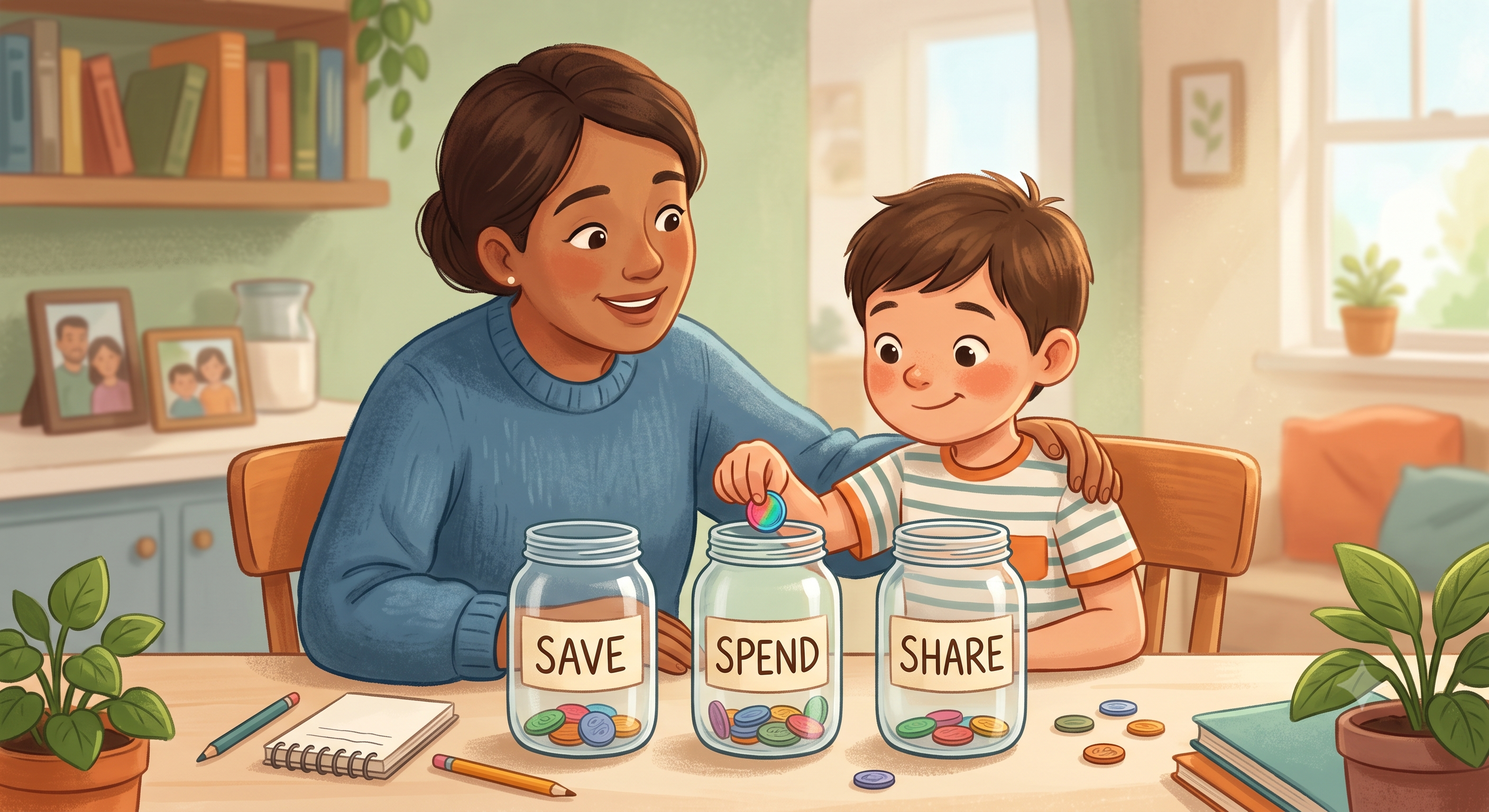
- Use three jars labelled Save, Spend and Share. When your child gets money, they split it between the jars. Decide the split together.
- Set a savings goal.Let your child pick something they want, such as a book or a game. Write down the price, draw a chart and colour a box each time they save.
- Let them make small buying choices.Give your child a set amount at a shop or fair and let them decide. If they spend it all on one item and then see something better, don’t rescue them. It is a gentle, real lesson.
- Compare prices.Ask, “Which biscuit packet costs less? Why might that be?”
- Pay for extra jobs, not daily chores.You might pay for washing the car, but keep tasks like making the bed separate, because those are part of being in a family.
Ages 10 to 12: Plan and make choices
At this age, children can think ahead, understand budgets and weigh trade-offs. They also start to feel pressure from friends and advertising.
What to teach:
- A budget is a plan for your money.
- Needs come before wants.
- Ads are designed to make us want things.
- Banks keep money safe and pay interest.
- Giving and helping others is part of good money habits.
Easy activities:
- Make a simple budget.Write down how much money comes in and where it goes, in a notebook or an app.
- Open a savings account.Visit a bank together or open a children’s account online. Let your child see the balance and the interest. In India, RBI rules let children aged 10 and above open and operate a savings account independently, subject to the bank’s limits.
- Spot the ad tricks.While watching TV or scrolling, ask, “What is this ad trying to make you feel?” Talk about words like “limited time” and “only today.”
- Plan a family event.Give your child a small budget for a birthday party or picnic. Let them list what they need and what each item costs.
- Try a small business idea.A lemonade stall, handmade rakhis or cards, or a school bake sale teaches cost, price and profit in a fun way.
Ages 13 to 15: Real-world skills
Teenagers are close to handling real money. They need more freedom and more honest conversations.
What to teach:
- How banks, debit cards, UPI and interest work.
- Why debt can be risky.
- How to track spending.
- How saving and investing differ.
- How to stay safe online with money.
Easy activities:
- Give a monthly allowance for a set list of costs, such as snacks, phone recharges or outings. When the money runs out, it runs out. It is a safe way to learn.
- Show a real bill.Look at an electricity, phone or internet bill together so they see what things actually cost.
- Explain how debt works.Use simple numbers to show how borrowing means paying back more than you borrowed.
- Talk about scams.Teach them never to share OTPs, passwords or UPI PINs, and that you only enter a UPI PIN to send money, never to receive it. Offers that sound too good to be true usually are.
- Try a pretend investment game. Many free tools let teens practise with virtual money, showing how prices rise and fall without real risk.
Ages 16 to 18: Get ready to be independent
Soon your child will be an adult. This is the time to turn knowledge into skill.
What to teach:
- How to earn income, read a payslip and understand income tax and PAN.
- How credit scores work and how to build a good credit history later.
- Why an emergency fund matters.
- How to rent, borrow and buy insurance safely.
- How to start long-term saving and investing, such as SIPs in mutual funds.
Easy activities:
- Help them manage their own bank account with light support.
- Build a small emergency fund and explain why it’s smart to keep money aside for surprises.
- Practise a full budget with real numbers for rent, food, travel and fun. Ask what they would cut if money were short.
- Review the cost of college or training, including fees, education loans and likely future earnings.
- Talk about long-term goals. Ask, “Where do you want to be in ten years? What would you need to save?”
What Savings Options Are Available for Children in India?
As your child grows, you can move from jars to real accounts. Here are common options:
Option | Who it’s for | Key features |
Minor savings account | Any child; those aged 10+ can operate it independently if the bank allows | Teaches banking basics; banks may set limits on withdrawals and features |
Public Provident Fund (PPF) for minors | Opened by a parent or guardian | Government-backed, 15-year lock-in, tax-efficient |
Sukanya Samriddhi Yojana (SSY) | Girl child below age 10 | Government savings scheme for a daughter’s education and future |
NPS Vatsalya | Minors, opened by parents (launched September 2024) | Long-term pension savings that convert to a regular NPS account at 18 |
Mutual fund investments in a minor’s name | Held through a parent or guardian | Useful for teaching about long-term investing and compounding |
Check current interest rates, limits and rules with the bank, post office or official scheme websites before opening any account.
Everyday Ways to Teach Smart Money
You don’t need special lessons. Daily life gives you plenty of chances.
Talk openly, but keep it age-appropriate
Many families avoid talking about money, which can make children think it’s a secret or a source of shame. You don’t need to share every detail, but you can explain simple things. Instead of “We can’t afford it,” try: “That’s not in our plan this month. We’re saving for something else.” This shows that money choices are about priorities, not just yes or no.
Be a good example
Children copy what they see. If you plan your spending, save a little and stay calm about money, they will notice. If you make a mistake, say so: “I bought that without thinking, and I regret it. Next time I’ll wait a day.” This shows that mistakes are normal and fixable.
Let them make small mistakes
It is tempting to protect children from every bad choice, but small mistakes are the best teachers. If your child spends their pocket money on a toy that breaks in a day, that lesson will stick. Stay kind and avoid “I told you so.” Instead, ask: “What would you do differently next time?”
Praise effort and good thinking
When your child saves for a goal, say, “You were patient. That was hard, and you did it.” This builds pride in the habit, not just the result.
Make saving visible
Children need to see progress. Clear jars, charts or a simple app showing the balance make saving feel exciting.
Teach giving, too
Money isn’t only for ourselves. Let children choose a cause or a person to help. Even a small gift teaches that money can do good and helps them feel they have something to offer.
Common Mistakes Parents Make
- Waiting too long. Even a three-year-old can learn that coins buy things.
- Giving money with no rules or conversation. Pocket money works best with simple guidance, like the three jars.
- Always saying yes. If children get everything they ask for, they never learn to wait or choose.
- Making money scary. If every money conversation is full of worry, children may fear it. Stay calm and honest.
- Rescuing too quickly. If you always top up when your child runs out, they won’t learn to plan.
- Linking money to love. Avoid saying, “I buy you things because I love you.” Love isn’t measured in money.
- Using money constantly as a bribe or punishment. This can teach children to focus only on rewards.
Should Children Earn Money for Chores?
Families choose different answers. Two common approaches:
- Option 1: Chores are family jobs. Everyone helps at home without payment. Pocket money is given separately to teach money skills.
- Option 2: Extra jobs earn extra money. Daily chores are unpaid, but bigger tasks, such as cleaning the balcony or helping with a garage clear-out, earn a small payment.
Many parents mix both. The key is to be clear, fair and consistent, so children know what is expected and what is extra.
What If I’m Not Good With Money Myself?
Many parents worry they aren’t the right teacher. You don’t need to be perfect. You only need to be willing to learn.
- Learn together. Read a children’s book about money with your child and look up questions together.
- Be honest. It’s fine to say, “I’m still learning this too.”
- Start small. One jar, one goal and one chat a week is enough.
- Use free resources. The NCFE, RBI, SEBI and many banks offer free lessons, games and videos for children and parents.
Showing that you are trying to improve is a powerful lesson in itself.
What Are the Long-Term Benefits?
When children learn about money early, they tend to:
- save with more ease, because saving feels normal, not painful;
- avoid unnecessary debt, because they know the real cost of borrowing;
- feel less stress, because they have a plan and feel in control;
- make wiser choices, because they think before they buy;
- handle emergencies better, because they have savings and know how to adapt;
- reach their goals, because they know how to turn a dream into a plan.
Just as importantly, they carry habits like patience, honesty and care for others, which matter far beyond money.
A Simple Start Plan for This Week
- Today: Get a clear jar, or three small jars labelled Save, Spend and Share.
- This week: Pick one small goal with your child and write down the price.
- At the shop: Let your child help you compare two prices.
- At dinner: Ask, “If you had a little money, what would you do with it?”
- Every week: Spend five minutes checking the jars together.
That’s all it takes to begin. Add more as your child grows.
Final Thoughts
Teaching children about money is one of the best gifts you can give. It isn’t about making them rich. It’s about helping them feel calm, capable and ready for the real world. You don’t need long lectures or fancy tools. A jar, a few honest conversations and a little patience are enough to start. Each small lesson builds a strong base; over time, those lessons grow into habits, and those habits grow into freedom.
The earlier you begin, the more time your child has to learn, make small mistakes and grow. So start today. Your child’s future self will thank you.
Source
- RBI – Opening and operation of deposit accounts of minors (21 April 2025): https://www.rbi.org.in/Scripts/NotificationUser.aspx?Id=12835
- NCFE – National Strategy for Financial Education: https://www.ncfe.org.in/NSFE
Full NSFE 2020–25 report (RBI): https://www.rbi.org.in/scripts/PublicationReportDetails.aspx?ID=1156 - PFRDA – NPS Vatsalya: https://www.pfrda.org.in/web/pfrda/schemes/national-pension-system/nps-vatsalya
- India Post – Small savings schemes (SSY and PPF): https://indiapost.gov.in/banking-services/saving
Ministry of Finance – Small savings: https://dea.gov.in/budgetdivision/small-savings - OECD – PISA 2022 Results (Volume IV): How Financially Smart Are Students?: https://oecd.org/en/publications/pisa-2022-results-volume-iv_5a849c2a-en.html