

9.1 Basics of Tax Planning

Tax planning in India is an essential part of mastering money management. It involves strategically organizing your financial affairs to minimize your tax liability and make the most of available deductions and credits. Here’s a detailed breakdown:
- Understand Your Tax Bracket
- Tax Brackets: Knowing your tax bracket helps you estimate how much tax you’ll owe. Tax rates increase progressively with income, so your income level determines your marginal tax rate.
- Taxable Income: This is the income that’s subject to tax after deductions and exemptions are applied. Understanding this will help you forecast your tax obligations.
- Maximize Deductions
- Standard Deduction: A set amount that reduces your taxable income. It’s different for various filing statuses (e.g., single, married filing jointly).
- Itemized Deductions: If your deductible expenses exceed the standard deduction, itemizing can reduce your taxable income further. Common deductions include:
- Mortgage interest
- Property taxes
- Medical expenses
- Charitable donations
- Business expenses (if self-employed)
- Take Advantage of Tax Credits
- Tax Credits vs. Deductions: Credits directly reduce the amount of tax you owe, unlike deductions which reduce taxable income. Credits can be non-refundable (only reduce tax to zero) or refundable (can result in a refund).
- Common Credits:
- Child Tax Credit: For families with dependent children.
- Earned Income Tax Credit (EITC): For low-to-moderate-income workers.
- Education Credits: Like the American Opportunity Tax Credit (AOTC) and Lifetime Learning Credit.
- Retirement Contributions
- 401(k) and IRA Contributions: Contributions to these accounts can reduce your taxable income. Traditional 401(k) contributions are pre-tax, and traditional IRA contributions may be tax-deductible.
- Roth Accounts: Contributions are made with after-tax dollars, but qualified withdrawals are tax-free. This can be advantageous depending on your future tax rate.
- Health Savings Accounts (HSAs)
- Triple Tax Benefit: Contributions are tax-deductible, grow tax-free, and withdrawals for qualified medical expenses are tax-free.
- Eligibility: Must be enrolled in a high-deductible health plan (HDHP).
- Plan for Major Life Events
- Marriage: Consider the tax implications of filing jointly or separately.
- Having a Child: Take advantage of child tax credits and dependent care credits.
- Buying a Home: Mortgage interest and property taxes can be itemized deductions.
- Income Timing and Deferral
- Defer Income: If you expect to be in a lower tax bracket in the future, defer receiving income to reduce current tax liability.
- Accelerate Deductions: If you’re in a higher tax bracket this year, accelerate deductible expenses to reduce taxable income.
- Tax-Advantaged Investments
- Municipal Bonds: Interest income from these bonds is often tax-free at the federal level and possibly at the state level.
- Capital Gains: Long-term capital gains (on assets held for more than a year) are taxed at a lower rate than short-term gains.
- Stay Organized
- Record-Keeping: Maintain thorough records of your income, expenses, and all relevant documents. This will make tax filing easier and ensure you don’t miss out on deductions or credits.
- Software and Tools: Use tax planning software or apps to track your finances and stay on top of tax-related deadlines.
- Consult a Professional
- Tax Advisor: Complex tax laws and frequent changes can make tax planning challenging. A professional can provide personalized advice and ensure compliance with current regulations.
- Regular Reviews: Periodically review your tax plan with a professional to adjust for changes in your financial situation or tax laws.
By mastering these tax planning strategies, you’ll be better equipped to manage your money effectively, reduce your tax liability, and optimize your financial well-being. Remember, proactive planning throughout the year can make tax season much less stressful and more financially rewarding.
Example
Let’s walk through an example of tax planning for Ravi, who has a monthly salary of ₹70,000. Here’s how Ravi can plan his taxes effectively for the financial year.
Scenario
- Monthly Salary: ₹70,000
- Annual Salary: ₹70,000 x 12 = ₹8,40,000
Step 1: Understanding Taxable Income
Ravi needs to know his gross income and identify the deductions and exemptions he can claim to reduce his taxable income.
- Gross Annual Income: ₹8,40,000
Step 2: Utilize Section 80C Deductions
Ravi can claim up to ₹1,50,000 as deductions under Section 80C by investing in eligible tax-saving instruments.
- Investments:
- Public Provident Fund (PPF): ₹50,000
- Employee Provident Fund (EPF): ₹36,000 (12% of ₹70,000 x 12 months)
- Equity-Linked Savings Scheme (ELSS): ₹64,000
- Total Section 80C Deductions: ₹1,50,000
Step 3: Health Insurance (Section 80D)
Ravi can claim deductions for health insurance premiums paid for himself and his family.
- Self and Family Health Insurance Premium: ₹25,000
- Total Section 80D Deductions: ₹25,000
Step 4: Home Loan Interest (Section 24)
Let’s assume Ravi has a home loan and can claim deductions for the interest paid on the loan.
- Home Loan Interest Paid: ₹1,50,000
- Total Section 24 Deductions: ₹1,50,000
Step 5: Other Deductions
- Savings Account Interest (Section 80TTA): ₹8,000 (up to ₹10,000 allowed)
Step 6: Calculating Taxable Income
Ravi will now calculate his taxable income by subtracting the total deductions from his gross income.
- Gross Income: ₹8,40,000
- Total Deductions:
- Section 80C: ₹1,50,000
- Section 80D: ₹25,000
- Section 24: ₹1,50,000
- Section 80TTA: ₹8,000
- Total Deductions: ₹3,33,000
- Taxable Income: ₹8,40,000 – ₹3,33,000 = ₹5,07,000
Step 7: Tax Calculation (Old Tax Regime)
Ravi will calculate his tax liability based on the old tax regime slabs:
- Up to ₹2,50,000: NIL
- ₹2,50,001 to ₹5,00,000: 5% of ₹2,50,000 = ₹12,500
- ₹5,00,001 to ₹5,07,000: 20% of ₹7,000 = ₹1,400
- Total Tax Liability: ₹12,500 + ₹1,400 = ₹13,900
- Tax Rebate under Section 87A (for income up to ₹5,00,000): ₹12,500 (as taxable income is slightly above ₹5,00,000)
Step 8: Final Tax Liability
- Total Tax Liability (after rebate): ₹13,900 – ₹12,500 = ₹1,400
By planning his taxes and strategically investing in tax-saving instruments, Ravi has managed to significantly reduce his taxable income and save on taxes.
9.2 Filing Tax Returns

Filing tax returns in India is a crucial process for every taxpayer. Here’s a detailed guide to help you understand the steps involved:
- Determine Your Income Sources
Identify all sources of income, such as:
- Salary
- Business or profession
- House property
- Capital gains
- Other sources (interest, dividends, etc.)
- Choose the Correct ITR Form
There are different Income Tax Return (ITR) forms based on your income sources and category:
- ITR-1 (Sahaj): For individuals with income from salary, one house property, and other sources (excluding lottery winnings and income from racehorses).
- ITR-2: For individuals and HUFs not having income from business or profession.
- ITR-3: For individuals and HUFs having income from business or profession.
- ITR-4 (Sugam): For individuals, HUFs, and firms (other than LLP) having presumptive income from business or profession.
- ITR-5: For persons other than individuals, HUFs, companies, and persons filing Form ITR-7.
- ITR-6: For companies other than those claiming exemption under section 11.
- ITR-7: For persons including companies required to furnish returns under sections 139(4A), 139(4B), 139(4C), or 139(4D).
- Gather Required Documents
Ensure you have the following documents ready:
- PAN card
- Aadhaar card
- Form 16 (for salaried individuals)
- Form 26AS (tax credit statement)
- Bank statements
- Investment proofs (for deductions)
- TDS certificates
- Login to the Income Tax E-Filing Portal
Visit the Income Tax E-Filing Portal and log in using your PAN as the user ID.
- Select the Assessment Year
Choose the relevant assessment year for which you are filing the return. For example, if you are filing for the financial year 2023-24, select AY 2024-25.
- Fill in the ITR Form
- Personal Information: Enter your personal details such as name, address, and contact information.
- Income Details: Provide details of your income from various sources.
- Deductions: Enter details of deductions under sections 80C, 80D, etc.
- Tax Paid: Verify the tax deducted at source (TDS) and advance tax paid.
- Validate and Submit
- Validate: Ensure all details are correct and validate the form.
- Submit: Submit the form electronically. You will receive an acknowledgment (ITR-V).
- E-Verify Your Return
You can e-verify your return using any of the following methods:
- Aadhaar OTP
- Net banking
- EVC (Electronic Verification Code)
- Sending a signed physical copy of ITR-V to the Centralized Processing Center (CPC) in Bengaluru.
- Track Your Refund
If you are eligible for a refund, you can track its status on the e-filing portal.
- Keep Records
Maintain a copy of the filed return and acknowledgment for future reference.
By following these steps, you can efficiently file your tax returns in India and ensure compliance with tax regulations
Example
Filing tax returns is a mandatory process for reporting income, expenses, and investments to the Income Tax Department. Ravi needs to gather all necessary documents, including Form 16 from his employer, bank statements, and details of any investments or deductions. He can use the online portal of the Income Tax Department to file his returns, ensuring he accurately reports his income and claims eligible deductions. By filing returns on time, Ravi avoids penalties and maintains compliance with tax laws.
9.3. Tax Saving Investment

Tax-saving investments in India are essential for reducing your tax liability while also growing your wealth. Here are some of the most popular tax-saving investment options:
- Equity-Linked Savings Scheme (ELSS)
Equity-Linked Savings Schemes (ELSS) are a type of mutual fund that primarily invests in equities (stocks). These funds are designed to provide the dual benefits of capital appreciation and tax savings. They are a popular investment choice for individuals looking to save on taxes while potentially earning higher returns. Investments in ELSS are eligible for tax deductions under Section 80C of the Income Tax Act, up to a limit of ₹1.5 lakh per financial year. This means that you can reduce your taxable income by investing in ELSS. ELSS funds come with a mandatory lock-in period of 3 years. During this time, you cannot redeem your investment. However, this is the shortest lock-in period among all tax-saving investment options under Section 80C. Since ELSS funds invest primarily in equities, they have the potential to generate higher returns compared to traditional fixed-income investments. However, the returns are market-linked and can vary based on the performance of the stock market. ELSS funds invest in a diversified portfolio of stocks across different sectors and market capitalizations. This diversification helps spread the risk and can potentially enhance returns. You can invest in ELSS through a Systematic Investment Plan (SIP), where you invest a fixed amount regularly (monthly, quarterly, etc.). This helps in averaging the purchase cost and mitigating market volatility.
- Public Provident Fund (PPF)
The Public Provident Fund (PPF) is a long-term, government-backed savings scheme aimed at providing a secure investment option with attractive returns. PPF offers a fixed interest rate, currently around 7-8% per annum, which is compounded annually. Investments in PPF are eligible for tax deductions up to ₹1.5 lakh under Section 80C of the Income Tax Act. The scheme has a lock-in period of 15 years, after which the invested amount, along with the accrued interest, can be withdrawn. Partial withdrawals are allowed from the 7th year onwards. PPF is an excellent choice for individuals seeking a safe investment with tax benefits and long-term growth.
- National Savings Certificate (NSC)
The National Savings Certificate (NSC) is a fixed-income investment scheme backed by the government, designed to encourage small savings among individuals. NSC offers a fixed interest rate, currently around 6-7% per annum, which is compounded annually but payable at maturity. Investments in NSC are eligible for tax deductions up to ₹1.5 lakh under Section 80C of the Income Tax Act. The scheme has a lock-in period of 5 years, making it suitable for individuals looking for a medium-term investment option with guaranteed returns. NSC is a secure investment that provides steady returns and tax benefits.
- Sukanya Samriddhi Yojana (SSY)
Sukanya Samriddhi Yojana (SSY) is a government-backed savings scheme specifically designed for the girl child. The scheme aims to promote the welfare of the girl child by encouraging parents to save for their daughter’s future education and marriage expenses. SSY offers a fixed interest rate, currently around 7-8% per annum, which is compounded annually. Investments in SSY are eligible for tax deductions up to ₹1.5 lakh under Section 80C of the Income Tax Act. The account remains active until the girl child turns 21 or gets married after the age of 18. Partial withdrawals are allowed for educational expenses after the child turns 18. SSY is a secure and rewarding investment for securing the financial future of a girl child.
- National Pension System (NPS)
The National Pension System (NPS) is a retirement-focused investment scheme that aims to provide financial security to individuals during their retirement years. NPS offers tax benefits under Section 80C (up to ₹1.5 lakh) and an additional deduction under Section 80CCD(1B) (up to ₹50,000). The scheme allows investors to choose from different asset classes, including equities, government bonds, and corporate bonds, providing the potential for market-linked returns. NPS has a lock-in period until the investor reaches the age of 60, after which they can withdraw a portion of the accumulated corpus as a lump sum and use the remaining amount to purchase an annuity for regular pension income. NPS is a versatile and efficient tool for retirement planning with tax benefits and flexible investment options.
- Senior Citizen Savings Scheme (SCSS)
The Senior Citizen Savings Scheme (SCSS) is a government-backed savings scheme designed to provide a secure and steady source of income for senior citizens. SCSS offers a fixed interest rate, currently around 7-8% per annum, which is payable quarterly. Investments in SCSS are eligible for tax deductions up to ₹1.5 lakh under Section 80C of the Income Tax Act. The scheme has a lock-in period of 5 years, which can be extended by an additional 3 years. SCSS is an ideal investment option for senior citizens seeking a safe investment with regular income and tax benefits.
- Unit Linked Insurance Plan (ULIP)
A Unit Linked Insurance Plan (ULIP) is a unique investment product that combines insurance and investment. ULIPs offer the dual benefits of life insurance coverage and the potential for wealth creation through market-linked investments. Premiums paid towards ULIPs are eligible for tax deductions up to ₹1.5 lakh under Section 80C of the Income Tax Act. The scheme has a lock-in period of 5 years, after which the policyholder can withdraw or switch funds. ULIPs allow investors to choose from a range of equity, debt, and balanced funds based on their risk appetite and financial goals. ULIPs are suitable for individuals looking for a comprehensive financial product that offers both protection and growth.
- Tax-Saving Fixed Deposits
Tax-Saving Fixed Deposits (FDs) are a type of fixed deposit with a lock-in period specifically designed for tax saving under Section 80C of the Income Tax Act. Investments in tax-saving FDs are eligible for tax deductions up to ₹1.5 lakh. These FDs offer a fixed interest rate, currently around 5-7% per annum, and the interest is payable annually or at maturity. The lock-in period for tax-saving FDs is 5 years, and premature withdrawals are not allowed during this period. Tax-saving FDs are a secure and straightforward investment option for individuals seeking tax benefits and guaranteed returns.
- Employee Provident Fund (EPF)
The Employee Provident Fund (EPF) is a retirement savings scheme for salaried employees, managed by the Employees’ Provident Fund Organisation (EPFO). Both employees and employers contribute a fixed percentage of the employee’s salary to the EPF account. Contributions up to ₹1.5 lakh are eligible for tax deductions under Section 80C of the Income Tax Act. The EPF offers a fixed interest rate, currently around 8-9% per annum, which is compounded annually. The scheme has a lock-in period until retirement, and the accumulated corpus can be withdrawn as a lump sum at the time of retirement. EPF is an excellent tool for long-term retirement planning with tax benefits and attractive returns.
- Voluntary Provident Fund (VPF)
The Voluntary Provident Fund (VPF) is an extension of the Employee Provident Fund (EPF) that allows employees to voluntarily contribute more than the mandatory EPF contribution. Contributions up to ₹1.5 lakh are eligible for tax deductions under Section 80C of the Income Tax Act. The VPF offers a fixed interest rate, similar to the EPF, and the interest is compounded annually. The lock-in period for VPF is until retirement, and the accumulated corpus can be withdrawn as a lump sum at the time of retirement. VPF is a beneficial option for employees looking to boost their retirement savings with additional contributions and tax benefits.
|
Scheme |
Description |
Tax Benefit |
Lock-in Period |
Returns |
|
ELSS |
Mutual funds investing in equities |
Up to ₹1.5 lakh |
3 years |
Market-linked, potentially high |
|
PPF |
Government-backed savings with fixed interest |
Up to ₹1.5 lakh |
15 years |
Fixed, 7-8% p.a. |
|
NSC |
Government-backed fixed-income |
Up to ₹1.5 lakh |
5 years |
Fixed, 6-7% p.a. |
|
SSY |
Savings for girl child |
Up to ₹1.5 lakh |
Until child is 21 or married after 18 |
Fixed, 7-8% p.a. |
|
NPS |
Retirement-focused |
Up to ₹1.5 lakh + ₹50,000 (80CCD(1B)) |
Until retirement (60 years) |
Market-linked |
|
SCSS |
For senior citizens |
Up to ₹1.5 lakh |
5 years (extendable by 3 years) |
Fixed, 7-8% p.a. |
|
ULIP |
Insurance + investment |
Up to ₹1.5 lakh |
5 years |
Market-linked |
|
Tax-Saving FD |
Fixed deposits for tax saving |
Up to ₹1.5 lakh |
5 years |
Fixed, 5-7% p.a. |
|
EPF |
For salaried employees |
Up to ₹1.5 lakh |
Until retirement |
Fixed, 8-9% p.a. |
|
VPF |
Extension of EPF |
Up to ₹1.5 lakh |
Until retirement |
Fixed, similar to EPF |
By investing in these tax-saving instruments, you can effectively reduce your tax liability while also building a robust financial portfolio. It’s important to choose investments based on your financial goals, risk tolerance, and investment.
Example
Tax-saving investments not only help in reducing taxable income but also aid in wealth creation. Ravi can invest in various tax-saving instruments such as:
- Public Provident Fund (PPF): Provides tax-free returns with a deduction of up to ₹1.5 lakh under Section 80C.
- National Savings Certificate (NSC): Eligible for deduction under Section 80C with a fixed interest rate.
- Equity Linked Savings Scheme (ELSS): Offers tax benefits under Section 80C with the potential for higher returns through equity investments.
- National Pension System (NPS): Allows an additional deduction of ₹50,000 under Section 80CCD (1B) beyond the ₹1.5 lakh limit of Section 80C. By investing in these instruments, Ravi can optimize his tax savings while growing his wealth.
9.4 What is the difference between Tax Avoidance and Tax Evasion?

Tax Avoidance and Tax Evasion are terms often used in discussions about taxes, but they represent two very different practices:
Tax Avoidance
Tax Avoidance is the legal practice of using the provisions and loopholes in tax laws to minimize tax liabilities. It involves planning and structuring financial transactions in a way that reduces the amount of tax owed, without breaking the law. Examples of tax avoidance include:
- Investing in tax-saving instruments: Making use of deductions and exemptions available under tax laws (e.g., investing in ELSS, PPF, etc.).
- Claiming legitimate deductions: Such as those for home loans, medical expenses, or education.
- Income splitting: Transferring income to family members in lower tax brackets.
While tax avoidance is legal, it is often viewed as ethically questionable, as it involves exploiting the tax system to reduce tax obligations.
Tax Evasion
Tax Evasion, on the other hand, is an illegal practice where individuals or businesses deliberately misrepresent or conceal information to reduce their tax liabilities. It involves dishonest methods to avoid paying taxes, and it is punishable under the law. Examples of tax evasion include:
- Underreporting income: Not declaring all sources of income or underreporting earnings.
- Inflating deductions: Claiming false expenses or deductions that are not legitimate.
- Using offshore accounts: Hiding money in overseas accounts to avoid paying taxes.
Tax evasion is a criminal offense and can result in severe penalties, including fines, interest on unpaid taxes, and even imprisonment.
Example
Tax avoidance is the legal practice of using provisions in the tax code to reduce tax liability. For example, Ravi investing in PPF for tax benefits is tax avoidance. It involves smart financial planning within the framework of the law. On the other hand, tax evasion is the illegal act of not paying taxes owed, such as underreporting income or inflating deductions. If Ravi fails to disclose his full salary or income from other sources, that would be tax evasion. Tax evasion is a punishable offense and can lead to penalties and legal consequences.
9.5 What are the basic fundas of Taxation?

The basic principles of taxation, often referred to as the “fundamentals” or “fundas” of taxation, provide a framework for understanding how taxes work and why they are important.
- Purpose of Taxation
The primary purpose of taxation is to generate revenue for the government to fund public goods and services, such as infrastructure, healthcare, education, defence, and social welfare programs. Taxes also help in redistributing wealth and reducing income inequality.
- Types of Taxes
There are several types of taxes, each serving a different purpose:
- Income Tax: A tax levied on individual and corporate earnings.
- Sales Tax: A tax on the sale of goods and services, typically added at the point of purchase.
- Property Tax: A tax on property ownership, often based on the value of the property.
- Excise Tax: A tax on specific goods, such as alcohol, tobacco, and fuel.
- Customs Duty: A tax on imported and exported goods.
- Wealth Tax: A tax on the net wealth of individuals.
- Tax Base and Tax Rate
- Tax Base: The tax base is the total amount of assets or income that is subject to taxation. For example, in the case of income tax, the tax base is the taxable income.
- Tax Rate: The tax rate is the percentage at which the tax base is taxed. Tax rates can be progressive (increasing with income), regressive (decreasing with income), or proportional (same rate for all income levels).
- Progressive, Regressive, and Proportional Taxes
- Progressive Tax: A tax system where the tax rate increases as the taxable income increases. It aims to reduce income inequality by taxing higher incomes at higher rates. Example: Income tax.
- Regressive Tax: A tax system where the tax rate decreases as the taxable income increases. Lower-income individuals pay a higher percentage of their income in taxes compared to higher-income individuals. Example: Sales tax.
- Proportional Tax: A tax system where the tax rate remains the same, regardless of the income level. Example: Flat tax.
- Principles of Taxation
There are several principles that guide taxation policies:
- Equity: The tax system should be fair, with individuals and businesses paying taxes in proportion to their ability to pay. This includes both horizontal equity (similar income levels should pay similar taxes) and vertical equity (higher incomes should pay more taxes).
- Efficiency: The tax system should not distort economic decisions or create excessive administrative burdens. It should be simple to understand and easy to comply with.
- Certainty: Taxpayers should know how much they are required to pay and when. The tax laws should be clear and predictable.
- Convenience: The tax system should be convenient for taxpayers to comply with, including easy filing and payment methods.
- Tax Evasion and Tax Avoidance
- Tax Evasion: The illegal act of deliberately misrepresenting or concealing information to reduce tax liability. It is punishable by law.
- Tax Avoidance: The legal practice of using provisions and loopholes in tax laws to minimize tax liability. While legal, it is often viewed as ethically questionable.
- Tax Administration
Effective tax administration is essential for a functioning tax system. It involves the collection, assessment, and enforcement of tax laws. Tax authorities are responsible for ensuring compliance, preventing tax evasion, and providing taxpayer education and assistance.
Example
Understanding the basics of taxation helps in effective financial planning. Key principles include:
- Tax Slab Rates: Ravi needs to know the tax slabs applicable to his income level to calculate his tax liability accurately.
- Taxable Income: Identifying which parts of his salary are taxable and which are exempt. For example, house rent allowance (HRA) and leave travel allowance (LTA) have specific exemptions.
- Deductions and Exemptions: Knowing the various sections of the Income Tax Act that provide deductions (e.g., Section 80C, 80D) and exemptions helps Ravi in reducing his taxable income. By grasping these fundamentals, Ravi can make informed decisions about his finances and optimize his tax liability.
9.6 How to Smartly Manage your taxes
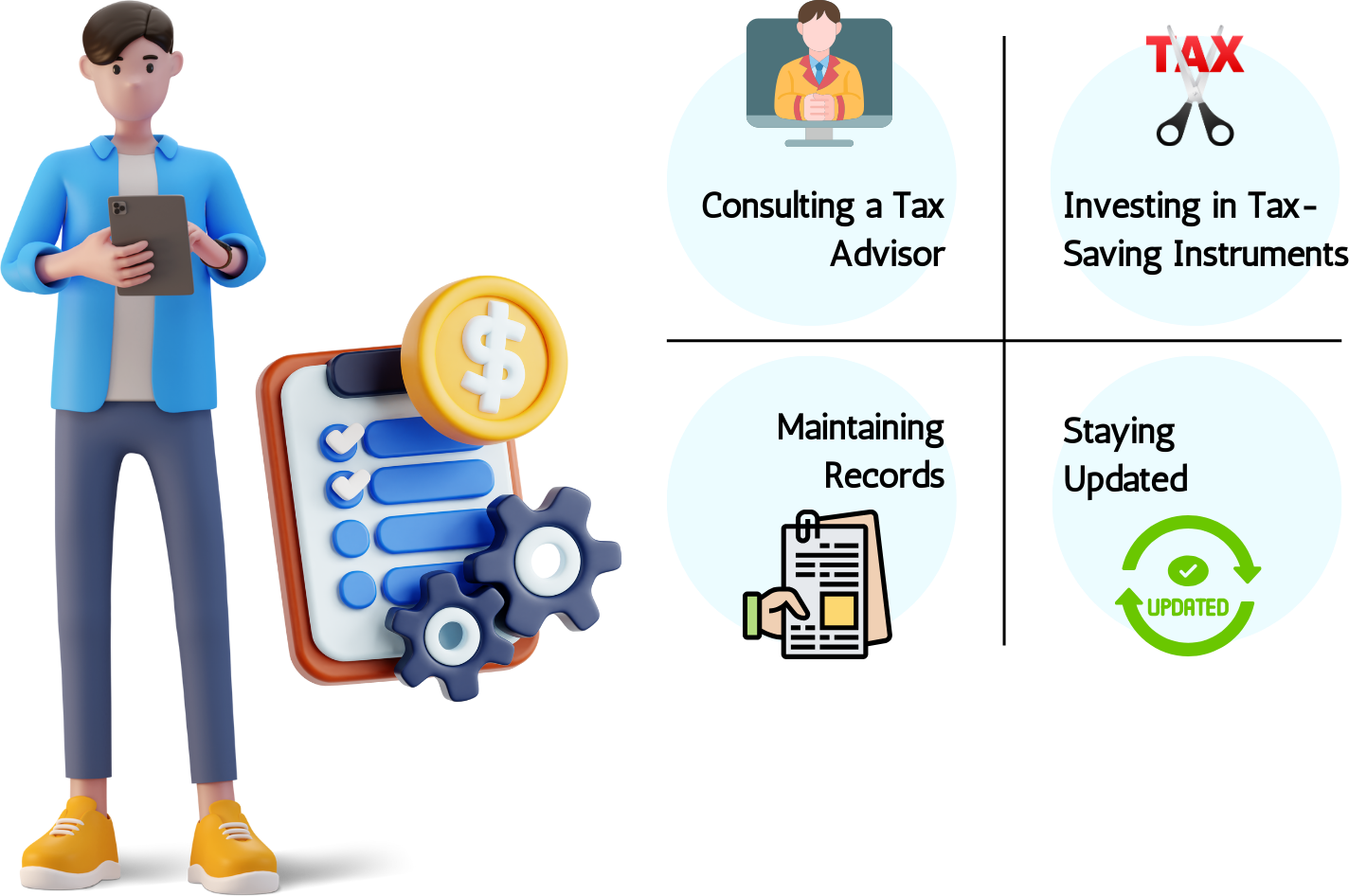
Smartly managing your taxes involves understanding the tax laws, making strategic financial decisions, and staying organized. Here are some tips to help you manage your taxes effectively:
- Understand Tax Laws and Regulations
- Stay Informed: Keep yourself updated with the latest tax laws and regulations. This includes knowing about tax deductions, exemptions, credits, and any changes in tax rates.
- Consult Professionals: Seek advice from tax professionals or financial advisors who can provide expert guidance tailored to your financial situation.
- Maximize Tax Deductions and Credits
- Utilize Section 80C: Take advantage of tax-saving investments such as ELSS, PPF, NSC, and others to reduce your taxable income. The maximum deduction under Section 80C is ₹1.5 lakh.
- Claim All Eligible Deductions: Ensure you claim deductions for expenses such as home loan interest (Section 24), health insurance premiums (Section 80D), and education loan interest (Section 80E).
- Leverage Tax Credits: Look for available tax credits, such as those for education expenses, energy-efficient home improvements, or charitable donations.
- Plan Your Investments Strategically
- Diversify Investments: Diversify your investment portfolio to balance risk and return. Include a mix of equity, debt, and other instruments.
- Invest for Long-Term Goals: Align your investments with your long-term financial goals, such as retirement planning, children’s education, or buying a home.
- Monitor Investment Performance: Regularly review and adjust your investments based on their performance and changing financial goals.
- Keep Accurate Records
- Organize Financial Documents: Maintain organized records of your income, expenses, investments, and tax-related documents. This includes keeping receipts, statements, and tax forms.
- Use Financial Software: Utilize financial software or apps to track your finances and generate reports that can help you during tax filing.
- Optimize Tax Withholding
- Review Withholding: Ensure that your employer is withholding the correct amount of tax from your salary. Adjust your withholding if necessary to avoid underpayment or overpayment of taxes.
- Make Estimated Tax Payments: If you have additional sources of income (e.g., freelance work, rental income), consider making quarterly estimated tax payments to avoid penalties.
- Take Advantage of Tax-Advantaged Accounts
- Retirement Accounts: Contribute to retirement accounts such as NPS, EPF, and VPF to benefit from tax deductions and long-term savings.
- Health Savings Accounts: Utilize health savings accounts (HSAs) or similar accounts that offer tax advantages for medical expenses.
- Stay Compliant and Avoid Penalties
- File Taxes on Time: Ensure you file your tax returns by the due date to avoid late filing penalties.
- Pay Taxes Due: Pay any taxes owed by the due date to avoid interest and penalties.
- Avoid Tax Evasion: Be honest and accurate in reporting your income and claiming deductions. Avoid any practices that could be considered tax evasion.
- Plan for Major Life Events
- Life Changes: Consider the tax implications of major life events such as marriage, having children, buying a home, or starting a business. Plan ahead to take advantage of any available tax benefits.
- Estate Planning: If you have significant assets, engage in estate planning to ensure your wealth is distributed according to your wishes and to minimize estate taxes.
Smart tax management involves strategic financial planning to optimize tax savings. Ravi can manage his taxes by:
- Investing in Tax-Saving Instruments: Regular contributions to PPF, NSC, ELSS, and NPS can maximize deductions.
- Maintaining Records: Keeping track of all tax-related documents, such as investment proofs and expense receipts, ensures accurate reporting.
- Staying Updated: Being aware of changes in tax laws and regulations helps Ravi in making informed decisions.
- Consulting a Tax Advisor: Seeking professional advice can provide tailored strategies for tax optimization. By following these steps, Ravi can effectively manage his taxes and reduce his tax burden.
9.7 Can you save lakhs by planning your taxes?

- Maximize Deductions under Section 80C
- Invest in Tax-Saving Instruments: Utilize the full ₹1.5 lakh deduction limit by investing in ELSS, PPF, NSC, SSY, and other eligible schemes.
- Premiums for Life Insurance: Premiums paid for life insurance policies also qualify for deductions under Section 80C.
- Additional Deductions Beyond Section 80C
- National Pension System (NPS): Contribute to NPS for an additional deduction of ₹50,000 under Section 80CCD(1B).
- Health Insurance Premiums: Claim deductions under Section 80D for health insurance premiums paid for yourself, your family, and your parents.
- Housing-Related Tax Benefits
- Home Loan Interest: Claim deductions up to ₹2 lakh under Section 24 for the interest paid on home loans.
- Principal Repayment: Principal repayment of home loans is also eligible for deduction under Section 80C.
- Education Loan Interest
- Section 80E: Deduct the interest paid on education loans for higher studies, with no upper limit on the amount.
- HRA and Rent Deductions
- House Rent Allowance (HRA): Claim HRA exemption if you live in a rented house and receive HRA as part of your salary.
- Section 80GG: If you do not receive HRA, you can still claim rent deductions under Section 80GG.
- Savings Account Interest
- Section 80TTA: Deduct up to ₹10,000 on interest earned from savings accounts.
- Other Tax-Saving Strategies
- Charitable Donations: Claim deductions under Section 80G for donations made to eligible charitable institutions.
- Leave Travel Allowance (LTA): Utilize LTA exemptions for travel expenses incurred while on leave.
Example Calculation
Let’s consider an example of potential tax savings:
- Section 80C Investments: ₹1.5 lakh
- NPS (Section 80CCD(1B)): ₹50,000
- Health Insurance (Section 80D): ₹25,000
- Home Loan Interest (Section 24): ₹2 lakh
- Education Loan Interest (Section 80E): ₹50,000
Total Deductions: ₹4.75 lakh
By effectively using these deductions, an individual in the 30% tax bracket could save around ₹1.425 lakh in taxes (30% of ₹4.75 lakh). This is a simplified example, and actual savings may vary based on individual circumstances.
Stay Organized
- Keep Records: Maintain organized records of all your investments, expenses, and tax-related documents to ensure you can claim all eligible deductions accurately.
- Plan Ahead: Regularly review your financial situation and plan your investments and expenses to maximize tax benefits.
New Tax Regime
The Union Budget 2025 introduced several significant changes to the new tax regime, making it more attractive for taxpayers. Here are the key highlights:
Revised Income Tax Slabs
The new tax regime now offers a progressive tax structure with the following income tax slabs:
|
Annual Income |
Tax Rate |
|
Up to ₹4,00,000 |
NIL |
|
₹4,00,001 – ₹8,00,000 |
5% |
|
₹8,00,001 – ₹12,00,000 |
10% |
|
₹12,00,001 – ₹16,00,000 |
15% |
|
₹16,00,001 – ₹20,00,000 |
20% |
|
₹20,00,001 – ₹24,00,000 |
25% |
|
Above ₹24,00,000 |
30% |
Key Changes and Benefits
- Increased Basic Exemption Limit: The basic exemption limit has been raised to ₹4 lakh, providing relief to low-income earners2.
- Higher Rebate under Section 87A: The rebate under Section 87A has been increased from ₹25,000 to ₹60,000. This means individuals with an income of up to ₹12 lakh will now have zero tax liability.
- Wider Tax Slabs: The tax slabs have been widened, offering lower tax rates for a broader range of incomes. This change is expected to benefit middle-class and high-income earners.
- Simplified Compliance: The new tax regime aims to simplify tax compliance by reducing the number of exemptions and deductions, making the tax filing process more straightforward.
Considerations
- No Exemptions and Deductions: Most exemptions and deductions available under the old tax regime, such as HRA, LTA, and deductions under Section 80C, are not applicable under the new regime.
- Choice of Regime: Taxpayers can choose between the new and old tax regimes based on their financial situation and tax-saving investments.
The new tax regime introduced in Budget 2025 aims to provide a more straightforward and lower tax rate structure, benefiting a wide range of taxpayers.
Can you save lakhs by planning your taxes under New Tax Regime
Under the new tax regime, saving lakhs specifically through tax planning is less straightforward compared to the old tax regime, primarily because most exemptions and deductions are not available. However, the new tax regime offers lower tax rates and wider income slabs, which can result in significant tax savings, especially for individuals with fewer deductions.
Key Features of the New Tax Regime
- Lower Tax Rates: The new tax regime offers concessional tax rates across different income slabs, which can reduce the overall tax liability.
- No Major Exemptions and Deductions: Most of the common deductions such as Section 80C (investments in ELSS, PPF, etc.), 80D (health insurance premiums), HRA, LTA, and others are not available under the new regime.
Potential Savings Calculation
Let’s consider an example to illustrate how you can save under the new tax regime.
Scenario:
- Annual Income: ₹20,00,000
Tax Calculation under Old Tax Regime:
Assuming you can claim the following deductions:
- Section 80C: ₹1,50,000
- NPS (Section 80CCD(1B)): ₹50,000
- Home Loan Interest (Section 24): ₹2,00,000
- Health Insurance (Section 80D): ₹50,000
Taxable Income: ₹20,00,000 – ₹4,50,000 (deductions) = ₹15,50,000
Tax Liability:
- Up to ₹2,50,000: NIL
- ₹2,50,001 to ₹5,00,000: 5% of ₹2,50,000 = ₹12,500
- ₹5,00,001 to ₹10,00,000: 20% of ₹5,00,000 = ₹1,00,000
- ₹10,00,001 to ₹15,50,000: 30% of ₹5,50,000 = ₹1,65,000
Total Tax Liability: ₹1,77,500
Tax Calculation under New Tax Regime:
Annual Income (no deductions): ₹20,00,000
Tax Liability:
- Up to ₹4,00,000: NIL
- ₹4,00,001 to ₹8,00,000: 5% of ₹4,00,000 = ₹20,000
- ₹8,00,001 to ₹12,00,000: 10% of ₹4,00,000 = ₹40,000
- ₹12,00,001 to ₹16,00,000: 15% of ₹4,00,000 = ₹60,000
- ₹16,00,001 to ₹20,00,000: 20% of ₹4,00,000 = ₹80,000
Total Tax Liability: ₹2,00,000
Comparison and Savings:
- Tax Liability (Old Regime): ₹1,77,500
- Tax Liability (New Regime): ₹2,00,000
- Tax Savings: In this case, the old regime results in a lower tax liability due to the available deductions.
Ravi can maximize deductions under Section 80C (up to ₹1.5 lakh), claim home loan interest benefits under Section 24 (up to ₹2 lakh), and invest in NPS under Section 80CCD (1B) (up to ₹50,000). By leveraging these deductions, Ravi can substantially reduce his taxable income and save lakhs over the years. Additionally, tax-efficient investment strategies and proper financial planning can enhance his overall savings.
9.8 What is a HUF and how to benefit from it?

A Hindu Undivided Family (HUF) is a unique entity recognized under Indian tax laws, allowing families to pool assets and be taxed as a separate entity. Here’s a detailed explanation of what a HUF is and how you can benefit from it:
What is a HUF?
A HUF is a family unit consisting of lineal descendants of a common ancestor, including their spouses and unmarried daughters. It is treated as a separate legal entity for tax purposes. HUFs can be formed by Hindu, Buddhist, Jain, and Sikh families. The head of the HUF is known as the “Karta,” and the members are called “coparceners.”
Formation of a HUF
To form a HUF, the following steps are typically involved:
- Create a Deed: Draft a deed that outlines the formation of the HUF, including details of the members and the nature of the business or assets.
- Apply for PAN: Obtain a Permanent Account Number (PAN) for the HUF by submitting Form 49A along with the deed.
- Open a Bank Account: Open a bank account in the name of the HUF to manage its financial transactions.
Benefits of a HUF
- Tax Savings:
- Separate Tax Entity: A HUF is taxed separately from its members, allowing the family to claim an additional basic tax exemption of ₹2.5 lakh.
- Deductions and Exemptions: HUFs can claim deductions under Sections 80C, 80D, and other provisions of the Income Tax Act, similar to individual taxpayers. This includes investments in tax-saving instruments, health insurance premiums, and more.
- Income Splitting: Income from ancestral properties or businesses can be taxed under the HUF, reducing the taxable income of individual family members.
- Wealth Management:
- Joint Management: HUF allows for the joint management of family wealth, including ancestral properties, businesses, and investments.
- Investment Opportunities: HUFs can invest in financial securities, open demat accounts, and manage assets under one umbrella entity.
- Owning Property:
- Residential Property: HUFs can own residential properties without paying tax on notional rent. They can also avail of home loans and claim tax benefits on loan repayment and interest.
- Insurance and Health Benefits:
- Life Insurance: HUFs can pay life insurance premiums for individual members and claim tax benefits under Section 80C.
- Health Insurance: HUFs can claim additional tax benefits on health insurance premiums paid for family members under Section 80D.
Example
A Hindu Undivided Family (HUF) is a unique entity under Indian tax law that allows a family to pool assets and income, thereby optimizing tax benefits. Ravi can form an HUF with his family, and the income generated by the HUF (such as rental income from ancestral property or business income) is taxed separately from his individual income. This allows Ravi to take advantage of the additional exemption limits and deductions available to HUFs. By utilizing the HUF structure, Ravi can reduce his overall tax liability and benefit from the tax-saving opportunities it offers.
9.1 Basics of Tax Planning
Tax planning in India is an essential part of mastering money management. It involves strategically organizing your financial affairs to minimize your tax liability and make the most of available deductions and credits. Here’s a detailed breakdown:
- Understand Your Tax Bracket
- Tax Brackets: Knowing your tax bracket helps you estimate how much tax you’ll owe. Tax rates increase progressively with income, so your income level determines your marginal tax rate.
- Taxable Income: This is the income that’s subject to tax after deductions and exemptions are applied. Understanding this will help you forecast your tax obligations.
- Maximize Deductions
- Standard Deduction: A set amount that reduces your taxable income. It’s different for various filing statuses (e.g., single, married filing jointly).
- Itemized Deductions: If your deductible expenses exceed the standard deduction, itemizing can reduce your taxable income further. Common deductions include:
- Mortgage interest
- Property taxes
- Medical expenses
- Charitable donations
- Business expenses (if self-employed)
- Take Advantage of Tax Credits
- Tax Credits vs. Deductions: Credits directly reduce the amount of tax you owe, unlike deductions which reduce taxable income. Credits can be non-refundable (only reduce tax to zero) or refundable (can result in a refund).
- Common Credits:
- Child Tax Credit: For families with dependent children.
- Earned Income Tax Credit (EITC): For low-to-moderate-income workers.
- Education Credits: Like the American Opportunity Tax Credit (AOTC) and Lifetime Learning Credit.
- Retirement Contributions
- 401(k) and IRA Contributions: Contributions to these accounts can reduce your taxable income. Traditional 401(k) contributions are pre-tax, and traditional IRA contributions may be tax-deductible.
- Roth Accounts: Contributions are made with after-tax dollars, but qualified withdrawals are tax-free. This can be advantageous depending on your future tax rate.
- Health Savings Accounts (HSAs)
- Triple Tax Benefit: Contributions are tax-deductible, grow tax-free, and withdrawals for qualified medical expenses are tax-free.
- Eligibility: Must be enrolled in a high-deductible health plan (HDHP).
- Plan for Major Life Events
- Marriage: Consider the tax implications of filing jointly or separately.
- Having a Child: Take advantage of child tax credits and dependent care credits.
- Buying a Home: Mortgage interest and property taxes can be itemized deductions.
- Income Timing and Deferral
- Defer Income: If you expect to be in a lower tax bracket in the future, defer receiving income to reduce current tax liability.
- Accelerate Deductions: If you’re in a higher tax bracket this year, accelerate deductible expenses to reduce taxable income.
- Tax-Advantaged Investments
- Municipal Bonds: Interest income from these bonds is often tax-free at the federal level and possibly at the state level.
- Capital Gains: Long-term capital gains (on assets held for more than a year) are taxed at a lower rate than short-term gains.
- Stay Organized
- Record-Keeping: Maintain thorough records of your income, expenses, and all relevant documents. This will make tax filing easier and ensure you don’t miss out on deductions or credits.
- Software and Tools: Use tax planning software or apps to track your finances and stay on top of tax-related deadlines.
- Consult a Professional
- Tax Advisor: Complex tax laws and frequent changes can make tax planning challenging. A professional can provide personalized advice and ensure compliance with current regulations.
- Regular Reviews: Periodically review your tax plan with a professional to adjust for changes in your financial situation or tax laws.
By mastering these tax planning strategies, you’ll be better equipped to manage your money effectively, reduce your tax liability, and optimize your financial well-being. Remember, proactive planning throughout the year can make tax season much less stressful and more financially rewarding.
Example
Let’s walk through an example of tax planning for Ravi, who has a monthly salary of ₹70,000. Here’s how Ravi can plan his taxes effectively for the financial year.
Scenario
- Monthly Salary: ₹70,000
- Annual Salary: ₹70,000 x 12 = ₹8,40,000
Step 1: Understanding Taxable Income
Ravi needs to know his gross income and identify the deductions and exemptions he can claim to reduce his taxable income.
- Gross Annual Income: ₹8,40,000
Step 2: Utilize Section 80C Deductions
Ravi can claim up to ₹1,50,000 as deductions under Section 80C by investing in eligible tax-saving instruments.
- Investments:
- Public Provident Fund (PPF): ₹50,000
- Employee Provident Fund (EPF): ₹36,000 (12% of ₹70,000 x 12 months)
- Equity-Linked Savings Scheme (ELSS): ₹64,000
- Total Section 80C Deductions: ₹1,50,000
Step 3: Health Insurance (Section 80D)
Ravi can claim deductions for health insurance premiums paid for himself and his family.
- Self and Family Health Insurance Premium: ₹25,000
- Total Section 80D Deductions: ₹25,000
Step 4: Home Loan Interest (Section 24)
Let’s assume Ravi has a home loan and can claim deductions for the interest paid on the loan.
- Home Loan Interest Paid: ₹1,50,000
- Total Section 24 Deductions: ₹1,50,000
Step 5: Other Deductions
- Savings Account Interest (Section 80TTA): ₹8,000 (up to ₹10,000 allowed)
Step 6: Calculating Taxable Income
Ravi will now calculate his taxable income by subtracting the total deductions from his gross income.
- Gross Income: ₹8,40,000
- Total Deductions:
- Section 80C: ₹1,50,000
- Section 80D: ₹25,000
- Section 24: ₹1,50,000
- Section 80TTA: ₹8,000
- Total Deductions: ₹3,33,000
- Taxable Income: ₹8,40,000 – ₹3,33,000 = ₹5,07,000
Step 7: Tax Calculation (Old Tax Regime)
Ravi will calculate his tax liability based on the old tax regime slabs:
- Up to ₹2,50,000: NIL
- ₹2,50,001 to ₹5,00,000: 5% of ₹2,50,000 = ₹12,500
- ₹5,00,001 to ₹5,07,000: 20% of ₹7,000 = ₹1,400
- Total Tax Liability: ₹12,500 + ₹1,400 = ₹13,900
- Tax Rebate under Section 87A (for income up to ₹5,00,000): ₹12,500 (as taxable income is slightly above ₹5,00,000)
Step 8: Final Tax Liability
- Total Tax Liability (after rebate): ₹13,900 – ₹12,500 = ₹1,400
By planning his taxes and strategically investing in tax-saving instruments, Ravi has managed to significantly reduce his taxable income and save on taxes.
9.2 Filing Tax Returns
Filing tax returns in India is a crucial process for every taxpayer. Here’s a detailed guide to help you understand the steps involved:
- Determine Your Income Sources
Identify all sources of income, such as:
- Salary
- Business or profession
- House property
- Capital gains
- Other sources (interest, dividends, etc.)
- Choose the Correct ITR Form
There are different Income Tax Return (ITR) forms based on your income sources and category:
- ITR-1 (Sahaj): For individuals with income from salary, one house property, and other sources (excluding lottery winnings and income from racehorses).
- ITR-2: For individuals and HUFs not having income from business or profession.
- ITR-3: For individuals and HUFs having income from business or profession.
- ITR-4 (Sugam): For individuals, HUFs, and firms (other than LLP) having presumptive income from business or profession.
- ITR-5: For persons other than individuals, HUFs, companies, and persons filing Form ITR-7.
- ITR-6: For companies other than those claiming exemption under section 11.
- ITR-7: For persons including companies required to furnish returns under sections 139(4A), 139(4B), 139(4C), or 139(4D).
- Gather Required Documents
Ensure you have the following documents ready:
- PAN card
- Aadhaar card
- Form 16 (for salaried individuals)
- Form 26AS (tax credit statement)
- Bank statements
- Investment proofs (for deductions)
- TDS certificates
- Login to the Income Tax E-Filing Portal
Visit the Income Tax E-Filing Portal and log in using your PAN as the user ID.
- Select the Assessment Year
Choose the relevant assessment year for which you are filing the return. For example, if you are filing for the financial year 2023-24, select AY 2024-25.
- Fill in the ITR Form
- Personal Information: Enter your personal details such as name, address, and contact information.
- Income Details: Provide details of your income from various sources.
- Deductions: Enter details of deductions under sections 80C, 80D, etc.
- Tax Paid: Verify the tax deducted at source (TDS) and advance tax paid.
- Validate and Submit
- Validate: Ensure all details are correct and validate the form.
- Submit: Submit the form electronically. You will receive an acknowledgment (ITR-V).
- E-Verify Your Return
You can e-verify your return using any of the following methods:
- Aadhaar OTP
- Net banking
- EVC (Electronic Verification Code)
- Sending a signed physical copy of ITR-V to the Centralized Processing Center (CPC) in Bengaluru.
- Track Your Refund
If you are eligible for a refund, you can track its status on the e-filing portal.
- Keep Records
Maintain a copy of the filed return and acknowledgment for future reference.
By following these steps, you can efficiently file your tax returns in India and ensure compliance with tax regulations
Example
Filing tax returns is a mandatory process for reporting income, expenses, and investments to the Income Tax Department. Ravi needs to gather all necessary documents, including Form 16 from his employer, bank statements, and details of any investments or deductions. He can use the online portal of the Income Tax Department to file his returns, ensuring he accurately reports his income and claims eligible deductions. By filing returns on time, Ravi avoids penalties and maintains compliance with tax laws.
9.3. Tax Saving Investment
Tax-saving investments in India are essential for reducing your tax liability while also growing your wealth. Here are some of the most popular tax-saving investment options:
- Equity-Linked Savings Scheme (ELSS)
Equity-Linked Savings Schemes (ELSS) are a type of mutual fund that primarily invests in equities (stocks). These funds are designed to provide the dual benefits of capital appreciation and tax savings. They are a popular investment choice for individuals looking to save on taxes while potentially earning higher returns. Investments in ELSS are eligible for tax deductions under Section 80C of the Income Tax Act, up to a limit of ₹1.5 lakh per financial year. This means that you can reduce your taxable income by investing in ELSS. ELSS funds come with a mandatory lock-in period of 3 years. During this time, you cannot redeem your investment. However, this is the shortest lock-in period among all tax-saving investment options under Section 80C. Since ELSS funds invest primarily in equities, they have the potential to generate higher returns compared to traditional fixed-income investments. However, the returns are market-linked and can vary based on the performance of the stock market. ELSS funds invest in a diversified portfolio of stocks across different sectors and market capitalizations. This diversification helps spread the risk and can potentially enhance returns. You can invest in ELSS through a Systematic Investment Plan (SIP), where you invest a fixed amount regularly (monthly, quarterly, etc.). This helps in averaging the purchase cost and mitigating market volatility.
- Public Provident Fund (PPF)
The Public Provident Fund (PPF) is a long-term, government-backed savings scheme aimed at providing a secure investment option with attractive returns. PPF offers a fixed interest rate, currently around 7-8% per annum, which is compounded annually. Investments in PPF are eligible for tax deductions up to ₹1.5 lakh under Section 80C of the Income Tax Act. The scheme has a lock-in period of 15 years, after which the invested amount, along with the accrued interest, can be withdrawn. Partial withdrawals are allowed from the 7th year onwards. PPF is an excellent choice for individuals seeking a safe investment with tax benefits and long-term growth.
- National Savings Certificate (NSC)
The National Savings Certificate (NSC) is a fixed-income investment scheme backed by the government, designed to encourage small savings among individuals. NSC offers a fixed interest rate, currently around 6-7% per annum, which is compounded annually but payable at maturity. Investments in NSC are eligible for tax deductions up to ₹1.5 lakh under Section 80C of the Income Tax Act. The scheme has a lock-in period of 5 years, making it suitable for individuals looking for a medium-term investment option with guaranteed returns. NSC is a secure investment that provides steady returns and tax benefits.
- Sukanya Samriddhi Yojana (SSY)
Sukanya Samriddhi Yojana (SSY) is a government-backed savings scheme specifically designed for the girl child. The scheme aims to promote the welfare of the girl child by encouraging parents to save for their daughter’s future education and marriage expenses. SSY offers a fixed interest rate, currently around 7-8% per annum, which is compounded annually. Investments in SSY are eligible for tax deductions up to ₹1.5 lakh under Section 80C of the Income Tax Act. The account remains active until the girl child turns 21 or gets married after the age of 18. Partial withdrawals are allowed for educational expenses after the child turns 18. SSY is a secure and rewarding investment for securing the financial future of a girl child.
- National Pension System (NPS)
The National Pension System (NPS) is a retirement-focused investment scheme that aims to provide financial security to individuals during their retirement years. NPS offers tax benefits under Section 80C (up to ₹1.5 lakh) and an additional deduction under Section 80CCD(1B) (up to ₹50,000). The scheme allows investors to choose from different asset classes, including equities, government bonds, and corporate bonds, providing the potential for market-linked returns. NPS has a lock-in period until the investor reaches the age of 60, after which they can withdraw a portion of the accumulated corpus as a lump sum and use the remaining amount to purchase an annuity for regular pension income. NPS is a versatile and efficient tool for retirement planning with tax benefits and flexible investment options.
- Senior Citizen Savings Scheme (SCSS)
The Senior Citizen Savings Scheme (SCSS) is a government-backed savings scheme designed to provide a secure and steady source of income for senior citizens. SCSS offers a fixed interest rate, currently around 7-8% per annum, which is payable quarterly. Investments in SCSS are eligible for tax deductions up to ₹1.5 lakh under Section 80C of the Income Tax Act. The scheme has a lock-in period of 5 years, which can be extended by an additional 3 years. SCSS is an ideal investment option for senior citizens seeking a safe investment with regular income and tax benefits.
- Unit Linked Insurance Plan (ULIP)
A Unit Linked Insurance Plan (ULIP) is a unique investment product that combines insurance and investment. ULIPs offer the dual benefits of life insurance coverage and the potential for wealth creation through market-linked investments. Premiums paid towards ULIPs are eligible for tax deductions up to ₹1.5 lakh under Section 80C of the Income Tax Act. The scheme has a lock-in period of 5 years, after which the policyholder can withdraw or switch funds. ULIPs allow investors to choose from a range of equity, debt, and balanced funds based on their risk appetite and financial goals. ULIPs are suitable for individuals looking for a comprehensive financial product that offers both protection and growth.
- Tax-Saving Fixed Deposits
Tax-Saving Fixed Deposits (FDs) are a type of fixed deposit with a lock-in period specifically designed for tax saving under Section 80C of the Income Tax Act. Investments in tax-saving FDs are eligible for tax deductions up to ₹1.5 lakh. These FDs offer a fixed interest rate, currently around 5-7% per annum, and the interest is payable annually or at maturity. The lock-in period for tax-saving FDs is 5 years, and premature withdrawals are not allowed during this period. Tax-saving FDs are a secure and straightforward investment option for individuals seeking tax benefits and guaranteed returns.
- Employee Provident Fund (EPF)
The Employee Provident Fund (EPF) is a retirement savings scheme for salaried employees, managed by the Employees’ Provident Fund Organisation (EPFO). Both employees and employers contribute a fixed percentage of the employee’s salary to the EPF account. Contributions up to ₹1.5 lakh are eligible for tax deductions under Section 80C of the Income Tax Act. The EPF offers a fixed interest rate, currently around 8-9% per annum, which is compounded annually. The scheme has a lock-in period until retirement, and the accumulated corpus can be withdrawn as a lump sum at the time of retirement. EPF is an excellent tool for long-term retirement planning with tax benefits and attractive returns.
- Voluntary Provident Fund (VPF)
The Voluntary Provident Fund (VPF) is an extension of the Employee Provident Fund (EPF) that allows employees to voluntarily contribute more than the mandatory EPF contribution. Contributions up to ₹1.5 lakh are eligible for tax deductions under Section 80C of the Income Tax Act. The VPF offers a fixed interest rate, similar to the EPF, and the interest is compounded annually. The lock-in period for VPF is until retirement, and the accumulated corpus can be withdrawn as a lump sum at the time of retirement. VPF is a beneficial option for employees looking to boost their retirement savings with additional contributions and tax benefits.
|
Scheme |
Description |
Tax Benefit |
Lock-in Period |
Returns |
|
ELSS |
Mutual funds investing in equities |
Up to ₹1.5 lakh |
3 years |
Market-linked, potentially high |
|
PPF |
Government-backed savings with fixed interest |
Up to ₹1.5 lakh |
15 years |
Fixed, 7-8% p.a. |
|
NSC |
Government-backed fixed-income |
Up to ₹1.5 lakh |
5 years |
Fixed, 6-7% p.a. |
|
SSY |
Savings for girl child |
Up to ₹1.5 lakh |
Until child is 21 or married after 18 |
Fixed, 7-8% p.a. |
|
NPS |
Retirement-focused |
Up to ₹1.5 lakh + ₹50,000 (80CCD(1B)) |
Until retirement (60 years) |
Market-linked |
|
SCSS |
For senior citizens |
Up to ₹1.5 lakh |
5 years (extendable by 3 years) |
Fixed, 7-8% p.a. |
|
ULIP |
Insurance + investment |
Up to ₹1.5 lakh |
5 years |
Market-linked |
|
Tax-Saving FD |
Fixed deposits for tax saving |
Up to ₹1.5 lakh |
5 years |
Fixed, 5-7% p.a. |
|
EPF |
For salaried employees |
Up to ₹1.5 lakh |
Until retirement |
Fixed, 8-9% p.a. |
|
VPF |
Extension of EPF |
Up to ₹1.5 lakh |
Until retirement |
Fixed, similar to EPF |
By investing in these tax-saving instruments, you can effectively reduce your tax liability while also building a robust financial portfolio. It’s important to choose investments based on your financial goals, risk tolerance, and investment.
Example
Tax-saving investments not only help in reducing taxable income but also aid in wealth creation. Ravi can invest in various tax-saving instruments such as:
- Public Provident Fund (PPF): Provides tax-free returns with a deduction of up to ₹1.5 lakh under Section 80C.
- National Savings Certificate (NSC): Eligible for deduction under Section 80C with a fixed interest rate.
- Equity Linked Savings Scheme (ELSS): Offers tax benefits under Section 80C with the potential for higher returns through equity investments.
- National Pension System (NPS): Allows an additional deduction of ₹50,000 under Section 80CCD (1B) beyond the ₹1.5 lakh limit of Section 80C. By investing in these instruments, Ravi can optimize his tax savings while growing his wealth.
9.4 What is the difference between Tax Avoidance and Tax Evasion?
Tax Avoidance and Tax Evasion are terms often used in discussions about taxes, but they represent two very different practices:
Tax Avoidance
Tax Avoidance is the legal practice of using the provisions and loopholes in tax laws to minimize tax liabilities. It involves planning and structuring financial transactions in a way that reduces the amount of tax owed, without breaking the law. Examples of tax avoidance include:
- Investing in tax-saving instruments: Making use of deductions and exemptions available under tax laws (e.g., investing in ELSS, PPF, etc.).
- Claiming legitimate deductions: Such as those for home loans, medical expenses, or education.
- Income splitting: Transferring income to family members in lower tax brackets.
While tax avoidance is legal, it is often viewed as ethically questionable, as it involves exploiting the tax system to reduce tax obligations.
Tax Evasion
Tax Evasion, on the other hand, is an illegal practice where individuals or businesses deliberately misrepresent or conceal information to reduce their tax liabilities. It involves dishonest methods to avoid paying taxes, and it is punishable under the law. Examples of tax evasion include:
- Underreporting income: Not declaring all sources of income or underreporting earnings.
- Inflating deductions: Claiming false expenses or deductions that are not legitimate.
- Using offshore accounts: Hiding money in overseas accounts to avoid paying taxes.
Tax evasion is a criminal offense and can result in severe penalties, including fines, interest on unpaid taxes, and even imprisonment.
Example
Tax avoidance is the legal practice of using provisions in the tax code to reduce tax liability. For example, Ravi investing in PPF for tax benefits is tax avoidance. It involves smart financial planning within the framework of the law. On the other hand, tax evasion is the illegal act of not paying taxes owed, such as underreporting income or inflating deductions. If Ravi fails to disclose his full salary or income from other sources, that would be tax evasion. Tax evasion is a punishable offense and can lead to penalties and legal consequences.
9.5 What are the basic fundas of Taxation?
The basic principles of taxation, often referred to as the “fundamentals” or “fundas” of taxation, provide a framework for understanding how taxes work and why they are important.
- Purpose of Taxation
The primary purpose of taxation is to generate revenue for the government to fund public goods and services, such as infrastructure, healthcare, education, defence, and social welfare programs. Taxes also help in redistributing wealth and reducing income inequality.
- Types of Taxes
There are several types of taxes, each serving a different purpose:
- Income Tax: A tax levied on individual and corporate earnings.
- Sales Tax: A tax on the sale of goods and services, typically added at the point of purchase.
- Property Tax: A tax on property ownership, often based on the value of the property.
- Excise Tax: A tax on specific goods, such as alcohol, tobacco, and fuel.
- Customs Duty: A tax on imported and exported goods.
- Wealth Tax: A tax on the net wealth of individuals.
- Tax Base and Tax Rate
- Tax Base: The tax base is the total amount of assets or income that is subject to taxation. For example, in the case of income tax, the tax base is the taxable income.
- Tax Rate: The tax rate is the percentage at which the tax base is taxed. Tax rates can be progressive (increasing with income), regressive (decreasing with income), or proportional (same rate for all income levels).
- Progressive, Regressive, and Proportional Taxes
- Progressive Tax: A tax system where the tax rate increases as the taxable income increases. It aims to reduce income inequality by taxing higher incomes at higher rates. Example: Income tax.
- Regressive Tax: A tax system where the tax rate decreases as the taxable income increases. Lower-income individuals pay a higher percentage of their income in taxes compared to higher-income individuals. Example: Sales tax.
- Proportional Tax: A tax system where the tax rate remains the same, regardless of the income level. Example: Flat tax.
- Principles of Taxation
There are several principles that guide taxation policies:
- Equity: The tax system should be fair, with individuals and businesses paying taxes in proportion to their ability to pay. This includes both horizontal equity (similar income levels should pay similar taxes) and vertical equity (higher incomes should pay more taxes).
- Efficiency: The tax system should not distort economic decisions or create excessive administrative burdens. It should be simple to understand and easy to comply with.
- Certainty: Taxpayers should know how much they are required to pay and when. The tax laws should be clear and predictable.
- Convenience: The tax system should be convenient for taxpayers to comply with, including easy filing and payment methods.
- Tax Evasion and Tax Avoidance
- Tax Evasion: The illegal act of deliberately misrepresenting or concealing information to reduce tax liability. It is punishable by law.
- Tax Avoidance: The legal practice of using provisions and loopholes in tax laws to minimize tax liability. While legal, it is often viewed as ethically questionable.
- Tax Administration
Effective tax administration is essential for a functioning tax system. It involves the collection, assessment, and enforcement of tax laws. Tax authorities are responsible for ensuring compliance, preventing tax evasion, and providing taxpayer education and assistance.
Example
Understanding the basics of taxation helps in effective financial planning. Key principles include:
- Tax Slab Rates: Ravi needs to know the tax slabs applicable to his income level to calculate his tax liability accurately.
- Taxable Income: Identifying which parts of his salary are taxable and which are exempt. For example, house rent allowance (HRA) and leave travel allowance (LTA) have specific exemptions.
- Deductions and Exemptions: Knowing the various sections of the Income Tax Act that provide deductions (e.g., Section 80C, 80D) and exemptions helps Ravi in reducing his taxable income. By grasping these fundamentals, Ravi can make informed decisions about his finances and optimize his tax liability.
9.6 How to Smartly Manage your taxes
Smartly managing your taxes involves understanding the tax laws, making strategic financial decisions, and staying organized. Here are some tips to help you manage your taxes effectively:
- Understand Tax Laws and Regulations
- Stay Informed: Keep yourself updated with the latest tax laws and regulations. This includes knowing about tax deductions, exemptions, credits, and any changes in tax rates.
- Consult Professionals: Seek advice from tax professionals or financial advisors who can provide expert guidance tailored to your financial situation.
- Maximize Tax Deductions and Credits
- Utilize Section 80C: Take advantage of tax-saving investments such as ELSS, PPF, NSC, and others to reduce your taxable income. The maximum deduction under Section 80C is ₹1.5 lakh.
- Claim All Eligible Deductions: Ensure you claim deductions for expenses such as home loan interest (Section 24), health insurance premiums (Section 80D), and education loan interest (Section 80E).
- Leverage Tax Credits: Look for available tax credits, such as those for education expenses, energy-efficient home improvements, or charitable donations.
- Plan Your Investments Strategically
- Diversify Investments: Diversify your investment portfolio to balance risk and return. Include a mix of equity, debt, and other instruments.
- Invest for Long-Term Goals: Align your investments with your long-term financial goals, such as retirement planning, children’s education, or buying a home.
- Monitor Investment Performance: Regularly review and adjust your investments based on their performance and changing financial goals.
- Keep Accurate Records
- Organize Financial Documents: Maintain organized records of your income, expenses, investments, and tax-related documents. This includes keeping receipts, statements, and tax forms.
- Use Financial Software: Utilize financial software or apps to track your finances and generate reports that can help you during tax filing.
- Optimize Tax Withholding
- Review Withholding: Ensure that your employer is withholding the correct amount of tax from your salary. Adjust your withholding if necessary to avoid underpayment or overpayment of taxes.
- Make Estimated Tax Payments: If you have additional sources of income (e.g., freelance work, rental income), consider making quarterly estimated tax payments to avoid penalties.
- Take Advantage of Tax-Advantaged Accounts
- Retirement Accounts: Contribute to retirement accounts such as NPS, EPF, and VPF to benefit from tax deductions and long-term savings.
- Health Savings Accounts: Utilize health savings accounts (HSAs) or similar accounts that offer tax advantages for medical expenses.
- Stay Compliant and Avoid Penalties
- File Taxes on Time: Ensure you file your tax returns by the due date to avoid late filing penalties.
- Pay Taxes Due: Pay any taxes owed by the due date to avoid interest and penalties.
- Avoid Tax Evasion: Be honest and accurate in reporting your income and claiming deductions. Avoid any practices that could be considered tax evasion.
- Plan for Major Life Events
- Life Changes: Consider the tax implications of major life events such as marriage, having children, buying a home, or starting a business. Plan ahead to take advantage of any available tax benefits.
- Estate Planning: If you have significant assets, engage in estate planning to ensure your wealth is distributed according to your wishes and to minimize estate taxes.
Smart tax management involves strategic financial planning to optimize tax savings. Ravi can manage his taxes by:
- Investing in Tax-Saving Instruments: Regular contributions to PPF, NSC, ELSS, and NPS can maximize deductions.
- Maintaining Records: Keeping track of all tax-related documents, such as investment proofs and expense receipts, ensures accurate reporting.
- Staying Updated: Being aware of changes in tax laws and regulations helps Ravi in making informed decisions.
- Consulting a Tax Advisor: Seeking professional advice can provide tailored strategies for tax optimization. By following these steps, Ravi can effectively manage his taxes and reduce his tax burden.
9.7 Can you save lakhs by planning your taxes?
- Maximize Deductions under Section 80C
- Invest in Tax-Saving Instruments: Utilize the full ₹1.5 lakh deduction limit by investing in ELSS, PPF, NSC, SSY, and other eligible schemes.
- Premiums for Life Insurance: Premiums paid for life insurance policies also qualify for deductions under Section 80C.
- Additional Deductions Beyond Section 80C
- National Pension System (NPS): Contribute to NPS for an additional deduction of ₹50,000 under Section 80CCD(1B).
- Health Insurance Premiums: Claim deductions under Section 80D for health insurance premiums paid for yourself, your family, and your parents.
- Housing-Related Tax Benefits
- Home Loan Interest: Claim deductions up to ₹2 lakh under Section 24 for the interest paid on home loans.
- Principal Repayment: Principal repayment of home loans is also eligible for deduction under Section 80C.
- Education Loan Interest
- Section 80E: Deduct the interest paid on education loans for higher studies, with no upper limit on the amount.
- HRA and Rent Deductions
- House Rent Allowance (HRA): Claim HRA exemption if you live in a rented house and receive HRA as part of your salary.
- Section 80GG: If you do not receive HRA, you can still claim rent deductions under Section 80GG.
- Savings Account Interest
- Section 80TTA: Deduct up to ₹10,000 on interest earned from savings accounts.
- Other Tax-Saving Strategies
- Charitable Donations: Claim deductions under Section 80G for donations made to eligible charitable institutions.
- Leave Travel Allowance (LTA): Utilize LTA exemptions for travel expenses incurred while on leave.
Example Calculation
Let’s consider an example of potential tax savings:
- Section 80C Investments: ₹1.5 lakh
- NPS (Section 80CCD(1B)): ₹50,000
- Health Insurance (Section 80D): ₹25,000
- Home Loan Interest (Section 24): ₹2 lakh
- Education Loan Interest (Section 80E): ₹50,000
Total Deductions: ₹4.75 lakh
By effectively using these deductions, an individual in the 30% tax bracket could save around ₹1.425 lakh in taxes (30% of ₹4.75 lakh). This is a simplified example, and actual savings may vary based on individual circumstances.
Stay Organized
- Keep Records: Maintain organized records of all your investments, expenses, and tax-related documents to ensure you can claim all eligible deductions accurately.
- Plan Ahead: Regularly review your financial situation and plan your investments and expenses to maximize tax benefits.
New Tax Regime
The Union Budget 2025 introduced several significant changes to the new tax regime, making it more attractive for taxpayers. Here are the key highlights:
Revised Income Tax Slabs
The new tax regime now offers a progressive tax structure with the following income tax slabs:
|
Annual Income |
Tax Rate |
|
Up to ₹4,00,000 |
NIL |
|
₹4,00,001 – ₹8,00,000 |
5% |
|
₹8,00,001 – ₹12,00,000 |
10% |
|
₹12,00,001 – ₹16,00,000 |
15% |
|
₹16,00,001 – ₹20,00,000 |
20% |
|
₹20,00,001 – ₹24,00,000 |
25% |
|
Above ₹24,00,000 |
30% |
Key Changes and Benefits
- Increased Basic Exemption Limit: The basic exemption limit has been raised to ₹4 lakh, providing relief to low-income earners2.
- Higher Rebate under Section 87A: The rebate under Section 87A has been increased from ₹25,000 to ₹60,000. This means individuals with an income of up to ₹12 lakh will now have zero tax liability.
- Wider Tax Slabs: The tax slabs have been widened, offering lower tax rates for a broader range of incomes. This change is expected to benefit middle-class and high-income earners.
- Simplified Compliance: The new tax regime aims to simplify tax compliance by reducing the number of exemptions and deductions, making the tax filing process more straightforward.
Considerations
- No Exemptions and Deductions: Most exemptions and deductions available under the old tax regime, such as HRA, LTA, and deductions under Section 80C, are not applicable under the new regime.
- Choice of Regime: Taxpayers can choose between the new and old tax regimes based on their financial situation and tax-saving investments.
The new tax regime introduced in Budget 2025 aims to provide a more straightforward and lower tax rate structure, benefiting a wide range of taxpayers.
Can you save lakhs by planning your taxes under New Tax Regime
Under the new tax regime, saving lakhs specifically through tax planning is less straightforward compared to the old tax regime, primarily because most exemptions and deductions are not available. However, the new tax regime offers lower tax rates and wider income slabs, which can result in significant tax savings, especially for individuals with fewer deductions.
Key Features of the New Tax Regime
- Lower Tax Rates: The new tax regime offers concessional tax rates across different income slabs, which can reduce the overall tax liability.
- No Major Exemptions and Deductions: Most of the common deductions such as Section 80C (investments in ELSS, PPF, etc.), 80D (health insurance premiums), HRA, LTA, and others are not available under the new regime.
Potential Savings Calculation
Let’s consider an example to illustrate how you can save under the new tax regime.
Scenario:
- Annual Income: ₹20,00,000
Tax Calculation under Old Tax Regime:
Assuming you can claim the following deductions:
- Section 80C: ₹1,50,000
- NPS (Section 80CCD(1B)): ₹50,000
- Home Loan Interest (Section 24): ₹2,00,000
- Health Insurance (Section 80D): ₹50,000
Taxable Income: ₹20,00,000 – ₹4,50,000 (deductions) = ₹15,50,000
Tax Liability:
- Up to ₹2,50,000: NIL
- ₹2,50,001 to ₹5,00,000: 5% of ₹2,50,000 = ₹12,500
- ₹5,00,001 to ₹10,00,000: 20% of ₹5,00,000 = ₹1,00,000
- ₹10,00,001 to ₹15,50,000: 30% of ₹5,50,000 = ₹1,65,000
Total Tax Liability: ₹1,77,500
Tax Calculation under New Tax Regime:
Annual Income (no deductions): ₹20,00,000
Tax Liability:
- Up to ₹4,00,000: NIL
- ₹4,00,001 to ₹8,00,000: 5% of ₹4,00,000 = ₹20,000
- ₹8,00,001 to ₹12,00,000: 10% of ₹4,00,000 = ₹40,000
- ₹12,00,001 to ₹16,00,000: 15% of ₹4,00,000 = ₹60,000
- ₹16,00,001 to ₹20,00,000: 20% of ₹4,00,000 = ₹80,000
Total Tax Liability: ₹2,00,000
Comparison and Savings:
- Tax Liability (Old Regime): ₹1,77,500
- Tax Liability (New Regime): ₹2,00,000
- Tax Savings: In this case, the old regime results in a lower tax liability due to the available deductions.
Ravi can maximize deductions under Section 80C (up to ₹1.5 lakh), claim home loan interest benefits under Section 24 (up to ₹2 lakh), and invest in NPS under Section 80CCD (1B) (up to ₹50,000). By leveraging these deductions, Ravi can substantially reduce his taxable income and save lakhs over the years. Additionally, tax-efficient investment strategies and proper financial planning can enhance his overall savings.
9.8 What is a HUF and how to benefit from it?
A Hindu Undivided Family (HUF) is a unique entity recognized under Indian tax laws, allowing families to pool assets and be taxed as a separate entity. Here’s a detailed explanation of what a HUF is and how you can benefit from it:
What is a HUF?
A HUF is a family unit consisting of lineal descendants of a common ancestor, including their spouses and unmarried daughters. It is treated as a separate legal entity for tax purposes. HUFs can be formed by Hindu, Buddhist, Jain, and Sikh families. The head of the HUF is known as the “Karta,” and the members are called “coparceners.”
Formation of a HUF
To form a HUF, the following steps are typically involved:
- Create a Deed: Draft a deed that outlines the formation of the HUF, including details of the members and the nature of the business or assets.
- Apply for PAN: Obtain a Permanent Account Number (PAN) for the HUF by submitting Form 49A along with the deed.
- Open a Bank Account: Open a bank account in the name of the HUF to manage its financial transactions.
Benefits of a HUF
- Tax Savings:
- Separate Tax Entity: A HUF is taxed separately from its members, allowing the family to claim an additional basic tax exemption of ₹2.5 lakh.
- Deductions and Exemptions: HUFs can claim deductions under Sections 80C, 80D, and other provisions of the Income Tax Act, similar to individual taxpayers. This includes investments in tax-saving instruments, health insurance premiums, and more.
- Income Splitting: Income from ancestral properties or businesses can be taxed under the HUF, reducing the taxable income of individual family members.
- Wealth Management:
- Joint Management: HUF allows for the joint management of family wealth, including ancestral properties, businesses, and investments.
- Investment Opportunities: HUFs can invest in financial securities, open demat accounts, and manage assets under one umbrella entity.
- Owning Property:
- Residential Property: HUFs can own residential properties without paying tax on notional rent. They can also avail of home loans and claim tax benefits on loan repayment and interest.
- Insurance and Health Benefits:
- Life Insurance: HUFs can pay life insurance premiums for individual members and claim tax benefits under Section 80C.
- Health Insurance: HUFs can claim additional tax benefits on health insurance premiums paid for family members under Section 80D.
Example
A Hindu Undivided Family (HUF) is a unique entity under Indian tax law that allows a family to pool assets and income, thereby optimizing tax benefits. Ravi can form an HUF with his family, and the income generated by the HUF (such as rental income from ancestral property or business income) is taxed separately from his individual income. This allows Ravi to take advantage of the additional exemption limits and deductions available to HUFs. By utilizing the HUF structure, Ravi can reduce his overall tax liability and benefit from the tax-saving opportunities it offers.