
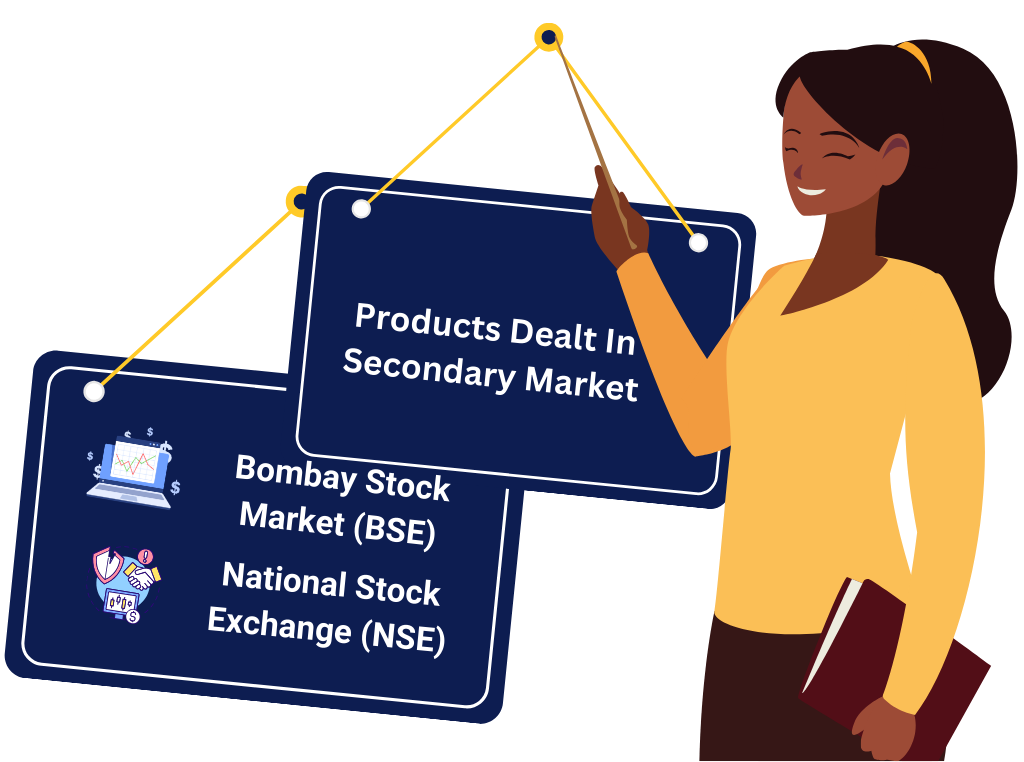
7.1 What Are The Products Dealt In Secondary Markets?
Vedant: Nirav I thought the secondary market was about buying and selling shares but now I know the secondary market is a lot more than that.
Nirav: You are right. The secondary market includes things like equities and bonds and mutual funds and ETFs and derivatives. Each of these things has its special job and its own risks.
Vedant: So the secondary market is not just for investing money it is also for hedging and speculation.
Nirav: Exactly. The secondary market has derivatives that help people manage risk or make bets.. It has ETFs that let people spread their money around with stock-like liquidity.
Vedant: And people trade all these things on platforms like NSE and BSE.
Nirav: Yes that is right. These exchanges let people use different instruments. They help people who want to invest for a time and people who want to trade for a short time.
Vedant: Then let us look at each product one by one to see how the secondary market works and how each product fits into plans.
Nirav: That sounds like an idea. Let us start with bonds and fixed-income products then we will look at derivatives and ETFs, in the market.
What Are The Products Dealt In Secondary Markets?
At a weekend investment seminar in Pune four different people came together to talk about market strategies. Asha is a confident person and she thinks a lot about what she does. She likes to invest in equities because she thinks they will be good in the long run.
Rahul is different he likes to play it safe with stocks because he wants to get a steady income that he can count on.
Priya is a bit of both she is careful. She also wants her money to grow so she invests in convertible debentures and she is always ready to change her plan if the market changes.
Ramesh is a go-getter he likes to take big risks with warrants because he thinks he can make a lot of money if he is right. The way these people invest says a lot about them it is not about money it is about how they feel about risk and reward and what they want to achieve with their investments it is about what they think is important, like risk, reward and ambition and how they feel about these things when it comes to Asha, Rahul, Priya and Ramesh and their investments.
They discussed about the products dealt in secondary market: –
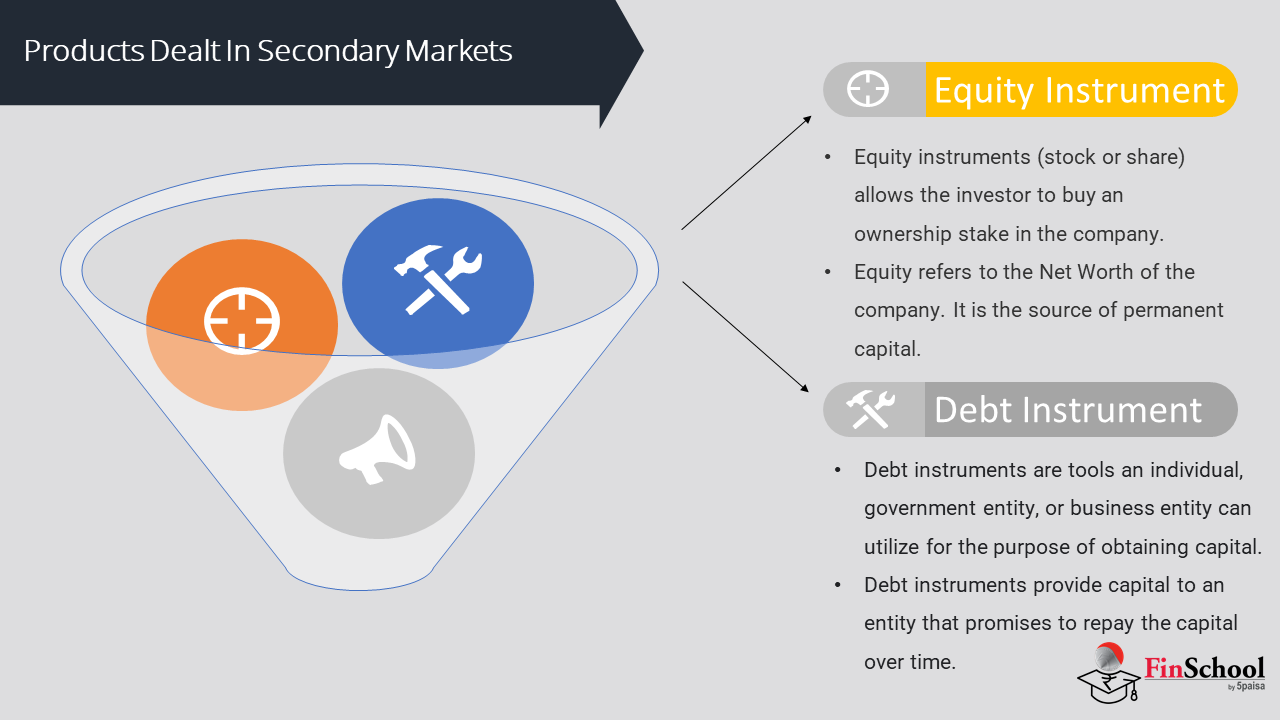
- Equity Instrument
- Debt Instrument
Equity instruments (stock or share) allows the investor to buy an ownership stake in the company. Equity refers to the Net Worth of the company. It is the source of permanent capital. Equity instruments may or may not pay their investors a monthly income because such income relies on the profit/loss of the business. When they do, it is a dividend.
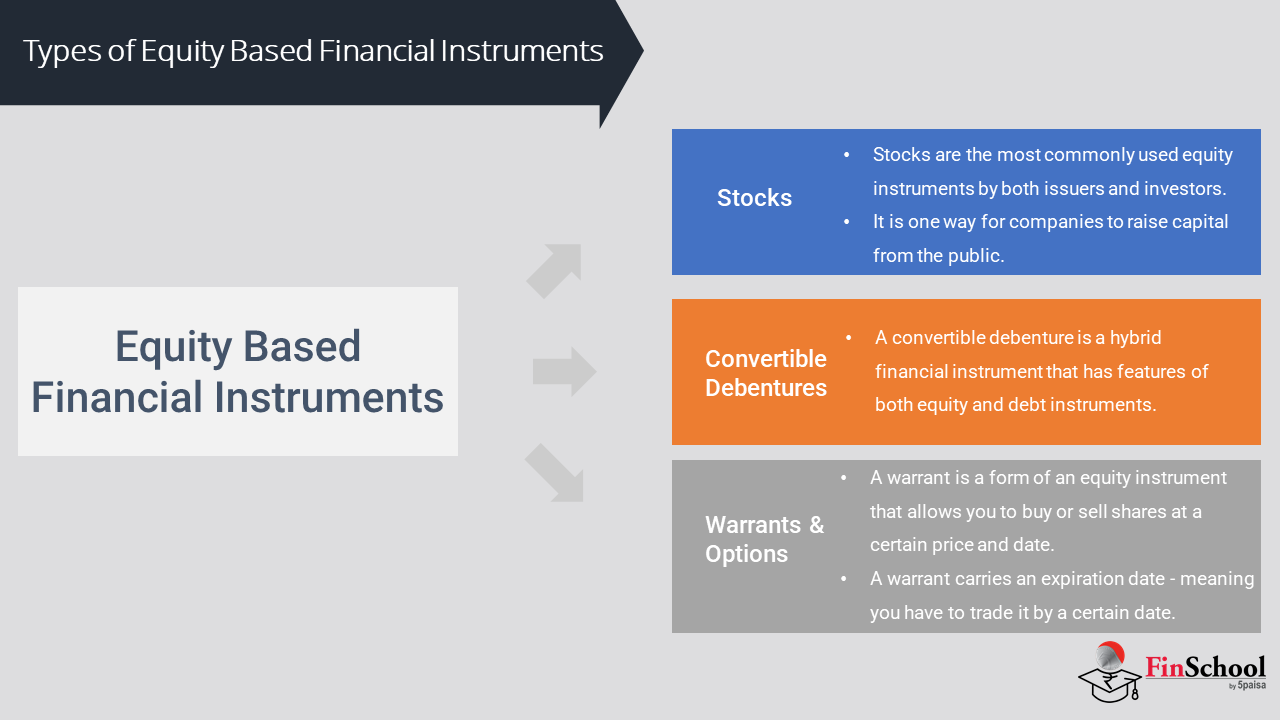
The most common types of equity-based financial instruments are:
- Stocks
Stocks are the most commonly used equity instruments by both issuers and investors. It is one way for companies to raise capital from the public.
There are two types of stocks:
- Common or ordinary stocks
- Preferred stocks
Investing in common/ordinary stocks comes with various benefits, such as:
Co-ownership of the company
- Right to vote in shareholders’ meetings
- Right to make decisions on capital raising, dividends, and business mergers
- Authority to apply for new shares when the company’s capital increase
- Can declare common stocks as assets when applying for loans
Common or ordinary stocks
Asha buys shares of a retail chain. This means she owns a part of the company and gets to vote on decisions like whether the company should expand to other countries. When the company makes money Asha gets some of that money, which is called a dividend.. When the company loses money she does not get any dividend. This is because dividends are not guaranteed.
Common shareholders like Asha take a risk. They are the ones to get paid when the company has money to give out. The people the company owes money to and the shareholders who have shares get paid first.. If the company does well common shareholders can make a lot of money.
Preferred stocks
Rahul chooses to buy shares in a utility company. He wants to get an income so he does not mind not being able to vote on company decisions. He gets a fixed amount of money every quarter even when the company does not make a lot of money.. When it comes to getting paid Rahul is ahead of the common shareholders. Preferred shareholders like Rahul own a part of the company. They do not get to vote. They also do not take much risk as common shareholders. They get paid after the people who lent money to the company. Before the common shareholders. This makes preferred shares a good choice for people who want an income.
Convertible Debentures
Priya invests in something called debentures from a company that makes electric vehicles. She gets interest payments like she would with a loan. If the company does well and its stock price goes up Priya can turn her debentures into shares of the company. This means she becomes a part-owner of the company and can make money if the company continues to do. Convertible debentures are a mix of loaning money and owning shares. They offer interest than a regular bond and Priya has the option to turn them into shares.. They are not as safe, as some other investments and there is some risk involved.
Warrants And Options
Ramesh receives a warrant from a pharma company, allowing him to buy shares at ₹150 anytime over the next 3 years. Since the current price is ₹120, he waits. But if the stock jumps to ₹250 after a drug approval, he can exercise the warrant and gain instantly. Warrants are company-issued equity instruments that offer a fixed-price deal for future potential, with an expiration date. Sneha, anticipating a tech stock surge, buys a call option at ₹200 valid for one month. If the stock rises to ₹280, she profits by exercising the option. If it stays at ₹190, she lets it expire, losing only the premium. Options offer a way to speculate with limited downside and no obligation to trade. While both warrants and options give rights to buy shares at a set price and date, warrants are issued by companies and typically have longer durations. Options, on the other hand, are traded on stock exchanges and offer more flexibility for short-term strategies.
Nirav: Vedant, some shares don’t have a maturity date, they’re designed to last forever.
Vedant: Right, that’s a key trait of equity securities. But not all shares are alike some have expiry terms or unique voting setups.
Nirav: I found it interesting that shareholders don’t run the company, they just elect the board. It’s influence without direct control.
Vedant: Exactly. Plus, features like par value, cash flow rights, and liquidation seniority matter too. Investors need to understand what they truly own.
Nirav: So equity isn’t just about price—it’s about the built-in terms.
Vedant: Agreed. Let’s break down each feature to evaluate companies more smartly
Features That Characterize and Vary Among Equity Securities:
- Life
Many equity securities are issued with an infinite life. In other words, they are issued without maturity dates. Some equity securities are issued with a maturity date.
- Par Value
Equity securities may or may not be issued with a par value. The par value of a share is the stated value, or face value, of the equity security. In some jurisdictions, issuing companies are required to assign a par value when issuing shares.
- Voting Rights
Some shares give their holders the right to vote on certain matters. Shareholders do not typically participate in the day-to-day business decisions of large companies. Instead, shareholders with voting rights collectively elect a group of people, called the board of directors, whose job it is to monitor the company’s business activities on behalf of its shareholders. The board of directors is responsible for appointing the company’s senior management (e.g., chief executive officer and chief operating officer), who manage the company’s day-to-day business operations. But decisions of high importance, such as the decision to acquire another company, usually require the approval of shareholders with voting rights.
- Cash flow rights Life
Cash flow rights are the rights of shareholders to distributions, such as dividends, made by the company. In the event of the company being liquidated, assets are distributed following a priority of claims, or seniority ranking. This priority of claims can affect the amount that an investor will receive upon liquidation.
Nirav: Vedant, I’ve been exploring FDs, gold, and real estate—but equities keep popping up. Why are they so hyped?
Vedant: Because equities offer ownership. You’re not just investing—you’re sharing in a company’s growth.
Nirav: So it’s more than price gains?
Vedant: Absolutely. Over time, equities build wealth through compounding and dividends. Risky short-term, but powerful long-term.
Nirav: Got it. It’s like backing business potential.
Vedant: Exactly. And with diversification, you can manage risk while tapping into growth.
7.2 Why Should One Invest In Equities In Particular?
Suppose if you spend ₹2,000 every month on takeaway coffees and weekend meals. On the other hand, if you decide to invest that same amount in a systematic investment plan (SIP) linked to a Nifty-based equity fund. After five years, you have nothing beyond memories and receipts, while your investments, assuming a 16% annual return, could grow to over ₹1.85 lakh.
This difference reflects how routine spending decisions, without considering opportunity cost, can delay wealth creation. Equities reward those who consistently invest and stay invested through market cycles, converting everyday trade-offs into long-term gains.
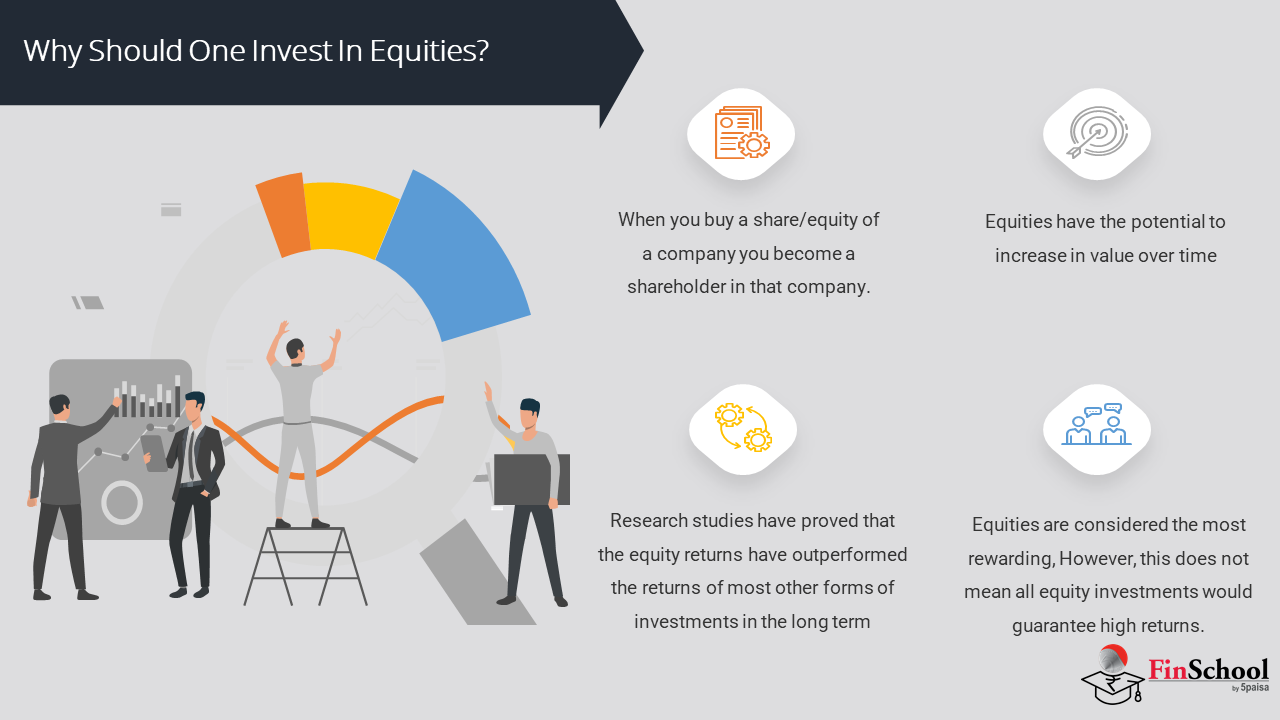
When you buy a share of a company you become a shareholder in that company. Shares are also known as Equities. Equities have the potential to increase in value over time. Research studies have proved that the equity returns have outperformed the returns of most other forms of investments in the long term. Investors buy equity shares or equity based mutual funds because: –
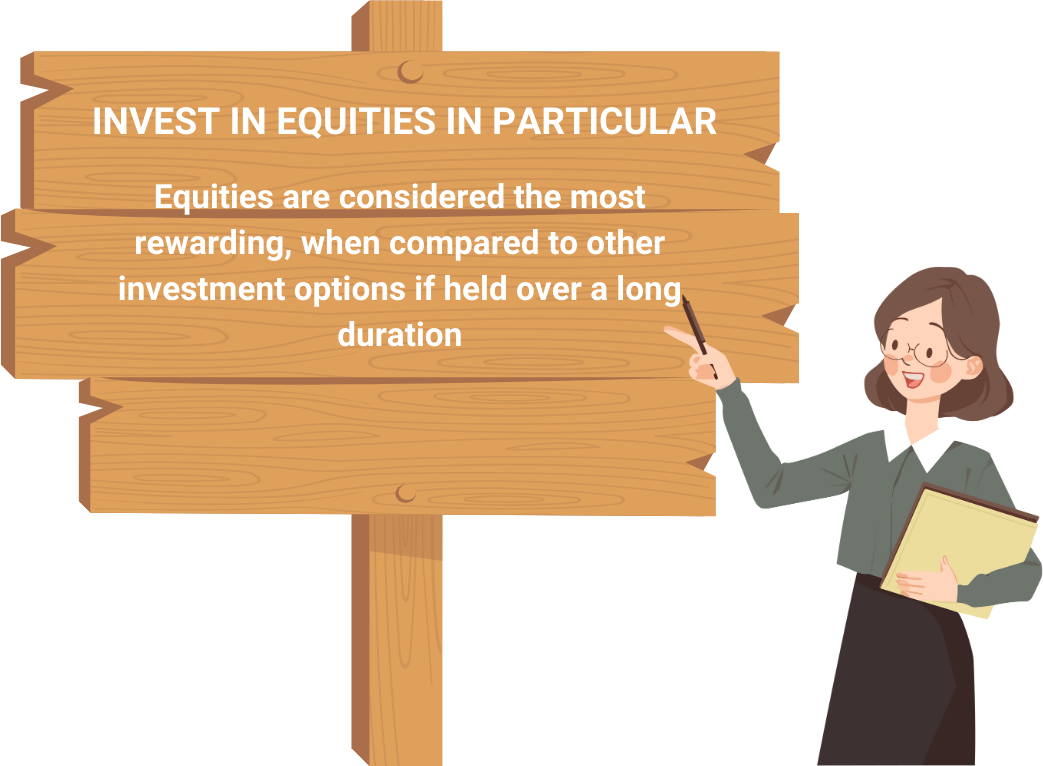
- Equities are considered the most rewarding, when compared to other investment options if held over a long duration.
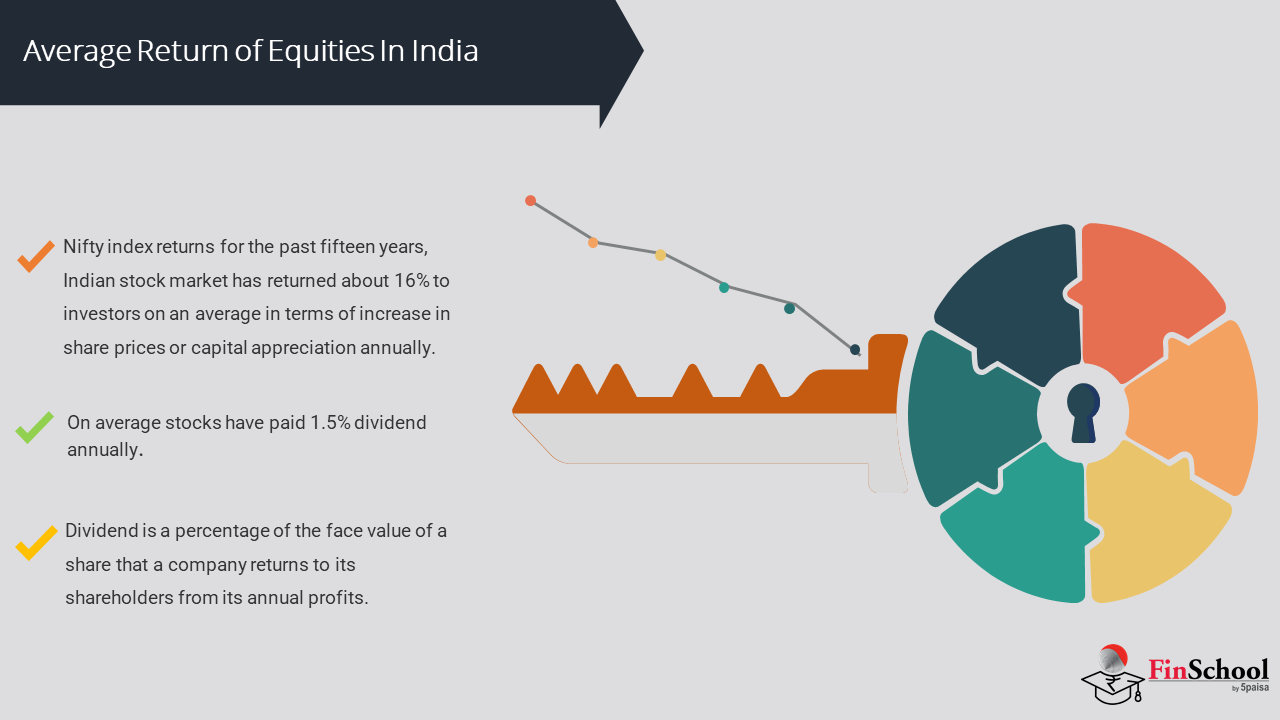
- Research studies have proved that investments in some shares with a longer tenure of investment have yielded far superior returns than any other investment. The average annual return of the stock market over the period of last fifteen years, if one takes the Nifty index as the benchmark to compute the returns, has been around 16%.
However, this does not mean all equity investments would guarantee similar high returns. Equities are high risk investments. Though higher the risk, higher the potential returns, high risk also indicates that the investor stands to lose some or all his investment amount if prices move unfavourably. One needs to study equity markets and stocks in which investments are being made carefully, before investing What Has Been The Average Return On Equities In India?
- If we take the Nifty index returns for the past fifteen years, Indian stock market has returned about 16% to investors on an average in terms of increase in share prices or capital appreciation annually. Besides that, on average stocks have paid 1.5% dividend annually.
- Dividend is a percentage of the face value of a share that a company returns to its shareholders from its annual profits. Compared to most other forms of investments, investing in equity shares offers the highest rate of return, if invested over a longer duration.
Nirav: Vedant, I’ve been watching a mid-cap stock—it swings wildly without any news. What’s driving that?
Vedant: It’s more than company performance. Prices react to market psychology, macro trends, and speculation.
Nirav: So not just earnings?
Vedant: Right. Fundamentals matter, but so do interest rates, global events, and investor sentiment. Even rumors can move prices.
Nirav: Feels unpredictable.
Vedant: It is, but patterns emerge when you track demand-supply, sector trends, and economic signals. Charts and news together give clarity.
Nirav: Like using a compass and map?
Vedant: Exactly—both help you navigate market volatility.
7.3 What Are The Factors That Influence The Price Of A Stock?
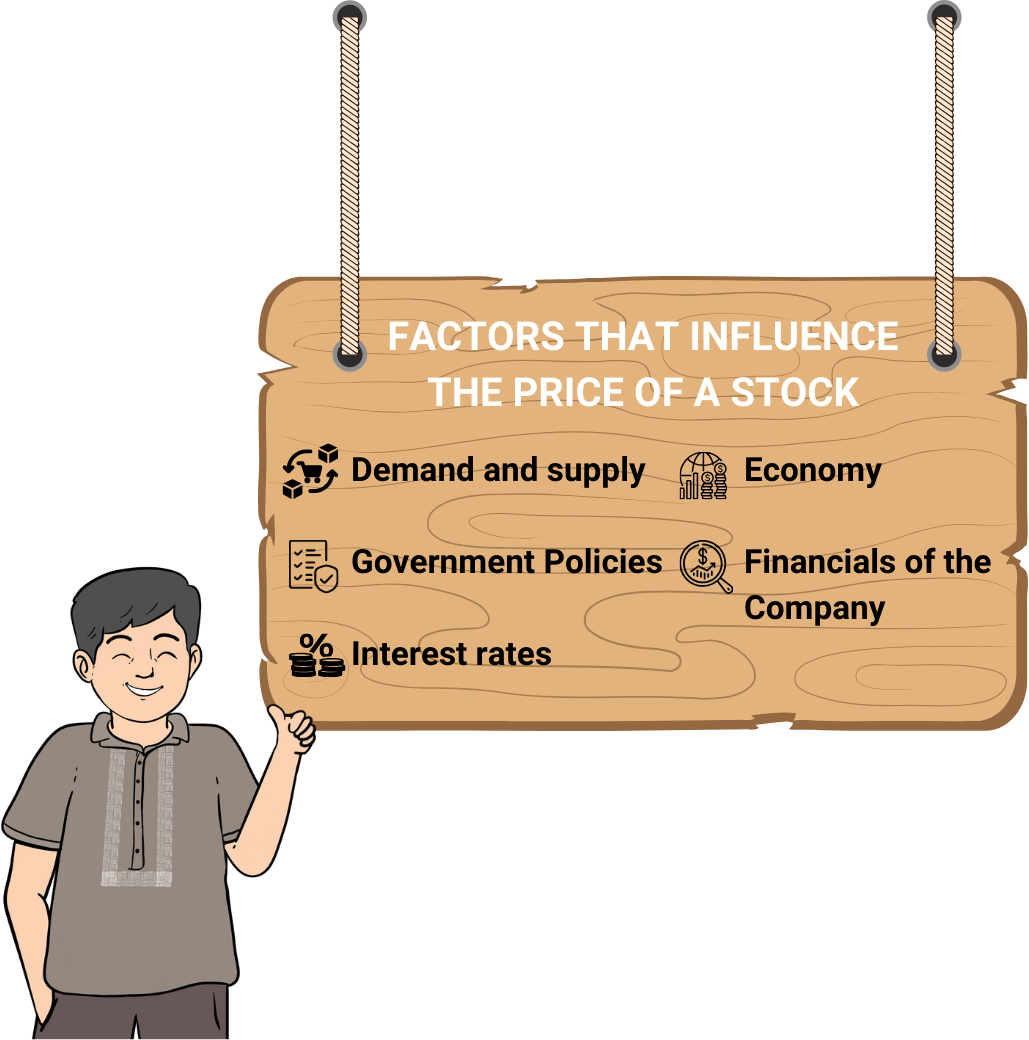
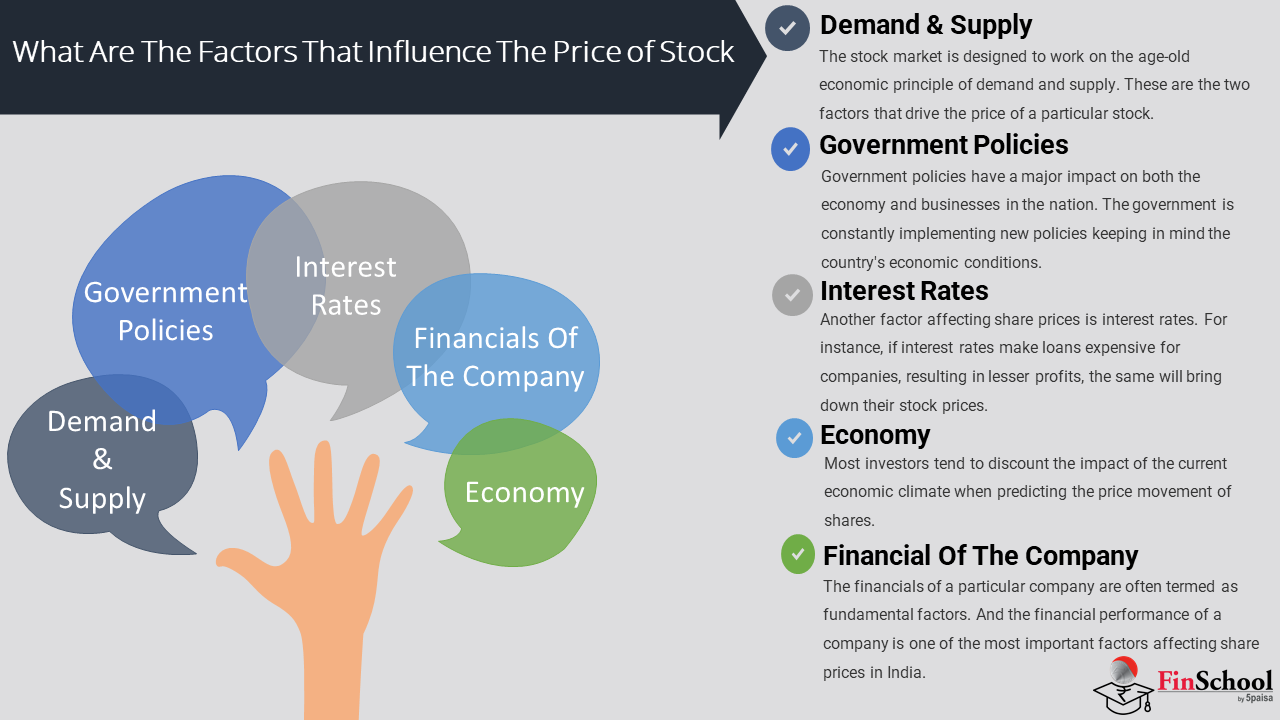
Demand and supply Imagine trying to book tickets for an India vs. Pakistan match—huge demand, limited seats. Prices soar on resale platforms because fans are willing to pay more. Now picture a local weekday match—plenty of tickets, few takers. Sellers drop prices just to fill seats.
Stocks work the same way.
- High demand, low supply → Price rises
- Low demand, high supply → Price falls
The stock market runs on this basic principle: when more people want to buy a stock than sell it, prices go up. When more want to sell than buy, prices drop. Just like any marketplace, it’s all about what people want and how much is available.
Government Policies
Imagine you own a bakery. The government increases electricity bills and taxes on food. Your costs go up profits go down. You might raise prices or cut staff. Now imagine this happening to a company like Jubilant FoodWorks. Higher taxes and costs mean profits. Investors get worried and sell their shares so the stock price falls.
- Government policies, like tax changes can hurt businesses and their profits.
- This can affect how investors feel causing stock prices to change.
Interest rates
Lets say your friend wants to open a café. The bank raises loan interest rates. Borrowing money gets more expensive so he. Reduces his plans. Less growth means profit.
Now think about companies. When interest rates go up borrowing gets costly. Businesses cut back profits dip and investors sell shares making stock prices fall.
The RBI changes rates, like the repo rate to control inflation.
- Higher rates mean loans, lower profits and falling stock prices.
- Lower rates mean loans, more growth and rising stock prices.
Interest rates affect business decisions. What investors expect.
Economy
Imagine your uncles travel agency struggling because people aren’t booking vacations during a slowdown. His earnings. He cuts costs. When Indias economy slows down or theres uncertainty companies face reduced demand. This hurts profits and stock prices. Foreign Institutional Investors play a role in Indian markets. If the economy weakens they might pull out their money seeking investments. This selling pressure can drag down stock prices showing how the economy and investor confidence are doing.
Financials of the Company
If your friends clothing brand triples its sales and boosts profits you’d feel confident investing in it. Similarly when companies report financials like rising revenue and healthy profit margins investor confidence grows. This increases demand, for their shares. Pushes prices up. A companys financial performance is a driver of stock prices. Investors tend to avoid firms with numbers causing their stock to fall. On the side strong fundamentals attract more investors and traders fueling price growth.
Nirav: Vedant, I saw “growth stock” and “value stock” in a blog. What’s the difference?
Vedant: Growth stocks are companies expected to grow faster than average—like tech disruptors. They’re priced for future potential, often with high valuations and no dividends.
Nirav: And value stocks?
Vedant: They’re stable companies trading below their true worth—like buying quality on discount. Investors believe the market’s undervalued them, and prices will eventually rise.
Nirav: So growth is momentum, value is mispricing?
Vedant: Exactly. It depends—do you want future stars or overlooked bargains?
7.4 What Is Meant By The Term Growth Stock/Value Stock?
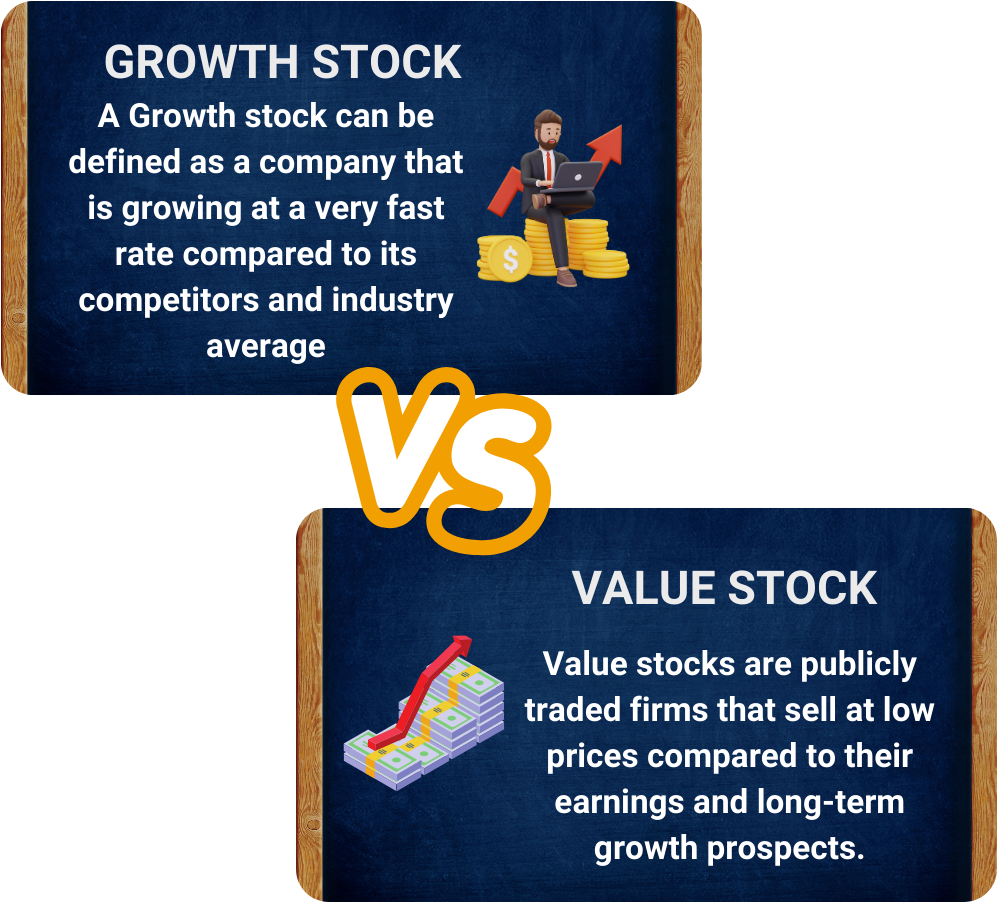
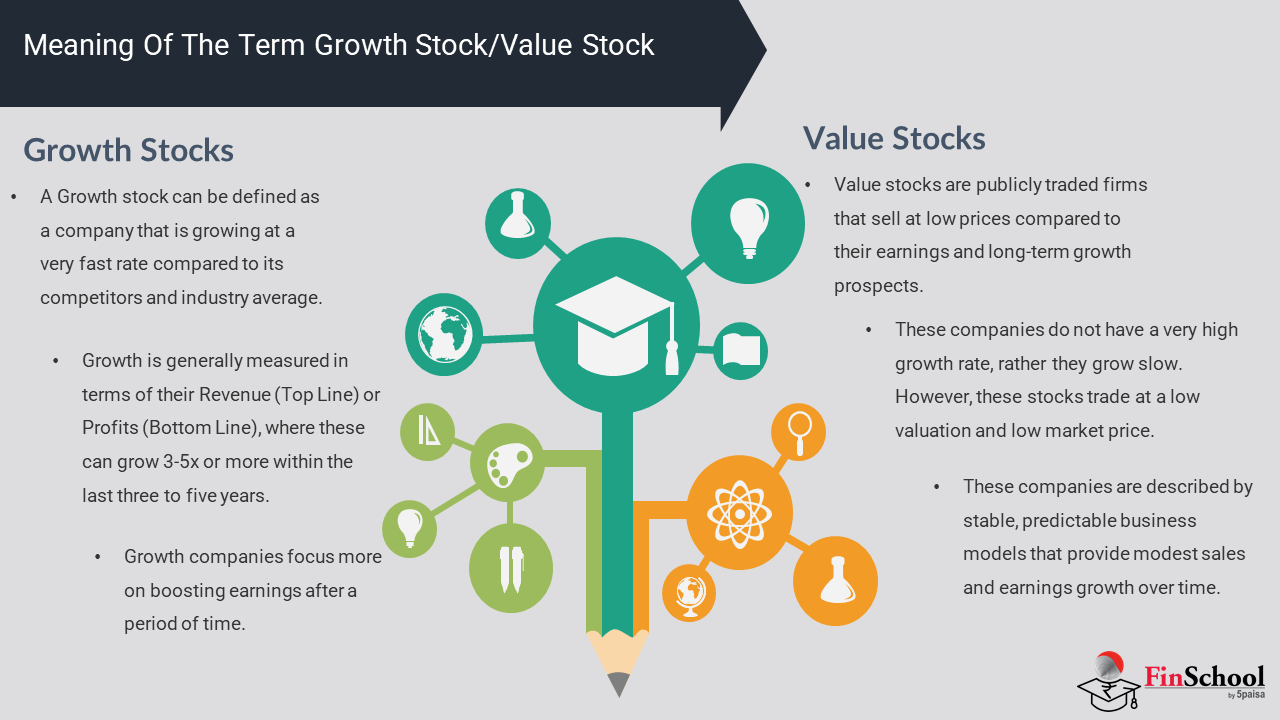
- Companies that are deemed to have the ability to outperform the broader market over time due to their future potential are known as growth stocks.
- Value stocks are companies that are currently trading at a discount to their true value and will consequently deliver a higher return. In this article we will be looking into both of their differences and which one is good to invest in Growth Stocks
Imagine TiffinBox, a company that delivers home-cooked meals in cities. They grew fast kept their prices low and spent a lot of money on technology. They were losing money. They wanted to get more customers.
Over three years TiffinBox went from making 500 meals a day to making 15,000 meals a day. They were not making money at first. They were getting more and more customers and making more money. This made investors want to put money into TiffinBox and the price of their shares went up.
There are companies that grow fast like TiffinBox. These companies are called growth stocks. They are growing faster than companies. We can tell they are growing by looking at how money they make how much profit they make or how much of the market they have. When these companies are just starting out they want to get bigger more than they want to make money. As they get better, with money investors become more confident. This makes the price of their shares go up and more people want to buy them.
Think of your neighborhood kirana store, steady sales, loyal customers, and predictable earnings. If it were listed on the stock exchange its slow growth might lead to a value.. Small improvements like making inventory digital or partnering with online businesses could quietly increase profits. This could attract investors before the rest of the market notices.
Value stocks are companies that are trading for less, than their worth. Often they are ignored because of growth or temporary problems.
They offer stable business models and modest earnings, but their low prices can hide strong long-term potential—making them ideal for patient, value-focused investors.
Growth v/s Value which one to choose?
When it comes to investing people have two choices: growth stocks and value stocks. Both growth stocks and value stocks can be options for investors. The thing that matters is what you want to achieve with your money and how you like to invest.
Nirav asks Vedant how do I decide between growth stocks and value stocks?
Vedant says, growth stocks are all about what’s going to happen in the future. These companies are growing fast they are. People think they are worth a lot of money. They put their profits back into the business. They do not usually pay dividends to the people who own the stocks.
Nirav wants to know about value stocks.
Vedant explains value stocks are companies that’re stable and often people do not think they are worth as much as they really are. They make money consistently. They pay dividends regularly. Growth stocks are about what might happen in the future. Value stocks are about finding companies that are underpriced right now.
Nirav says,. It is like I have to choose between getting excited, about something that might happen soon or being patient and waiting for something to pay off.
Vedant says, that is exactly right.
The way you invest is what helps you pick between growth stocks and value stocks.
Growth Stocks and value Stocks Characteristics Growth Stocks Characteristics
- You are not concerned about your portfolio’s current income
The majority of fast-growing corporations do not pay big dividends to their owners. This is because they choose to reinvest all available cash back into their firm in order to promote faster growth.
- You are at ease with large stock price swings
A growth stock’s price is very sensitive to changes in a company’s business prospects in the future. Growth stocks can skyrocket in value when things go better than expected. Higher-priced growth stocks can fall back to Earth just as rapidly as lower-priced growth companies when they disappoint.
- You are confident in your ability to predict winners in emerging markets
Growth stocks are frequently found in fast-moving sectors of the economy, such as technology. Many various growth companies fight against each other on a regular basis. You’ll need to identify as many future winners as possible in a certain industry while avoiding losers.
- You will have plenty of time to get your money back before you need it
Growth stocks can take a long time to reach their full potential, and they frequently experience setbacks. It’s vital to have a long enough time horizon to allow the business to flourish.
Value Stocks Characteristics
- You are looking for current income from your investment portfolio
Many value stocks pay out large amounts of money in dividends to their stockholders. Because such organisations lack considerable development potential, they must find other ways to keep their stock appealing. One strategy to entice investors to look at a stock is to pay out attractive dividend pay-outs.
- You would rather have more consistent and stable stock prices
Value stocks aren’t known for having huge price swings in either way. Stock price volatility is usually modest as long as their business circumstances remain within predictable parameters.
- You are certain you will be able to avoid value traps
Stocks that appear to be bargains are frequently value traps or bargains for a cause. It’s possible that a business has lost its competitive advantage or is unable to keep up with the pace of innovation. To see whether a company’s future business prospects are weak, you’ll need to be able to look past its enticing values.
- You are looking for a faster return on your investment
Value stocks don’t make money overnight. A company’s stock price might fast grow if it is successful in getting its business moving in the correct way. The finest value investors spot stocks that are undervalued and buy shares before others do.
Nirav: What does “portfolio” mean in finance?
Vedant: It’s a collection of investments—like stocks, bonds, or real estate. Think of it like a cricket team, where each asset plays a role: growth, safety, or income.
Nirav: And diversification?
Vedant: That’s spreading investments across types or sectors to manage risk. If one underperforms, others can balance it—just like a team effort.
Nirav: So managing a portfolio is strategic?
Vedant: Exactly. It depends on your goals, risk appetite, and time horizon. Smart investors review and adjust regularly.
7.5 What Is a Portfolio?
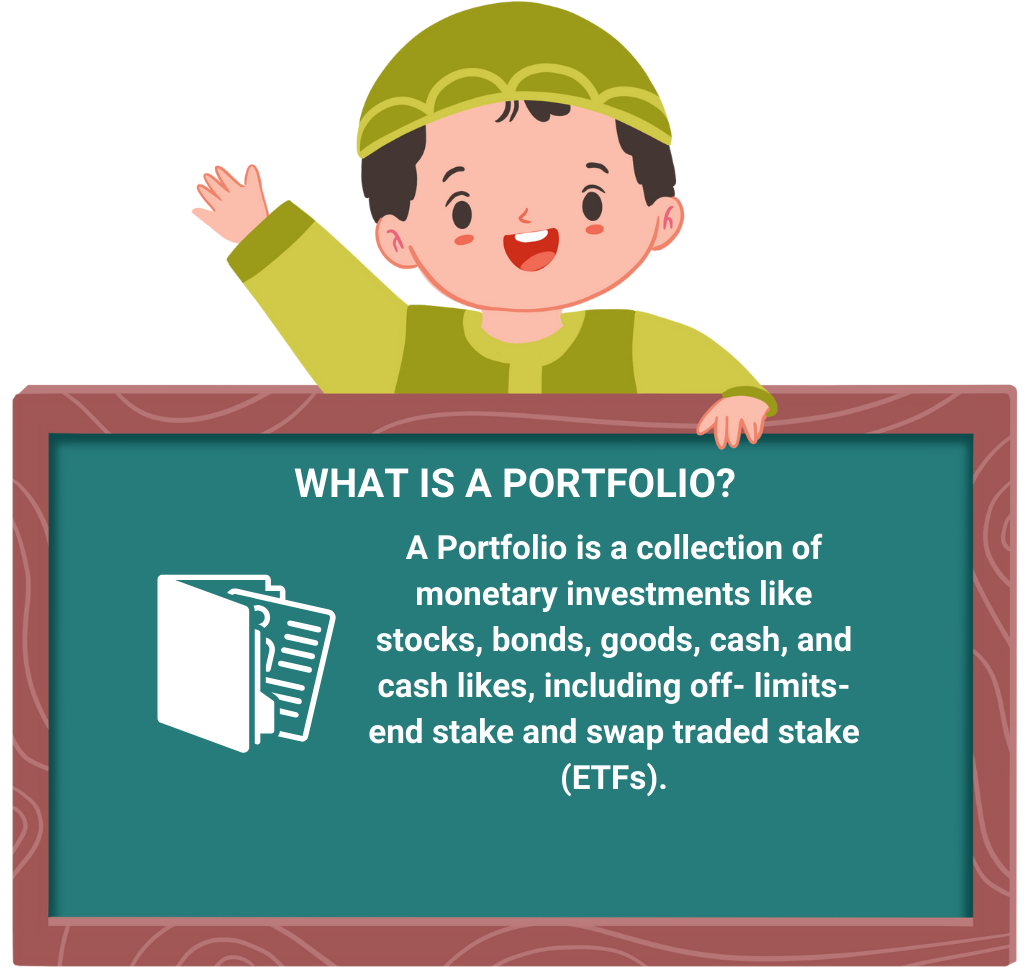
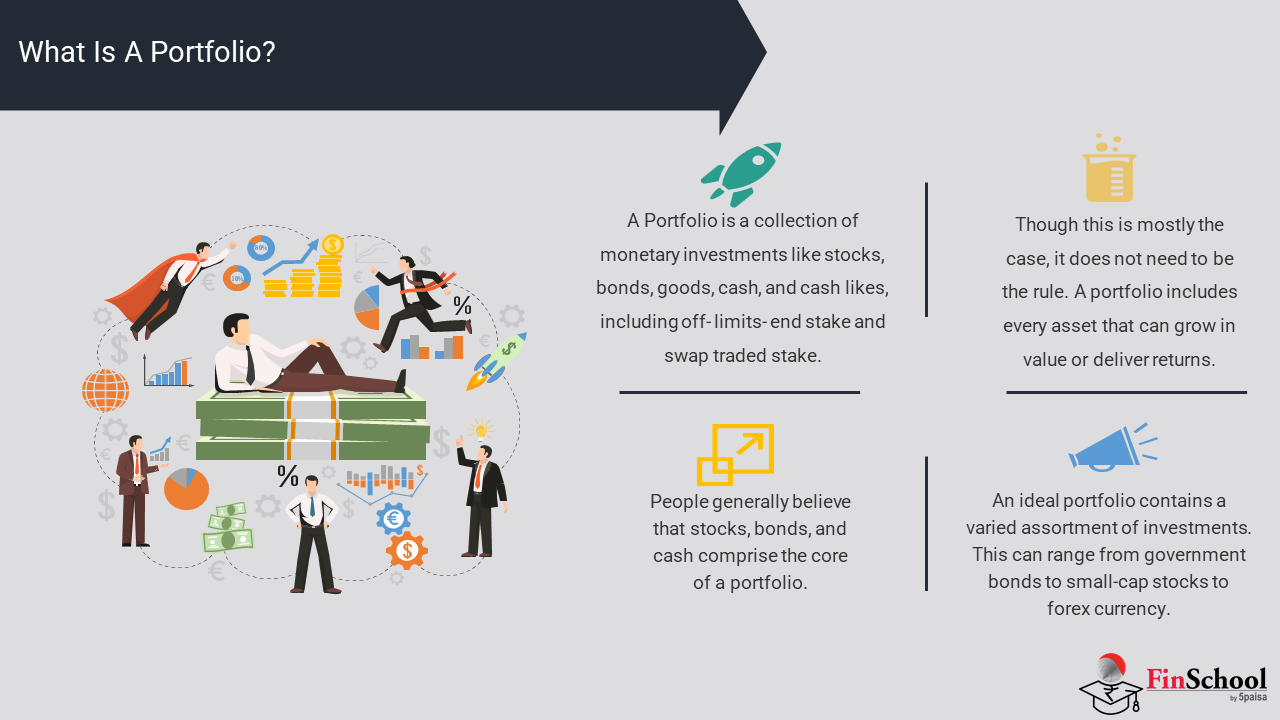
Meera uses her bonus in a way. She puts ₹50,000 in fixed deposits for safety, ₹40,000 in funds for growth, ₹30,000 in blue-chip stocks ₹10,000 in savings for emergencies and also invests in gold ETFs and international funds. This mix of investments is called her portfolio. It helps balance risk, returns and liquidity. A portfolio is a group of investments like stocks, bonds, cash, ETFs and more. A diversified portfolio works like a diet. It helps keep your finances healthy. Managing it well helps you grow your money steadily and protects you from market ups and downs.
Portfolio Management
How well you manage investment risk is very important for investing. Risk happens when there is uncertainty meaning many things can happen from a situation or action.
In investing risk is the chance that the actual return on an investment will be different from what you expected. There will be times when the return’s less than you expected and times when it is more.
Nirav asks Vedant “Everyone talks about returns in equities but what about the risks?”
Vedant replies, “That’s a point. Equities can give returns but they also come with ups and downs. Prices can change quickly due to news, sentiment and economic changes.”
Nirav says, “So it’s more than picking the right stock?” Vedant answers, “Yes there is business risk, market risk and liquidity risk. That’s why diversification, time horizon and knowing your risk tolerance are important.”
Nirav asks, “So we shouldn’t fear risk but manage it?”
Vedant says, “Exactly. Equities need a strategy, not optimism.”
Risk Involved
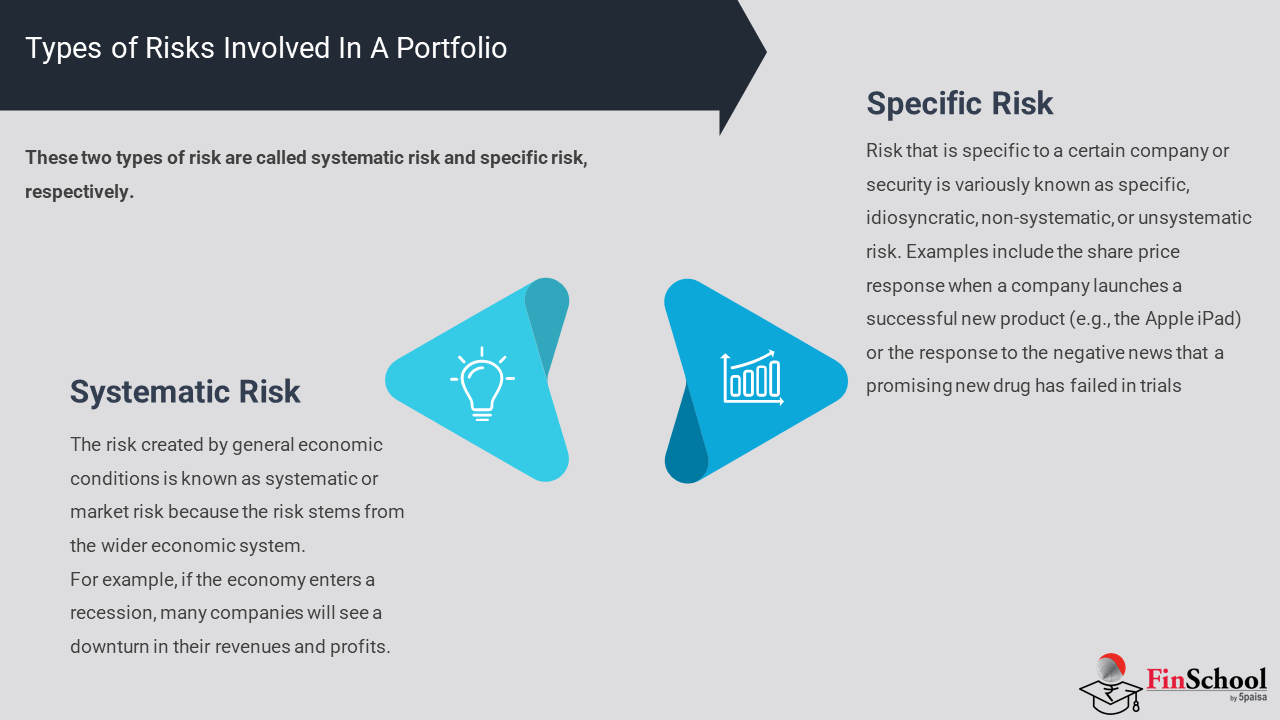
There are two types of risk: risk and specific risk.
Systematic risk:
- Imagine Rahul has a chain of clothing stores. During a downturn people shop less and his revenue drops. This is not because of something he did. Because the overall economy is struggling. This type of risk affects all businesses no matter how well they are managed.
- The risk created by economic conditions is called systematic or market risk. For example if the economy enters a recession many companies will see a downturn in their revenues and profits.
Specific risk:
If Rahul invests heavily in a clothing line and it fails thats specific risk. Its linked to company-level decisions. He can reduce it by expanding to cities. Like investors diversify across stocks and sectors to manage unsystematic risk. Even if Rahul diversifies a nationwide recession would still hurt his business. That’s risk, caused by broad economic factors. It affects all investments. Can’t be eliminated through diversification. Investors accept this risk for higher long-term returns.
Nirav asks Vedant “What does diversification really mean?” Vedant explains, “It’s about spreading investments, across assets, sectors or geographies. So if one investment crashes others can help reduce the impact.”
Nirav says, “Like a safety net?” Vedant replies, “Exactly. Holding types of stocks or mixing equities, debt and gold helps balance risk. True diversification means choosing assets that react differently to market shifts.”
Nirav asks, “So the aim is returns and fewer shocks?” Vedant says, “That’s correct. Are you ready to explore how to build a portfolio for the market?”
7.6 What Is Diversification?
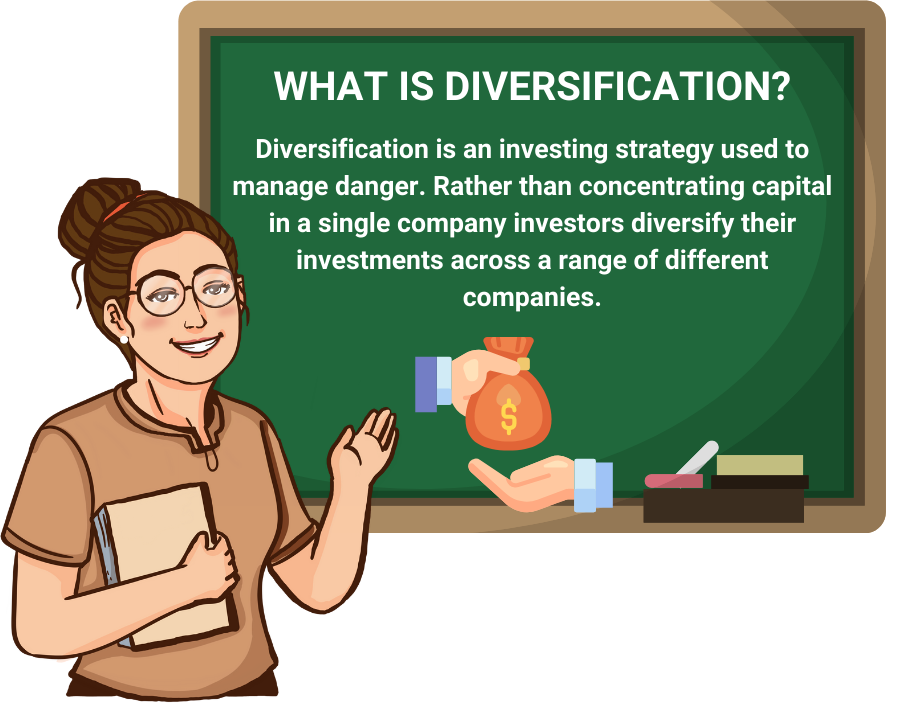
Diversification is an investing strategy used to manage danger. Rather than concentrating capital in a single company, sector or asset class, investors diversify their investments across a range of different companies, sector and asset classes. When assets and/ or asset classes with different characteristics are combined in a portfolio, the overall level of risk is typically reduced. Mathematically, a portfolio that combines two assets has an expected return that is the weighted average of the returns on the individual assets.
Provided that the two assets are less than perfectly correlated, the risk of the portfolio will be less than the weighted average of the risk of the two assets individually.
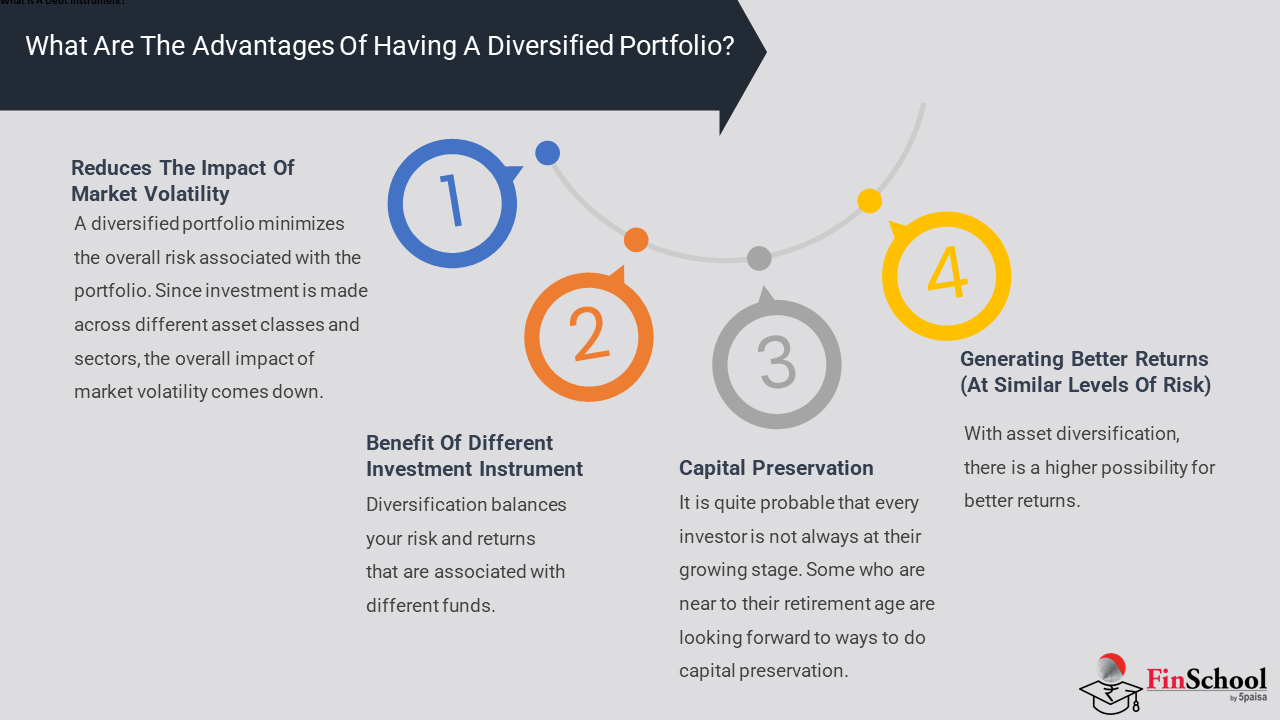
What Are The Advantages Of Having A Diversified Portfolio? Reduces the Impact Of Market Volatility
A diversified portfolio minimizes the overall risk associated with the portfolio. Since investment is made across different asset classes and sectors, the overall impact of market volatility comes down. Owning investments across different funds ensures that industry-specific and enterprise-specific risks are low. Thus, it reduces risks and generates higher returns in the long run.
Benefit Of Different Investment Instrument
Diversification balances your risk and returns that are associated with different funds. For example, if you are investing in mutual funds, you enjoy debt and equity. When you invest in fixed deposits, you would be taking advantage of returns and low risk. This is the case with a diversified portfolio, and you can enjoy the benefits of different instruments.
Capital Preservation
It is quite probable that every investor is not always at their growing stage. Some who are near to their retirement age are looking forward to ways to do capital preservation. At that time, portfolio diversification will help them in achieving that objective.
Generating Better Returns (At Similar Levels Of Risk)
With asset diversification, there is a higher possibility for better returns. There are market rallies when certain asset classes perform extremely well and having a diversified portfolio better ensures you benefitting from this. Having equity during a bull market phase allows for higher-than-average returns. And having debt during a bear market allows decent returns even with drop-in equity portfolio.
Nirav: Vedant, I get the basic idea behind stocks. But I saw this term “debt instrument” in a portfolio breakdown, what exactly does it mean?
Vedant: Simply put, debt instruments are tools companies or governments use to borrow money. When you invest in one, you’re basically lending them money in exchange for interest.
Nirav: So it’s like being the bank?
Vedant: Exactly. Instruments like bonds, debentures, and treasury bills fall under this. They come with fixed returns and maturity dates—unlike equities, where returns depend on market performance.
Nirav: Sounds safer than stocks?
Vedant: Generally, yes. Less volatile and more predictable. But returns are usually lower too. And some carry credit risk—if the borrower defaults, you might lose money.
Nirav: Got it. So debt instruments are about capital preservation and steady income. Vedant: Spot on. They’re useful for balancing a portfolio, especially when you want reduced exposure to market swings.
7.7 What Are The Advantages Of Having A Diversified Portfolio?
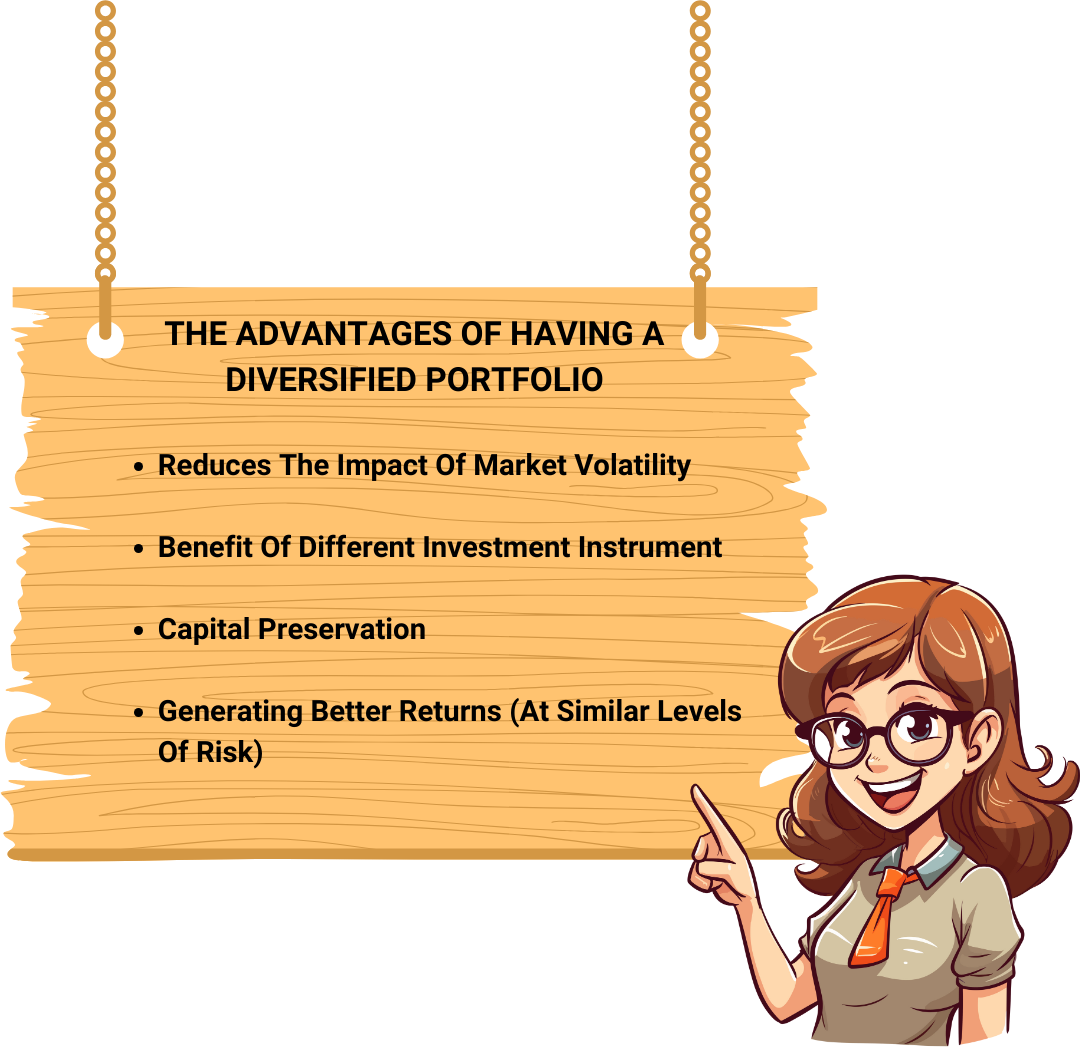
Reduces the Impact Of Market Volatility
A diversified portfolio minimizes the overall risk associated with the portfolio. Since investment is made across different asset classes and sectors, the overall impact of market volatility comes down. Owning investments across different funds ensures that industry-specific and enterprise-specific risks are low. Thus, it reduces risks and generates higher returns in the long run.
Benefit Of Different Investment Instrument
Diversification balances your risk and returns that are associated with different funds. For example, if you are investing in mutual funds, you enjoy debt and equity. When you invest in fixed deposits, you would be taking advantage of returns and low risk. This is the case with a diversified portfolio, and you can enjoy the benefits of different instruments.
Capital Preservation
It is quite probable that every investor is not always at their growing stage. Some who are near to their retirement age are looking forward to ways to do capital preservation. At that time, portfolio diversification will help them in achieving that objective.
Generating Better Returns (At Similar Levels Of Risk)
With asset diversification, there is a higher possibility for better returns. There are market rallies when certain asset classes perform extremely well and having a diversified portfolio better ensures you benefitting from this. Having equity during a bull market phase allows for higher-than-average returns. And having debt during a bear market allows decent returns even with drop-in equity portfolio.
Nirav: Vedant, I get the basic idea behind stocks. But I saw this term “debt instrument” in a portfolio breakdown, what exactly does it mean?
Vedant: Simply put, debt instruments are tools companies or governments use to borrow money. When you invest in one, you’re basically lending them money in exchange for interest.
Nirav: So it’s like being the bank?
Vedant: Exactly. Instruments like bonds, debentures, and treasury bills fall under this. They come with fixed returns and maturity dates—unlike equities, where returns depend on market performance.
Nirav: Sounds safer than stocks?
Vedant: Generally, yes. Less volatile and more predictable. But returns are usually lower too. And some carry credit risk—if the borrower defaults, you might lose money.
Nirav: Got it. So debt instruments are about capital preservation and steady income.
Vedant: Spot on. They’re useful for balancing a portfolio, especially when you want reduced exposure to market swings.
7.8 What Is A Debt Instrument?
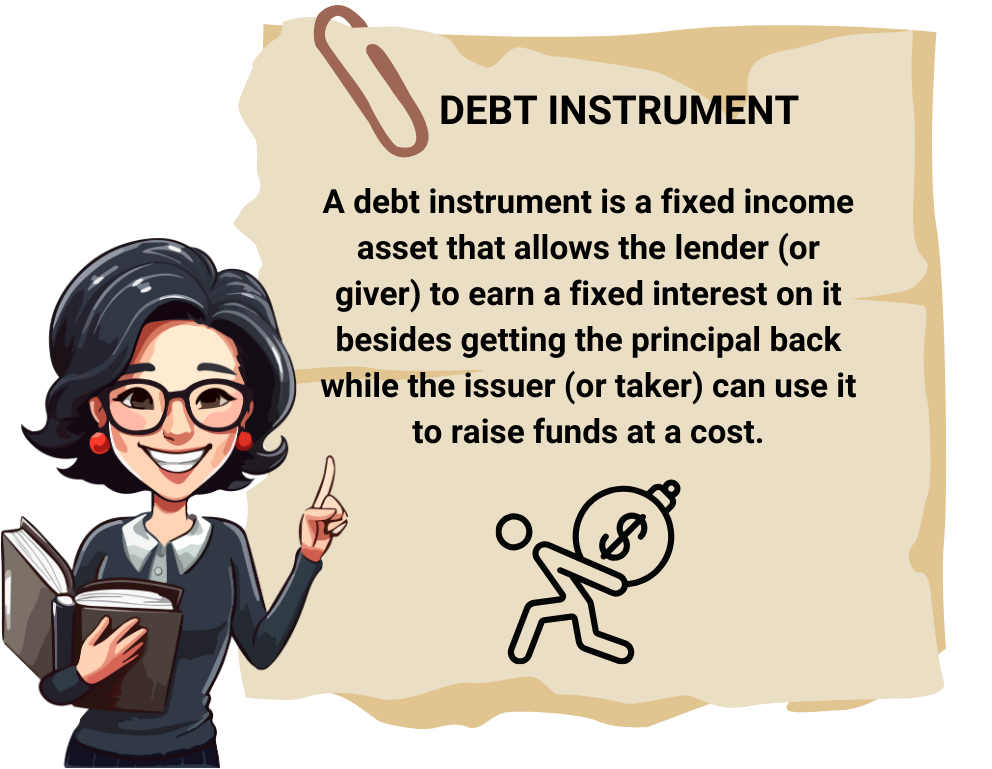
Ankit gives Neha fifty thousand rupees for her baking business. They make a promissory note that says Neha has to pay back the money with ten percent interest in one year. This promissory note means Neha has to pay Ankit so it is like a debt. Ankit gets a fixed amount of money from this. Neha gets the money she needs to make her business grow.
Debt instruments like promissory notes are good for people who want to earn an income. There are debt instruments like bonds and debentures. These debt instruments are like promises to pay back money. The person who borrows the money has to pay back the amount plus some extra money, which is called interest. You can have debt instruments on paper or, on a computer. These instruments may also be transferred, offering predictable returns to lenders.
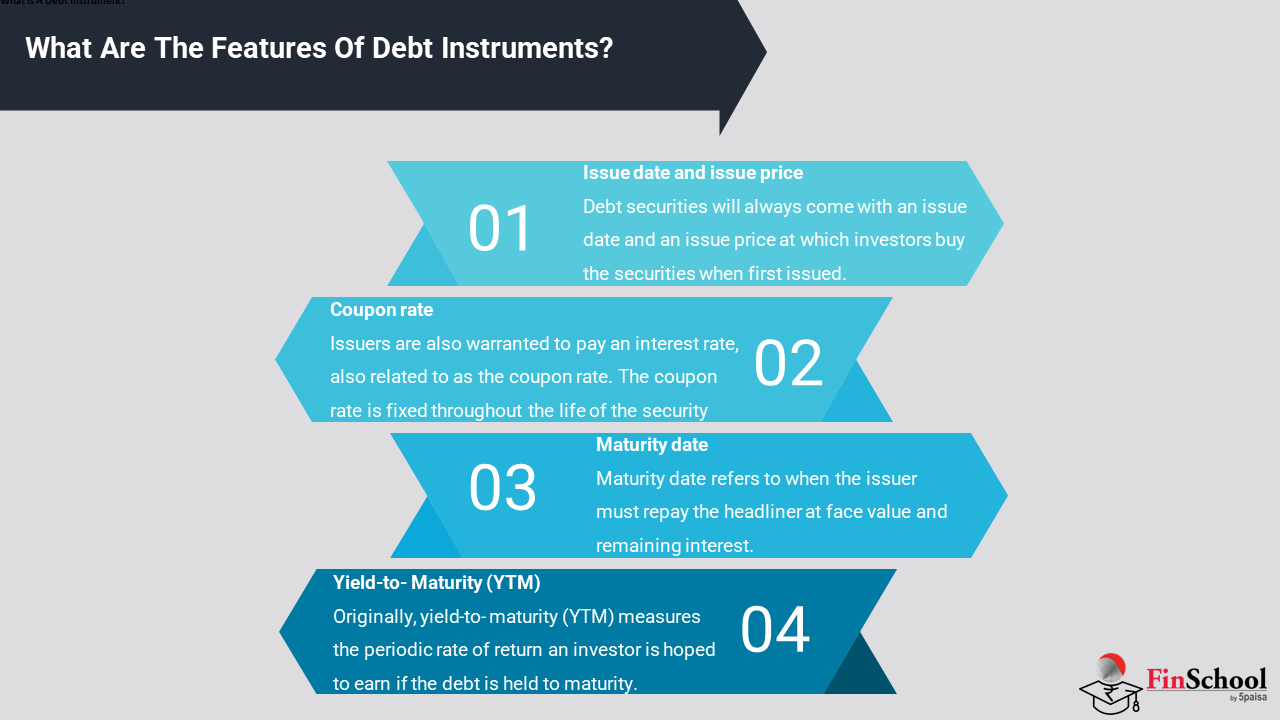
7.9 What Are The Features Of Debt Instruments?
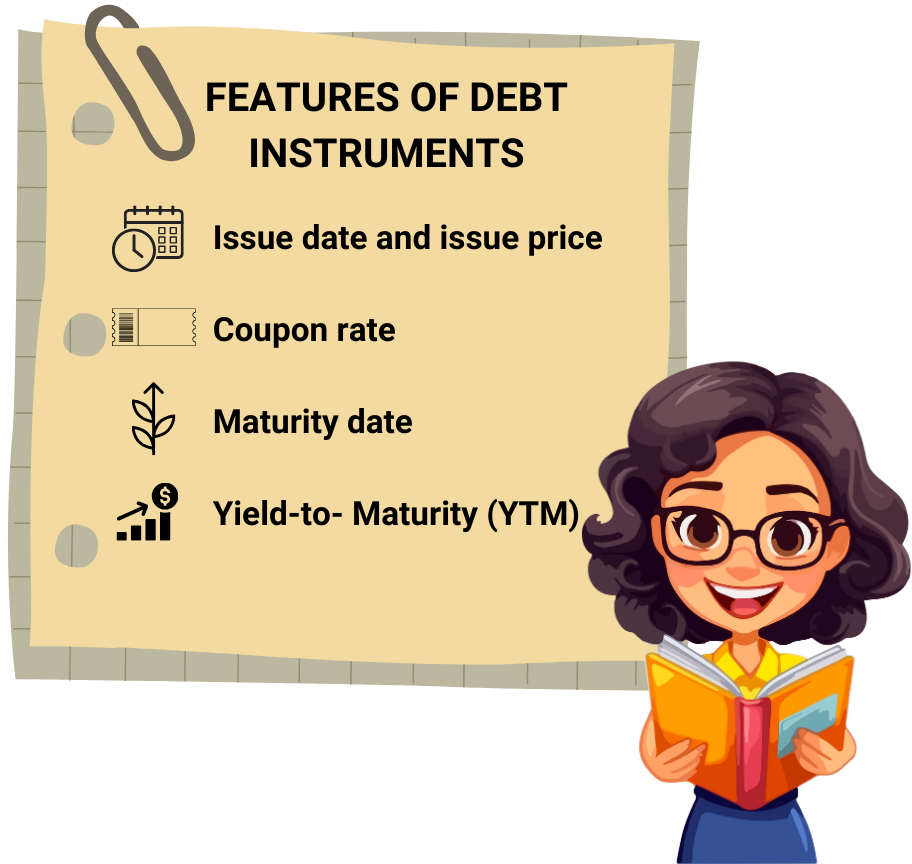
Main Features of Debt Securities Issue date and issue price
Debt securities will always come with an issue date and an issue price at which investors buy the securities when first issued.
Coupon rate
Issuers are also warranted to pay an interest rate, also related to as the coupon rate. The coupon rate is fixed throughout the life of the security. Coupons are declared either by stating the number (example: 8%) or with a benchmark rate (example: LIBOR+0.5%). It is usually represented as a percentage of the face value or the par value of the bond.
Maturity date
Maturity date refers to when the issuer must repay the headliner at face value and remaining interest. The maturity date determines the term that categorizes debt securities.
Yield-to- Maturity (YTM)
Originally, yield-to- maturity (YTM) measures the periodic rate of return an investor is hoped to earn if the debt is held to maturity. It’s used to compare securities with parallel maturity dates and considers the bond’s pasteboard payments, copping price, and face value.
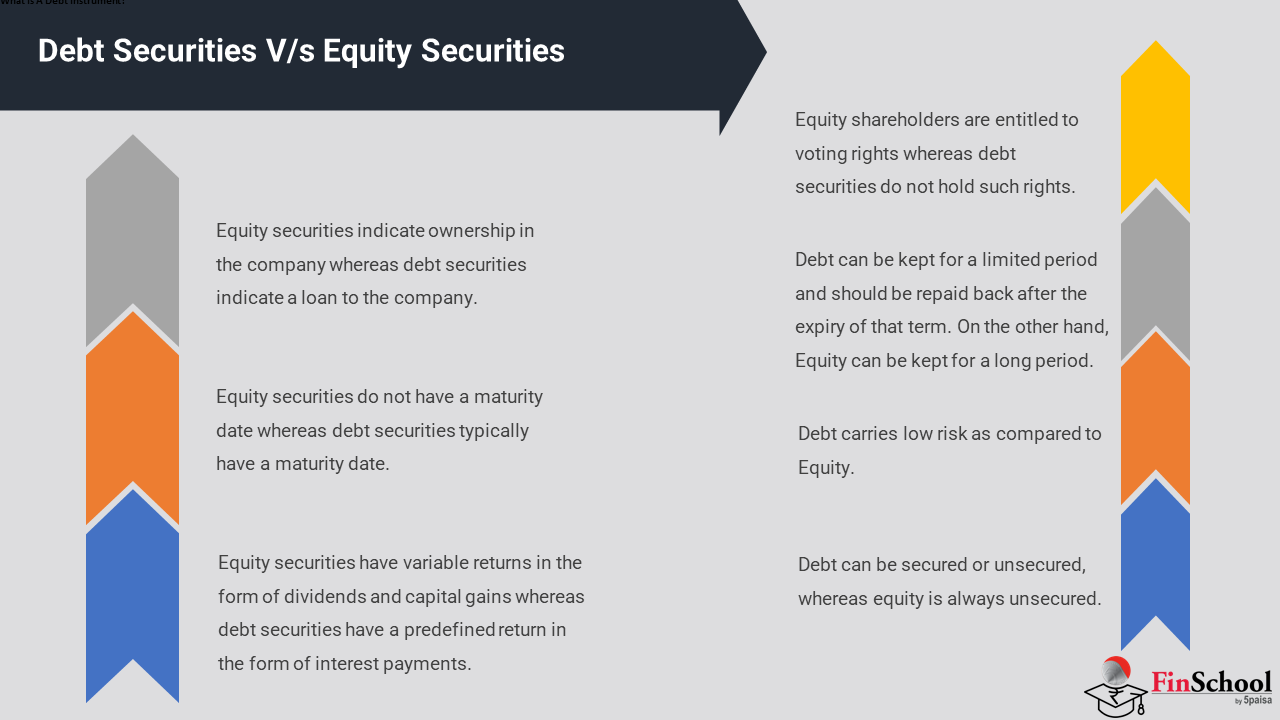
Debt Securities Versus Equity Securities
- Equity securities mean you own a part of the company. Debt securities mean you are lending money to the company.
- Equity securities do not have an end date but debt securities usually have a date when they expire.
- When you have equity securities you can get money from dividends. When you sell the securities but debt securities give you a fixed amount of money as interest.
- People who own equity securities can vote on company decisions. People who own debt securities cannot vote.
- You can only keep debt securities for a time and then you have to give the money back but you can keep equity securities for a very long time.
- Debt securities are generally safer than equity securities.
- Debt securities can be. Not secured, but equity securities are never secured.
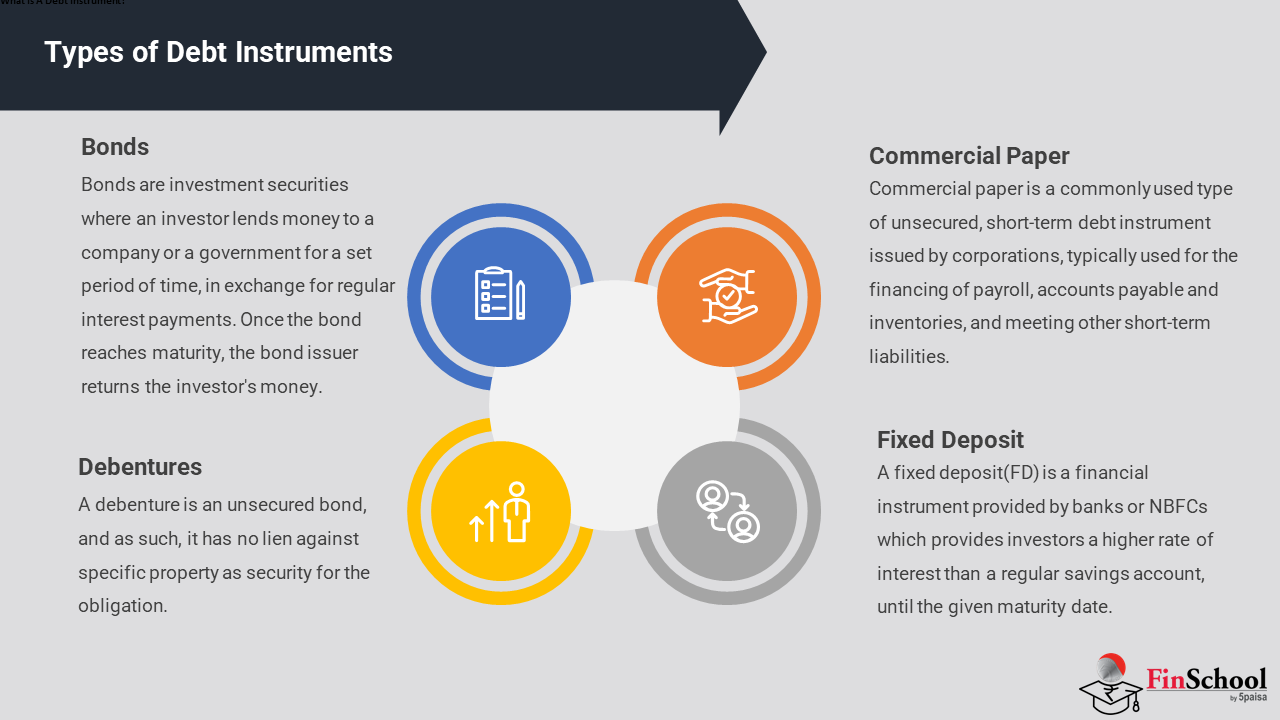
Types of Debt Instruments
Bonds : Bonds are a type of investment where you lend money to a company or the government for a set time. They pay you back with interest. Companies use bonds to get money for their projects or to help with their finances. Bonds are considered an investment than stocks, especially high-quality bonds. They help you spread out your investments give you an income and keep your money safe which makes them a good choice for when you retire or to balance out other investments that are riskier.
Debenture: A debenture is a type of bond that is not backed by any assets. People who lend money through debentures are like creditors and they rely on the company being trustworthy. Companies that are seen as trustworthy or do not have many assets often use debentures because they think their good name will attract investors.
Commercial Paper: Commercial paper is a short-term debt instrument that companies use to pay for things they need away like paying their employees or buying inventory. It usually expires in a days or up to 270 days pays a fixed interest rate and is sold at a lower price because it is riskier.
Fixed Deposit: A fixed deposit is a type of savings account that banks or other financial companies offer, where you can put your money for a set time and get interest than a regular savings account. In India fixed deposits are very popular. You cannot take your money out until the time is up. There are types of fixed deposits like regular ones, recurring deposits and flexi deposits.
Nirav: I learned a lot about equity and debt securities and how to diversify my investments. I did not know there were many different types of stock market products.
Vedant: That is right. Each investment product has a purpose like helping you build wealth preserve your capital or manage risk. Now you can look at each product. Decide which ones are right for you based on your goals and what is happening in the market.
Nirav: I keep hearing about the Nifty 50, the Sensex and sectoral indices. What do they do?
Vedant: Those are stock market indices, which’re like tools that track how a group of stocks are doing and show how the market is performing. They are, like reference points, not products you can invest in.
Nirav: So they help us understand how the market is feeling?
Vedant: Exactly. Now let us learn more about how they work why they are important and how investors use them to make decisions.