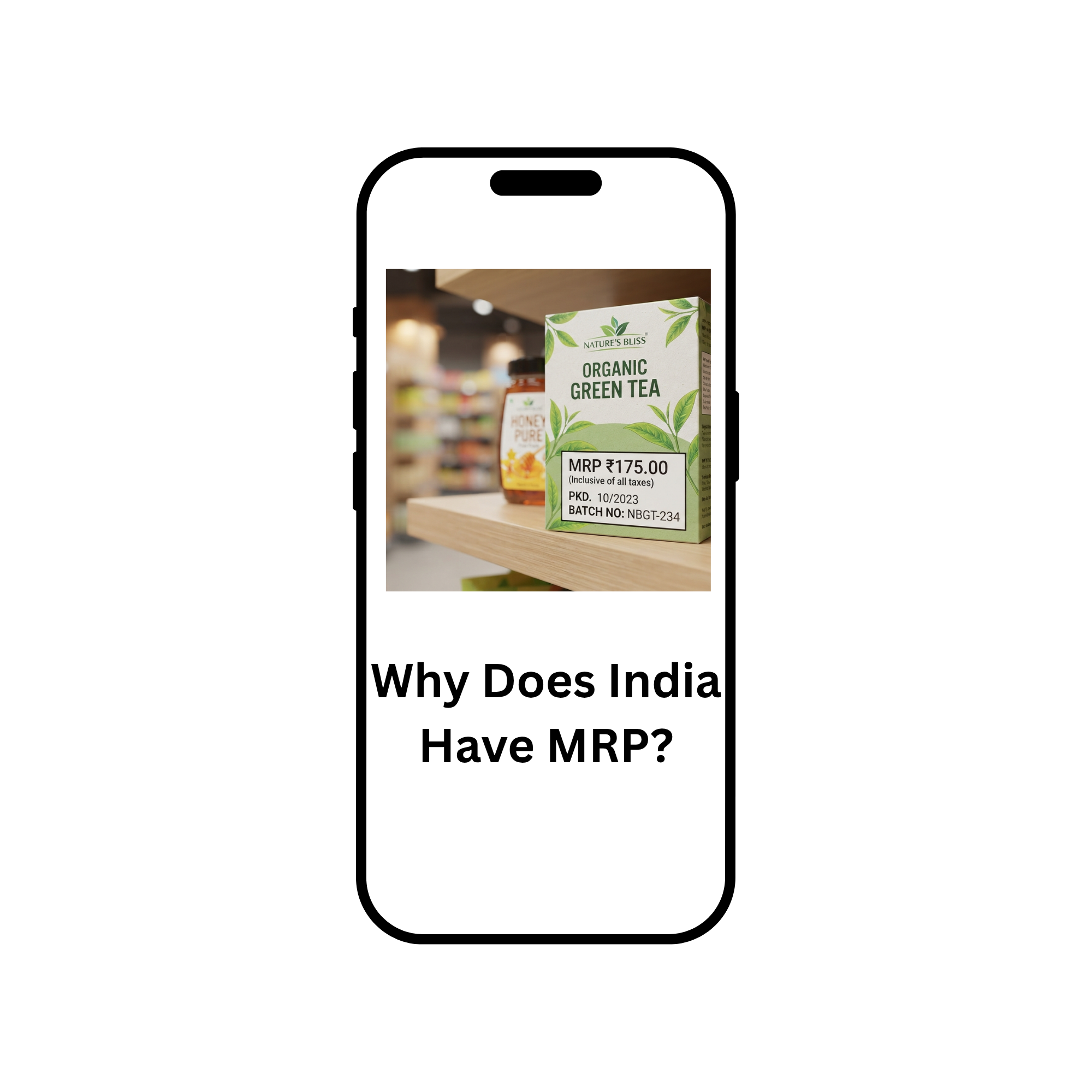
In India, almost all packaged items sold in supermarkets, pharmacies and neighborhood shops carry a printed price on their packaging. This includes a wide range of items from biscuits and shampoo to rice and household goods. The shown price is called the MRP which is Maximum Retail Price.
But what is Maximum Retail Price MRP ?
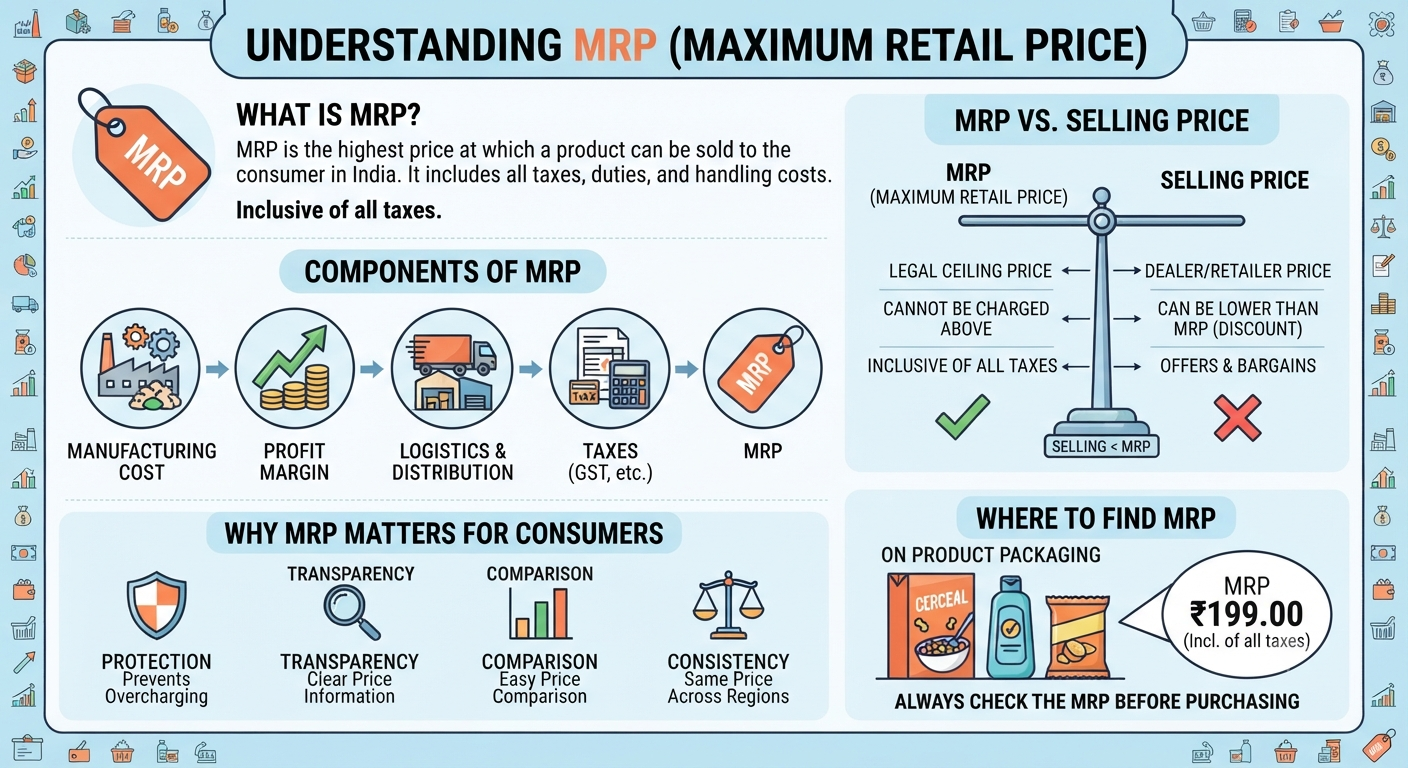
The MRP is the maximum retail price at which the retailer is permitted by law to sell the product to a consumer. It includes all applicable taxes and manufacturers or packers are required to display it on the package under the Legal Metrology (Packaged Commodities) Rules. A shop can sell an item for less than the MRP, but cannot charge more.
Most consumers see this number daily and don’t give it a second thought. But MRP is not merely a price on a packet. It is part of the consumer-protection and legal-metrology framework of India, aimed at making maximum retail price of covered packaged commodities transparent to consumers.
Can a shopkeeper price above the MRP? Can a retailer price below it? Does MRP include GST? Why do different stores sell the same product for different prices?
To make sense of these questions one must remember one fundamental principle:
MRP is Maximum Retail Price. Not a compulsory selling price.
The basic concept of MRP is
Think about buying the same packet of biscuits from three different stores.
- One shop charges Rs 45.
- One charges 50 rupees.
- The third costs ₹60.
There was no clear statement of the maximum price, so a customer might have trouble knowing whether the price being asked was fair or too much.
- This creates an information imbalance. The retailer knows the price at which the product was bought, the costs involved and the margin being earned. None of this may be known to the consumer. MRP closes this information gap. Manufacturers, packers and importers of packaged commodities covered under the Legal Metrology rules of India are required to include some declarations on the package such as the maximum retail price, subject to applicable rules and exemptions.
- The concept is simple: The maximum retail price should be visible to the consumer before buying the product. What Does “Maximum Retail Price” Mean Average, for real? Key word is maximum in MRP. Assuming a packet has: MRP: Rs.100 The retailer is not bound to sell it at ₹100.
- The product can be sold at Rs.95 or Rs.90 or even Rs.80, as per applicable laws and commercial conditions. What the retailer generally cannot do is charge more than the applicable MRP for a covered packaged commodity. This is why you might see advertisements like: MRP ₹999/- Special Price ₹749.00 The ₹999 is the declared maximum retail price. Retailer is offering actual selling price at ₹749. So lower selling price is not a breach of the MRP system. In fact selling below MRP is an essential part of retail competition. Why the Government Can’t Fix the Selling Price? This is a significant difference. MRP is not price regulation. In general, the government is not saying,
- “This product has to be sold by every retailer at Rs 100.” Instead, the framework establishes a maximum declared price for covered packaged commodities, allowing retailers to compete under that price. Imagine two supermarkets have the same product. Supermarket A sells it at ₹95. Supermarket B sells it at ₹90. The consumer wins from the competition. If the law required a uniform price of exactly ₹100 for both retailers, then the scope for price discounts by retailers would be much narrower. MRP combines price transparency with scope for retail competition.
Can a shopkeeper charge you more than the MRP? In the case of a packaged commodity to which the applicable MRP rules apply, the retailer generally cannot charge the consumer more than the declared MRP.
Assuming: Printed MRP = 200 Rs
A retailer can’t simply say:
Selling price = ₹230
Give a reason for the increase like shop has more rent, more cost for electricity or is in a busy area. These are real costs for the retailer but do not normally create a general right to charge over the applicable MRP . This is one of the most important consumer protections that MRP has.
Does MRP Include GST?
In the case of packaged commodities which are covered by the MRP rules, the MRP declared is generally required to be inclusive of all taxes.
So if the package says:
MRP ₹100, a retailer generally cannot just add GST on top of that printed MRP.
This differs from many services and other commercial transactions where a price may be quoted exclusive of GST with the relevant tax added separately.Consumers should therefore be able to distinguish between the sale of a packaged commodity under the MRP framework and other types of transactions.The presence of a GST component in the price does not mean that a retailer can just add GST to a legally declared MRP.
Why the same product can have different selling price?
This is where a lot of consumers get confused by the MRP. Now suppose a manufacturer is supplying a product all over India.
Product features:
MRP Rs. 500
- It may cost you Rs 450 at a supermarket.
- It can be sold by an online retailer at Rs 420.
- Another shop might sell it for ₹ 500.
The selling prices being different does not necessarily imply that either of the retailers is violating the MRP rules.
Retailers are permitted to sell below MRP, if the necessary legal requirements are fulfilled. Thus, MRP should be treated as a ceiling and not as a price at which every retailer will sell.
MRP is not retailer’s profit Another common misconception is that:
The MRP is ₹ 100 . If the shopkeeper buys it for ₹ 70 , he gets ₹ 30 .That ₹30 is not pure profit automatically.
The retailer might have to cover:
- Hire employees
- Electric power
- Transportation
- Inventory
- Storage
- Payment processing fees;
- Taxes and compliances and
- Other costs of operations.
The difference between purchase price and selling price is better understood as the retailer’s gross margin and not necessarily net profit. It’s an important distinction when you think about how retail businesses really make money.
The Supply Chain Behind an MRP
The packaged product has to go through several steps before it gets to the consumer.
For instance:
Manufacturer » Wholesaler » Retailer » Consumer
Consider a simple example.
- A manufacturer sells a product to a distributor at Rs.60.
- It is supplied by the distributor to a retailer at ₹ 70.
- The retailer sells it to a consumer at ₹85.
The package may have:
MRP ₹100.
The ₹100 need not be the price at any one point in the supply chain.
It is the highest price announced for retail sale to the end consumer, within the applicable legal framework.
Thus, MRP is not the same as wholesale price, distributor price or manufacturing cost.
Why manufacturers keep MRP higher than actual selling price?
Discounts are often factored into retail prices.
Suppose a firm takes as given:
MRP = ₹1,000 but selling product through retailers at: ₹800
- The higher MRP allows for promotional discounts while ensuring a declared maximum price.
- But there are regulations about how these declarations and discounts are presented. “Companies cannot simply deceive consumers about a supposed discount by deceptive pricing practices.
The bottom line for consumers is straightforward:
- Just because something is heavily discounted from the MRP, it doesn’t mean you’re getting a good deal.
- The comparison is the actual market value of the product.
MRP and Online Shopping
When you buy online, the same principle is particularly interesting.
An e-commerce site could show:
- MRP Rs. 2,000.
- MRP ₹ 1,299.00
MRP is a benchmark and is available at ₹1,299.
But consumers shouldn’t assume that:
If the ₹2,000 is a meaningful reference price and the product is actually available at that price in the relevant market, the ₹2,000 − ₹1,299 = ₹701 is real savings.
A percentage discount on the screen is not economic value.
The more relevant question is:
At what price can I realistically purchase this product and is the product worth it?
What About Restaurants and Hotels?
MRP is often misunderstood in restaurants and hotels because the consumer may see a packaged product being sold as part of a broader service. A restaurant is not simply functioning as a retail shop selling packaged commodities from a shelf. It is also providing food preparation, service, premises, seating and other facilities. Therefore, the legal treatment can depend on the nature of the transaction. The important lesson is not to apply the MRP rule mechanically to every situation in which a consumer sees a packaged product. The specific legal and factual circumstances matter.
Why MRP Matters for Consumer Protection
The real value of MRP is information.
A consumer cannot negotiate effectively if there is no reliable reference price. MRP provides a common reference point across retailers.
Suppose you see:
MRP ₹250 and the retailer asks for: ₹275
You immediately know that something requires explanation. Without a declared maximum price, that comparison would be much harder. MRP therefore gives consumers a simple tool for identifying potentially excessive pricing.
What Should Consumers Check?
When buying packaged goods, consumers should look beyond just the MRP.
Check:
- the quantity or net contents;
- manufacturing or packing information;
- expiry or best-before information where applicable;
- the MRP;
- the actual selling price;
- mandatory declarations; and
- whether the product is being sold in the condition and packaging represented.
A lower MRP does not automatically make one product cheaper.
Suppose:
Product A: ₹100 for 1 litre
Product B: ₹70 for 500 ml
Product B appears cheaper.
But per litre:
₹70 × 2 = ₹140 per litre
Product A costs: ₹100 per litre
The MRP alone therefore does not tell you which product offers better value.
The Bigger Picture
MRP exists because consumers need price transparency.
- It does not guarantee that products are cheap.
- It does not guarantee that the printed price is competitive.
- It does not prevent retailers from offering discounts.
And it does not tell you whether a product represents good value for money.
What it does is establish a legally relevant maximum retail price for covered packaged commodities, while allowing retailers to sell below that amount.
So the next time you see an MRP printed on a packet, remember the three most important words:
Maximum. Retail. Price.
It is a ceiling, not necessarily the price you should pay.
A financially aware consumer should therefore ask not only:
“What is the MRP?”
but also:
“What is the actual price being charged, how much product am I getting, and is that price good value?”