
1.1 Introduction- The Marketplace for Shares

Why Shares Need a Market
Like any other commodity, shares need a marketplace in which buyers and sellers can meet. Without it investors would struggle to find counterparties to trade with. In addition to ensuring liquidity, fair valuation, and transparency, the stock market also provides a platform that is thoroughly organized.
Two Different Types of Markets
- Primary Market – This is when a company issues shares for the very first time.
- Secondary Market – Where existing shares are traded between investors.
The Primary Market
IPOs (Initial Public Offerings)
The most common way for companies to raise capital is through an IPO. Take, for example, the landmark IPO of India’s Mamaearth in November 2023 that drew huge interest from investors.
Rights issue
Firms can also obtain finance by offering extra shares to existing shareholders in a rights issue. This allows loyal investors to buy more shares at a lower price.
Private Placements
Shares are sold in a private placement selectively to institutional investors like mutual funds, insurance companies or pension funds. It is a quicker method and is often used by firms that wish to avoid the complicated nature of a public issue.
The Secondary Market
Trading Daily
Shares are sold and then traded on the secondary market. Here investors trade with one another. For example Zomato shares are actively traded on NSE and BSE and Tesla shares are traded on NASDAQ.
Price Discovery
Prices on the secondary market are determined by demand and supply, the performance of the company, and the macroeconomic environment. Commodity prices go up and down with scarcity; stock prices go up and down with sentiment and news.
Stock Exchanges – The Organised Bazaar
What is Stock Exchange
A stock exchange is an organized and regulated marketplace — today largely electronic — where securities such as shares, bonds, and derivatives are listed and traded. Companies list their shares here, and registered brokers execute trades on behalf of investors through automated order-matching systems. Physical trading floors have mostly been phased out; NSE and BSE, for example, operate primarily electronically
Functions of Stock Exchange
- Transparency – All trades are recorded and transparent.
- Fair Valuation – Prices reflect collective market sentiment
- Liquidity –Investors can buy or sell immediately without having to find buyers themselves.
- Regulation –Only licensed and financially backed brokers are allowed to trade, and this is to protect investors.
Examples of Major Exchanges
- National Stock Exchange (NSE): India’s biggest exchange, handling tens of millions of trades daily across its segments (exact figures vary by year and are published in NSE’s own trading statistics).
- Bombay Stock Exchange (BSE) – Asia’s oldest and still very active exchange.
- New York Stock Exchange (NYSE) –The largest in the world based on market capitalisation.
- NASDAQ –Known for its tech stocks, such as Apple, Microsoft, and Tesla.
Why Do Stock Exchanges Matter?
Without exchanges selling shares would be cumbersome you would need to find a buyer yourself. To solve this, exchanges pool thousands of buyers and sellers, which ensures instant liquidity.
1.2 Investments Meaning
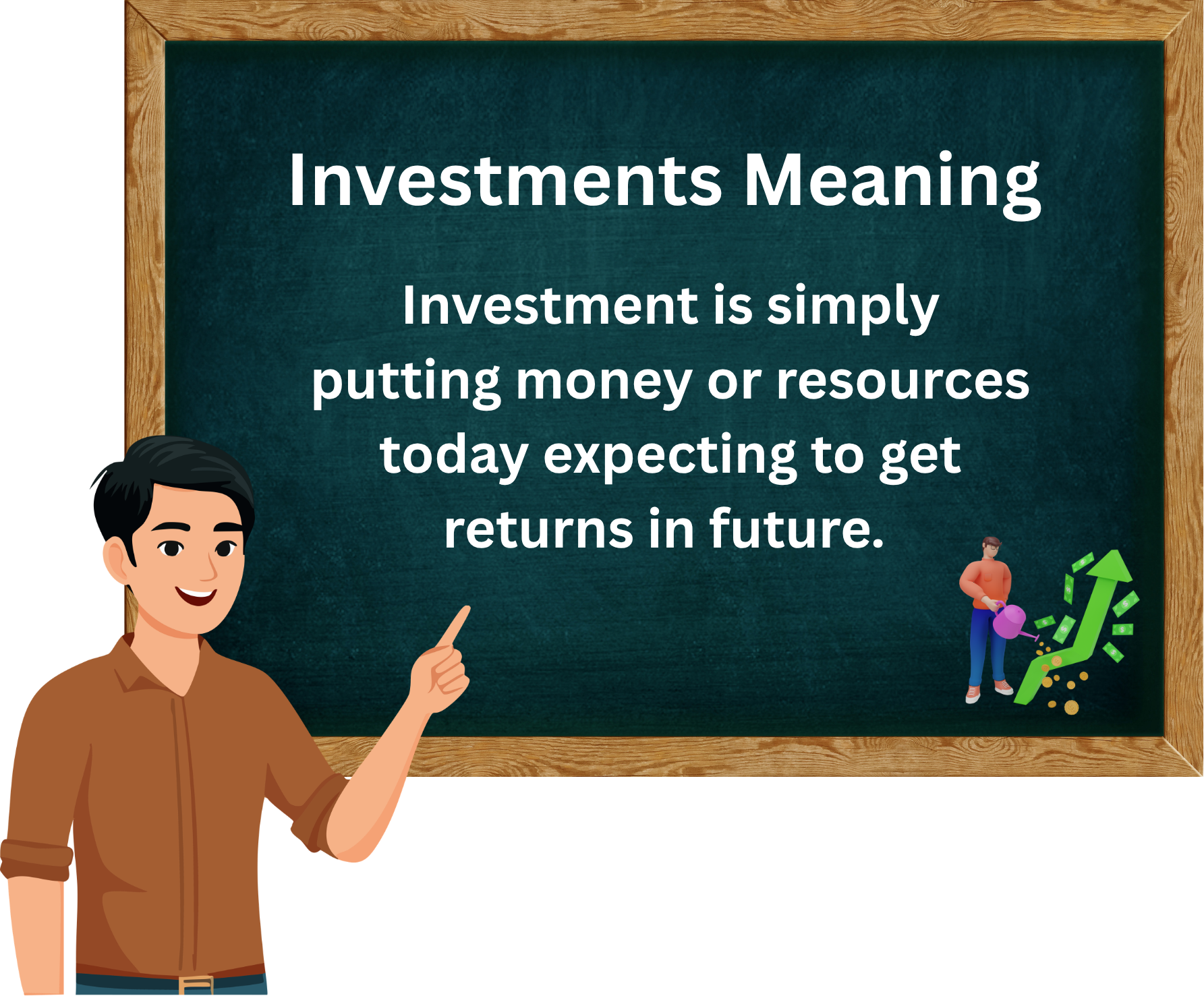
Investment is simply putting money or resources today expecting to get returns in future. This is the postponement of current consumption in an effort to build up wealth or productive capacity. There are many ways to invest in India from gold, property, stock markets and government schemes.
Investment in Financial Assets
Investment is the purchase of goods that are not consumed today but are used in the future to create wealth. In finance, an investment is an asset or item bought with the hope that it will produce income or appreciate in the future. For instance:
- Investing in Infosys shares on the NSE is a financial investment for dividends and capital gains.
- Fixed deposits of State Bank of India offer low-risk interest income.
Investment in Real Assets
Indians also put money into the real assets very heavily:
- Gold has been a traditional choice, but Gold ETFs are a modern alternative.
- Real estate in cities like Bengaluru or Pune is a long-term investment that can provide rental income and appreciation.
Balance of risk/reward
All investments are somewhere on the risk-return spectrum.
- RBI bonds are low risk like other government securities.
- Equity investments in start-ups or IPOs like Zomato’s IPO in 2021, come with higher risk but also potentially higher returns.
Economics of investment
Real Investment
Economists define investment as the purchase or development of real assets that will be used in future production. Examples in India include: Delhi-Mumbai Industrial Corridor (DMIC), metro rail projects, and solar parks in Rajasthan — large infrastructure projects contributing to productive capacity.
Separately, economists also recognize human capital investment spending on education, training, and skills that raises future productivity, even though it isn’t physical capital. Example: the Skill India Mission, which invests in training and education rather than physical infrastructure.
Gross Domestic Product and National Income
Investment is a big part of GDP:
GDP=C+I+G+NX
Where I is investment. For example, India’s efforts to build renewable energy projects such as solar parks in Rajasthan are real investment.
- Gross Investment – total expenditure on new capital goods.
- Net Investment – gross investment less depreciation
If India constructs new metros worth ₹50,000 crore but the existing infrastructure depreciates by ₹10,000 crore, the net investment is ₹40,000 crore.
Investment & Business Management
Capital investment decisions
In business management, investment decisions are known as Capital Budgeting. Managers assess if projects add value.
Example:
- Tata Motors’ decision to invest in EV plants in Pune is a capital budgeting decision based on the anticipated demand for electric vehicles.
- Infosys’s investment in AI-enabled platforms is an intangible investment in technology.
Active vs. Passive Investing
- Passive Investments– buying and holding securities for long-term profit, with minimal ongoing management, e.g. index mutual funds or bonds.
- Active Investments– frequently buying and selling securities to try to outperform the market, requiring hands-on research and decision-making, e.g. actively managed equity funds or individual stock-picking.
For example, a fund manager running an actively managed equity fund such as SBI Bluechip Fund or HDFC Flexi Cap Fund frequently buys and sells stocks in an effort to outperform a benchmark index.
Stock vs. Flow
Imagine a bathtub filling with water.
- Flow = how much water pours in per minute (a rate, measured over time). This is Investment. Example: how much India spends building highways this year under Bharatmala.
- Stock = how much water is sitting in the tub right now, at one moment. This is Capital. Example: the total number of highways, factories, and IT parks that already exist as of today.
Investment adds to Capital. Every year’s investment (flow) piles up over time to become the capital stock (a snapshot). Just like every minute of water flowing in adds to the total water level in the tub.
What decides how much a firm invests?
Two things mainly:
a) Income (Y) — When people/businesses earn more, they spend more — on homes, cars, appliances, machinery. More income → more investment. Simple as that.
b) Interest rate (r) — This is the “price” of using money. When interest rates go up, borrowing money becomes expensive, so people/firms invest less. Example: when RBI hiked repo rates in 2023, home loans got costlier, so fewer people bought homes → residential investment fell.
So: Investment = a function of Income and Interest rate. Higher income → more investment. Higher interest rate → less investment.
The tricky part: Opportunity Cost of Capital
Here’s the part that confuses people. What if a company doesn’t even borrow money — it just uses cash it already has? Does the interest rate still matter?
Yes — and here’s the simple way to see why.
Imagine you have ₹1 lakh in savings. You’re thinking of using it to buy a food cart to start a small business.
Now ask: what else could you do with that ₹1 lakh?
- You could just put it in a fixed deposit and earn, say, 7% interest — risk-free, no effort.
- So if your food cart business is only going to earn you 5% profit a year, you’re actually losing out by starting the business — you would have been better off just keeping the money in the bank.
This is opportunity cost: even though you didn’t “pay” any interest to anyone, you still gave up the interest you could have earned. That giving-up is a real cost, even though no cash left your pocket for it.
Why this matters
This is why interest rates affect investment decisions even for companies that are cash-rich and don’t need to borrow at all:
- If interest rates are high, the “bar” your own money needs to clear before it’s worth investing goes up.
- If a project’s expected profit is lower than what you’d earn just parking the money safely, it’s not worth doing — even with your own funds.
Examples of Modern Investments in India
- Real investment in infrastructure: Adani Group’s investment in renewable energy projects.
- Intangible investment in technology– Reliance Jio’s investment in 5G network.
- LIC IPO 2022– investment opportunity for retail investors.
- Government Sovereign Gold Bonds (SGBs)– Financial instruments with interest and gold price appreciation.
- Venture capital investments in high-risk, high-return startups such as Zepto (quick-commerce) and Sarvam AI (AI/deeptech), which remain privately held and VC-backed as of 2025–26.
1.3 Types of Investment
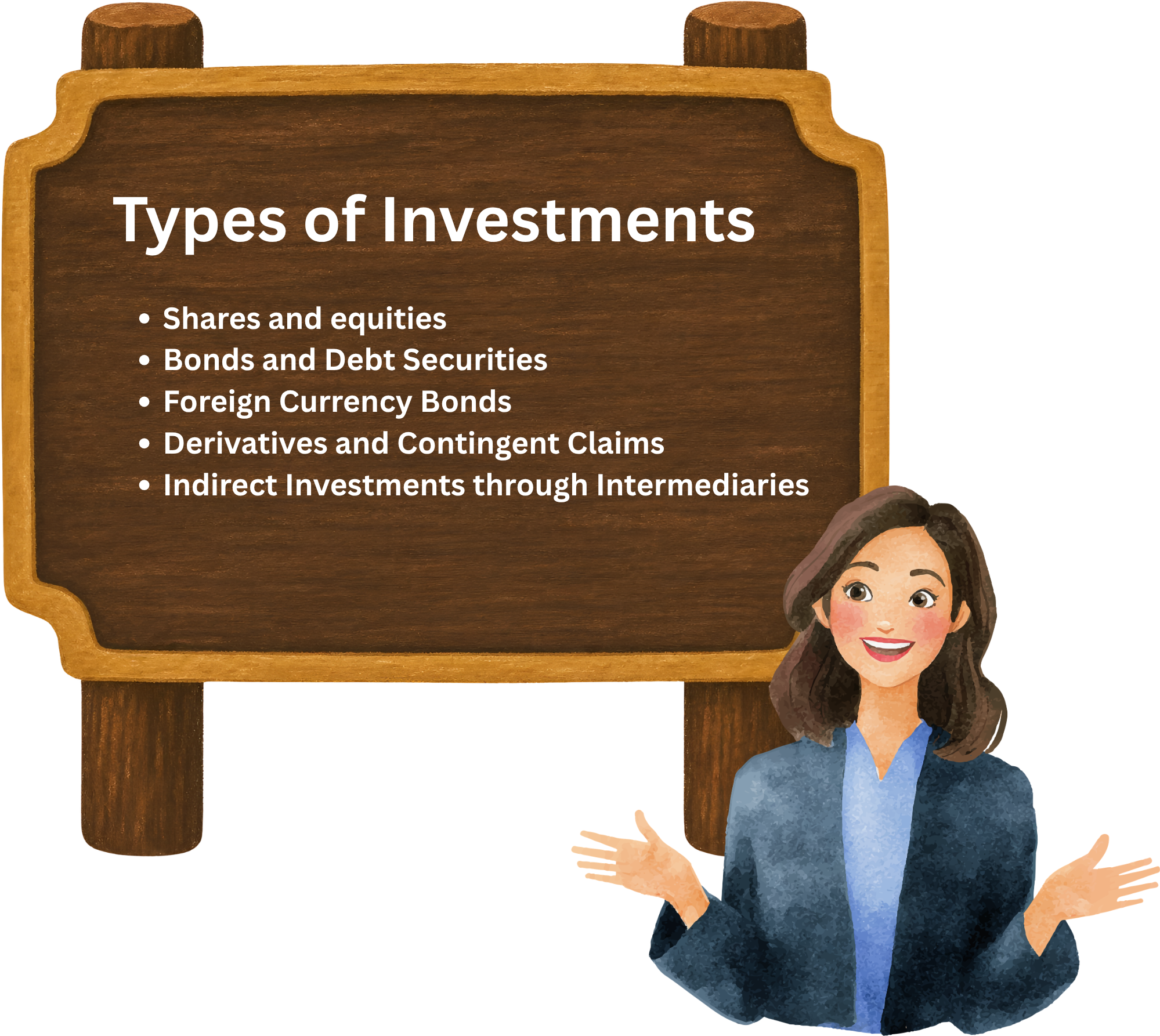
Investment can be of various types .
It can be financial investment in shares , bonds , etc . It can be physical investment in property or gold . Every type of investment has a degree of risk and a potential return. The investment landscape in India has rapidly evolved in recent years, introducing new instruments such as digital gold, sovereign bonds and startup equity to the traditional options.
Financial Investment
Shares and equities
- One of the most usual forms of investing is to buy shares of companies quoted on stock exchanges.
- However, investors would buy shares of Infosys or HDFC Bank in NSE looking forward to dividends and capital appreciation.
- IPOs such as LIC in 2022 or Zomato in 2021 offered retail investors an opportunity to directly participate in equity markets.
Bonds and Debt Securities
- Bonds are debt securities that pay interest at regular intervals.
- India Government Sovereign Gold Bonds (SGBs) track gold prices, and pay 2.5% interest annually too.
- Investors can earn a predictable return from corporate bonds issued by companies like NTPC or Reliance Industries.
Foreign Currency Bonds
Indian investors are shifting to foreign currency bonds for global market exposure.
Example: Indian companies such as Reliance Industries and State Bank of India have issued USD-denominated bonds in international markets, and firms also raise funds via External Commercial Borrowings (ECBs) in foreign currency. Here, the Indian issuer bears the currency risk, since repayment is owed in a foreign currency while revenues are largely earned in rupees.
Derivatives and Contingent Claims
- Derivatives such as futures and options are based on underlying assets. But derivatives do not necessarily generate positive cash flows.
- Traders on the NSE derivatives segment buy Nifty futures or Bank Nifty options to speculate or hedge risk.
- Not traditional investments, but thoroughly studied because they are based on the prices of equities or commodities.
Indirect Investments through Intermediaries
A large number of Indians buy assets through intermediaries rather than directly.
- Mutual Funds –For example, SBI Bluechip Fund collects money from thousands of investors and invests in diversified equity portfolios.
- Pension Funds – People can invest in National Pension System (NPS) for retirement and get tax benefits.
- Insurance linked Investments – ULIPs (Unit Linked Insurance Plans) – These are a combination of insurance and equity/debt investments.
They act as middlemen, and offer professional management and diversification . This means less risk for individual investors .
Difference Between Saving and Investment
- Savings – Money put away in safe instruments e.g. bank deposits. The State Bank of India’s fixed deposit of ₹1 lakh earns guaranteed interest.
- Investing – Putting money into assets such as shares or property, where the value can go up and down. Example: Capital risk but potential of bigger returns by buying shares in DLF real estate.
Technically, deposits are savings, but banks often market deposit accounts as ‘investment accounts’. Investments are risky (you can lose your capital). Saving is not (the only risk is inflation, which devalues it).
Examples from Modern India
- Equity – Retail investors buy into Adani Enterprises after its push into renewable energy.
- Debt – Invest in RBI Floating Rate Savings Bonds (2020) for regular income.
- Mutual Funds – SIPs (Systematic Investment Plans) in funds like HDFC Balanced Advantage Fund.
- Instead of buying physical gold, you can buy digital gold through Paytm or PhonePe.
- Startups- Angel and early-stage investors invest in companies such as Skyroot Aerospace (space-tech) or Sarvam AI, looking for long-term capital gains if the company scales or eventually lists.