1.1 Introduction to Currency, Commodity and Government Securities

Varun: Hey Isha, I was reading about different asset classes and got a bit confused. Stocks I get, but what’s the deal with currencies, commodities, and government securities?
Isha: Great question! These are all part of the broader financial market, but each plays a different role.
Varun: So what is currency market , is that just forex trading?
Isha: Exactly. Currency markets, or forex, involve trading one country’s currency against another. It’s the most liquid market in the world. Think USD/INR or EUR/USD.
Varun: Got it. And commodities , that’s like gold and oil, right?
Isha: Yes! Commodities are raw materials. Traders buy and sell them based on global demand and supply. Gold, silver, crude oil, even agricultural products like wheat and cotton fall under this.
Varun: Interesting. And government securities , are those like bonds?
Isha: Spot on. Government securities are debt instruments issued by the government to raise money. In India, we have T-bills, G-Secs, and sovereign gold bonds. They’re considered low-risk.
Varun: So currencies are traded globally, commodities are physical goods, and government securities are like loans to the government?
Isha: Exactly! Each has its own risk-return profile and suits different types of investors. Want to dive deeper into how they’re traded and who invests in them?
Varun: Yes please , let’s break each one down with examples !
Let us begin this module with a clear roadmap. We will be exploring three distinct asset classes.
- Currencies,
- Commodities, and
- Interest rate futures.
Firstly let us begin our journey with currencies, focusing on pairs that are actively traded in India such as USD-INR, GBP-INR, and INR-JPY, as well as globally significant pairs like EUR-USD, GBP-USD, and USD-JPY. This section will unfold over several chapters, guiding you through the foundational aspects. You will gain clarity on contract specifications and develop a strong grasp of the macroeconomic forces that drive currency movements, including interest rate differentials, inflation trends, trade balances, and geopolitical shifts.
Next, we will shift our attention to commodities, following a similarly structured approach and introduce key instruments across both agricultural and non-agricultural categories. Here we will explore what influences the prices of Gold, Silver, Zinc, Aluminium, Crude Oil, and Natural Gas, alongside Agri-commodities like Turmeric, Cardamom, Pepper, and Cotton. We will also understand pricing mechanisms for instance; how domestic gold prices are derived from international benchmarks so you can interpret commodity charts with greater confidence and context.
Finally, we’ll explore the evolving world of Interest Rate Futures (IRFs). These contracts, linked to sovereign bonds and RBI’s borrowing operations, are traded on platforms like NSE and offer unique opportunities for macro-driven strategies. As we progress, we may also dive into bond trading frameworks and examine how IRFs fit into broader economic narratives.
1.2 Currency Inequality

Varun: Isha, I had the weirdest moment at the airport last week. I was buying a coffee at the Dubai terminal just a regular cappuccino and the guy at the counter said, That will be 18 Dirhams.
Isha: 18 Dirhams? That’s like ₹400, right?
Varun: Exactly! I paused for a second. Back home, I would pay ₹150 max for the same thing. My instinct was to say “That is so expensive!” But then I realized it is not about the coffee. It is about the currency.
Isha: That’s such a relatable moment. We often forget that one unit of currency doesn’t mean the same thing everywhere. A Dirham isn’t a Rupee, and a Rupee isn’t a Dollar.
Varun: Right. It got me thinking why aren’t all currencies equal? Why can’t one Dollar be equal to one Rupee or one Dirham?
Isha: Great question. To understand that, we need to look at how money evolved.
Stage 1- The Barter Era
- Before money existed, trade was a matter of negotiation and necessity. In ancient marketplaces, people arrived not with coins, but with goods, sacks of grain, bundles of cotton, livestock, or handmade tools. A person might exchange freshly harvested cotton for wheat, or offer oranges in return for help tending cattle.
- Every transaction depended on mutual need. If one trader had what another wanted, and vice versa, a deal could be struck. But problems quickly emerged. What if someone had pulses but needed half a cow? There was no way to divide livestock precisely, and no standard measure to compare the value of different goods. Trade became inefficient.
- People often had to travel long distances, carrying bulky items, hoping to find someone who wanted exactly what they had to offer. The lack of divisibility and the challenge of matching needs made barter unsustainable as economies grew.
- Eventually, communities began searching for a more practical solution something portable, divisible, and universally accepted. This search led to the use of metals like gold and silver, marking the beginning of a new era in exchange.
Stage 2- When Metal Became Money
- As trade expanded and communities grew, the inefficiencies of barter became impossible to ignore. People needed a way to exchange value that didn’t rely on coincidence or compromise. The search began for a universal medium, something that could represent worth, store value, and simplify transactions. At first, societies experimented with food grains, shells, and even livestock. But these had limitations, they spoiled, varied in quality, or couldn’t be divided easily. Eventually, attention turned to metals.
- Gold and silver emerged as the clear winners. They were durable, divisible, portable, and rare enough to be valuable. Traders could now walk into a marketplace with a pouch of silver coins and walk out with spices, textiles, or livestock. For centuries, this direct exchange of metal for goods became the norm. A merchant in Gujarat could sell silk to a trader from Persia and receive gold in return.
- But as trade networks expanded and wealth accumulated, carrying large amounts of metal became risky. So people began depositing their gold and silver in secure vaults , often run by trusted merchants or early institutions and received paper receipts in return. These receipts weren’t just placeholders they became promises of value.
- Soon, these paper notes started circulating as currency. If a receipt said it was backed by 100 grams of gold, it could be used to buy goods without ever touching the metal. Trust shifted from the metal itself to the institution that held it.
- Over time, these vaults evolved into banks, and the receipts transformed into currencies , no longer just backed by gold, but by the credibility of governments and central banks. This was the beginning of a new chapter: where value moved from physical assets to symbolic trust, and the foundations of modern monetary systems were quietly laid.
Stage 3- From Metal to Monetary Trust
- As domestic economies matured, trade began to cross borders. Merchants realized that producing everything locally was inefficient, importing goods from regions with comparative advantages made better economic sense. But with international trade came a new challenge: how to settle payments across countries with different currencies.
- There was no universal medium of exchange, and trust in foreign currencies was limited. To solve this, nations began anchoring their currencies to a common reference i.e. gold. By the late 19th century, gold had become the global benchmark. Each country defined the value of its currency in terms of a fixed quantity of gold. This system, known as the Gold Standard, allowed traders and governments to convert currencies with confidence, knowing that each unit was backed by a tangible asset.
- However, as the world entered the 20th century, geopolitical tensions world wars, economic depressions, and shifting alliances disrupted global stability. The need for a more coordinated monetary framework became urgent. In 1944, representatives from 44 countries gathered in Bretton Woods, New Hampshire, to design a new system.
- The result was the Bretton Woods System (BWS) which is a hybrid model where global currencies were pegged to the US Dollar, and the Dollar itself was backed by gold. This gave the world a single reference point for international trade. Countries agreed to maintain their exchange rates within a narrow band (±1%) against the Dollar, which in turn was convertible to gold at a fixed rate.
- With the Dollar backed by gold and accepted globally, it became the de-facto international currency. Trade, investment, and reserves were increasingly denominated in USD, simplifying cross-border transactions. But over time, the system strained under economic pressures. Developed nations began to question the rigidity of fixed exchange rates. As global capital flows increased and domestic priorities shifted, countries gradually exited the Bretton Woods framework. By the early 1970s, the gold backing was removed, and the world transitioned to floating exchange rates.
- Today, currency values are determined by market forces influenced by a country’s political stability, economic performance, interest rates, and global perception. The Gold Standard may be history, but its legacy lives on in the way we understand trust, value, and international trade.
1.3 The Global Currency Market: A Borderless Engine of Trade

Varun: Isha, I was reading about how the forex market trades trillions of dollars every single day. That’s more than the GDP of some countries! How is that even possible?
Isha: It’s wild, right? The sheer scale of currency trading is mind-blowing. But it makes sense when you realize how global and nonstop the market is. Unlike stock exchanges, forex doesn’t sleep.
Varun: Wait, you mean it runs 24/7?
Isha: Pretty much! It follows the sun—starting in Sydney, then Tokyo, Mumbai, London, and finally New York. By the time New York closes, Sydney’s already waking up. It’s like a relay race across time zones.
Varun: That’s fascinating. So who’s actually trading all this money? Just big banks?
Isha: Not just banks. It’s a mix—central banks, corporations, retail traders, even tourists exchanging currency. Everyone plays a part, and that’s what makes the market so liquid and dynamic.
Varun: Okay, now I’m curious. What makes this market tick? Why is it so massive?
Isha: Great question. Let’s dive into it.
The scale of the international currency market is staggering and growing. As of April 2025, the average daily trading volume in the global forex market has reached $9.6 trillion, according to the Bank for International Settlements (BIS). To put that in perspective, this figure exceeds the annual GDP of many large economies and it’s traded every single day.
So what drives this massive volume?
The answer lies in the structure and rhythm of the forex market. Unlike equity markets, which operate within fixed hours and centralized exchanges, the currency market is decentralized and continuous. It follows the sun opening in Sydney, moving through Tokyo, Singapore, Mumbai, Dubai, London, and finally New York before repeating back again. This 24-hour cycle runs five to six days a week, ensuring that currency trading never truly sleeps.
India, interestingly, sits in a strategic time zone. Its trading hours overlap with both Southeast Asian markets and European financial hubs like London and Frankfurt. This overlap creates a vibrant window of activity, especially during the transition between Asian and European sessions.
Who Trades in the Forex Market?
Unlike stock markets, forex isn’t just the playground of investors and speculators. It’s a multi-participant ecosystem, including:
- Central Banks:Managing currency reserves and monetary policy
- Corporates:Hedging foreign revenue or import/export exposure
- Commercial Banks:Facilitating client transactions and proprietary trading
- Retail Traders: Speculating on currency movements
- Travelers and Tourists: Exchanging currency for personal use
Each participant enters the market with a different motive hedging, settlement, speculation, or conversion but collectively, they contribute to the enormous liquidity.
Why Are the Volumes So Large?
Two key reasons:
- Leverage: Forex trading often involves high leverage, meaning traders can control large positions with relatively small capital. This inflates the notional value of trades.
- Global Utility: Currency is the lifeblood of international trade, travel, and investment. Every cross-border transaction whether it’s a shipment of goods or a tourist buying coffee involves currency exchange.
A Market Without Borders
There is no single global exchange for forex. Transactions occur over-the-counter (OTC) through a network of banks, brokers, and electronic platforms. In India, institutions like the NSE and RBI facilitate domestic forex operations, but globally, the market is fluid information and orders flow seamlessly across continents.
This decentralized structure makes forex resilient, responsive, and truly global a market that reflects the pulse of international economics in real time.
1.4 Currency Pairs and Quotes

Varun: You know, the more I learn about forex, the more I realize it’s not just about charts and numbers.
Isha: True. It’s like decoding how countries interact—trade, politics, even tourism. Every currency move tells a story.
Varun: That’s probably why it feels so alive. Like, even a speech in Europe can ripple through Asia.
Isha: Exactly. And to read that ripple, you need to understand how currencies are paired. That’s where the real interpretation begins.
Varun: So the pair isn’t just a price—it’s a relationship?
Isha: Yep. And once you grasp that, you stop seeing it as just math. It becomes a conversation between economies.
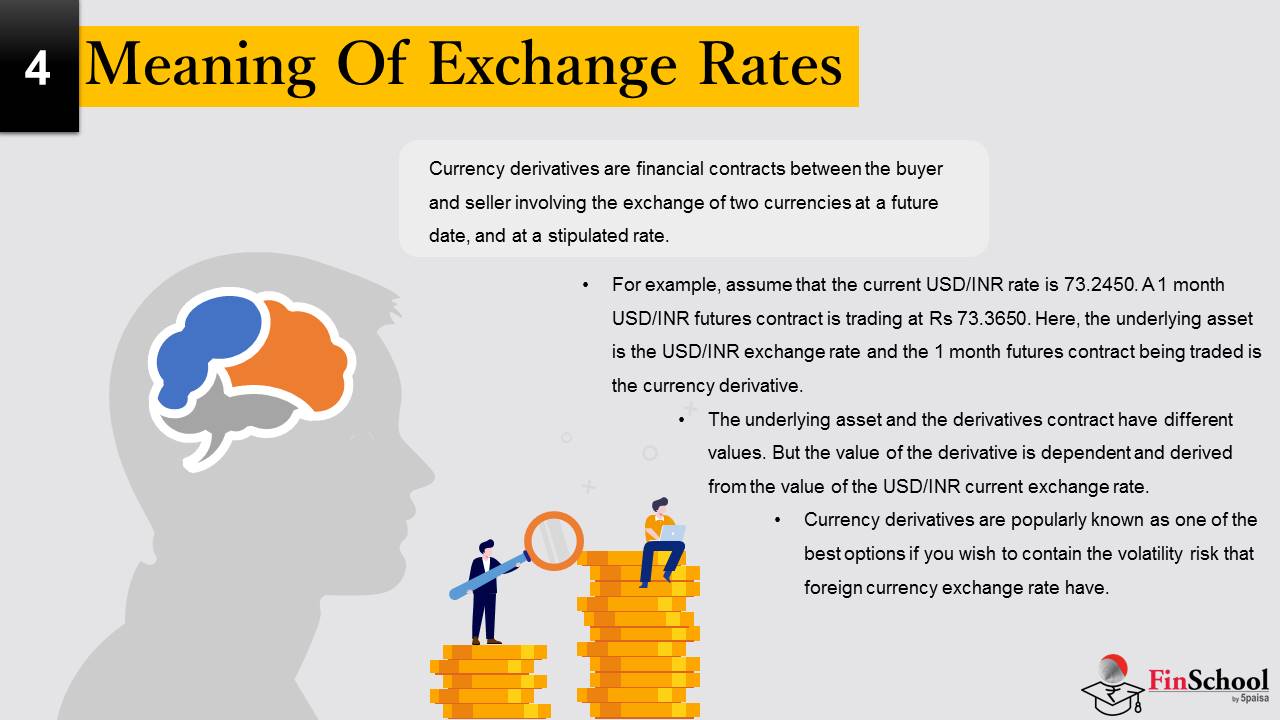
In currency trading, you never buy or sell a single currency in isolation—you always deal with a pair. This pair represents the exchange rate between two different currencies. The format typically looks like this:
Base Currency / Quote Currency = Exchange Rate.
The base currency is the reference point and is always considered as one unit. The quote currency tells you how much of it is needed to purchase one unit of the base currency. For instance, if we look at the pair GBP/INR = 105, it means that one British Pound is equivalent to ₹105. Here, GBP is the base currency and INR is the quote currency. So if you’re exchanging pounds for rupees, this rate tells you how many rupees you’ll get for each pound.
Let’s take another example: JPY/AUD = 0.0095. This means one Japanese Yen is worth 0.0095 Australian Dollars. In other words, you’d need about 105 yen to get 1 AUD. These exchange rates are constantly changing due to market forces like interest rate changes, geopolitical developments, trade balances, and investor sentiment. Currency pairs such as EUR/INR, USD/SGD, or CAD/JPY are actively traded across global markets, each reflecting the dynamic relationship between two economies. Understanding this structure is crucial for anyone entering the forex market, as it forms the foundation for analyzing price movements and making informed trading decisions.
1.5 Key-Takeaways
- Three Core Asset Classes: The chapter introduces currencies, commodities, and government securities as distinct yet interconnected components of the financial market.
- Forex Market Scale: As of April 2025, the global forex market trades an average of $9.6 trillion daily, making it the largest and most liquid financial market in the world.
- 24-Hour Trading Cycle: Unlike stock markets, forex operates continuously across global time zones—from Sydney to New York—creating a seamless, border-less trading environment.
- India’s Strategic Time Zone: India benefits from overlapping trading hours with both Asian and European markets, making it a key participant in global currency flows.
- Participants in Forex: The forex ecosystem includes central banks, commercial banks, corporations, retail traders, and even travelers—each with different motives like hedging, speculation, or conversion.
- Leverage and Liquidity: High leverage in forex allows traders to control large positions with small capital, contributing to the market’s massive volumes and liquidity.
- Evolution of Money: The journey of money spans from barter systems to metal-based trade, to paper currency backed by gold, and finally to today’s fiat currencies based on trust and economic strength.
- Bretton Woods & USD Dominance: The Bretton Woods System pegged global currencies to the US Dollar, which was backed by gold—establishing the USD as the world’s reserve currency.
- Currency Pairs Explained: Currencies are always traded in pairs (e.g., USD/INR), where the base currencyis compared against the quote currency to determine exchange rates.
- Exchange Rate Dynamics: Currency values fluctuate due to macroeconomic factors like interest rates, inflation, trade balances, and geopolitical events—making forex analysis both complex and essential.
1.6 Fun Activity
Fun Activity: “Match the Asset to the Situation”
Below are five everyday scenarios. Your task is to match each one to the most relevant asset class: Currency, Commodity, or Government Security.
Scenarios:
- A jeweller in Mumbai wants to hedge against rising gold prices before Diwali.
- An exporter in Chennai receives payments in Euros and wants to protect against EUR-INR fluctuations.
- A retired teacher in Pune wants a safe investment with regular interest income for the next 20 years.
- A textile manufacturer in Surat is worried about cotton price volatility during the monsoon.
- A tourist from Delhi is exchanging rupees for Japanese Yen at Tokyo airport.
Match the Asset Class:
|
Scenario |
Asset Class |
|
1 |
Commodity |
|
2 |
Currency |
|
3 |
Government Security |
|
4 |
Commodity |
|
5 |
Currency |
Answer Key & Explanation:
- Commodity– Gold is a tradable commodity, and the jeweller is managing price risk.
- Currency – The exporter is exposed to foreign exchange risk and needs currency hedging.
- Government Security – Long-term bonds or G-Secs offer stable returns, ideal for retirement planning.
- Commodity – Cotton is an agricultural commodity, and monsoon affects its supply and pricing.
- Currency – Currency exchange for travel is a direct use of the forex market.