4.1 The Contract

Varun: Isha I keep hearing that most of the action happens in Futures. Is that true?
Isha: Yes, absolutely. In currencies and commodities, Futures are the backbone. If you’re not comfortable with derivatives, this space can feel overwhelming.
Varun : I’m fairly confident with derivatives, I understand how Futures differ from Options, how margins work, expiry dates, and lot sizes.
Isha: That’s great. Then you probably also use Technical Analysis for short-term trades?
Varun: Definitely. I rely on charts, indicators, and price action setups to time entries and exits.
Isha: Perfect. Then you’re ready to dive into currency Futures. Let’s start with the USD-INR contract—it’s the most traded pair in India.
Varun: Sounds good. I’m curious about how the contract is structured and what the logistics look like.
1. Contract Type
The USD/INR pair is available in both futures and options formats on Indian exchanges such as NSE, BSE, and MSEI. These contracts fall under the currency derivatives segment regulated by SEBI. Futures are more commonly used for directional bets and hedging, while options offer strategic flexibility for managing risk and volatility.
2. Lot Size
Each USD/INR contract represents a notional value of USD 1,000. This standardized lot size ensures accessibility for retail traders while maintaining sufficient exposure for institutional participants. It also simplifies margin calculations and tick value assessments.
3. Tick Size
The minimum price movement, or tick size, is ₹0.25 per USD. Given the lot size of 1,000 USD, each tick translates to ₹250. This granularity allows traders to manage risk and execute precise strategies, especially in volatile currency environments.
4. Trading Hours
Currency derivatives, including USD/INR, trade from 9:00 AM to 5:00 PM IST, Monday through Friday. These hours align with the broader Indian financial market and allow participants to respond to domestic and global macroeconomic developments during the day.
5. Expiry Cycle
USD/INR contracts are available in both weekly and monthly formats. Monthly contracts expire two working days prior to the last business day of the month, while weekly contracts expire on Fridays. This structure provides flexibility for short-term and long-term hedging or speculative strategies.
6. Final Settlement
Settlement for USD/INR contracts is done in cash, based on the RBI reference rate published on the final settlement day. This avoids the complexities of physical delivery and ensures smooth closure of positions. The final settlement day is the last working day of the month.
7. Margin Requirements
Trading USD/INR contracts requires maintaining SPAN and exposure margins. These margins are generally lower than those for equity derivatives due to the relatively lower volatility in currency markets. This makes currency trading more capital-efficient for hedgers and speculators.
8. Regulatory Oversight
The contracts are regulated by SEBI and cleared by the Clearing Corporation of India Ltd (CCIL). This ensures transparency, risk management, and compliance with global best practices. All participants must adhere to SEBI’s guidelines on position limits and surveillance.
9. Underlying Reference Rate
The underlying for USD/INR contracts is the RBI reference rate, which is published daily. This rate reflects the average market rate for USD/INR and serves as the benchmark for settlement. It ensures consistency and credibility in pricing across exchanges.
10. Use Cases
USD/INR contracts are widely used by importers, exporters, portfolio managers, and retail traders. They help hedge foreign exchange exposure, speculate on currency movements, and diversify portfolios. The cash-settled nature and regulatory clarity make them a preferred tool for managing currency risk in India.
For example
This is the 15-minute chart of the USD-INR pair. As you can see, the encircled candle has formed a bearish Marubuzo, a strong signal of selling pressure. A trader could initiate a short position based on this pattern, using the high of the Marubuzo candle as the stoploss.
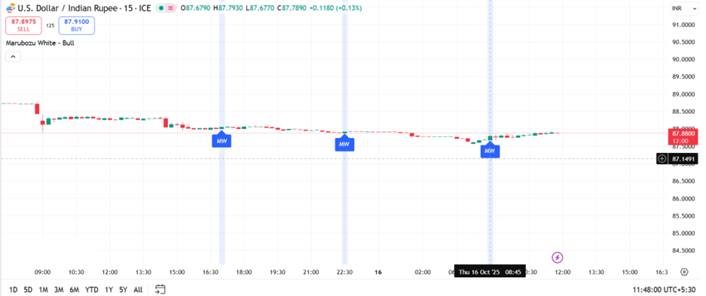
To be clear, this isn’t a trade recommendation. The objective here is to demonstrate how the USD-INR futures contract functions in practice.
Trade Illustration:
- Date: October 16, 2025
- Position: Short
- Entry Price:₹87.6770
- Stoploss (SL):₹87.7930
- Number of Lots:10
- Lot Size:$1,000 per lot
Contract Value Calculation:
Each lot represents $1,000, so the contract value for one lot is:
This setup helps illustrate how margin, tick size, and price movement translate into real trade logistics in the USD-INR futures market.
Margin Requirement
Assuming a margin of 2.5% (SPAN + Exposure):
Further, the idea is to short 10 lots, hence total margin required is –
10* = 21,919.25
As you can see, the margin required to initiate a fresh position in USD INR is about Rs.. Therefore on a contract size of 87,677 , this works out to –
2191.925/87677
= 2.5%
Out of this, about 1.5% would be SAPN margin requirement and the rest as exposure margin.
So, to initiate this short position, the trader would need approximately ₹as margin.
This means the trader needs ₹21,919 to initiate the position—just 2.5% of the total contract value. Compare this to equity futures, where margins range from 15% to 65%, and you’ll see how currency futures offer higher leverage.
Tick Size & Movement
- Tick Size: ₹0.0025
- Tick Value:
- For 10 Lots: ₹25 per tick
So, every 1-paisa move (₹0.01) in USD-INR equals ₹100 in P&L for 10 lots.
Risk Management Snapshot
- Stoploss Distance:
- Risk per Lot:
- Total Risk (10 Lots): ₹1,160
This setup offers a defined risk, tight stoploss, and high leverage—ideal for short-term tactical trades.
Note :
15-Minute Chart
A candlestick chart where each candle represents 15 minutes of price movement. Commonly used for short-term trading strategies and intraday analysis.
Bearish Marubuzo
A candlestick with a long red body and little to no wicks. It opens at the high and closes at the low, indicating strong selling pressure and bearish sentiment.
Entry Price
The price at which a trader initiates a position. In this example, ₹87.6770 is the short entry level based on the Marubuzo signal.
Stoploss (SL)
A predefined price level to exit a losing trade to limit losses. Here, ₹87.7930 is the SL, placed just above the Marubuzo high.
Lot Size
The standardized quantity of the asset in one futures contract. For USD-INR, 1 lot equals $1,000.
Contract Value
The total rupee value of a futures contract, calculated as: Contract Value = Lot Size × Entry Price For 10 lots at ₹87.700, this equals ₹877,000.
Margin Requirement
The amount a trader must deposit to initiate a futures position. It includes:
- SPAN Margin: Minimum margin mandated by the exchange based on volatility.
- Exposure Margin: Additional buffer to cover potential losses.
- Total Margin: SPAN + Exposure. In this case, 2.5% of ₹876,770 = ₹21,919.25.
- Tick Size: The smallest possible price movement in a futures contract. For USD-INR, it’s ₹0.0025.
- Tick Value: The monetary impact of one tick movement: Tick Value = Tick Size × Lot Size For 1 lot: ₹0.0025 × 1,000 = ₹2.50 For 10 lots: ₹25 per tick
- Leverage: The ability to control a large contract value with a small margin. Currency futures offer high leverage due to low margin requirements and tight price ranges.
- Short Position: A trade setup where the trader profits if the price falls. In this case, the trader sells USD-INR futures expecting the rupee to strengthen.
- SPAN Margin: Standard Portfolio Analysis of Risk margin—calculated by the exchange to cover worst-case daily losses.
- Exposure Margin : An additional margin charged to cover intraday volatility and potential mark-to-market losses.
- P&L (Profit and Loss) : The financial outcome of a trade. In futures, P&L is calculated based on tick movement and lot size.
4.2 Currency Logistics

Varun: Okay, so we’ve got the short trade setup from the Marubuzo candle—entry at ₹87.6770, stoploss at ₹87.7930, 10 lots. But Isha, I’ve always wondered… why do these currency quotes go all the way to the fourth decimal? I mean, equities don’t do that.
Isha: Great observation, Varun. That fourth decimal is actually a big deal in currency trading. Let’s break it down.
Varun: Go on.
Isha: Currency futures—especially USD-INR—are quoted up to four decimal places because even a tiny move like 0.0025 can have a meaningful impact. This smallest unit is called a tick or a pip.
Varun: So when USD-INR moves from ₹87.9000 to ₹87.9025, that’s one pip?
Isha: Exactly. And that pip isn’t just symbolic. When the RBI publishes its reference rate, it goes to the fourth decimal. Even a minor shift there can affect foreign reserves, trade settlements, and hedging outcomes.
Varun: Makes sense. But how does that translate into actual money for a trader?
Isha: Simple math. Tick Value = Lot Size × Tick Size = 1,000 × 0.0025 = ₹2.50 per lot
Varun: So with 10 lots, every pip move is ₹25?
Isha: Right. That’s why precision matters so much in currency futures. Even small moves can add up, especially with leverage.
Varun: Got it. So going back to our Marubuzo setup, every tick in our favour adds ₹25 to the P&L. That’s clean.
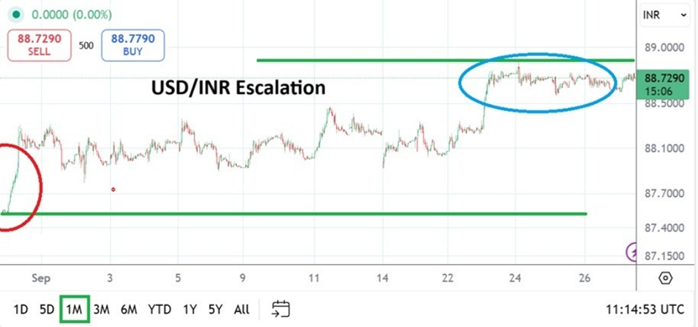
Let’s assume it’s September 30, 2025, and the USD-INR pair has shown a strong upward trend throughout the month. The chart titled “USD/INR Escalation” shows the pair rising from below ₹87.4000 (marked by the red circle) to a high of ₹88.7290, where it is currently consolidating (highlighted by the blue oval). This zone suggests potential exhaustion of bullish momentum.
Spotting this, a trader initiates a short position at:
- Entry Price: ₹88.7290
- Stoploss: ₹88.9000
- Number of Lots: 10
- Lot Size: $1,000 per lot
Intraday Profit Calculation
Later in the day, the price drops to ₹88.6000, offering an opportunity to exit.
- Points Captured= ₹88.7290 – ₹88.6000 = ₹0.1290
- Pip Size= ₹0.0025
- Number of Pips= ₹0.1290 ÷ ₹0.0025 = 51.6 pips
Profit = Lot Size × Number of Lots × Points Captured = 1,000 × 10 × ₹0.1290 = ₹1,290
This is the intraday profit if the position is exited at ₹88.6000.
Carrying Forward to Expiry
If the trader chooses to hold the position, they must maintain margin. At 2.5%, the margin per lot is ₹2,183.23, totalling ₹21,832.30 for 10 lots.

Assuming September 30, 2025 is the last working day of the month, the expiry date for the September contract would be September 26, 2025 (two working days prior), with trading ceasing at 12:30 PM.
Settlement Scenario
If the RBI reference rate on September 26 is ₹88.4000, then:
- Points Captured= ₹88.7290 – ₹88.4000 = ₹0.3290
- Profit= 1,000 × 10 × ₹0.3290 = ₹3,290
This amount will be credited to the trader’s account on September 27, and the position will be marked to market daily until expiry.
4.3 USD/INR Options Contract

Let’s explore how the USD-INR options contract is structured. As of now, options are available only on the USD-INR pair. Hopefully, in the future, we’ll see options on other currency pairs like EUR-INR or GBP-INR.
While many parameters mirror the futures contract, a few features are unique to options:
- Expiry Style:European (can be exercised only on expiry)
- Premium:Quoted in INR
- Contract Cycle:Options are available for the current and next two months. So in October, contracts are available for October, November, and December.
- Strike Availability:Typically 25 strikes—12 In-the-Money (ITM), 12 Out-of-the-Money (OTM), and 1 Near-the-Money (NTM). Strikes are spaced at ₹0.25 intervals.
- Settlement:Settled in INR based on the RBI reference rate on expiry day
Example: USD-INR Call Option (October 2025)
Let’s say you’re looking at the following option quote:
- Option Type:Call Option
- Strike Price: ₹88.0000
- Spot Price (RBI Reference Rate):₹88.1875
- Expiry Date:28th October 2025
- Position:Long
- Premium: ₹0.8200
- Lot Size:$1,000
Premium Outlay
To buy this option, the premium outlay is: This is the upfront cost to hold the right (but not the obligation) to buy USD at ₹88.0000 on expiry.
Exit Scenario
Let’s say the premium rises to ₹0.8650 and you decide to square off your position:
Selling the Option
- If you were to write (sell) this option instead, you would receive ₹820 upfront but would need to deposit margin. Based on current margin estimates, the required margin for writing this option is approximately:
- This margin acts as a buffer against potential losses if the option moves against you.
- This example gives you a practical sense of how USD-INR options contracts function, right from quoting conventions to premium calculations and margin logistics. In the next section, we’ll explore some quantitative aspects of the USD-INR pair and look at how other currency contracts are structured.
4.4 Key Takeaways

- The USD-INR pair is the most actively traded currency contract in India, available in both futures and options formats.
- Each USD-INR contract represents $1,000, with a tick size of ₹0.0025, translating to ₹2.50 per lot.
- Futures contracts are cash-settled based on the RBI reference rate and offer both weekly and monthly expiry cycles.
- Trading hours for currency derivatives in India are from 9:00 AM to 5:00 PM IST, Monday to Friday.
- Margin requirements for USD-INR futures are relatively low, typically around 2.5%, offering high leverage.
- Currency quotes go to four decimal places because even small movements significantly impact P&L due to leverage.
- Technical analysis tools like candlestick patterns and intraday charts are commonly used for short-term USD-INR trades.
- USD-INR options are European-style, settled in INR, and quoted with premiums in rupees.
- Options contracts are available for three consecutive months with 25 strike prices spaced at ₹0.25 intervals.
- Writing options requires margin, while buying options involves only the premium outlay, offering different risk-reward profiles.
4.5 Fun Activity-“Build Your Own USD-INR Trade!”
You are now a currency trader. Use the clues below to build a complete USD-INR futures trade setup. Fill in the blanks and calculate your potential profit or loss.
Scenario:
It’s October 28, 2025. You spot a bearish Marubuzo candle on the 15-minute chart and decide to go short.
- Entry Price: ₹88.6500
- Stoploss: ₹88.7500
- Target Price: ₹88.5000
- Number of Lots: 5
- Lot Size: $1,000
- Tick Size: ₹0.0025
Questions:
- What is the contract value for one lot?
- What is the total margin required if margin is 2.5%?
- How many ticks between entry and target?
- What is the tick value for 5 lots?
- What is the total profit if target is hit?
Answer Key:
- Contract Value (1 lot)= ₹88.6500 × 1,000 = ₹88,650
- Margin (2.5%)= ₹88,650 × 2.5% = ₹2,216.25 → For 5 lots = ₹11,081.25
- Ticks to Target= (₹88.6500 − ₹88.5000) ÷ ₹0.0025 = 60 ticks
- Tick Value (5 lots)= ₹0.0025 × 1,000 × 5 = ₹12.50
- Total Profit= 60 ticks × ₹12.50 = ₹750