
10.1 Multi-Cap Funds
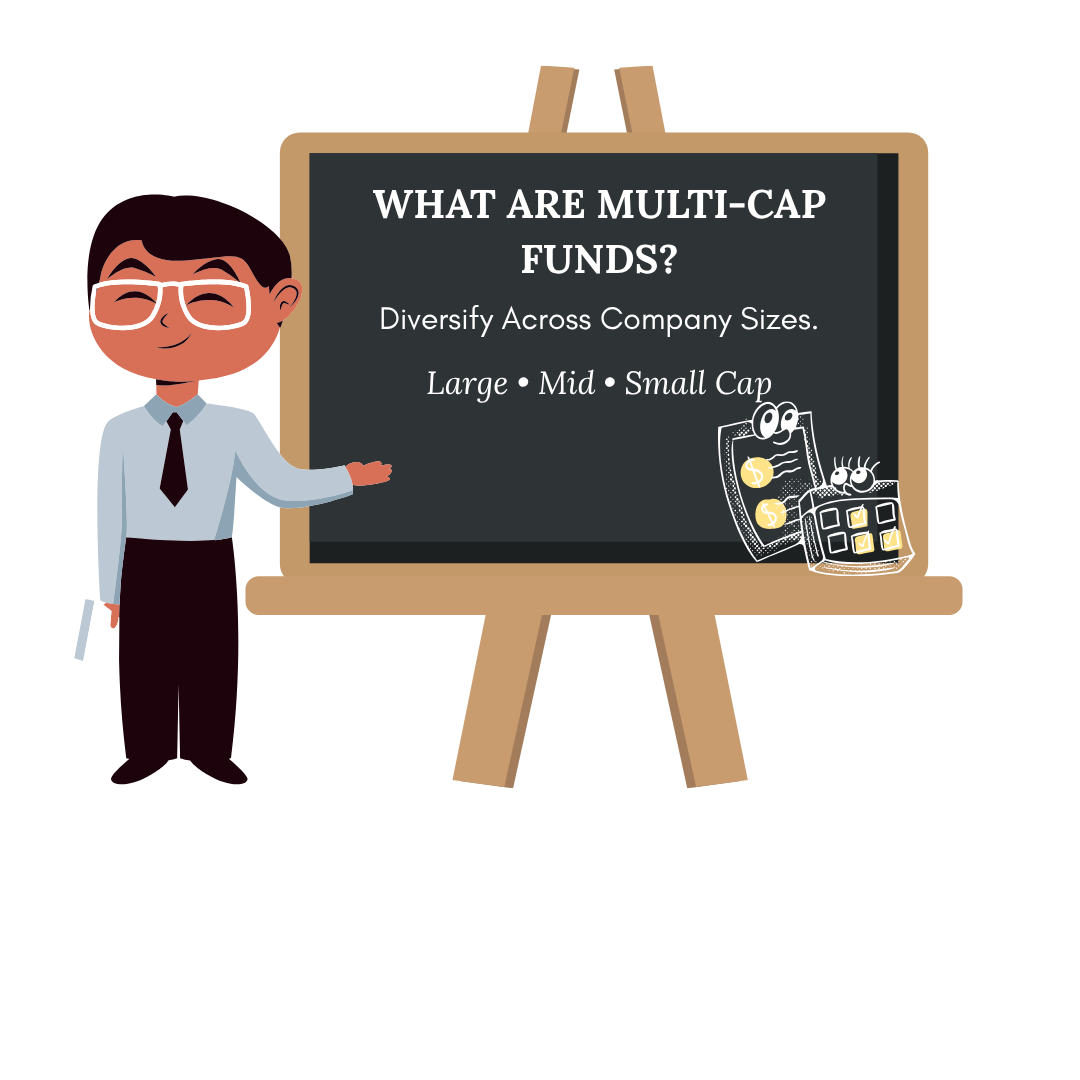
A multi-cap fund grants the fund manager flexibility across the entire stock market. Rather than restricting investments to a single market cap, multi-cap funds dynamically allocate capital across large, mid, and small-sized companies.
Under current SEBI regulations, multi-cap schemes must maintain at least 75% of total assets invested in equity (with mandatory minimum 25% allocations across each of Large, Mid, and Small-cap buckets).
Think of a fund manager as an athletic talent scout who allocates capital across three tiers: large caps, mid caps, small caps.
Modern Asset Allocation Example
To understand portfolio structure, examine the portfolio of Kotak Multicap Fund:
- Market Cap Distribution: Large Cap Stocks (5%), Mid Cap Stocks (25.1%), Small Cap Stocks (33.9%), and Cash Margin/Equivalents (~1.5%).
- Key Holdings: Its largest positions are large caps like HDFC Bank Ltd. (5.66%), Maruti Suzuki India Ltd. (4.10%) and State Bank of India (3.55%), alongside other high-conviction picks like Oracle Financial Services Software Ltd. (3.46%) and Indo-MIM Ltd. (3.33%).
Benchmarking and Liquidity Risk
Multi-cap schemes are typically benchmarked against an index built to mirror the category’s 25/25/25 floors, the Nifty500 Multicap 50:25:25 TRI (used by Kotak Multicap Fund), rather than a plain broad-market index such as the Nifty 500 TRI.
As a fund’s AUM grows to tens of thousands of crores, trading volume constraints in illiquid small-cap stocks make it difficult for fund managers to quickly enter or exit positions without triggering price slippage. Because a multi-cap fund must keep at least 25% in small caps however large it grows, this liquidity constraint becomes a real risk at high AUM—unlike a flexi-cap fund, which can simply lean toward highly liquid large caps.
10.2. Focused Funds
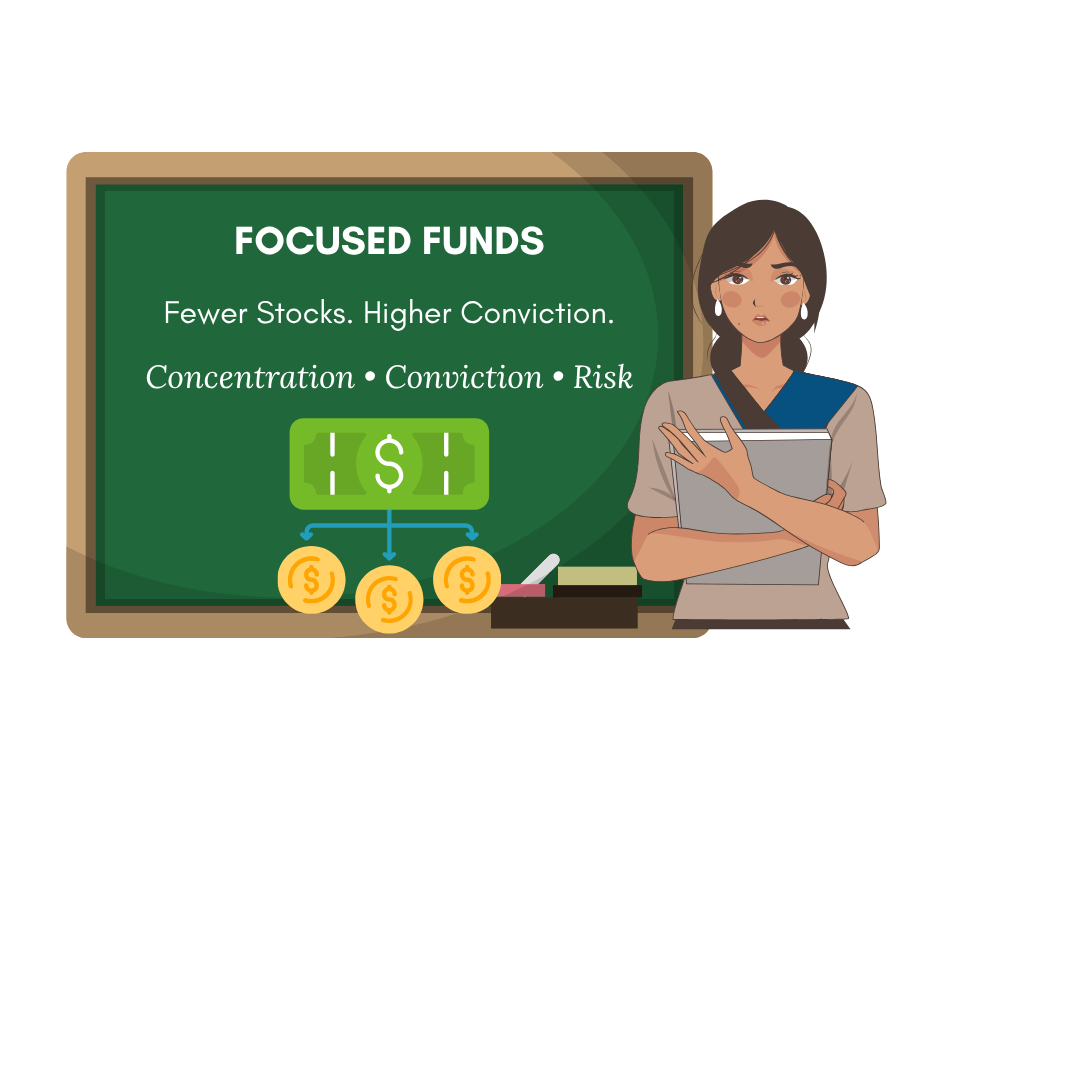
Standard equity mutual funds often spread capital across 40 to 80 stocks to dilute risk. In contrast, Focused Funds concentrate investments into a target-rich basket capped at a maximum of 30 stocks.
Under SEBI’s February 2026 recategorisation circular, focused funds must also keep at least 80% of total assets in equity and equity-related instruments up from 65%. This structure forces the portfolio manager to select only high-conviction ideas backed by rigorous fundamental analysis.
Portfolio Concentration: SBI Focused Fund
Consider SBI Focused Fund (formerly SBI Focused Equity Fund), which held fewer than 30 stocks as of 30 September 2026:
|
Asset / Holding |
Sector / Asset Type |
Weightage |
|
Bajaj Finance Ltd. |
Financial Services |
8.99% |
|
Alphabet Inc. Class A |
Communication Services / Global |
7.24% |
|
ICICI Bank Ltd. |
Financial Services |
7.11% |
|
Kotak Mahindra Bank |
Financial Services |
5.82% |
|
State Bank of India |
Financial Services |
5.16% |
|
Muthoot Finance Ltd. |
Financial Services |
4.97% |
|
Cash, TREPS & Others |
Short-Term Debt / Cash |
7.37% |
Risk Profile and Suitability
While focused strategies can significantly outperform during broad market rallies, they exhibit wider return swings when key sector bets drag down the portfolio.
Because of this volatility, focused schemes are not ideal for novice investors. They serve as an aggressive satellite holding for seasoned investors who already have a stable foundation in broad index funds.
10.3. Dividend Yield Funds
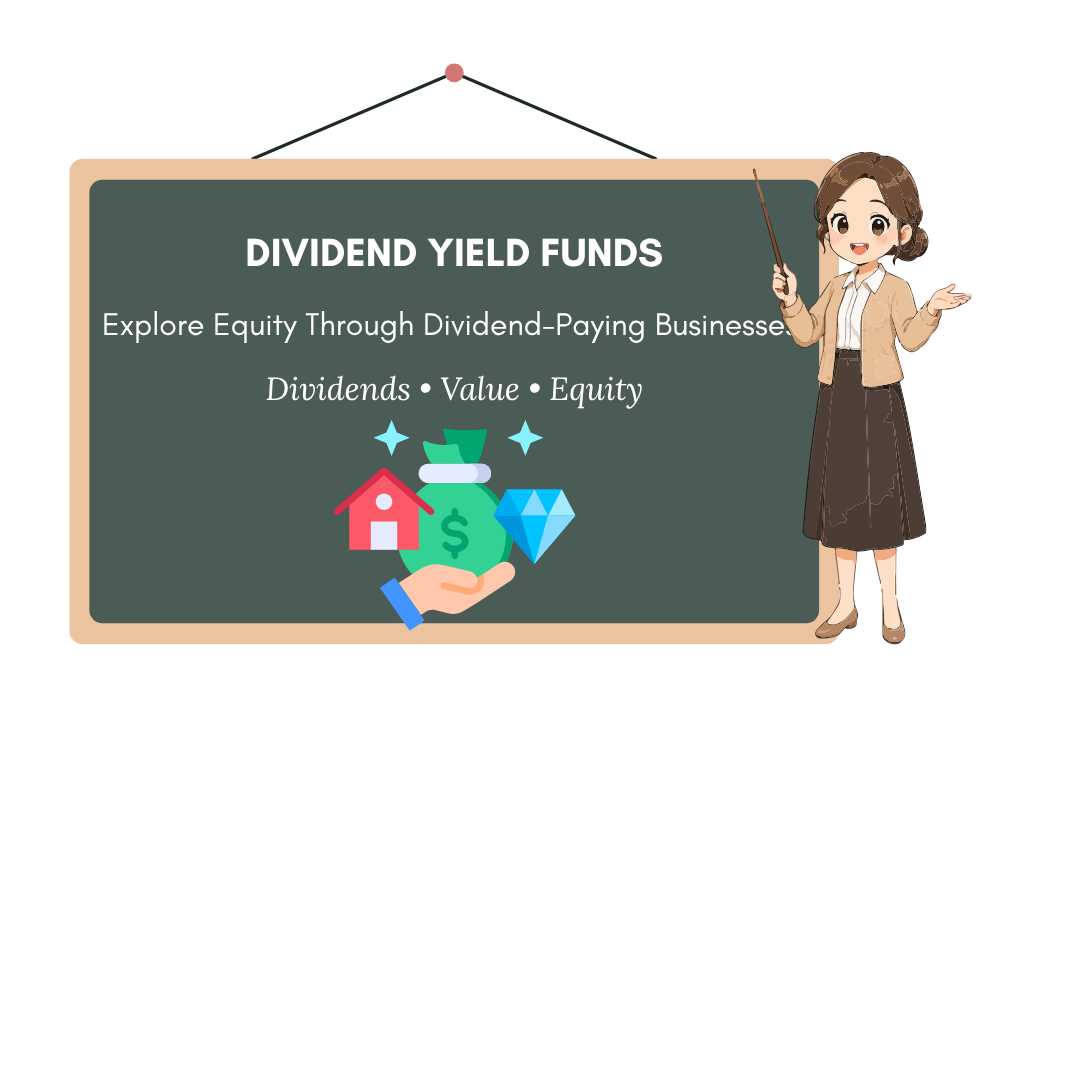
A common misconception is that a Dividend Yield Fund generates regular interest or cash payouts directly to the investor’s bank account. The name describes the manager’s stock selection strategy: acquiring shares in businesses with a history of distributing excess operational cash flows through dividends.
Calculating Dividend Yield
Dividend yield measures cash dividends returned relative to current market price:
Dividend Yield = Annual Dividend Paid per share/Current Market Share Price
- Calculation Example: If Hindustan Unilever (HUL) trades at ₹2,400 per share and pays out ₹60 per share in annual dividends, its dividend yield is 2.50% (60/2400).
- Calculation Example: If Coal India trades at ₹450 per share and pays out ₹25 per share in dividends, its dividend yield is 5.56% (24/450).
SEBI Mandate & Holdings
SEBI requires dividend yield schemes to invest predominantly in dividend-yielding stocks, with at least 80% of total assets in equity (raised from 65% by SEBI’s February 2026 recategorisation circular).
Benchmarks vary: many funds use a broad index such as the Nifty 500 TRI, while others use dividend-focused indices like the Nifty Dividend Opportunities 50 TRI. Portfolio holdings favor legacy companies with mature cash flows—such as utility providers, mining companies, and cash-rich tech exporters—which can offer some downside cushioning during bear markets.
10.4. Equity Linked Savings Schemes (ELSS)
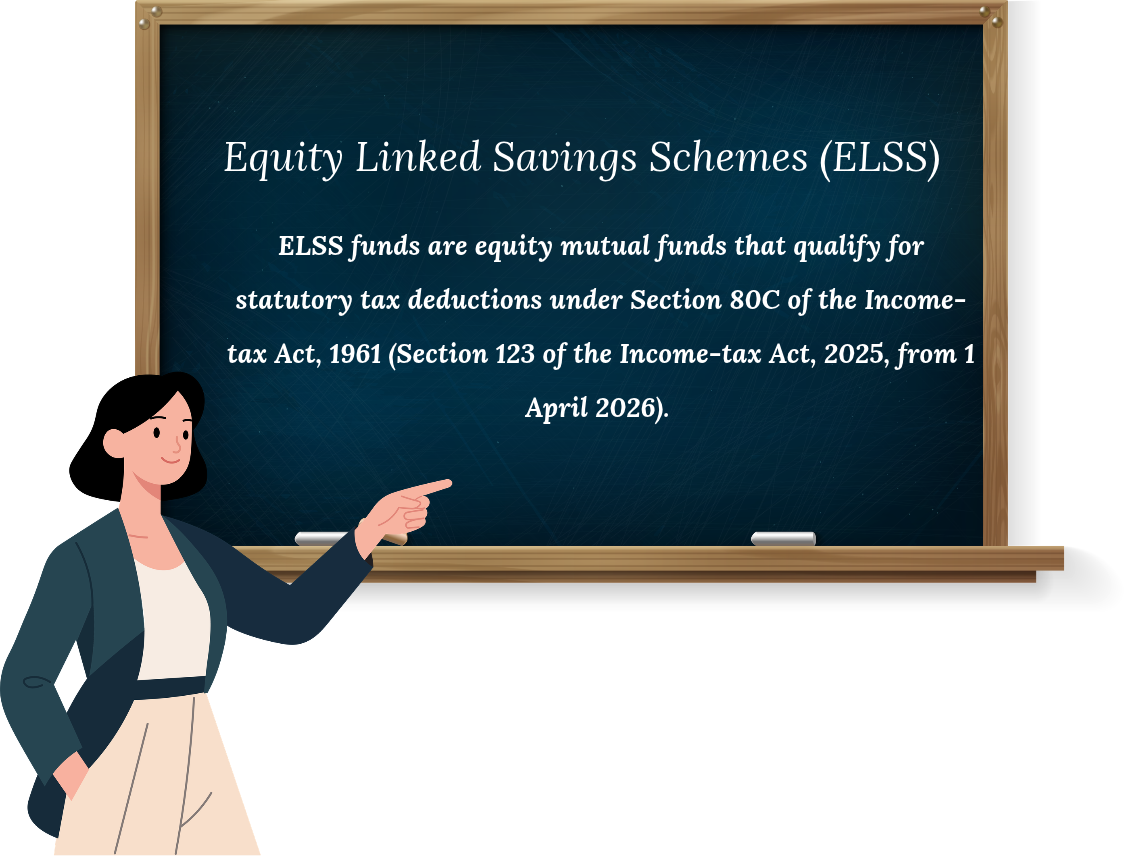
ELSS funds are equity mutual funds that qualify for statutory tax deductions under Section 80C of the Income-tax Act, 1961 (Section 123 of the Income-tax Act, 2025, from 1 April 2026).
Tax Savings Mechanism
Under the old tax regime only (the deduction is not available under the default new regime), Section 80C (now Section 123) allows taxpayers to reduce their gross taxable income by up to ₹1,50,000 per financial year:
Net Taxable Income =Gross Yearly Income-Section 80C Investments (Up to ₹1,50,000)
Tax Example: If an individual earns ₹15,00,000 annually, opts for the old regime and invests ₹1,50,000 into an ELSS fund, their taxable income (before other deductions) drops to ₹13,50,000.
Category Characteristics
- 3-Year Lock-in Period: Capital invested in an ELSS cannot be redeemed or transferred for 36 months. This lock-in is shorter than alternative 80C options like 5-Year Bank Tax-Saver FDs or 15-Year PPF accounts. Each SIP instalment has its own 3-year lock-in.
- 80% Equity Allocation: SEBI mandates that at least 80% of assets must be deployed into equity instruments.
Asset Breakdown Example: Axis ELSS Tax Saver Fund
Many investors assume ELSS funds are conservative, but they often act as multi-cap proxies. Axis ELSS Tax Saver Fund illustrates this breakdown:
- Large Cap Allocation: 6% of equity
- Mid Cap Allocation: 5% of equity
- Small Cap Allocation: 9% of equity
- Debt & Cash Equivalents: About 2.1% of total assets
- Top Holdings: ICICI Bank (6.89%), HDFC Bank (6.09%), Bharti Airtel (4.45%), Eternal (3.35%), Bajaj Finance (3.35%), as of 30 September 2026.
10.5. Flexi Cap Funds

Flexi cap funds are equity mutual funds where the fund manager can invest across large, mid and small-cap companies in any proportion. There’s no fixed split.
Regulatory Origin & The Flexi Cap Difference
Following SEBI’s September 2020 circular, Multi-Cap funds were forced to hold a rigid minimum allocation of 25% Large Cap, 25% Mid Cap, and 25% Small Cap at all times. To give fund managers complete freedom without enforced allocations, SEBI created the Flexi Cap category in November 2020.
Under SEBI rules, a Flexi Cap Fund must invest at least 65% of its total assets in equity and equity-related instruments across any market capitalization. Unlike Multi-Cap funds, the manager can allocate 0% to 100% into Large Caps, Mid Caps, or Small Caps depending on economic cycles.
Modern Portfolio Allocation Example: Parag Parikh Flexi Cap Fund
Parag Parikh Flexi Cap Fund demonstrates the flexibility of this category by combining domestic equities across market caps with a meaningful allocation to overseas stocks and a debt and arbitrage buffer
|
Holding / Asset Class |
Category / Sector |
Portfolio Weightage |
|
HDFC Bank Ltd. |
Domestic Equity (Large Cap / Financials) |
7.75% |
|
Power Grid Corporation of India |
Domestic Equity (Large Cap / Utilities) |
5.60% |
|
ITC Ltd. |
Domestic Equity (Large Cap / FMCG) |
5.49% |
|
Coal India Ltd. |
Domestic Equity (Large Cap / Mining) |
5.39% |
|
ICICI Bank Ltd. |
Domestic Equity (Large Cap / Financials) |
5.24% |
|
Overseas Equity (4 stocks) |
International Equity |
~11.9% |
|
Debt, Money Market & Arbitrage |
Debt, Money Market & Hedged Arbitrage |
~9.8% |
Strategic Advantage Over Multi-Cap Funds
No Forced Rebalancing Risk: In a Multi-Cap scheme, each of the large, mid and small-cap buckets must stay at or above 25%. If one segment (say, small caps) falls sharply, its weight can slip below the floor and the manager must top it up—even when they would rather avoid that segment. A Flexi-Cap manager has no such floors and can let winners run or avoid weak segments entirely.
Downside Cushioning: During deep market corrections, a Flexi Cap manager can shift as much as it wants—even 80–90% or more—into liquid large caps to reduce volatility.
10.6. Sectoral & Thematic Funds

Sectoral Funds and Thematic Funds represent the most aggressive edge of active equity management. Rather than holding a broad cross-section of the economy, these schemes concentrate capital in a single sector or an umbrella macro-theme.
SEBI Mandate & Definition
Sectoral Funds: Must invest a minimum of 80% of total assets in stocks of a single specified sector (e.g., Banking, Technology, Healthcare).
Thematic Funds: Must invest a minimum of 80% of total assets in equities aligned with a broader theme, which may combine two or more sectors (e.g., Manufacturing, Infrastructure, Green Energy). Since SEBI’s circular of 26 February 2026, sectoral and thematic funds are separate categories, and each such fund’s portfolio overlap with the fund house’s other sectoral/thematic schemes and other equity schemes (except large-cap funds) is capped at 50%, measured quarterly. Existing schemes have three years from the circular to comply.
Real-World Portfolio Example: ICICI Prudential Technology Fund (as of 30 September 2026)
|
Holding Name |
Market Cap Bucket |
Portfolio Allocation |
|
Bharti Airtel Ltd. |
Large Cap |
13.47% |
|
Infosys Ltd. |
Large Cap |
9.28% |
|
Tech Mahindra Ltd. |
Large Cap |
8.38% |
|
Mphasis Ltd. |
Mid Cap |
4.39% |
|
HCL Technologies Ltd. |
Large Cap |
4.21% |
|
Coforge Ltd. |
Mid Cap |
3.92% |
The “Cyclical Concentration” Risk
While broad-market funds diversify across 15+ sectors to suppress volatility, a Sectoral fund exposes investors to extreme cyclical draw-down risk:
Broad Equity Fund: [Tech] + [Banks] + [Auto] + [Pharma] + [FMCG] ──> Balanced Volatility
Sectoral Tech Fund: [Tech] + [Tech] + [Tech] + [Tech] + [Tech] ──> High Concentration Volatility
10.7. Key Takeaways

- Multi-Cap Funds: Diversified equity schemes that must hold at least 25% each in large, mid and small caps (75% equity minimum), which can create liquidity constraints at higher AUMs.
- Focused Funds: High-conviction equity portfolios capped at a maximum of 30 stocks with at least 80% in equity, offering higher return potential paired with stock concentration risk.
- Dividend Yield Funds: Schemes investing predominantly in dividend-yielding stocks, with at least 80% of assets in equity, favouring mature, cash-generative companies.
- ELSS Funds: Tax-saving equity schemes under Section 80C (Section 123 of the Income-tax Act, 2025, from 1 April 2026; old tax regime only) with an 80% equity mandate and a 3-year lock-in period.
- Flexi Cap Funds: Equity schemes with at least 65% in equity and no fixed market-cap floors, letting managers move freely between large, mid and small caps as conditions change.
- Sectoral & Thematic Funds: Concentrated schemes with at least 80% in one sector or theme, now subject to a 50% portfolio-overlap cap, carrying high cyclical draw-down risk.