
11.1 Understanding the Origins of Debt

Debt exists because individuals, businesses, and governments often need more money than they currently have to carry out important activities. When the available capital falls short, borrowing bridges the gap. This borrowed money creates a debt obligation — a promise to repay with interest.
Think of debt as a financial bridge: it connects today’s limited resources with tomorrow’s ambitions.
Personal Debt Example
Imagine you want to pursue a master’s degree abroad. The total cost -tuition, living expenses, travel comes to ₹40 lakh. You have saved ₹10 lakh, but you still need ₹30 lakh. To fill this gap, you approach a bank for an education loan.
The bank checks your background, including your academic record and your parents’ financial standing. If satisfied, it lends you the money. You now have a debt obligation: repay the loan in monthly installments over the next 7–10 years.
Here, debt enables you to achieve something otherwise impossible — higher education abroad. But it also creates responsibility: regular repayments, interest costs, and the risk of default if you fail to repay.
Risks for the Lender
From the bank’s perspective, lending is never risk-free. Several things can go wrong:
- Cashflow risk: You may delay or skip installments, disturbing the bank’s expected inflow.
- Default risk: If you lose your job or face financial distress, repayment may stop altogether.
- Interest rate risk: If market rates rise while your loan is at a fixed rate, the bank earns less than it could on newer loans (on a floating-rate loan, falling rates reduce the bank’s income instead).
- Credit rating risk: Your creditworthiness may deteriorate, increasing the chance of default.
- Asset risk: If collateral loses value, the bank may struggle to recover its money.
These risks explain why lenders scrutinize borrowers so carefully before approving loans.
Corporate Debt Example
Now scale this idea to a company. Suppose a renewable energy firm wants to build a solar power plant costing ₹1,000 crore. It has ₹200 crore internally but needs ₹800 crore more.
Two options exist:
- Bank loan– The company borrows the entire ₹800 crore from a single bank.
- Bond issuance– Instead of one lender, the company raises smaller amounts from thousands of investors. Large institutions might buy ₹10 crore or more each, while individuals can buy bonds with a face value as low as ₹10,000.
In the second case, the company issues bonds — formal promises to pay back principal plus periodic interest (called coupons). Bonds spread the risk across many investors rather than concentrating it in one bank.
What is a Bond?
A bond is essentially an IOU. The borrower (company or government) says: “Lend me money today, and I’ll pay you interest regularly plus return the full amount at maturity.”
For example, if the solar company issues a 10-year bond at 8% interest, investors receive annual coupon payments and get their principal back after 10 years. Bonds are tradable, meaning investors can sell them in the secondary market before maturity.
Risks in Bonds
Just like personal loans, bonds carry risks:
- Credit risk: The company may fail to honor payments.
- Interest rate risk: If rates in the economy rise, existing bonds with lower coupons lose value.
- Price risk: Bond prices fluctuate in the market, so selling before maturity may lead to losses.
These risks are why rating agencies like CRISIL or ICRA assign credit ratings to bonds, helping investors judge their safety.
Debt Funds Connection
Mutual funds step into this ecosystem by pooling investor money and buying bonds issued by companies, banks, or governments. As an investor, you don’t directly lend to a company — instead, you invest in a debt fund, and the fund manager decides which bonds to buy.
Your concerns as an investor are simpler:
- Which category of debt fund suits your goal?
- What risks are attached to that category?
- When should you invest?
The fund manager worries about trading bonds, timing interest rates, and managing credit risk. You only need to understand the fund’s purpose and suitability.
Why Debt Funds Matter
Debt funds are not just about returns; they serve multiple roles:
- Relative stability for conservative investors (debt funds do not guarantee capital).
- Liquidity through categories like liquid and overnight funds.
- Diversification by balancing equity risk.
- Steady income via coupon payments embedded in fund returns.
Globally, the bond market is massive, and debt funds act as a gateway for retail investors to participate without directly buying bonds.
11.2. What is a Liquid Fund
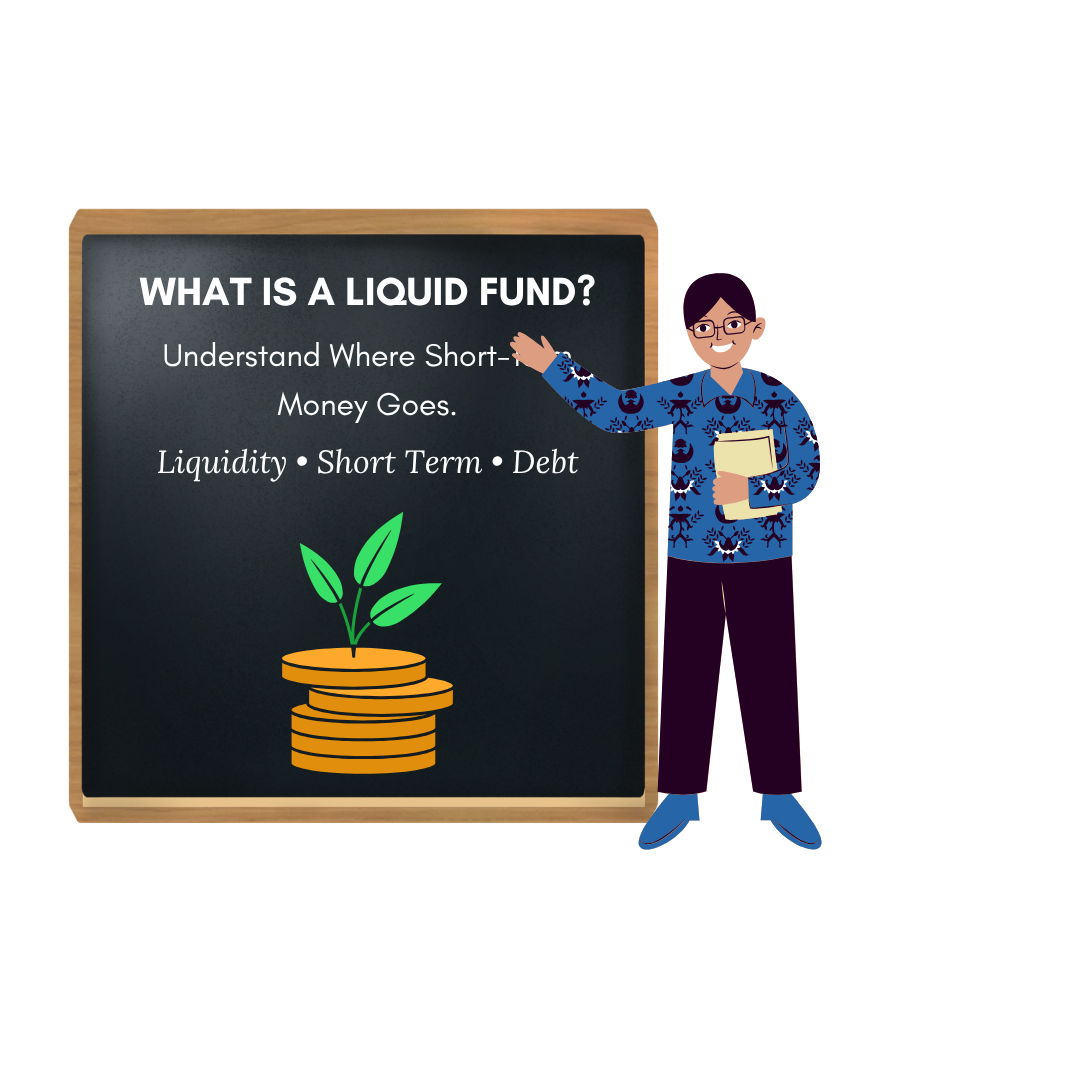
Among all debt mutual funds, liquid funds are the most widely used because they serve a very practical purpose: parking money safely for short durations. By regulation, liquid funds can only invest in debt instruments that mature within 91 days (residual maturity), and they must keep at least 20% in liquid assets such as cash, T-bills and government securities. This short maturity period ensures that the fund remains stable, low-risk, and highly liquid.
Think of it as a financial “waiting room” — a place where your money rests temporarily, earning better returns than a savings account, while still being available at short notice.
How Liquid Funds Work
Suppose Indian Oil Corporation needs ₹500 crore to pay suppliers and manage day-to-day expenses. Instead of taking a long-term loan, it borrows for 60 days. It issues a short-term debt instrument promising repayment within that period, along with interest.
Now imagine SBI Mutual Fund has idle cash from investors. Seeing this opportunity, it invests ₹500 crore in Indian Oil’s short-term paper. After 60 days, Indian Oil repays the principal plus interest.
The interest quoted is always annualized. So if the coupon is 7% per year, the actual return for 60 days is calculated proportionally:
Interest for 60 days = 60*7%/365≈ 1.15 %
This way, the fund earns a small but steady return without locking money for long.
Types of Short-Term Instruments
Liquid funds invest in short-term money market instruments. Two of the most common are described below. In practice, bank certificates of deposit (CDs) often make up a large share of a liquid fund’s portfolio, alongside TREPS (overnight lending backed by government securities):
- Commercial Papers (CPs): Issued by companies to meet working capital needs. For example, a telecom company may issue a 45-day CP to pay vendors.
- Treasury Bills (T-Bills): Issued by the Government of India to manage short-term cash requirements. These come in maturities of 91, 182, and 364 days.
T-Bills are considered the safest because the government is virtually risk-free as a borrower. CPs, however, carry credit risk depending on the company’s financial health.
Credit Risk and Coupon Rates
Imagine you are an investor with ₹100 crore to lend. Two borrowers approach you:
- A large FMCG company offering 6.5% interest.
- The Government of India offering the same 6.5%.
You would naturally prefer the government because the risk of non-repayment is negligible. The FMCG company, despite being strong, carries some risk. To attract you, it must offer a higher coupon, say 7.5%.
Now consider two companies:
- Company X: Established for 30 years, profitable, strong balance sheet.
- Company Y: A startup, only 5 years old, still stabilizing cash flows.
If both offer 8%, you’d choose Company X. For Company Y to raise funds, it must offer more — perhaps 10% — to compensate for the higher risk.
This difference is captured by credit ratings, which work like a corporate version of an individual’s credit score. Higher-rated companies borrow at lower rates; lower-rated ones must pay more.
Portfolio Composition of Liquid Funds
A liquid fund typically holds a mix of CDs, CPs, T-Bills and TREPS. T-Bills and TREPS provide safety and stability, while CPs and CDs add slightly higher returns but with some credit risk. The balance between government and corporate paper determines the fund’s risk-return profile.
For example, a conservative liquid fund may hold a larger share of T-Bills and TREPS and only top-rated CPs and CDs, while a more aggressive one may tilt towards papers of lower-rated companies to chase higher yields.
11.3. Purpose of Liquid Funds

Liquid funds are essentially short-term parking lots for money you don’t want lying idle but also don’t want locked away. Imagine you’re a small business owner who has just received ₹10 lakh from a client. You know you’ll need to pay suppliers in about two months. Keeping this money in a savings account feels wasteful because the returns are minimal. A liquid fund allows you to earn a slightly better return while still keeping the money accessible when the time comes.
Think of it like parking your car in a safe, monitored lot instead of leaving it on the street. You’re not planning a long road trip (that would be equity or long-term debt funds), but you want the car secure and ready to drive whenever needed.
Liquid Fund vs Savings Account
The natural question is: why not just leave the money in a savings account? The answer lies in the return differential. Savings accounts at most large banks in India offer about 2.5–3% interest. Liquid funds have recently delivered roughly 5.5–6.5% a year, moving in line with short-term interest rates (the RBI raised its repo rate from 5.25% to 5.50% on 7 October 2026, and liquid fund yields tend to follow such moves). That difference may sound small, but on larger sums, it adds up. For example, ₹10 lakh in a savings account might earn ₹25,000–30,000 in a year, while a liquid fund could generate ₹55,000–65,000. Both are taxed at your income-tax slab rate.
That extra ₹30,000 or so could cover your annual car insurance or a family vacation. So, while the difference isn’t life-changing, it’s meaningful enough for people who want their money to work harder without losing accessibility.
The Risk Factor
Here’s the catch: liquid funds are not risk-free. They invest in instruments like commercial papers (CPs) issued by companies, treasury bills (T-bills) issued by the government, and short-term corporate bonds or certificates of deposit maturing within 91 days. While government securities are virtually risk-free thanks to sovereign backing, CPs carry credit risk.
For instance, imagine a liquid fund holds CPs issued by a large retail chain. If that chain suddenly faces financial trouble and its credit rating is downgraded, the value of those CPs drops. This directly impacts the fund’s NAV (Net Asset Value), meaning investors could see their capital shrink overnight.
Real-World Example of Risk
A dramatic case occurred in 2017 when Taurus AMC’s liquid fund lost nearly 7% in a single day. The reason? The fund had invested heavily in CPs issued by Ballarpur Industries. When rating agencies downgraded Ballarpur’s papers, the NAV collapsed. Investors who thought their money was “safe” suddenly saw losses. Since then, SEBI has tightened the rules: liquid funds must hold at least 20% in liquid assets, can invest only in listed commercial papers, must value their holdings at market prices, and can ring-fence a defaulted or downgraded paper in a separate “side pocket.” Liquid funds also charge a small graded exit load on units redeemed within the first six days of investment.
This shows that while liquid funds are marketed as “better than savings accounts or fixed deposits,” they are not substitutes. Bank savings accounts and FDs pay a fixed interest rate and are insured by DICGC up to ₹5 lakh per depositor per bank. Liquid funds, though relatively safe, still carry market-linked risks.
How to Choose Wisely
If you decide to invest in liquid funds, the key is to look at the portfolio composition. A fund with a higher share of government securities or treasury bills is safer than one loaded with corporate CPs. For example, if Fund A has 70% government securities and Fund B has 70% corporate CPs, Fund A is the safer bet, even if Fund B promises slightly higher returns.
It’s like choosing between two parking lots: one is guarded by the government, the other by private security. Both may be fine, but the government-backed lot gives you more peace of mind.
11.4 Key Takeaways

- Liquid funds are ideal for short-term parking of spare cash.
- They offer better returns than savings accounts, but not without risk.
- They are not substitutes for FDs or savings accounts, which offer fixed returns and deposit insurance.
- Always check the portfolio mix—funds with more government securities are safer.
- Use liquid funds for money you may need within about three months, not for long-term wealth creation. For three to twelve months, the ultra-short and money market categories in Chapters 12 and 13 usually fit better.
Liquid funds are only the first step on the debt fund ladder. In the next chapter, we look at what actually drives a debt fund’s returns: how bond prices react to interest rates, what Macaulay and modified duration measure, and how SEBI arranges the debt fund categories by duration and risk.