
12.1 The Real Mechanics of Debt Funds

Debt mutual funds do not act like fixed deposits; they operate as dynamic pricing systems. Returns stem from two underlying components:
- Accrual Income:The interest income earned each day from holding fixed-income instruments, accrued and added to the Net Asset Value (NAV). A fund’s Yield to Maturity (YTM) is a useful guide to this, although YTM also includes the gain or loss as each bond moves towards its face value at maturity.
- Capital Appreciation/Depreciation (Mark-to-Market Pricing):The change in the bond’s capital value as underlying market interest rates fluctuate.
Bond Price vs. Interest Rate Inverse Relationship
Price of Bond = ∑t=1n C/(1+r)t + F/(1+r)n
Where:
- C = Coupon payment
- F= Face value (Principal)
- r= Market interest rate / Yield to Maturity (YTM)
- t= Time period
- n = Total number of periods until maturity
When prevailing market interest rates (r) fall, the present value of the fixed coupon payments (c) increases, pushing the bond price up. When market interest rates rise, existing fixed coupons become less attractive, reducing the bond price.
12.2 Macaulay Duration vs. Modified Duration

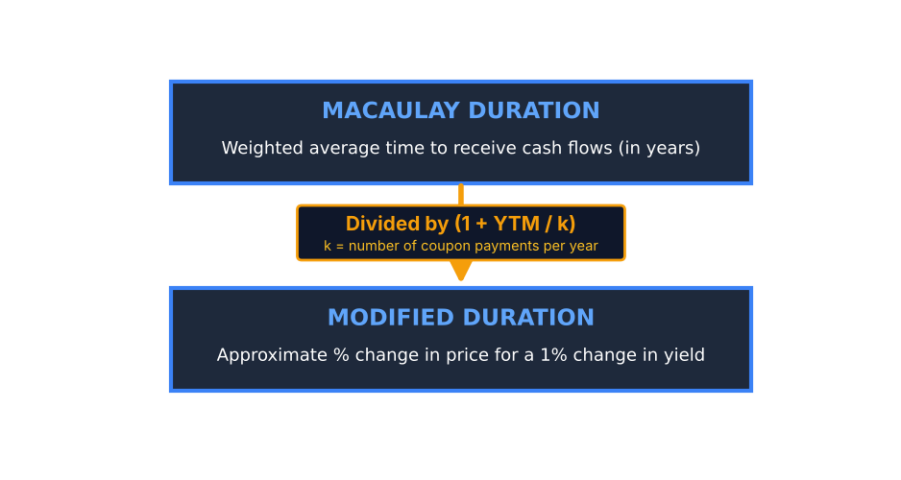
While Macaulay Duration measures time, Modified Duration measures price sensitivity. For a bond that pays one coupon a year, Modified Duration =
The Exact Mathematical Calculation
Macaulay Duration is calculated as:
Dmac = [ Σ(t=1 to n) t·C / (1 + y)^t + n·F / (1 + y)^n ] / Current Bond Price
Worked Example:
Consider a 3-Year Bond with a Face Value of ₹1,000, paying an 8% annual coupon (₹80/year), with a Yield to Maturity (YTM) of 10%.
Calculate Present Value (PV) of Cash Flows:
- Year 1: 80 / (1.10)^1 = 72.73
- Year 2: 80 / (1.10)^2 = 66.12
- Year 3: 1080 / (1.10)^3 = 811.42
- Total Present Value (Bond Price): 73 + 66.12 + 811.42 = ₹950.26
Calculate Time-Weighted Present Value:
- Year 1: 1 × 72.73 = 72.73
- Year 2: 2 × 66.12 = 132.24
- Year 3: 3 × 811.42 = 2,434.26
- Total Time-Weighted Value: 73 + 132.24 + 2,434.26 = 2,639.23
Compute Durations:
- Macaulay Duration: 2,639.23 / 950.26 = 2.777 ≈ 2.78 years
- Modified Duration: D_mac / (1 + y) = 2.777 / 1.10 ≈ 2.52
Interpretation: A modified duration of 2.52 means that if market interest rates rise by 1%, the bond price will drop by approximately 2.52%.
12.3. Case Studies

Case 1: The April 2023 Tax Reform (Section 50AA)
The Finance Act 2023 inserted Section 50AA into the Income-tax Act, 1961. It removed Long-Term Capital Gains (LTCG) treatment and indexation for “specified mutual funds”, which at first meant funds investing not more than 35% in domestic equity shares.
- Impact: Gains on such funds bought on or after April 1, 2023 are treated as short-term capital gains and taxed at the investor’s income-tax slab rate, regardless of holding period. From April 1, 2025, the definition changed to funds investing more than 65% in debt and money-market instruments (and funds of funds investing 65% or more in such funds), so hybrid funds with 35–65% equity are no longer caught. The same treatment continues under the Income-tax Act, 2025, which replaced the 1961 Act from April 1, 2026. Units bought before April 1, 2023 are taxed differently: if held for more than 24 months, gains are taxed at 12.5% without indexation.
- Strategic Shift: For investors in the highest (30%) tax slab, debt fund returns are now taxed much like bank fixed deposit interest: a 7% gross yield becomes about 4.8% after 30% tax and 4% cess (before any surcharge). The difference is that debt fund gains are taxed only on redemption, not every year. This has shifted some interest towards Arbitrage Funds and Equity Savings Funds for tax-efficient parking, although these carry their own equity-related risks.
Case 2: The AT1 Bond Write-Down Crisis (Yes Bank & Credit Suisse)
Additional Tier-1 (AT1) bonds are perpetual debt instruments used by banks to absorb losses.
- Event:In the rescue of Yes Bank (March 2020), AT1 bonds worth ₹8,415 crore were written down to zero while shareholders kept some value. A similar write-down of about CHF 16 billion happened in the rescue of Credit Suisse (March 2023). The Bombay High Court quashed the Yes Bank write-off in January 2023, and in October 2026 the Supreme Court upheld that ruling, holding the write-off invalid.
- Mutual Fund Risk Exposure:Indian schemes holding Yes Bank’s AT1 bonds suffered sudden, large NAV write-downs, showing that paper categorised as “bank debt” can carry equity-like loss risk without equity-like upside. SEBI now caps a scheme’s investment in such perpetual bonds at 10% of its NAV (5% for any single issuer) and requires them to be valued as if they mature 100 years from the date of issue.
Case 3: The Rate Hike Cycle Stress Test
During the 2022–23 rate-hiking cycle, global central banks raised rates sharply, and the RBI lifted its repo rate from 4.00% to 6.50% between May 2022 and February 2023 to curb inflation.
Outcome: Long-duration debt funds (Macaulay duration > 7 years) experienced sharp short-term drawdowns. Funds managed under an Accrual Strategy (holding short-term instruments to maturity) remained stable, while Duration Strategies incurred capital losses due to mark-to-market revaluations.
12.4. Strategic Execution Matrix for Debt Fund Allocation

|
Fund Category |
SEBI Mandate |
Primary Risk Driver |
Recommended Horizon |
Optimal Portfolio Role |
|
Overnight |
Securities maturing in 1 day |
Reinvestment Risk |
1–7 Days |
Instant Cash Parking / STP Source |
|
Liquid |
Max. 91-day residual maturity |
Minimal Credit / Accrual |
1–3 Months |
Emergency Reserve / Liquidity |
|
Ultra Short Term (formerly Ultra-Short Duration) |
3 to 6 Months |
Low Credit / Low Interest Rate |
3–6 Months |
Money Needed in 3–6 Months |
|
Ultra Short to Short Term (formerly Low Duration) |
6 to 12 Months |
Moderate Credit / Accrual |
6–12 Months |
Park Funds for Near-Term Goals |
|
Short Term (formerly Short Duration) |
1 to 3 Years |
Moderate Duration Sensitivity |
2–3 Years |
Core Stable Allocation |
|
Gilt Funds |
Minimum 80% in G-Secs |
Pure Interest Rate Risk (Zero Credit) |
5+ Years |
Long-Term Holding; Gains When Rates Fall |
|
Credit Risk Funds |
Min 65% in AA and below (excl. AA+) |
Default & Downgrade Risk |
3+ Years |
High-Yield; Not Suitable for Most Retail Investors |
Category names follow SEBI’s circular of 26 February 2026, which renamed several debt categories without changing their duration limits. The table shows the categories most used by retail investors. SEBI’s full list also includes Money Market, Medium Term, Medium to Long Term, Long Term, Dynamic, Corporate Bond, Banking & PSU, Floating Rate, 10-year Constant Maturity Gilt and the new Sectoral Debt funds. Chapters 13 and 14 cover the most important of these.
Advanced Bond Valuation & Duration Dynamics
The Complete Convexity Equation
While Modified Duration provides a linear approximation of price sensitivity, bond price changes are non-linear (curved). For larger changes in interest rates (Δy), Modified Duration alone understates price increases when rates fall and overstates price drops when rates rise.
To correct this, Convexity () measures how much duration itself changes as yields change, that is, the curvature of the price–yield relationship. The complete percentage change in bond price is calculated as:
ΔP / P ≈ −(ModD × Δy) + [ (1/2) × C × (Δy)^2 ]
Where Bond Convexity () is given by:
C = [ 1 / (P × (1 + y)^2) ] × Σ(t=1 to n) [ t(t + 1) × C_t / (1 + y)^t ]
Where: C = Convexity C_t = Cash flow at time t (coupon, plus principal in the final year) P = Current bond price y = Yield per period
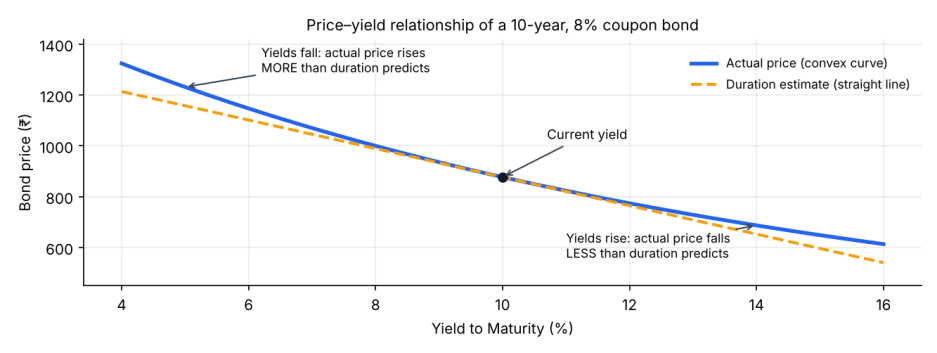
Practical Implication: In volatile rate environments, funds holding bonds with higher convexity experience lower downside risk when yields spike and higher upside potential when yields fall.
Advanced Risk Dimensions Beyond Credit & Interest Rates
Reinvestment Risk
Occurs when coupon cash flows or maturing principals are reinvested at prevailing market yields lower than the original YTM.
Example:When the RBI cuts rates, liquid and money market funds see their yields fall quickly, because cash from maturing short-term paper (such as 91-day CPs) must be reinvested in lower-yielding instruments.
Liquidity Risk & Bid-Ask Spreads
Secondary market trading volumes in Indian corporate debt are heavily concentrated in AAA-rated paper. Lower-rated paper (AA or A) trades at steep bid-ask spreads. During market panic, fund managers attempting to sell AA paper face fire-sale discounts, triggering sharp single-day NAV drops. Chapters 13 and 14 look at liquidity risk in detail through the Franklin Templeton case.
Spread Risk
Even if benchmark G-Sec rates remain constant, the yield spread between corporate bonds and government debt can widen due to deteriorating market confidence. A widening credit spread reduces the market value of corporate debt funds, even without a formal credit rating downgrade.
Modern Case Studies (2024–2026)
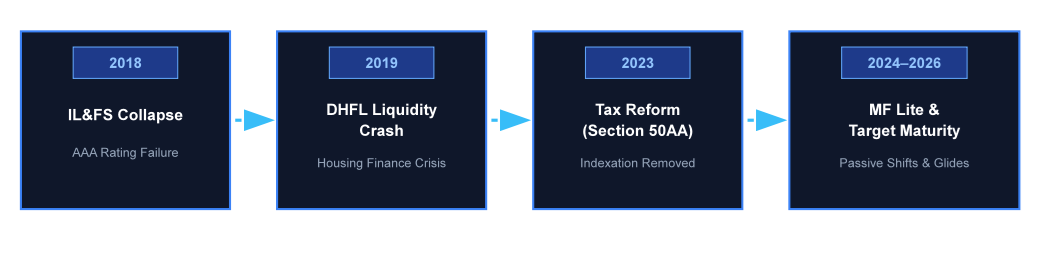
2018 – IL&FS: AAA-rated paper of IL&FS was downgraded to default grade within weeks, showing that even top ratings can change suddenly
2019 – DHFL: DHFL, a housing finance company rated AAA until early 2019, defaulted in June 2019, causing sharp markdowns across many debt schemes
2023 – Section 50AA: LTCG treatment and indexation were removed for new debt fund investments
2024–2026 – Passive funds and new rules: Target Maturity Funds, which are passive funds holding bonds that mature around a fixed date, grew as investors looked for predictable returns. SEBI’s “MF Lite” framework eased the rules for fund houses that run only passive schemes. In February 2026, SEBI revised its scheme categories, renaming several debt categories and adding Sectoral Debt Funds. In October 2026, the Supreme Court ruled the Yes Bank AT1 write-off invalid and the RBI raised the repo rate to 5.50%.