32.1 – Investments: The Glamorous but Misunderstood Part

Investing often gets the spotlight in personal finance. People obsess over which stock to buy or which mutual fund will deliver the “highest return.” But here’s the truth: investing is only one piece of the puzzle, and it’s not even the most important one.
Your portfolio exists to help you reach your goals, not to beat the Nifty or Sensex. For example, if your goal is to retire comfortably at 60, the right benchmark is whether your investments are on track to fund that retirement—not whether you outperformed an index last year.
|
Savings rate, asset allocation, and risk management matter far more than picking the “perfect” fund. A portfolio that you can stick with through ups and downs is better than a theoretically perfect one that you abandon in panic. And as you age, risk management becomes critical—reducing equity exposure gradually ensures your retirement corpus isn’t wiped out by a sudden crash.
32.2 – Diversification and Asset Allocation

Diversification is often called the only free lunch in investing. It simply means spreading your money across different asset classes so that no single shock destroys your wealth.
For example, if you only invest in Indian equities, a domestic slowdown could hurt your portfolio. But if you also hold international equities, debt funds, and some gold, you balance the risks. Debt provides stability, equities provide growth, and gold can act as a hedge during crises.
But beware of “diworsification”—owning too many similar funds. Holding five largecap mutual funds is pointless because they all invest in the same top 100 companies. You end up replicating an index fund but paying higher fees. True diversification means mixing asset classes, not collecting dozens of funds.
When reviewing your portfolio, ask:
- Am I diversified across equity, debt, and gold?
- Is my asset allocation aligned with my age and goals?
- Are my funds performing against their benchmarks, not just peers?
Evidence shows most active funds underperform over time, especially in largecaps. That’s why broad index funds like Nifty 50 or Nifty Next 50 often make better core holdings. Midcaps and smallcaps can add growth but come with higher risk.
Diversification and Asset Allocation
Diversification spreads risk across asset classes. True diversification means mixing equity, debt, and gold—not owning multiple similar funds.
|
Asset Class |
Role |
Example |
|
Equity |
Growth |
Indian equities, international equities |
|
Debt |
Stability |
Debt mutual funds, government bonds |
|
Gold |
Hedge |
Gold ETFs, physical gold |
|
Diworsification |
Overlap |
Owning 5 largecap funds = duplication |
32.3 – Rebalancing: Keeping Risk in Check
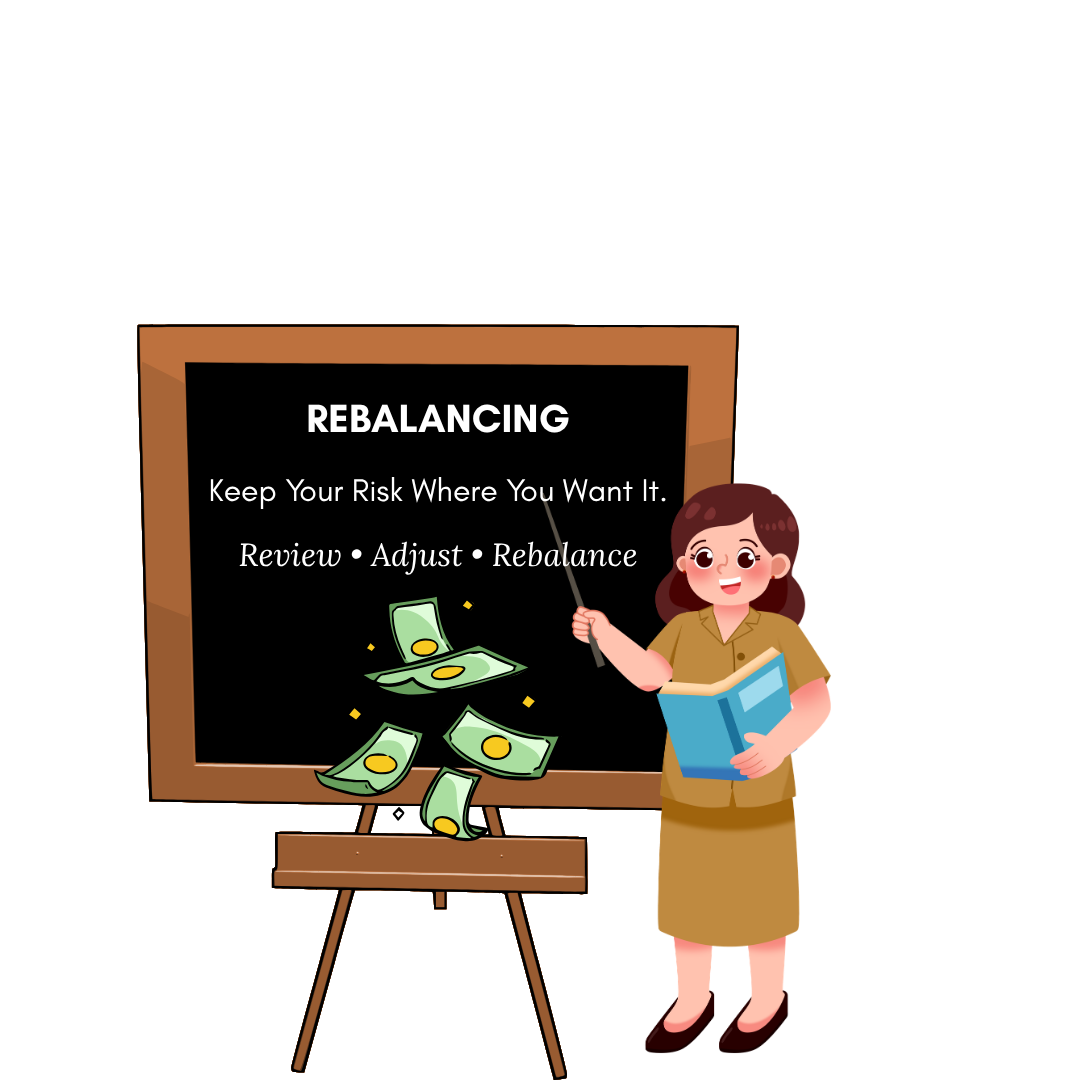
Asset allocation isn’t static. If equities rally, your portfolio may tilt too heavily toward stocks, increasing risk. Rebalancing means selling some of what has grown too much and buying what has lagged to restore balance.
For example, if your plan was 60% equity, 30% debt, and 10% gold, but equities rise to 70%, you trim equity and add to debt or gold. This reduces volatility and keeps your portfolio aligned with your goals.
Yes, rebalancing can trigger taxes, but taxes are a small price to pay for risk control. You don’t need to rebalance constantly—once a year or when allocations drift beyond 5% bands is enough. Sometimes, fresh investments can be used to rebalance without selling.
Think of rebalancing as portfolio maintenance. Just like servicing your car prevents breakdowns, rebalancing prevents your portfolio from drifting into dangerous territory.
Rebalancing restores portfolio balance when one asset class grows disproportionately.
|
Planned Allocation |
After Rally |
Action |
|
60% Equity, 30% Debt, 10% Gold |
70% Equity, 20% Debt, 10% Gold |
Trim equity, add debt/gold |
|
Frequency |
Annual or >5% drift |
Prevents portfolio from becoming too risky |
32.4 – Savings Rate vs. Returns
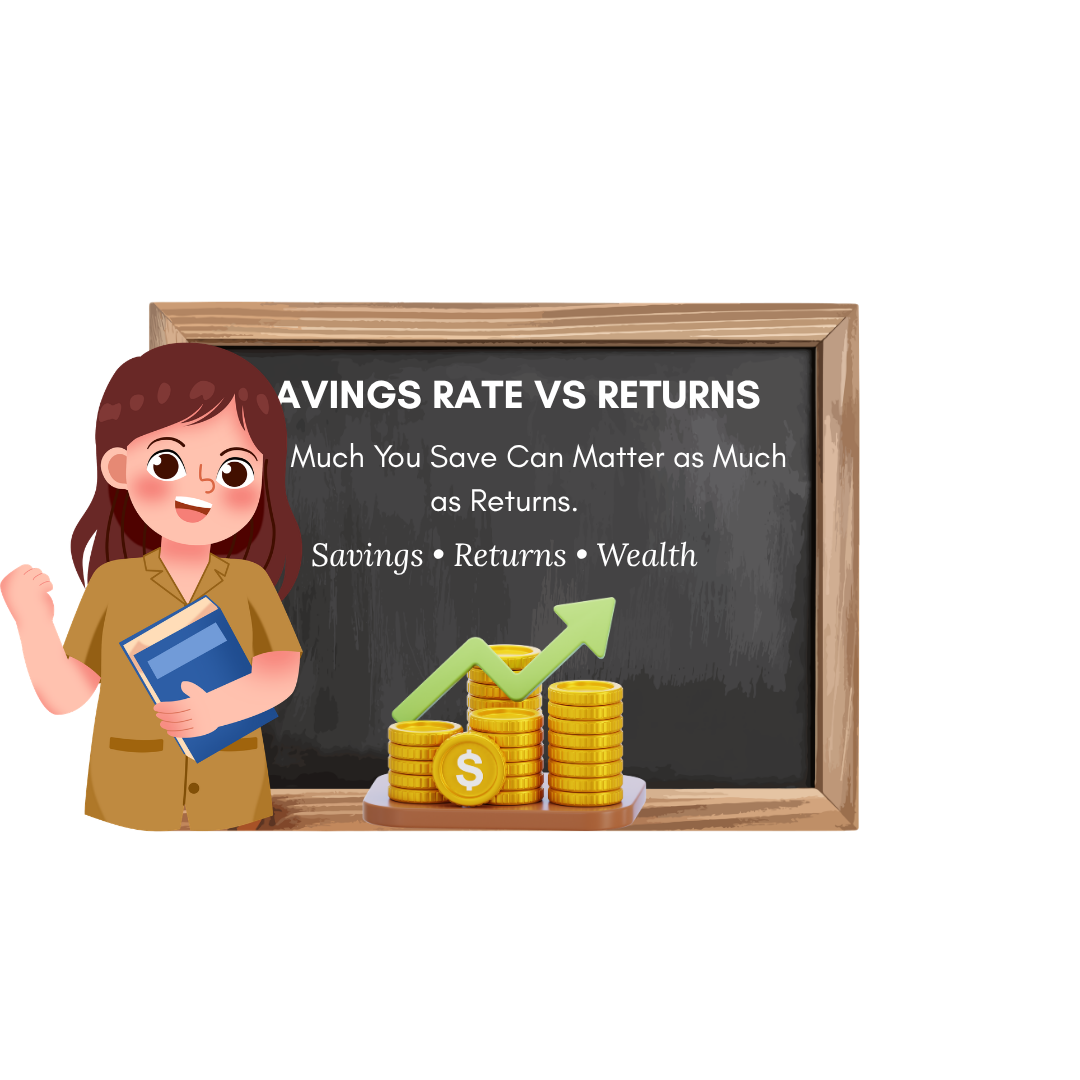
Most investors obsess over returns—“Kitna deti hai?”—but ignore savings rate. In reality, how much you save matters more than the return you earn.
Consider two investors:
- Investor A saves ₹10,000 monthly, increases savings by 10% annually, and earns 9% returns.
- Investor B saves ₹10,000 monthly, never increases savings, but earns 13% returns.
After 30 years, Investor A ends up with about ₹5.3 crore versus about ₹3.8 crore for Investor B, because steadily rising savings compound powerfully (Investor A also contributes much more over time, which is exactly the point).
Your biggest asset isn’t your house or stocks—it’s your human capital, i.e., your future earning potential. A young professional has decades of income ahead, which can be converted into financial capital through disciplined saving. Investing in skills and education boosts your human capital, leading to higher income and higher savings.
Think of it this way: your job stability is like a bond, while a volatile career (say, freelancing) is more like equity. Understanding your human capital helps you decide how much risk to take in your portfolio.
Savings rate matters more than chasing returns.
|
Investor |
Savings Pattern |
Return |
Outcome after 30 years |
|
Investor A |
₹10,000/month, +10% annually |
9% |
Higher corpus |
|
Investor B |
₹10,000/month, no increase |
13% |
Lower corpus |
|
Lesson |
Increasing savings beats chasing returns |
Human capital is the biggest asset |
32.5 – Behavior: The Real Driver of Wealth

Behavioral finance teaches us that humans aren’t rational robots. We procrastinate, chase fads, panic during crashes, and hold on to bad products. These behaviors, not poor stock selection, often ruin portfolios.
For example, many investors panicsold during the COVID crash in March 2020, only to miss the sharp recovery. Others chase “hot” sectors like crypto or penny stocks, only to lose money.
The antidote is automation. Set up SIPs, automate insurance premiums, loan repayments, and bill payments. This reduces the chance of impulsive mistakes. Also, avoid checking your portfolio daily—constant monitoring increases anxiety and leads to rash decisions.
Discipline, patience, and humility matter more than picking the “best” stock. Wealth is built slowly, not through shortcuts.
|
Behavior |
Example |
Impact |
|
Panic Selling |
Selling in March 2020 crash |
Missed recovery |
|
Chasing Fads |
Crypto/penny stocks |
High losses |
|
Overmonitoring |
Checking portfolio daily |
Anxiety, rash decisions |
|
Solution |
Automate SIPs, reduce monitoring |
Builds discipline |
32.6 – Money and Mental Health

Money is one of the biggest sources of stress worldwide. For someone living paycheck to paycheck, financial anxiety can feel overwhelming. Even for higher earners, debt, job insecurity, or poor planning can cause sleepless nights.
Your relationship with money is shaped by childhood experiences and family beliefs. For example, someone who grew up during a recession may be overly conservative, hoarding cash instead of investing. Others may overspend to compensate for past deprivation.
Financial stress affects mental health, which in turn impacts physical health. Recognizing this link is crucial. While you can’t control global events like pandemics or wars, you can control personal habits: saving regularly, avoiding unnecessary spending, building emergency funds, and being transparent with family about finances.
As the serenity prayer says: focus on what you can control, and accept what you cannot.
Financial stress affects mental and physical health.
|
Cause |
Example |
Impact |
|
Debt |
Credit card dues |
Anxiety, sleepless nights |
|
Job Insecurity |
Contract work |
Stress, poor planning |
|
Childhood Beliefs |
Grew up in recession |
Overly conservative investing |
|
Solution |
Build emergency fund, save regularly |
Reduces stress |
32.7 – The “What If” Folder

A shocking amount of money in India lies unclaimed because nominees weren’t added or informed. Unclaimed bank deposits alone transferred to the RBI’s Depositor Education and Awareness Fund run into tens of thousands of crores; the RBI’s UDGAM portal now helps families search for such deposits. Imagine working hard to build wealth, only for your family to struggle accessing it after your death.
To avoid this, create a “What If” folder—digital or physical—with:
- Details of all investments, bank accounts, and insurance policies.
- Loan and liability records.
- Property documents.
- Identity proofs and account opening documents.
- Instructions for claims processes.
Share this securely with nominees, ensuring they use strong passwords and twofactor authentication. This simple step ensures your loved ones aren’t left in the dark.
A “What If” folder ensures family can access wealth easily.
|
Document Type |
Examples |
Purpose |
|
Investments |
Mutual funds, stocks |
Easy access for nominees |
|
Liabilities |
Loan records |
Clear repayment obligations |
|
Property |
House deeds |
Legal clarity |
|
Identity Proofs |
PAN, Aadhaar |
Claim processes |
32.8 – Guarding Against Financial Fraud
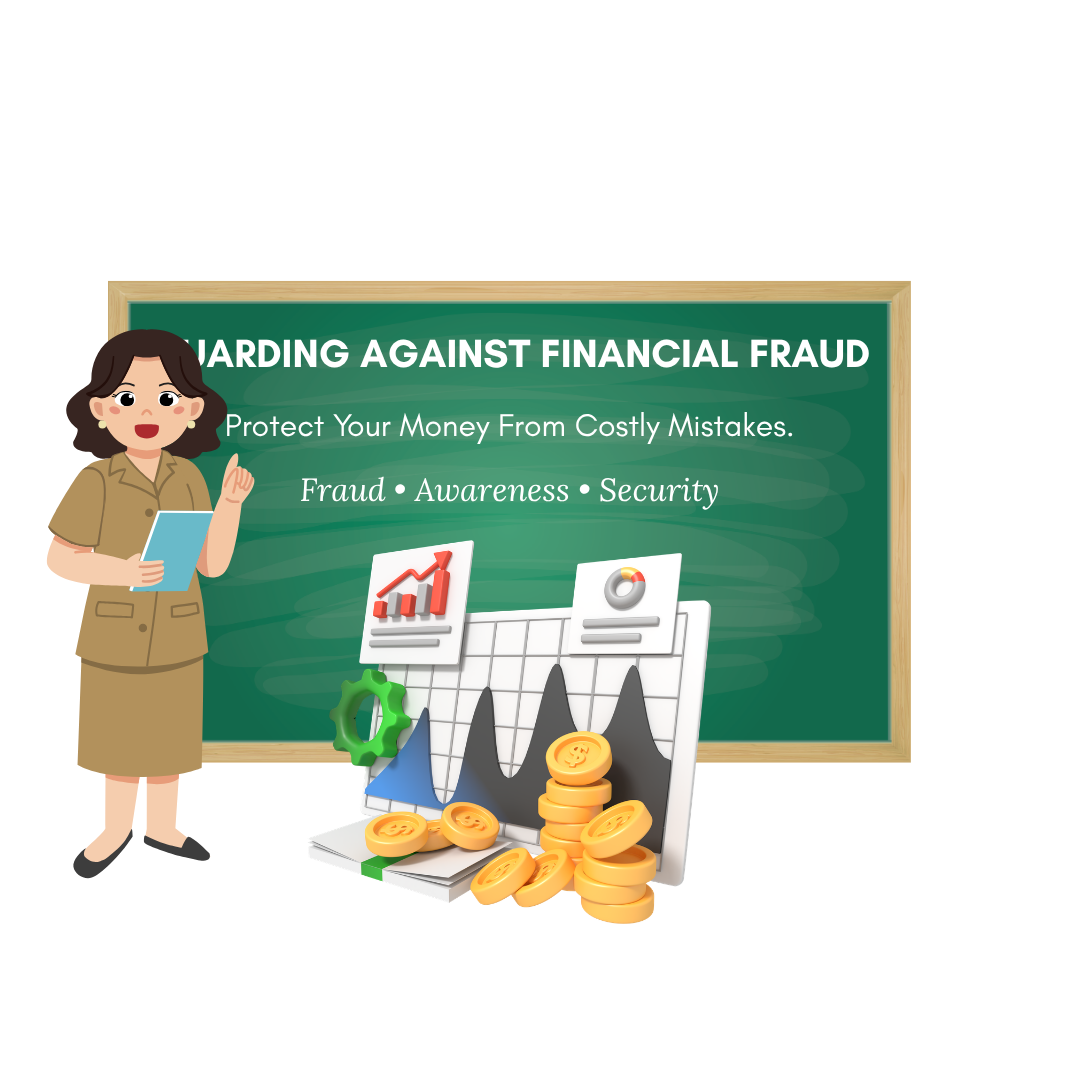
Fraud is everywhere—phishing emails, fake websites, lending app scams. Protect yourself with strong passwords, two factor authentication, and secure devices.
Never share sensitive information over phone calls or WhatsApp. Verify websites before entering credentials. Avoid platforms with shady reputations. Be wary of new scams such as fake “digital arrest” calls from people posing as police or regulators, and report cyber fraud immediately on the national helpline 1930 or at cybercrime.gov.in.
Think of fraud prevention as locking your house. You wouldn’t leave your door open at night—so don’t leave your financial accounts vulnerable.
Fraud prevention is as important as investing.
|
Fraud Type |
Example |
Prevention |
|
Phishing |
Fake bank emails |
Verify sender, avoid links |
|
Lending App Scams |
Hidden charges |
Use trusted apps only |
|
Password Theft |
Weak passwords |
Strong passwords + 2FA |
|
Fake Websites |
Duplicate portals |
Check URLs carefully |
32.9 – Understanding Risk and Volatility
Risk is often misunderstood as the chance of “losing money.” In reality, risk is the uncertainty of outcomes, and volatility is the day to day fluctuation in asset values. For example, equity markets may swing 20% in a year, but over decades they tend to deliver higher returns than debt.
A practical example: if you invest ₹1 lakh in equities, it may fall to ₹80,000 during a crash but rise to ₹2 lakh over 10 years. Debt funds, on the other hand, may grow steadily to ₹1.5 lakh with fewer fluctuations. Understanding this difference helps you decide how much volatility you can tolerate without panic-selling.
32.10 – The Role of Debt in Portfolios
Debt is often seen as “boring,” but it plays a crucial role in stabilizing portfolios. Debt instruments like government bonds, fixed deposits, or debt mutual funds provide predictable returns and reduce overall risk.
Example: A portfolio with 70% equity and 30% debt will not fall as sharply during a market crash compared to a 100% equity portfolio. If equities drop 40%, the mixed portfolio may only fall 28%, cushioning the blow. Debt also provides liquidity for shortterm needs, ensuring you don’t have to sell equities at a loss.
32.11 – Common Investment Mistakes
Many investors fall into traps that erode wealth. Examples include:
- Chasing past performance: Buying a mutual fund because it delivered 20% last year, only to see it underperform later.
- Ignoring costs: High-expense funds eat into returns. For example, a 2% expense ratio on a ₹10 lakh portfolio costs ₹20,000 annually.
- Overtrading: Constant buying and selling increases transaction costs and taxes.
- Lack of patience: Selling too early during downturns, missing the recovery.
A classic example is the COVID crash in March 2020. Many investors sold in panic when markets fell nearly 40% from their January 2020 peak, but those who stayed invested saw portfolios recover within months, with the Nifty hitting new highs by November 2020.
Building an Investment Discipline
The most important part of investing is discipline. Markets will rise and fall, but sticking to a plan ensures long-term success. Discipline means:
- Automating investments through SIPs.
- Rebalancing annually to maintain asset allocation.
- Avoiding impulsive decisions based on news headlines.
- Reviewing portfolios periodically but not obsessively.
Example: An investor who consistently invests ₹10,000 monthly in an index fund for 20 years, regardless of market conditions, will likely build far more wealth than someone who invests sporadically based on “hot tips.” Discipline turns volatility into opportunity by buying more units when markets are down and fewer when markets are high.
Key Takeaways
- Investments serve your goals, not market benchmarks.
- Diversification prevents wealth destruction; avoid diworsification.
- Rebalancing keeps risk in check.
- Savings rate matters more than chasing returns.
- Human capital is your biggest asset.
- Behavioral discipline drives long-term success.
- Money and mental health are deeply linked.
- What If folder ensures family security.
- Fraud prevention is non-negotiable.
32.1 – Investments: The Glamorous but Misunderstood Part
Investing often gets the spotlight in personal finance. People obsess over which stock to buy or which mutual fund will deliver the “highest return.” But here’s the truth: investing is only one piece of the puzzle, and it’s not even the most important one.
Your portfolio exists to help you reach your goals, not to beat the Nifty or Sensex. For example, if your goal is to retire comfortably at 60, the right benchmark is whether your investments are on track to fund that retirement—not whether you outperformed an index last year.
|
Savings rate, asset allocation, and risk management matter far more than picking the “perfect” fund. A portfolio that you can stick with through ups and downs is better than a theoretically perfect one that you abandon in panic. And as you age, risk management becomes critical—reducing equity exposure gradually ensures your retirement corpus isn’t wiped out by a sudden crash.
32.2 – Diversification and Asset Allocation
Diversification is often called the only free lunch in investing. It simply means spreading your money across different asset classes so that no single shock destroys your wealth.
For example, if you only invest in Indian equities, a domestic slowdown could hurt your portfolio. But if you also hold international equities, debt funds, and some gold, you balance the risks. Debt provides stability, equities provide growth, and gold can act as a hedge during crises.
But beware of “diworsification”—owning too many similar funds. Holding five largecap mutual funds is pointless because they all invest in the same top 100 companies. You end up replicating an index fund but paying higher fees. True diversification means mixing asset classes, not collecting dozens of funds.
When reviewing your portfolio, ask:
- Am I diversified across equity, debt, and gold?
- Is my asset allocation aligned with my age and goals?
- Are my funds performing against their benchmarks, not just peers?
Evidence shows most active funds underperform over time, especially in largecaps. That’s why broad index funds like Nifty 50 or Nifty Next 50 often make better core holdings. Midcaps and smallcaps can add growth but come with higher risk.
Diversification and Asset Allocation
Diversification spreads risk across asset classes. True diversification means mixing equity, debt, and gold—not owning multiple similar funds.
|
Asset Class |
Role |
Example |
|
Equity |
Growth |
Indian equities, international equities |
|
Debt |
Stability |
Debt mutual funds, government bonds |
|
Gold |
Hedge |
Gold ETFs, physical gold |
|
Diworsification |
Overlap |
Owning 5 largecap funds = duplication |
32.3 – Rebalancing: Keeping Risk in Check
Asset allocation isn’t static. If equities rally, your portfolio may tilt too heavily toward stocks, increasing risk. Rebalancing means selling some of what has grown too much and buying what has lagged to restore balance.
For example, if your plan was 60% equity, 30% debt, and 10% gold, but equities rise to 70%, you trim equity and add to debt or gold. This reduces volatility and keeps your portfolio aligned with your goals.
Yes, rebalancing can trigger taxes, but taxes are a small price to pay for risk control. You don’t need to rebalance constantly—once a year or when allocations drift beyond 5% bands is enough. Sometimes, fresh investments can be used to rebalance without selling.
Think of rebalancing as portfolio maintenance. Just like servicing your car prevents breakdowns, rebalancing prevents your portfolio from drifting into dangerous territory.
Rebalancing restores portfolio balance when one asset class grows disproportionately.
|
Planned Allocation |
After Rally |
Action |
|
60% Equity, 30% Debt, 10% Gold |
70% Equity, 20% Debt, 10% Gold |
Trim equity, add debt/gold |
|
Frequency |
Annual or >5% drift |
Prevents portfolio from becoming too risky |
32.4 – Savings Rate vs. Returns
Most investors obsess over returns—“Kitna deti hai?”—but ignore savings rate. In reality, how much you save matters more than the return you earn.
Consider two investors:
- Investor A saves ₹10,000 monthly, increases savings by 10% annually, and earns 9% returns.
- Investor B saves ₹10,000 monthly, never increases savings, but earns 13% returns.
After 30 years, Investor A ends up with about ₹5.3 crore versus about ₹3.8 crore for Investor B, because steadily rising savings compound powerfully (Investor A also contributes much more over time, which is exactly the point).
Your biggest asset isn’t your house or stocks—it’s your human capital, i.e., your future earning potential. A young professional has decades of income ahead, which can be converted into financial capital through disciplined saving. Investing in skills and education boosts your human capital, leading to higher income and higher savings.
Think of it this way: your job stability is like a bond, while a volatile career (say, freelancing) is more like equity. Understanding your human capital helps you decide how much risk to take in your portfolio.
Savings rate matters more than chasing returns.
|
Investor |
Savings Pattern |
Return |
Outcome after 30 years |
|
Investor A |
₹10,000/month, +10% annually |
9% |
Higher corpus |
|
Investor B |
₹10,000/month, no increase |
13% |
Lower corpus |
|
Lesson |
Increasing savings beats chasing returns |
Human capital is the biggest asset |
32.5 – Behavior: The Real Driver of Wealth
Behavioral finance teaches us that humans aren’t rational robots. We procrastinate, chase fads, panic during crashes, and hold on to bad products. These behaviors, not poor stock selection, often ruin portfolios.
For example, many investors panicsold during the COVID crash in March 2020, only to miss the sharp recovery. Others chase “hot” sectors like crypto or penny stocks, only to lose money.
The antidote is automation. Set up SIPs, automate insurance premiums, loan repayments, and bill payments. This reduces the chance of impulsive mistakes. Also, avoid checking your portfolio daily—constant monitoring increases anxiety and leads to rash decisions.
Discipline, patience, and humility matter more than picking the “best” stock. Wealth is built slowly, not through shortcuts.
|
Behavior |
Example |
Impact |
|
Panic Selling |
Selling in March 2020 crash |
Missed recovery |
|
Chasing Fads |
Crypto/penny stocks |
High losses |
|
Overmonitoring |
Checking portfolio daily |
Anxiety, rash decisions |
|
Solution |
Automate SIPs, reduce monitoring |
Builds discipline |
32.6 – Money and Mental Health
Money is one of the biggest sources of stress worldwide. For someone living paycheck to paycheck, financial anxiety can feel overwhelming. Even for higher earners, debt, job insecurity, or poor planning can cause sleepless nights.
Your relationship with money is shaped by childhood experiences and family beliefs. For example, someone who grew up during a recession may be overly conservative, hoarding cash instead of investing. Others may overspend to compensate for past deprivation.
Financial stress affects mental health, which in turn impacts physical health. Recognizing this link is crucial. While you can’t control global events like pandemics or wars, you can control personal habits: saving regularly, avoiding unnecessary spending, building emergency funds, and being transparent with family about finances.
As the serenity prayer says: focus on what you can control, and accept what you cannot.
Financial stress affects mental and physical health.
|
Cause |
Example |
Impact |
|
Debt |
Credit card dues |
Anxiety, sleepless nights |
|
Job Insecurity |
Contract work |
Stress, poor planning |
|
Childhood Beliefs |
Grew up in recession |
Overly conservative investing |
|
Solution |
Build emergency fund, save regularly |
Reduces stress |
32.7 – The “What If” Folder
A shocking amount of money in India lies unclaimed because nominees weren’t added or informed. Unclaimed bank deposits alone transferred to the RBI’s Depositor Education and Awareness Fund run into tens of thousands of crores; the RBI’s UDGAM portal now helps families search for such deposits. Imagine working hard to build wealth, only for your family to struggle accessing it after your death.
To avoid this, create a “What If” folder—digital or physical—with:
- Details of all investments, bank accounts, and insurance policies.
- Loan and liability records.
- Property documents.
- Identity proofs and account opening documents.
- Instructions for claims processes.
Share this securely with nominees, ensuring they use strong passwords and twofactor authentication. This simple step ensures your loved ones aren’t left in the dark.
A “What If” folder ensures family can access wealth easily.
|
Document Type |
Examples |
Purpose |
|
Investments |
Mutual funds, stocks |
Easy access for nominees |
|
Liabilities |
Loan records |
Clear repayment obligations |
|
Property |
House deeds |
Legal clarity |
|
Identity Proofs |
PAN, Aadhaar |
Claim processes |
32.8 – Guarding Against Financial Fraud
Fraud is everywhere—phishing emails, fake websites, lending app scams. Protect yourself with strong passwords, two factor authentication, and secure devices.
Never share sensitive information over phone calls or WhatsApp. Verify websites before entering credentials. Avoid platforms with shady reputations. Be wary of new scams such as fake “digital arrest” calls from people posing as police or regulators, and report cyber fraud immediately on the national helpline 1930 or at cybercrime.gov.in.
Think of fraud prevention as locking your house. You wouldn’t leave your door open at night—so don’t leave your financial accounts vulnerable.
Fraud prevention is as important as investing.
|
Fraud Type |
Example |
Prevention |
|
Phishing |
Fake bank emails |
Verify sender, avoid links |
|
Lending App Scams |
Hidden charges |
Use trusted apps only |
|
Password Theft |
Weak passwords |
Strong passwords + 2FA |
|
Fake Websites |
Duplicate portals |
Check URLs carefully |
32.9 – Understanding Risk and Volatility
Risk is often misunderstood as the chance of “losing money.” In reality, risk is the uncertainty of outcomes, and volatility is the day to day fluctuation in asset values. For example, equity markets may swing 20% in a year, but over decades they tend to deliver higher returns than debt.
A practical example: if you invest ₹1 lakh in equities, it may fall to ₹80,000 during a crash but rise to ₹2 lakh over 10 years. Debt funds, on the other hand, may grow steadily to ₹1.5 lakh with fewer fluctuations. Understanding this difference helps you decide how much volatility you can tolerate without panic-selling.
32.10 – The Role of Debt in Portfolios
Debt is often seen as “boring,” but it plays a crucial role in stabilizing portfolios. Debt instruments like government bonds, fixed deposits, or debt mutual funds provide predictable returns and reduce overall risk.
Example: A portfolio with 70% equity and 30% debt will not fall as sharply during a market crash compared to a 100% equity portfolio. If equities drop 40%, the mixed portfolio may only fall 28%, cushioning the blow. Debt also provides liquidity for shortterm needs, ensuring you don’t have to sell equities at a loss.
32.11 – Common Investment Mistakes
Many investors fall into traps that erode wealth. Examples include:
- Chasing past performance: Buying a mutual fund because it delivered 20% last year, only to see it underperform later.
- Ignoring costs: High-expense funds eat into returns. For example, a 2% expense ratio on a ₹10 lakh portfolio costs ₹20,000 annually.
- Overtrading: Constant buying and selling increases transaction costs and taxes.
- Lack of patience: Selling too early during downturns, missing the recovery.
A classic example is the COVID crash in March 2020. Many investors sold in panic when markets fell nearly 40% from their January 2020 peak, but those who stayed invested saw portfolios recover within months, with the Nifty hitting new highs by November 2020.
Building an Investment Discipline
The most important part of investing is discipline. Markets will rise and fall, but sticking to a plan ensures long-term success. Discipline means:
- Automating investments through SIPs.
- Rebalancing annually to maintain asset allocation.
- Avoiding impulsive decisions based on news headlines.
- Reviewing portfolios periodically but not obsessively.
Example: An investor who consistently invests ₹10,000 monthly in an index fund for 20 years, regardless of market conditions, will likely build far more wealth than someone who invests sporadically based on “hot tips.” Discipline turns volatility into opportunity by buying more units when markets are down and fewer when markets are high.
Key Takeaways
- Investments serve your goals, not market benchmarks.
- Diversification prevents wealth destruction; avoid diworsification.
- Rebalancing keeps risk in check.
- Savings rate matters more than chasing returns.
- Human capital is your biggest asset.
- Behavioral discipline drives long-term success.
- Money and mental health are deeply linked.
- What If folder ensures family security.
- Fraud prevention is non-negotiable.