
9.1 What Is a Systematic Investment Plan (SIP)?
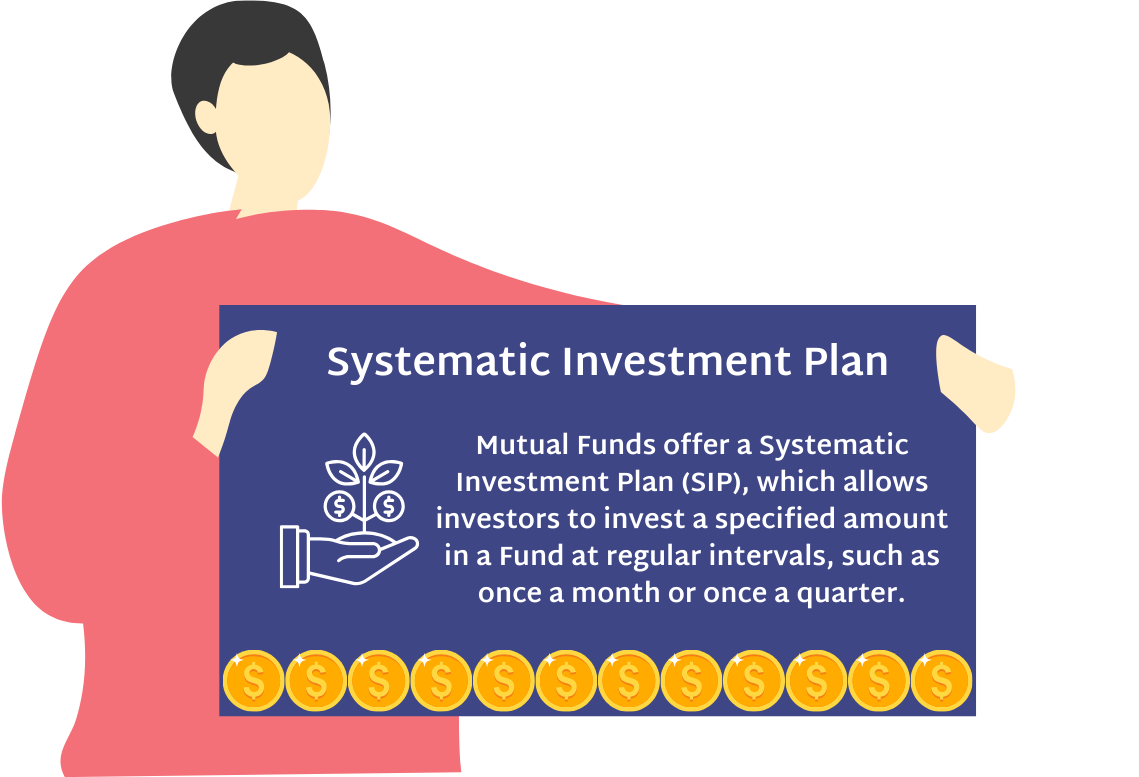
Anand asks Ridhima what is a Systematic Investment Plan.
Ridhima says a Systematic Investment Plan is where you put in a fixed amount of money at times like every month or every quarter instead of putting in a lot of money all at once.
Anand wants to know how it works.
Ridhima explains that each time you put in money it buys units of the fund at the price of that day. When the market is down you get units for your money. When the market is up you get units for your money. Over time this evens out which is called rupee cost averaging.
Anand asks if this helps to build wealth.
Ridhima says yes it does. It also helps you to be disciplined. You have to save your money and then you can spend it so you make sure you are investing consistently.
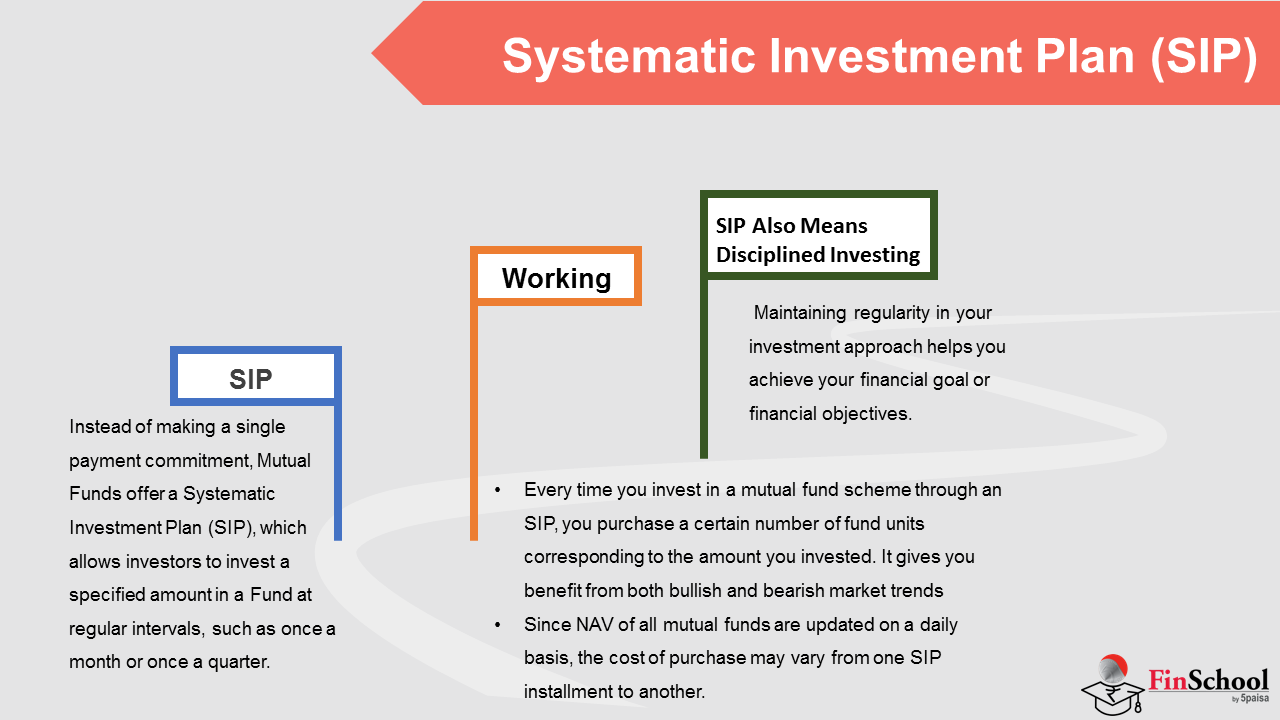
- Rather than committing a single lump-sum payment, mutual funds offer a Systematic Investment Plan (SIP), which lets investors put in a fixed amount at regular intervals — monthly or quarterly, for instance. This instalment, much like a recurring deposit, can be as low as ₹500, and it’s convenient because you can simply set up an auto-debit from your bank account.
- SIPs have grown increasingly popular among Indian mutual fund investors because they encourage disciplined investing without the pressure of timing the market or worrying about short-term volatility. Because you keep investing regardless of near-term performance, SIPs are often described as a passive investing approach.
How Does an SIP Work?
- Each SIP instalment buys a certain number of fund units corresponding to the amount invested. You never need to time the market with an SIP, since you naturally benefit from both bullish and bearish phases.
- When markets fall, you end up purchasing more units for the same amount; when markets rise, you purchase fewer. Since a fund’s NAV is updated daily, the purchase cost varies slightly from one instalment to the next, and over time this cost tends to average out — a benefit known as rupee cost averaging, which a lump-sum investment simply doesn’t offer.
- SIPs also help build wealth steadily. Suppose a mutual fund’s NAV is ₹100, and you invest ₹10,000 — you’d be allotted 100 units. If the NAV rises to ₹130 the following year, those same 100 units would be worth ₹13,000. This is how a disciplined SIP investment compounds and grows wealth over the long term.
SIP Also Means Disciplined Investing
- Investing through an SIP instils genuine financial discipline. Experienced investors often recommend framing your monthly finances around a simple formula: Earnings − Savings = Expenses.
- If you earn a certain amount every month and don’t control your spending within a set budget, you may find yourself with nothing left to save by month’s end.
An SIP flips that habit , you’re compelled to save first and spend afterward. Once you’re clear on your expenses, budgeting within them becomes second nature. Structuring your finances this way saving first, spending after helps you avoid financial strain and steadily work toward your goals, because you’re following a genuinely disciplined investment approach.
9.2 What Is Systematic Transfer Plan (STP)?
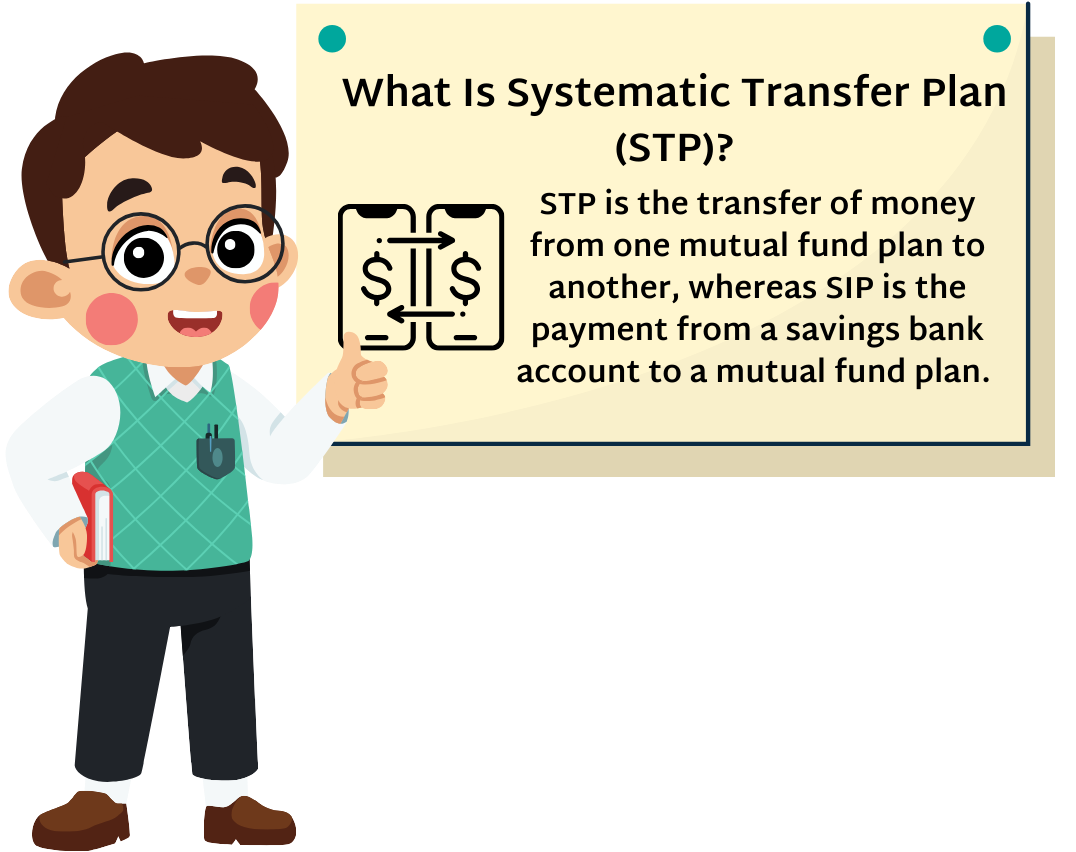
Anand asks Ridhima how a Systematic Transfer Plan is different from a Systematic Investment Plan.
Ridhima says a Systematic Investment Plan moves money from your bank account to a fund. A Systematic Transfer Plan moves money from one fund to another usually from a debt fund to an equity fund.
Anand wants to know why someone would use a Systematic Transfer Plan.
Ridhima says it helps to balance your portfolio. It also helps to average out the costs, like a Systematic Investment Plan. You can earn returns from the debt fund until your money is moved to the equity fund.
Anand asks if there are types of Systematic Transfer Plans.
Ridhima says yes there are. There is a Fixed Systematic Transfer Plan, where you move a fixed amount of money. There is a Capital Appreciation Systematic Transfer Plan, where you move the profits from one fund to another.. There is a Flexi Systematic Transfer Plan, where you can move a variable amount of money based on the market.
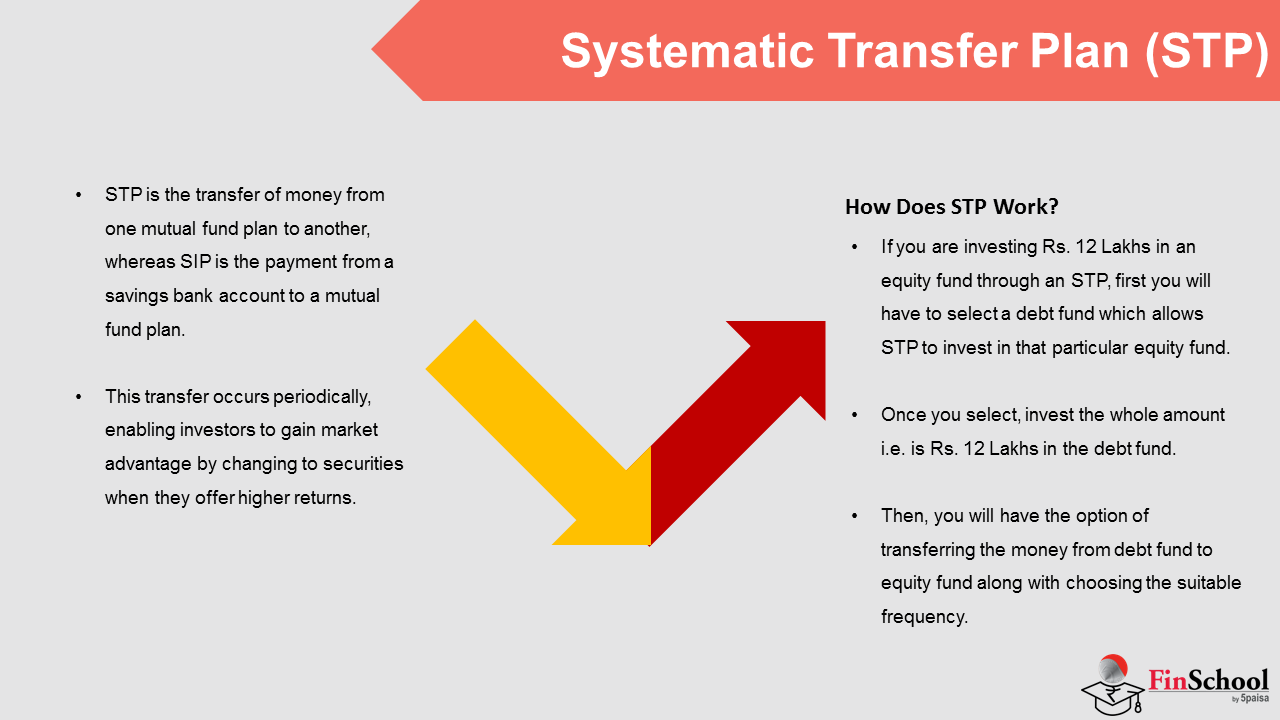
- An STP transfers money from one mutual fund scheme to another, whereas an SIP moves money from a savings bank account into a mutual fund. An STP is a smart way to manage risk and balance returns by staggering an investment over a set period.
- In other words, a Systematic Transfer Plan lets investors shift their money from one scheme to another smoothly and periodically, allowing them to capture better opportunities as they arise while cushioning the impact of market fluctuations.
How Does STP Work?
Suppose you’re investing ₹12 lakh into an equity fund via an STP. You’d first choose a debt fund that supports STPs into that particular equity fund, invest the full ₹12 lakh into the debt fund, and then set up a transfer schedule — choosing the frequency at which the money moves from the debt fund into the equity fund.
Benefits of STP
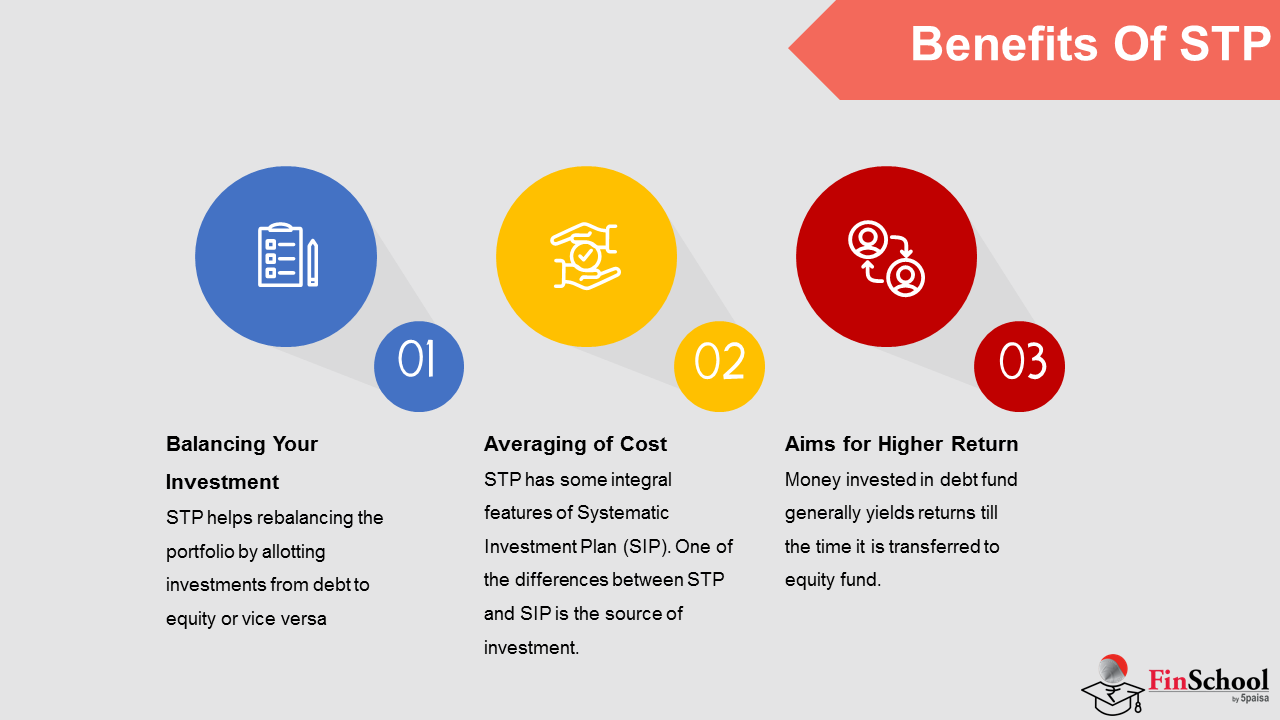
Balancing your investment
An STP helps rebalance a portfolio by shifting money between debt and equity as needed.
Averaging of Cost
An STP shares some key traits with an SIP — the main difference being the source of the money. With an STP, funds typically move from a debt fund; with an SIP, they come straight from the investor’s bank account. Because of this similarity, an STP also delivers the benefit of rupee cost averaging.
Aims for Higher Returns
Money sitting in the debt fund continues to earn a return until it’s transferred to the equity fund. Since debt fund returns are usually higher than a savings account, this approach aims to deliver relatively better overall performance during the transition period.
Types of STPs
There are a few different types of STPs. Under a Fixed STP, investors transfer a set sum from one fund to another at regular intervals. Under a Capital Appreciation STP, only the profits earned on the source investment are transferred to the other fund. Under a Flexi STP, investors can transfer a variable amount — with a fixed minimum, topped up by a variable portion that depends on market conditions.
9.3 What Is Systematic Withdrawal Plan (SWP)?
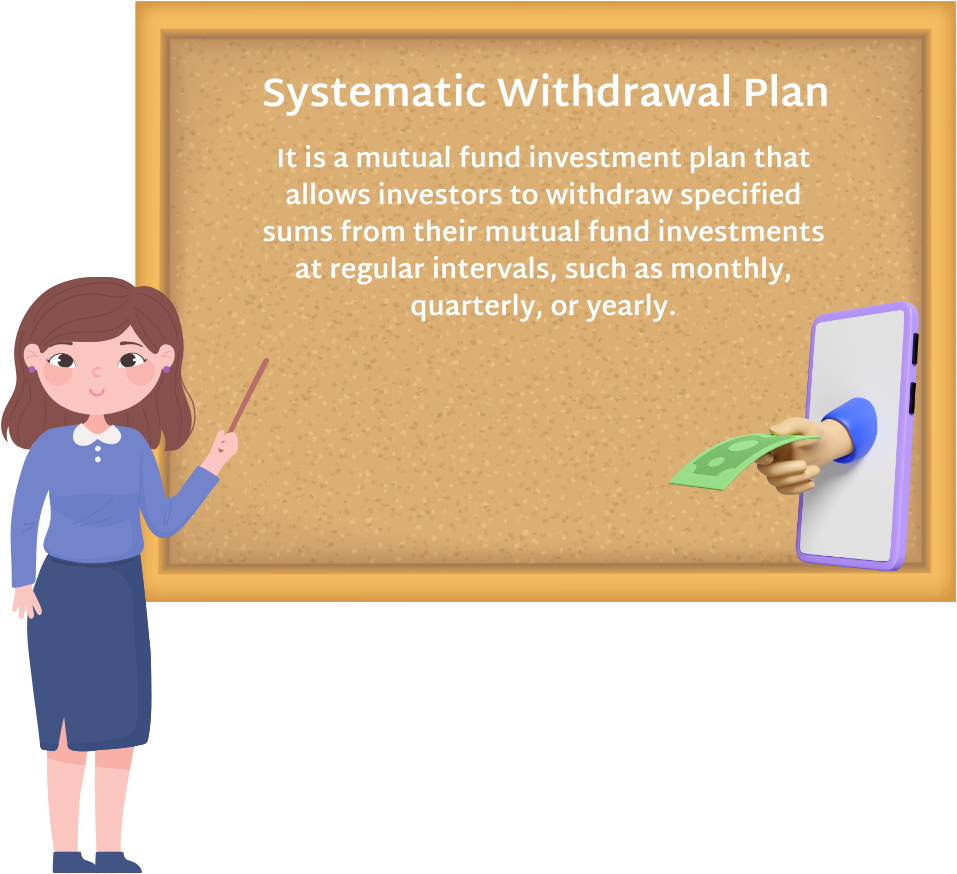
Anand asks Ridhima what a Systematic Withdrawal Plan is.
Ridhima says it is a plan that lets you take out a fixed amount of money from your fund at regular times like every month every quarter or every year.
Anand wants to know how it works.
Ridhima explains that the mutual fund company takes out units from your fund to give you the cash. If the price of the units goes up faster than you are taking out money your investment will grow. If the price of the units goes down more units will be taken out to give you the amount of cash.
Anand asks who benefits the most from a Systematic Withdrawal Plan.
Ridhima says it is people who are retired or anyone who needs an income. It is flexible. It gives you a regular flow of cash.. If you live in the country you do not have to pay tax on the money you take out.
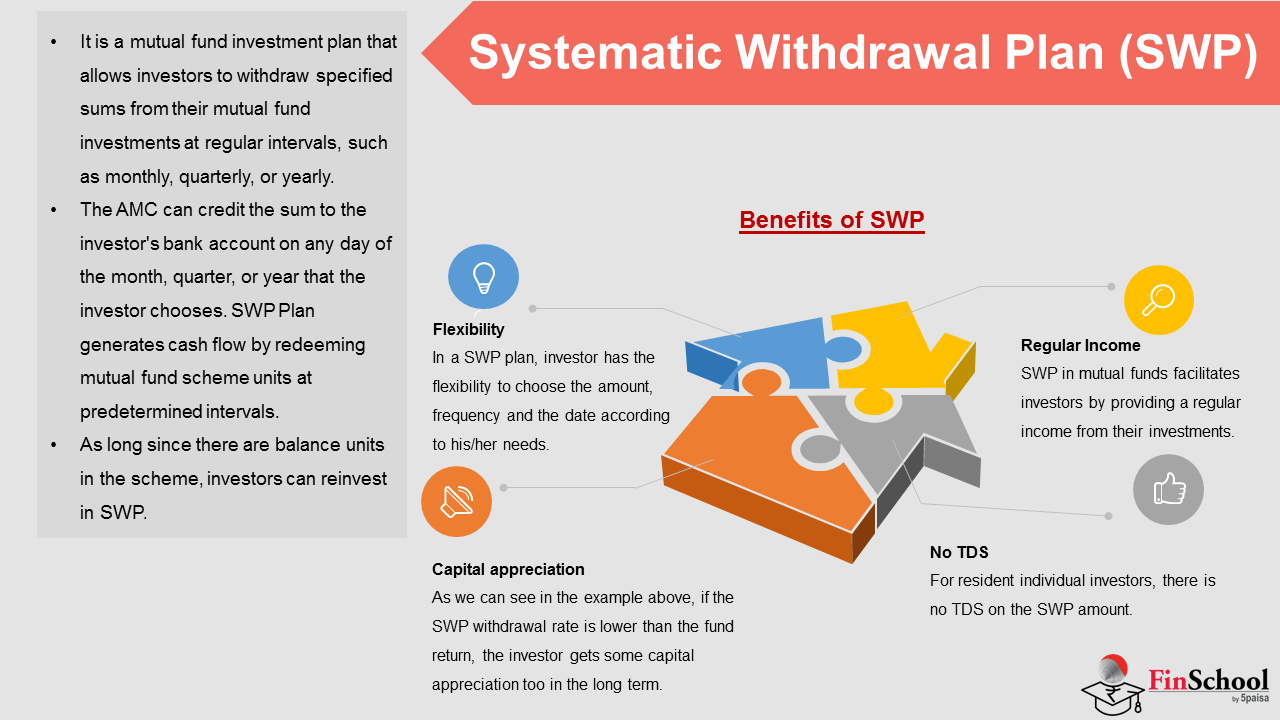
- An SWP is a mutual fund investment plan that lets investors withdraw a specified sum from their holdings at regular intervals — monthly, quarterly, or yearly.
- The AMC can credit this amount to the investor’s bank account on a chosen date each period. An SWP generates cash flow by redeeming fund units at these predetermined intervals, and as long as units remain in the scheme, the investor can continue drawing on it.
- Example— An investor puts a lump sum of ₹10 lakh into a mutual fund scheme at a purchase NAV of ₹20, receiving 50,000 units. Suppose they start a monthly SWP of ₹6,000 one year after investing, to sidestep any exit load.
- In the first month of the SWP, assume the scheme’s NAV is ₹22. To generate ₹6,000, the AMC redeems 272.728 units (₹6,000 / 22), leaving a balance of 49,727.272 units. In the second month, with NAV at ₹22.50, the AMC redeems 266.667 units, leaving 49,460.605 units. In the third month, with NAV at ₹23.00, it redeems 260.870 units, leaving 49,199.735 units — and this process continues each month for the duration of the SWP.
- As this example shows, the unit balance steadily declines over time under an SWP, but if the NAV rises faster than the withdrawal rate, the overall investment value can still grow. After the third SWP payment above, the fund value stands at ₹11,31,593.91 (49,199.7354 units × ₹23 NAV) against the original investment of ₹10 lakh — an appreciation of ₹1,31,593.91. If the NAV falls instead, the effect reverses: more units need to be redeemed to generate the same cash amount, which erodes the investment value faster.
Benefits of SWP
Flexibility
Investors can choose the withdrawal amount, frequency, and date to suit their needs, and can pause the SWP at any time, add further investments, or withdraw more than the fixed SWP amount if required.
Regular Income
An SWP provides investors with a steady, regular income stream from their investments — a genuinely convenient option for anyone who needs consistent cash flow to cover regular expenses.
Capital Appreciation
As the example above shows, if the withdrawal rate stays below the fund’s actual return, the investor can still enjoy capital appreciation over the long term.
No TDS
For resident individual investors, no TDS applies to SWP withdrawals.
9.4 Mutual Fund Plans

Anand asks Ridhima what kinds of plans mutual funds offer.
Ridhima says there are three plans.
- Dividend Payout Plan. The mutual fund company pays the dividends directly to you, which reduces the price of the units. This is good for people who need an income.
- Dividend Reinvestment Plan. The dividends are used to buy units, which helps your investment to grow faster.. You have to pay tax on the dividends as if they were income.
- Growth Option. The profits are reinvested in the fund, which makes the price of the units go up over time. This is the option if you do not need to take out money regularly.
Anand asks if the choice, between the growth option and the dividend option depends on whether you need cash.
Ridhima says yes that is right. The growth option is better if you want to create wealth over a time. The dividend option is better if you need to take out money at times.
Dividend Payout Plan
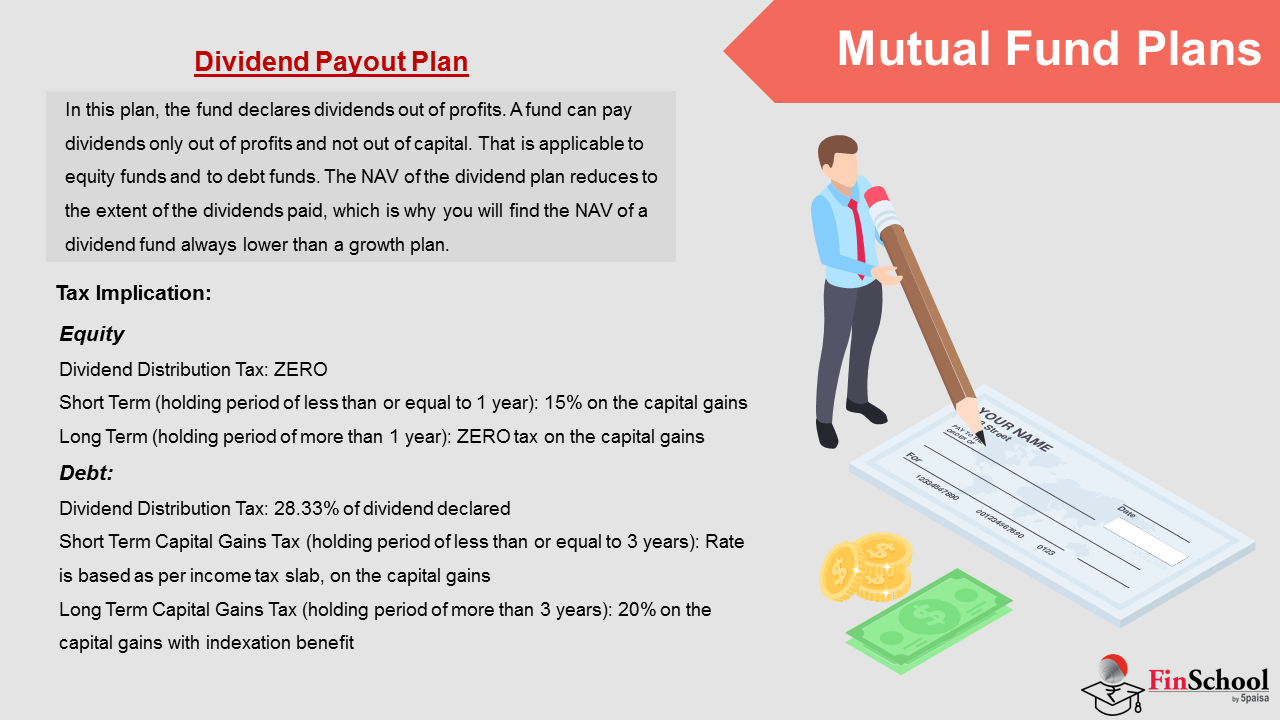
- Under this plan, the fund declares dividends out of profits — never out of capital — and this holds for both equity and debt funds. The NAV of the dividend plan falls by the amount of the dividend paid, which is why a dividend plan’s NAV is typically always lower than that of the corresponding growth plan.
- These dividends are paid directly to the investor, usually straight into a bank account, or occasionally by cheque if preferred. In most cases, investors don’t pay any additional fee to receive dividends this way.
- The tax treatment of a dividend is the same whether it’s paid out or reinvested — from a tax standpoint, both are treated identically. This plan suits investors who need regular income from their mutual fund holdings, though the trade-off is losing the opportunity to reinvest and compound that money further.
Tax Implication:
Equity
- Dividend Distribution Tax: ZERO
- Short Term (holding period of less than or equal to 1 year): 15% on the capital gains
- Long Term (holding period of more than 1 year): ZERO tax on the capital gains
Debt:
- Dividend Distribution Tax: 28.33% of dividend declared
- Short Term Capital Gains Tax (holding period of less than or equal to 3 years): Rate is based as per income tax slab, on the capital gains
- Long Term Capital Gains Tax (holding period of more than 3 years): 20% on the capital gains with indexation benefit
Dividend Reinvestment
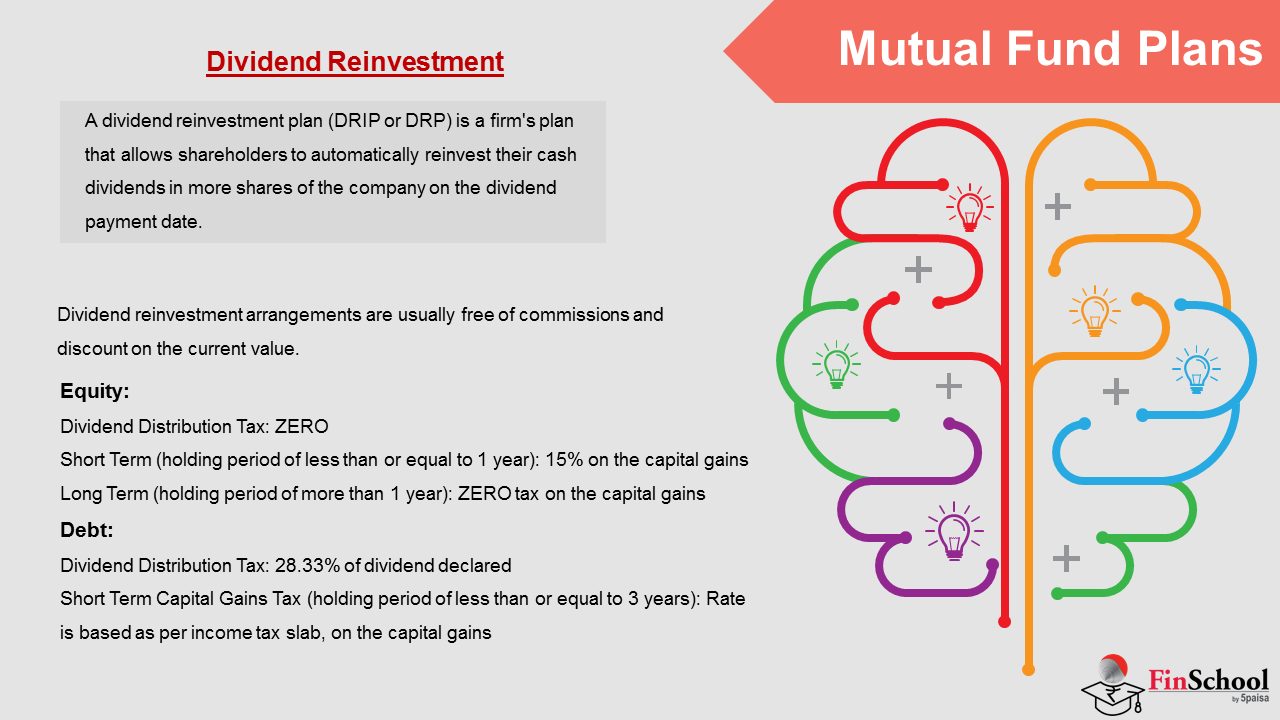
- A Dividend Reinvestment Plan (DRIP) automatically uses an investor’s cash dividends to purchase more units on the dividend payment date, typically free of any commission and at the prevailing NAV.
- Rather than paying dividends out in cash, this option uses that money to buy additional fund units on the investor’s behalf, which are then credited to their holding.
- Over time, the number of units an investor holds grows through this reinvestment, so the investment’s value tends to grow faster than it would if dividends were simply paid out.
- Because a dividend plan’s NAV already reflects the dividend declared, it stays lower than the growth option’s NAV — though by the end of the investment period, the unit-holder ends up owning more units. Under current income tax rules, all dividends received from mutual fund schemes after April 1, 2020 are taxable in the investor’s hands according to their tax slab, and this applies even when the dividend is reinvested rather than paid out — the income tax department still treats it as income, and tax is owed accordingly.
- So, an investor in the 30% tax bracket would pay 30% tax on dividends declared under a Reinvestment Plan in a given financial year, which further reduces the effective return from the investment.
Equity:
- Dividend Distribution Tax: ZERO
- Short Term (holding period of less than or equal to 1 year): 15% on the capital gains
- Long Term (holding period of more than 1 year): ZERO tax on the capital gains
Debt:
- Dividend Distribution Tax: 28.33% of dividend declared
- Short Term Capital Gains Tax (holding period of less than or equal to 3 years): Rate is based as per income tax slab, on the capital gains
- Long Term Capital Gains Tax (holding period of more than 3 years): 20% on the capital gains with indexation benefit
Growth Option
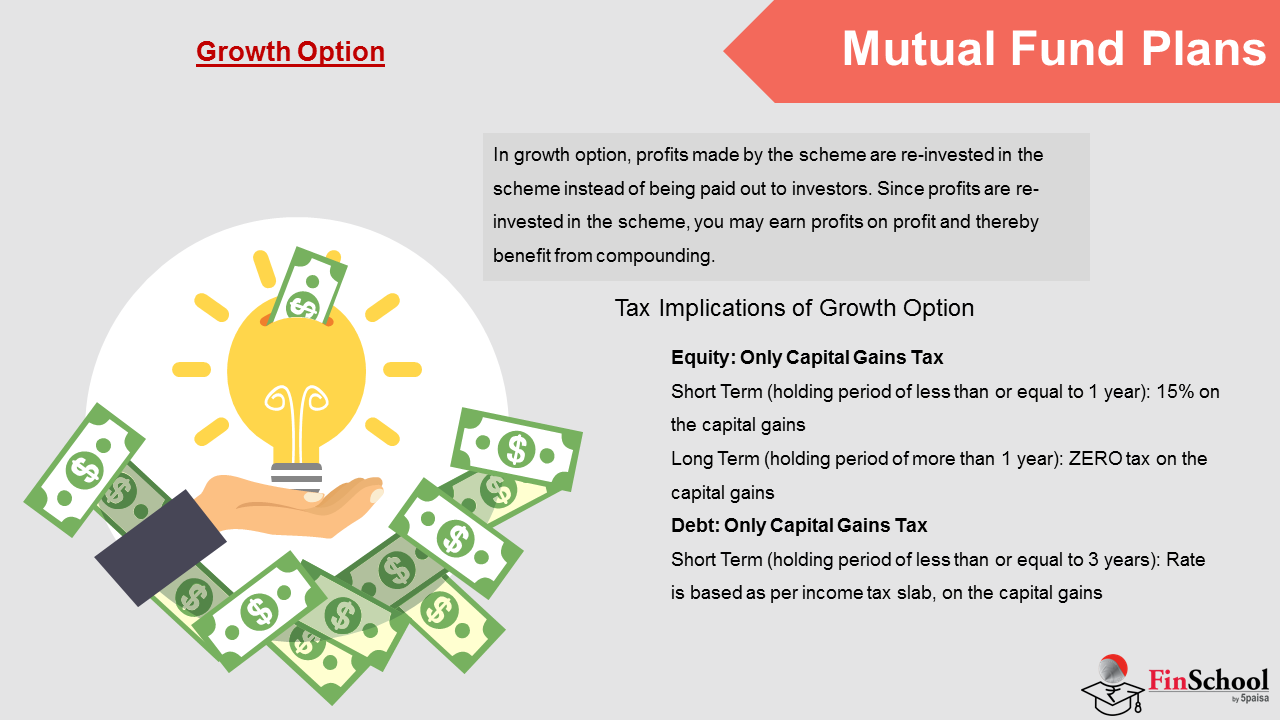
- Under the growth option, profits made by the scheme are reinvested rather than paid out to investors. Because profits are continually reinvested, investors effectively earn returns on their returns, benefiting from compounding.
- Whenever the scheme earns a profit, its NAV rises automatically; when it suffers a loss, the NAV falls. The only way to realise a profit is to sell your units. Suppose you buy 100 units of an equity fund at a NAV of ₹40, and under the growth option that NAV rises to ₹50 within a year. Selling those units nets you ₹5,000 — a profit of ₹1,000 (₹5,000 − ₹4,000).
- This option best suits investors who don’t need regular income in the form of dividends.
Equity: Only Capital Gains Tax
- Short Term (holding period of less than or equal to 1 year): 15% on the capital gains
- Long Term (holding period of more than 1 year): ZERO tax on the capital gains
Debt: Only Capital Gains Tax
- Short Term (holding period of less than or equal to 3 years): Rate is based as per income tax slab, on the capital gains
- Long Term (holding period of more than 3 years): 20% on the capital gains with indexation benefit
Key Difference Between Dividend Vs Growth Plan
The difference between a growth plan and a dividend plan is best understood through an example.
- Assume you have ₹1,000 invested in each of the growth and dividend options of a fund, receiving 100 units in each.
- The NAV of both options starts at ₹20.
- Suppose the fund declares a 20% dividend. On a face value of ₹10 per unit, that works out to a payout of ₹2 per unit held.
- Your investment in the dividend option would yield a dividend of ₹200 (₹2 × 100 units), and the NAV of the dividend option would fall to ₹18 (₹20 − ₹2 dividend).
- If you now redeem all your units in both options, the growth option would yield ₹2,000 (₹20 × 100 units), while the dividend option would yield ₹1,800 (₹18 × 100 units).
- However, since you’ve already received ₹200 in dividends, the total yield from both investments is identical — ₹2,000 from the Growth Option versus ₹1,800 from redemption plus ₹200 in dividends from the Dividend Option.
So the choice between these two options should be driven primarily by your cash flow needs. If you have no periodic liquidity requirements, the growth option makes sense, since its returns show up entirely in the scheme’s NAV. If you need regular cash flow from your investments, the dividend option is the better fit — though it’s worth remembering that dividend payouts are never guaranteed, and there may be none in a year the fund doesn’t generate a surplus.
Difference Between Growth Vs Dividend Reinvestment
- At first glance, the two plans look quite similar. Look closer, though, and you’ll see that while profit is reinvested directly in the growth option, it’s technically reinvested as a declared dividend under the dividend reinvestment option.
- This reinvested dividend still attracts a Dividend Distribution Tax of 28.84% on the amount declared.
- That tax is precisely why it’s worth understanding which option works out better for you from a tax-saving perspective.