
8.1 Capital Gain Taxation
Anand: Ridhima “How do mutual funds get taxed?”
Ridhima: “They are taxed through capital gains. When you sell fund units the profits are taxed as either term or long-term gains.”
Anand: “What are equity-oriented funds?”
Ridhima: “Any scheme that has least 65% invested in Indian listed companies is considered an equity-oriented fund. Aggressive hybrid funds also qualify. However debt funds, gold funds and international funds do not.”
Anand: “What is the difference between term and long-term gains?”
Ridhima: For equity funds if you hold them for than a year it is considered a short-term gain and taxed at 15%. If you hold them for than a year it is a long-term gain and taxed at 10% if the gains exceed one lakh rupees. For debt funds if you hold them for than 3 years it is a short-term gain and taxed according to your income slab. If you hold them for than 3 years it is a long-term gain and taxed at 20% with indexation benefit.”
Anand asked about losses.
Ridhima said, “Short-term losses can be set off against long-term gains but not the way around. You can carry forward losses for 8 years.”
Anand inquired, “How are dividends taxed?”
Ridhima replied, “Dividends are treated as income. The fund house deducts 10% TDS if the dividends exceed five thousand rupees in a year.”
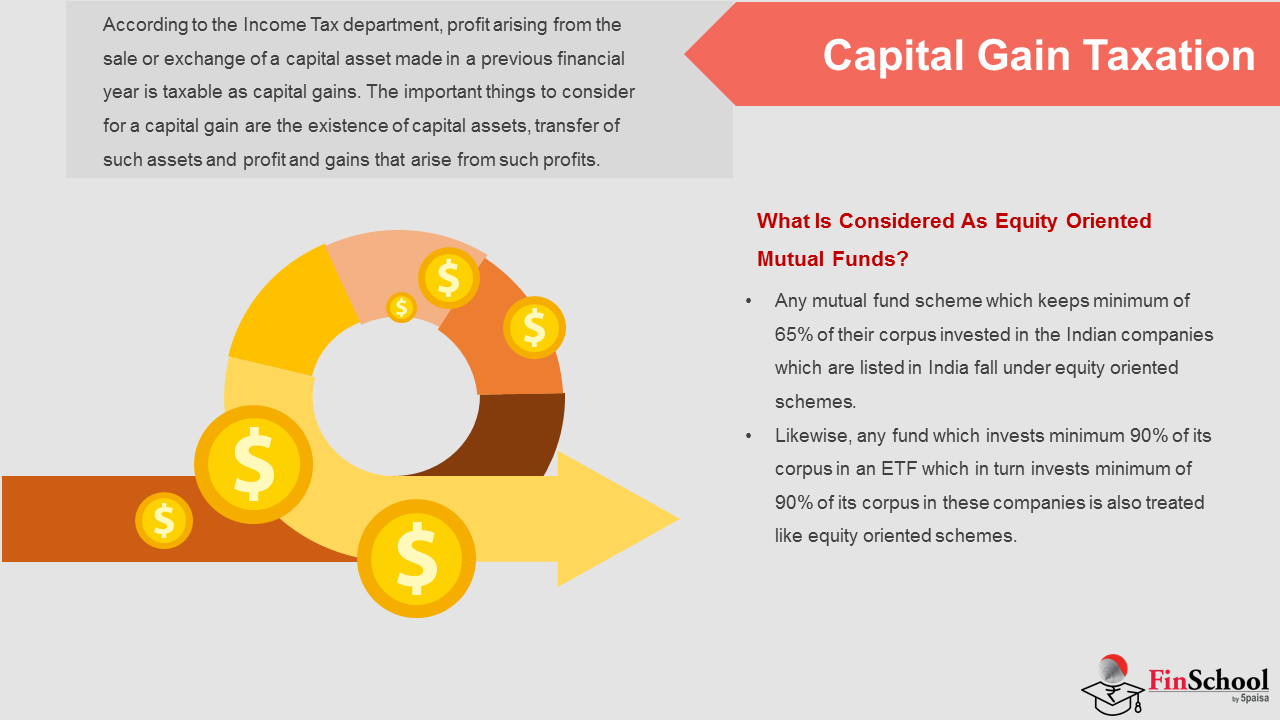
- Under the Income Tax Act, any profit from the sale or exchange of a capital asset during a financial year is taxable as capital gains. Three elements matter here: the existence of a capital asset, the transfer of that asset, and the profit that arises from the transaction.
- For taxation purposes, mutual fund schemes fall into two broad categories: equity-oriented schemes, and everything else. Investments in equity-oriented schemes become long-term after one year, while investments in the remaining schemes become long-term only after three years.
What is considered an equity-oriented mutual fund?
- Any mutual fund scheme that keeps a minimum of 65% of its portfolio invested in Indian-listed companies qualifies as an equity-oriented scheme. This also extends to any fund that invests at least 90% of its corpus in an ETF that, in turn, invests at least 90% of its own corpus in such companies. By this definition, all aggressive hybrid funds that maintain a minimum 65% equity allocation are also treated as equity-oriented schemes. Everything else — conservative hybrid schemes, debt funds, gold ETFs, gold funds, and international funds — falls into the second category.
Understanding Long-Term & Short-Term Capital Gains Tax
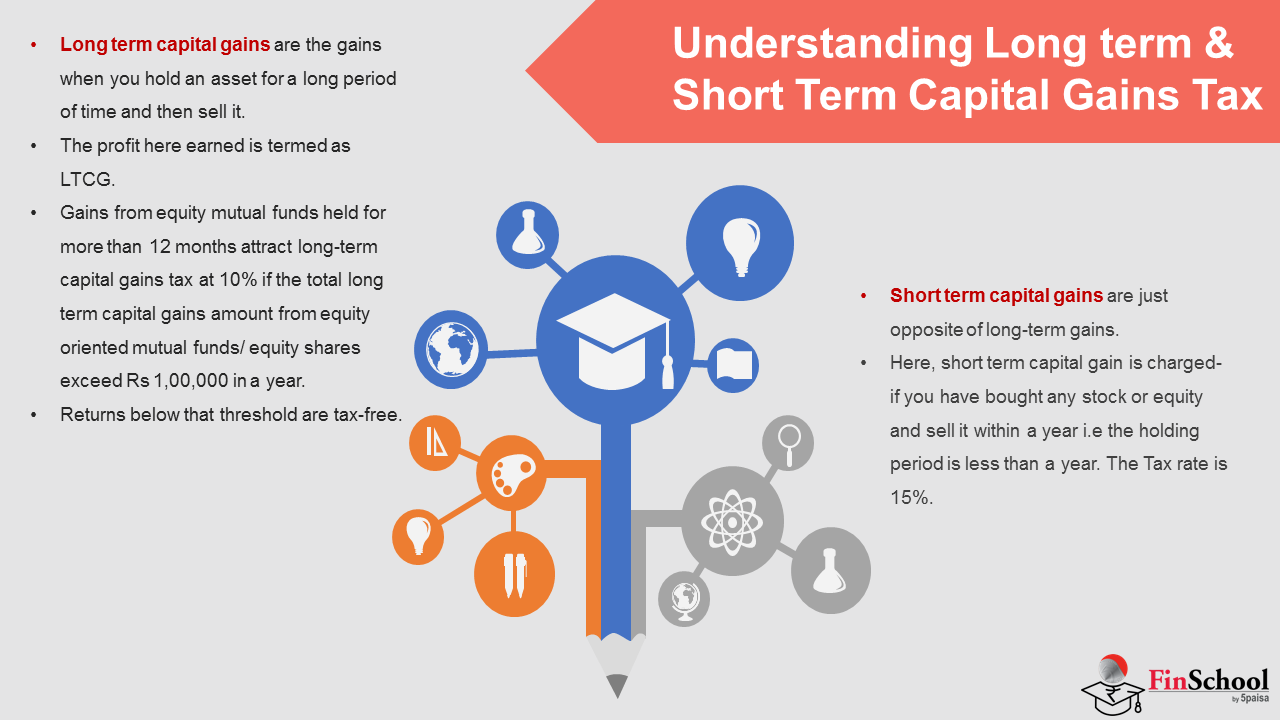
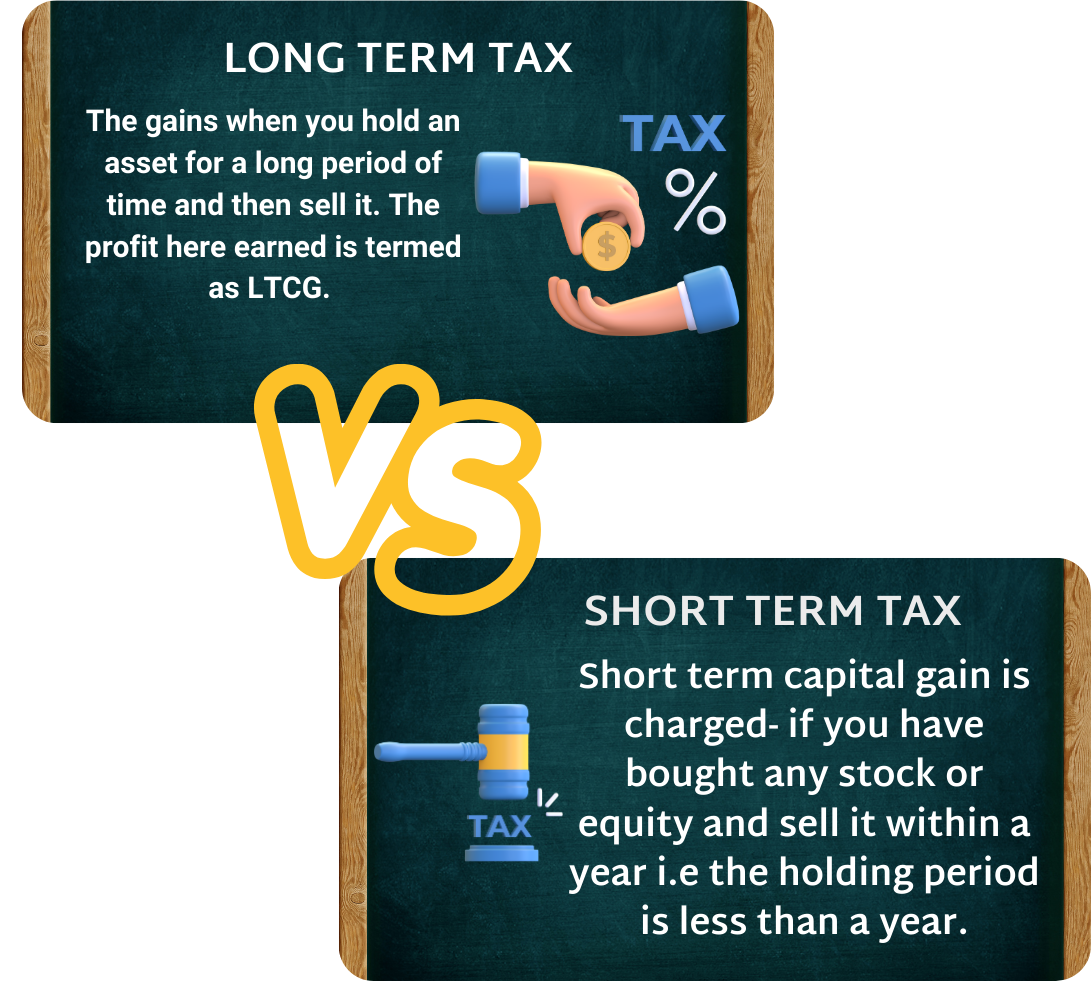
- Long-term capital gainsarise when you hold an asset for a long period before selling it. Gains from equity mutual funds held for more than 12 months attract long-term capital gains tax at 10%, but only if total long-term gains from equity-oriented mutual funds or shares exceed ₹1,00,000 in a year — anything below that threshold is tax-free. Gains from debt funds, by contrast, are taxed at 20% after the indexation benefit, provided they’re held for more than 36 months. Indexation adjusts the purchase cost for inflation, and without it, the tax burden on debt funds would be considerably higher.
- Short-term capital gainsare the opposite: if you buy and sell equity within a year, the gain is short-term and taxed at 15%. For example, a gain of ₹1 lakh would attract tax of ₹15,000. For debt funds, a holding period of under 36 months counts as short-term, and gains are taxed according to your individual income slab.
Set Off of Losses of Capital Gains on Mutual Funds
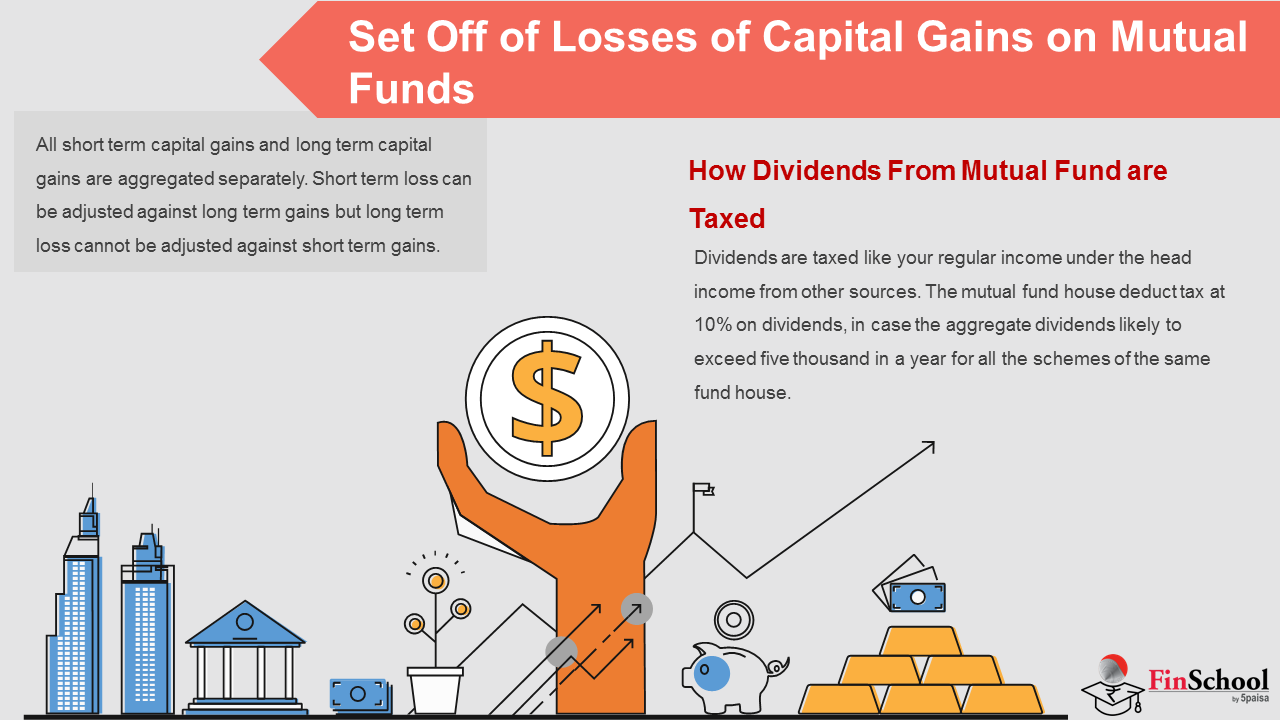
Short-term and long-term capital gains are aggregated separately. A short-term loss can be adjusted against long-term gains, but a long-term loss cannot be adjusted against short-term gains, and capital losses can never be set off against income under any other head. Any capital loss not fully absorbed in the current year can be carried forward for up to 8 years for set-off in subsequent years.
How Dividends From Mutual Funds are Taxed
Dividends are taxed as regular income under “income from other sources.” The mutual fund house deducts 10% TDS on dividends once the aggregate dividend from all schemes of that fund house is likely to exceed ₹5,000 in a year. If you’ve borrowed money to invest in mutual funds, you can claim interest expense of up to 20% of the aggregate dividend amount as a deduction against that income.
8.2 Indexation And Its Benefits
Anand asked, “What is indexation?”
Ridhima explained, “Indexation is adjusting the purchase price of an asset for inflation using the Cost Inflation Index. This reduces gains.”
Anand asked for an example.
Ridhima gave one “Suppose I invested one lakh rupees in 2015 and redeemed it for one point three five lakh rupees in 2020. Without indexation the gain is thirty-five thousand rupees. With indexation the cost is adjusted to one point one nine lakh rupees. The taxable gain is only sixteen thousand rupees.”
Anand observed, “So tax reduces?”
Ridhima confirmed, “Exactly. At 20% tax she pays three thousand two hundred rupees instead of much more. The effective tax rate drops to about 9%. That’s how indexation boosts post-tax returns, in debt funds.”
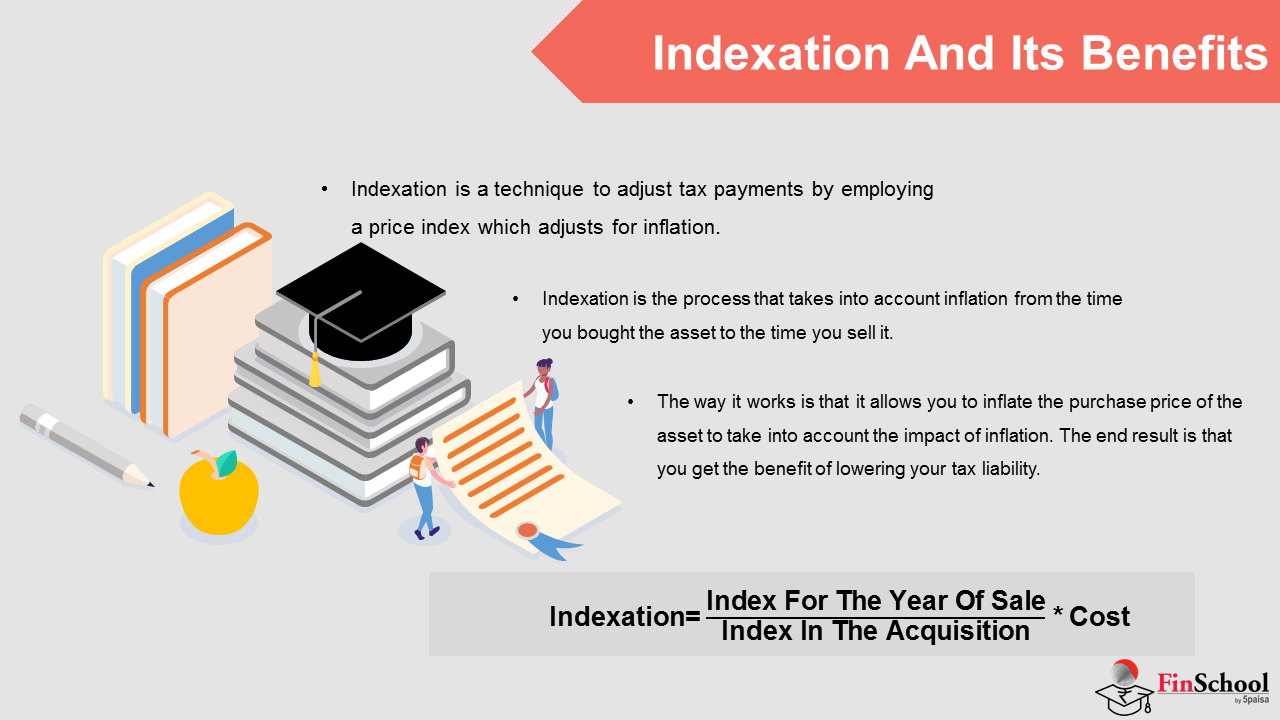
- Indexation is a technique used to adjust tax liability by applying a price index that accounts for inflation.
- In other words, indexation factors in the inflation that occurred between the time you bought an asset and the time you sold it, effectively inflating the purchase price to reflect that erosion in value — which, in turn, lowers your tax liability.
- Inflation steadily erodes the value of money over time: ₹5,000 today, assuming an annual inflation rate of 5%, would be worth roughly ₹3,868 in real terms after 5 years. This effect can’t be ignored when computing tax on the difference between the buy and sell price of an asset, which is precisely why indexation exists.
- The government tracks this using the Cost Inflation Index (CII), a tool that measures the rate of inflation in the economy. The CII value is set by the central government and revised upward each year to reflect prevailing inflation.
Indexation = (Index for the year of sale / Index for the year of acquisition) × cost
- Suppose Ms Ridhi invested ₹1 lakh in a debt fund during 2015–16 and redeemed it for ₹1.35 lakh in 2020–21. Her absolute return on this investment is ₹35,000. Given the roughly five-year holding period, she’s eligible for the indexation benefit.
- The indexed cost of her investment works out to ₹1.19 lakh (₹1 lakh × 301/254). As a result, her taxable long-term capital gain is ₹1.35 lakh minus ₹1.19 lakh, or ₹16,000. While the LTCG tax rate on debt funds is 20%, her effective tax comes to just ₹3,200 — an effective tax rate of about 9.14% on her absolute return. This is precisely how indexation helps investors lower their effective tax burden on non-equity fund returns and boost their post-tax gains.
- Note: 301 and 254 are the Cost Inflation Index values published by the government for the years 2020–21 and 2015–16 respectively.