
1.1 Introduction
One evening, Ridhima and Anand were sitting in a cafe in Mumbai. Ridhima has just received her first salary She wanted to unburden herself. Anand also wanted to know about investing and money. He suggested that they both learn about mutual funds. Then they got to talking about Mutual Funds.
Anand: So what is a mutual fund?
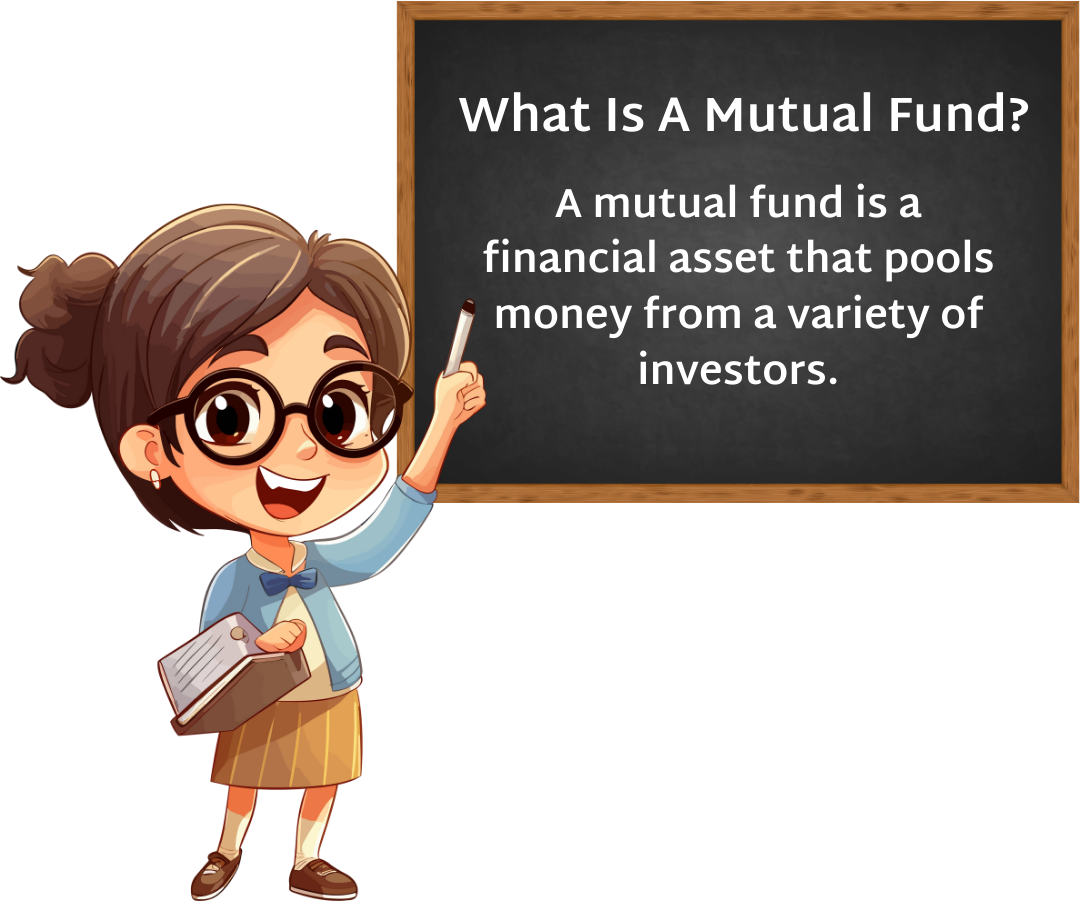
Ridhima: It’s a big pot of money. And a lot of people invest money in it. That cash is put to work in stuff like shares in companies, bonds etc. Truth is you don’t own the shares directly. Instead you buy “units” in the fund.
Anand: How is that different from buying shares in a company?
Ridhima: “Experts manage your money in a mutual fund. SEBI is the government body that watches over these experts. This keeps your money safe.”
What does “fund” stand for?
One of the easiest ways the average person can invest is through a fund. You don’t have to select stocks and bonds yourself. Somebody else does it for you. But remember when you buy a fund you are not actually buying shares like Infosys or Reliance or HDFC Bank. You own units of the fund. Those units tell you what your share of the pie is. If the fund’s investments do well, you make money. If they do badly you lose money. The gains and losses are borne by all the investors.
Who operates a mutual fund?
Mutual funds are managed by professional fund managers. They are watching the markets closely. They are the ones who control the buying and selling. For example, a fund manager may have a view that Indian IT companies will do well. They can buy shares of Infosys, TCS. If the market looks risky they may invest in safer investments such as government bonds. That relieves the pressure. You don’t have to be on the market yourself, making those calls every day.
Who runs mutual funds in India?
Mutual Funds are regulated by the Securities and Exchange Board of India (SEBI) .SEBI frames rules for investor protection .“Funds need to be transparent about how they invest, how they make money. Another thing to know is that owning fund units is not the same as owning company shares. If you hold shares you have a say in the running of the company. If you own fund units, you do not get to vote. But you get something else. Your money is spread over lots of investments, not just one.An equity mutual fund can invest in shares of companies from banking, IT and pharma sectors at the same time. If one sector goes down the others can help share the load.
Want more safety?
Invest in a liquid fund. It puts your money into short term low risk investments such as treasury bills. You won’t get rich, but your money is safer than the stock market and likely to earn more than a simple savings account.
The Benefits of Mutual Funds
- They let many investors pool their money
- They are run by trained professionals
- They are Strictly controlled by SEBI.
- Diversify your money, don’t invest all your money in one place
And, because of that safety and simplicity, mutual funds are such a good choice for the new and the seasoned investor. They allow you to invest in the stock market without having to do all of the work yourself.
Anand: So how do they actually structure a mutual fund here?
Ridhima: There are three big parts,
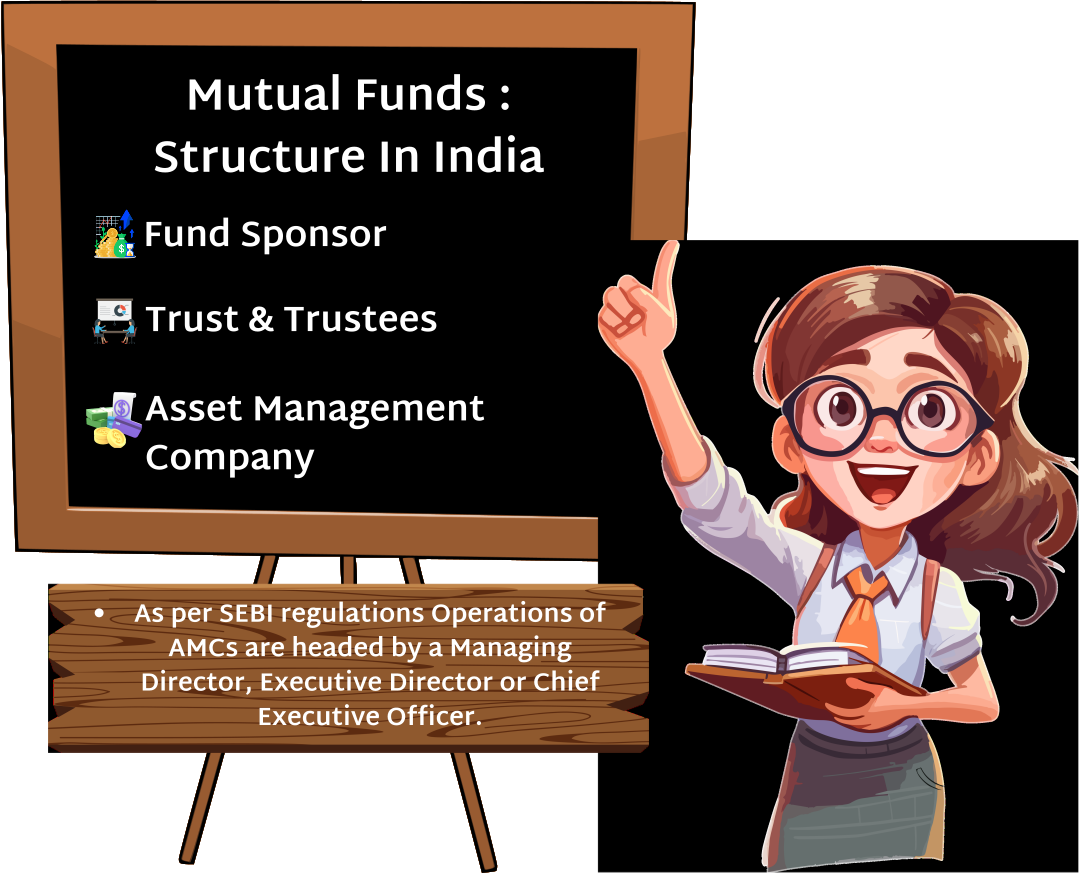
- The Sponsor — the person or company that sets up the fund.
- The Trustees-They manage the fund and report to SEBI.
- The Asset Management Company (AMC) – the team who manages the fund day-to-day with the assistance of managers and analysts.
Anand: So The AMC is the company that takes your money and puts it into investments
Ridhima: “Yes.” AMC makes investment decisions. They are the rules that govern the money that people like us put into the fund.
1.2 Mutual Funds : Structure In India
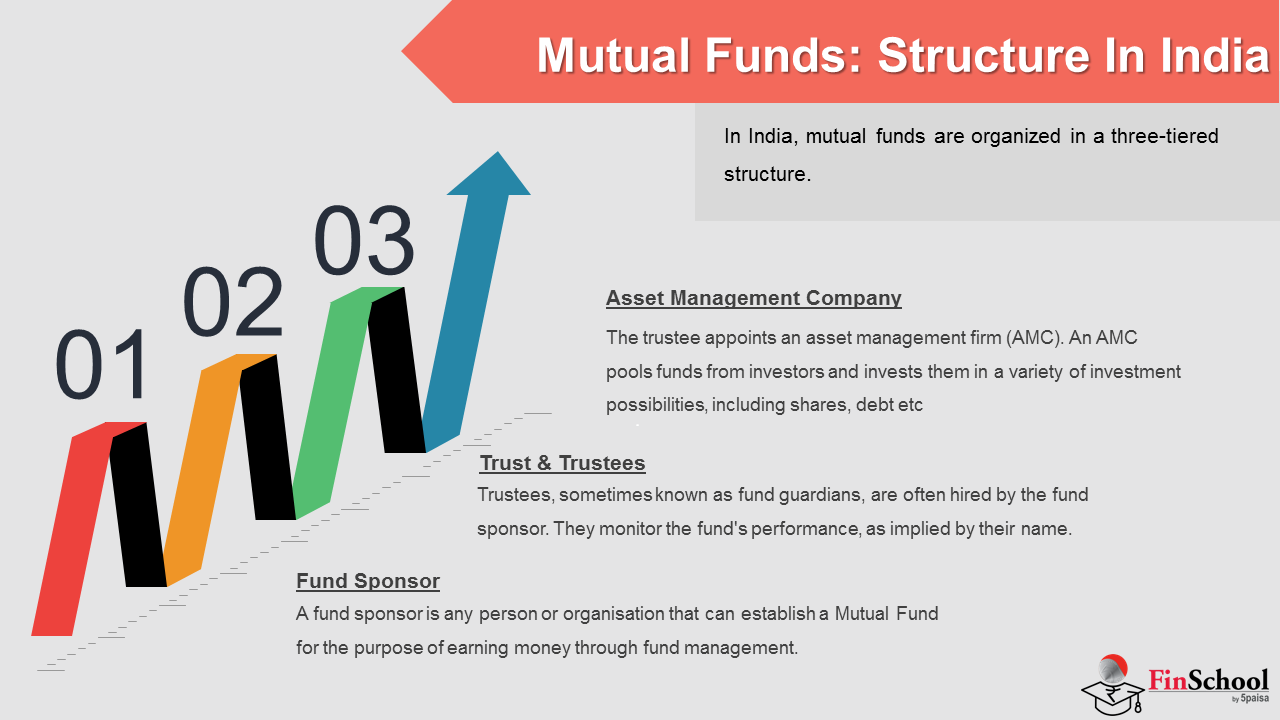
Mutual funds in India are based on a three-tier system. This system is there to help keep things clear and safe for the people who put their money in the funds. The rules for this system were formed by the Securities and Exchange Board of India or SEBI in 1996. Even today SEBI monitors and controls the setting up and running of mutual funds.
This system consists of three main parts: The Fund Sponsor Board of Trustees Asset Management Company (AMC) Every bit has its place. Together, they work to protect people’s money and make sure mutual funds are run ethically.
Mutual funds in India are based on a three-tier system. This system is intended to provide a clear and safe environment for fund investors. The rules for this system were framed in 1996 by the Securities and Exchange Board of India or SEBI. SEBI still watches over and controls how mutual funds are created and managed today.
The three main parts of this system are:
-
The Fund Sponsor
-
The Trustees
-
The Asset Management Company (AMC)
Each part has its own job. Together, they make sure people’s money is handled safely and that mutual funds are run in an honest way.
-
The Fund Sponsor
The Fund Sponsor can be termed as the parent of a mutual fund, as he/she is the one who comes up with the idea of the scheme and launches it in the market. SEBI lays down certain guidelines regarding the eligibility criteria for becoming a sponsor. A few of these are as mentioned below: A sponsor must have been in the finance or business field for the past five years. He/she must have sufficient funds and net worth. The sponsor must hold a significant portion of the Asset Management Company’s (AMC) stocks. For example, SBI Mutual fund is a brainchild of the State Bank of India. Similarly, ICICI Bank tied up with Prudential Plc to launch the ICICI Prudential Mutual Fund. It must be noted that a sponsor cannot manage the whole scheme on his own. He/she is required by law to form a trust, and appoint trustees, who will make sure that all regulations are followed and the interests of the investors are prioritized.
-
The Trustees
These are the guardians of the interests of the investors. The trustees are appointed by the sponsor, but they function independently, in the interest of the investors and not the sponsor. The responsibilities of a trustee include: Keeping a constant check on the performance and activities of the AMC. Making sure that it complies with all rules and regulations. Approving new schemes presented to the board before presenting it to the public. They also have to submit reports to SEBI regarding the performance of the mutual fund every six months. For instance, the HDFC Mutual fund has a Trustee Company which solely oversees that the AMC is functioning honestly and ethically. As they have to ensure that everything runs smoothly without a hitch, the trustee companies are highly monitored by SEBI. In case of their performance being unsatisfactory, they can be penalized or debarred from operating further.
-
The Asset Management Company (AMC)
This company is responsible for the day-to-day operations of the mutual fund scheme. The AMCs are hired and managed by the trustees. The AMCs look after all aspects and operations of the fund, including making crucial investment decisions. For instance, they decide where and how the money of the investors will be placed. All promotional activities and advertisements of the scheme are also handled by them. Moreover, the investors’ complaints and queries are dealt with by the AMCs. In order to perform their tasks efficiently, a team of experts is employed by the AMCs, including fund managers, researchers, and legal advisers, among others. For instance, Nippon India Asset Management Company manages a wide range of mutual funds. Some of their schemes invest in blue-chip stocks, such as Infosys and reliance, while others are focused towards government securities.
Responsibilities of the Asset Management Company:
-
The AMCs formulate an investment policy that the fund will follow, after considering various market factors.
-
They analyze the market conditions regularly in order to make profitable investment decisions.They design and market new mutual fund schemes.
Key Personnel in an Asset Management Company:
- Chief Investment Officer (CIO)- He/she formulates and designs the investment strategies and policies of the AMC.
- Fund Managers-These people manage the schemes or portfolios of the mutual fund.
- Analysts– As the name suggests, analysts analyze and research the market and companies prior to making any investment decisions.
- Dealers- The dealers are the ones who take action, i.e., buy/sell the stock.Chief Marketing Officer and Sales Team- They are responsible for promoting and marketing the schemes.
Anand: Are there any other parties involved in the working of a mutual fund?
Ridhima: Yeah, there are few other entities, other than the ones we discussed:
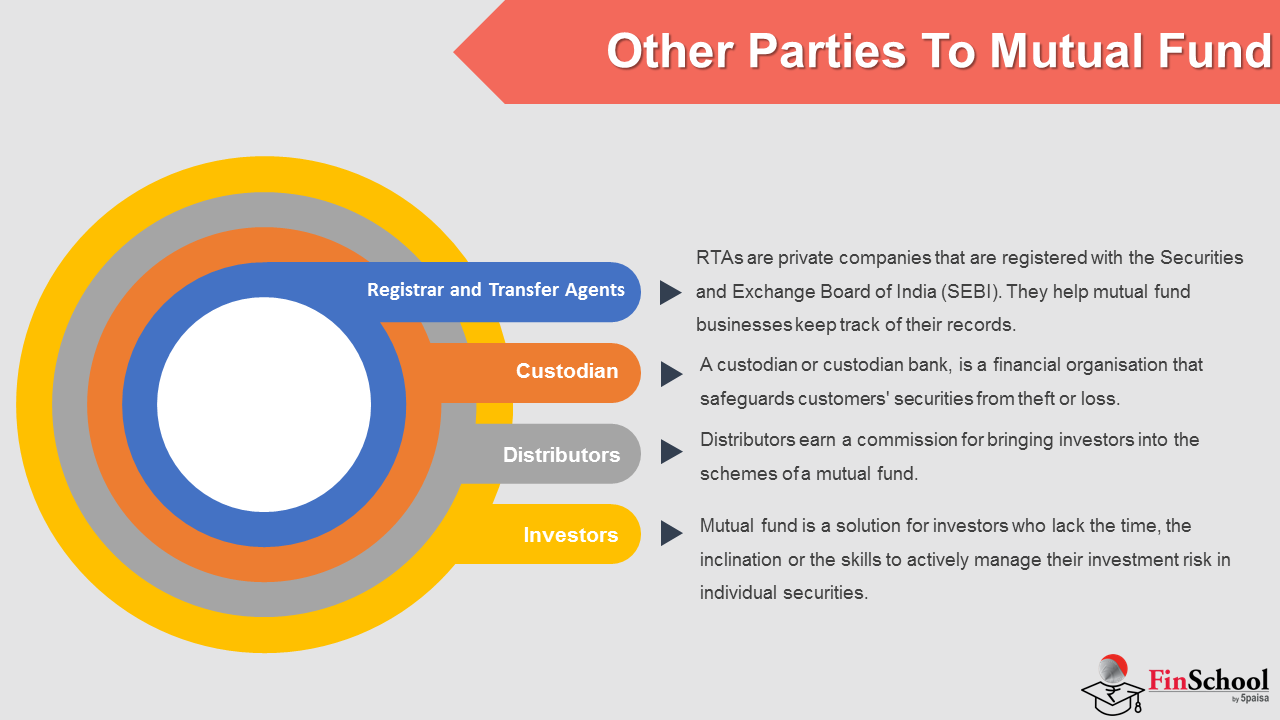
- Investors– These are the normal people like you and me who invest in mutual funds.
- Distributors- Distributors are the people who help channel the investors to a particular scheme.
- Registrar & Transfer Agents (RTAs)- They maintain a database of all the investors and key information regarding their investments.
- Custodians– They protect all the assets of the investors.
1.3 Other Parties To Mutual Fund

When we talk about funds in India it is not just the sponsor, trustees and Asset Management Company that play a role. There are other entities which keep the whole process running and which help investors to get their money in, track and safeguard it. Let us look at them in brief with real world examples.
Investors
Investors are the backbone of the mutual fund industry. Investors can be broadly classified into two groups based on their risk appetite, those who want to park their money in safe and secure instruments and those who want to take calculated risks to make higher returns. Mutual funds are ideal for the first category of investors who may not have the know-how or the time to buy and sell stocks or bonds. For example, an urban dweller in Mumbai may not wish to devote his free time to tracking the stock market; he would rather entrust his savings to a mutual fund scheme which in turn would park the money in equity shares of companies like Infosys, Tata Consultancy Services, Reliance etc. and generate returns for him. In this way, the mutual fund grows his wealth instead of it lying dormant in a bank fixed deposit.
Distributors
Distributors are agents who facilitate connection between investors and mutual funds. They get commissioned for bringing potential investors towards mutual fund schemes. These distributors like NJ India Invest or banks like HDFC Bank have a pan India reach whereas smaller regional level distributors focus on the market. Even independent financial advisors in towns contribute towards awareness generation about mutual funds. It is the distributors’ outreach which decides the ability of a mutual fund to reach out to investors.
Registrar and Transfer Agents
Registrar and Transfer Agents are service providers who keep a record of all transactions and details of all investors. The top two Registrar and Transfer Agents in India are Computer Age Management Services and KFin Technologies. They offer a single portal for investors to view all their holdings in various mutual fund schemes. For instance if an investor has Systematic Investment Plans in SBI Mutual Fund as well as ICICI Prudential Mutual Fund he can view his holdings through Computer Age Management Services. They also manage changes like change in bank mandate or change of address and through their online portal and apps help investors in getting all required information related to their mutual fund holdings at one place easily.
Custodians
Mutual funds buy securities through custodians who hold these funds in custody, either physically or in the case of bonds, electronically. In India custodians like HDFC Bank and Citibank offer these services to funds and settle trades collect dividends and ensure compliance with Securities and Exchange Board of India rules. Importantly to prevent conflicts of interest the Securities and Exchange Board of India ensures that a custodian that is closely tied to a sponsor cannot represent that sponsors mutual fund. These different players investors, distributors, Registrar and Transfer Agents and custodians form the ecosystem which enables the mutual fund industry to be as transparent efficient and trustworthy as it is. Without these different intermediaries the mutual fund industry would not be what it is today.
Anand: Why should I choose to invest in funds?
Ridhima: Mutual funds are a choice because they are easy to understand, offer a range of options to choose from, diversify the risk across a range of companies and are professionally managed.
Anand: Can small investors like me start investing in funds too?
Ridhima: Of course you can start investing in mutual funds with a small amount of money even something like ₹2,000 a month in an equity fund is enough to get started.
1.4 Advantages Of Mutual Fund

When we think about the advantages of funds we can understand them in a simple way.
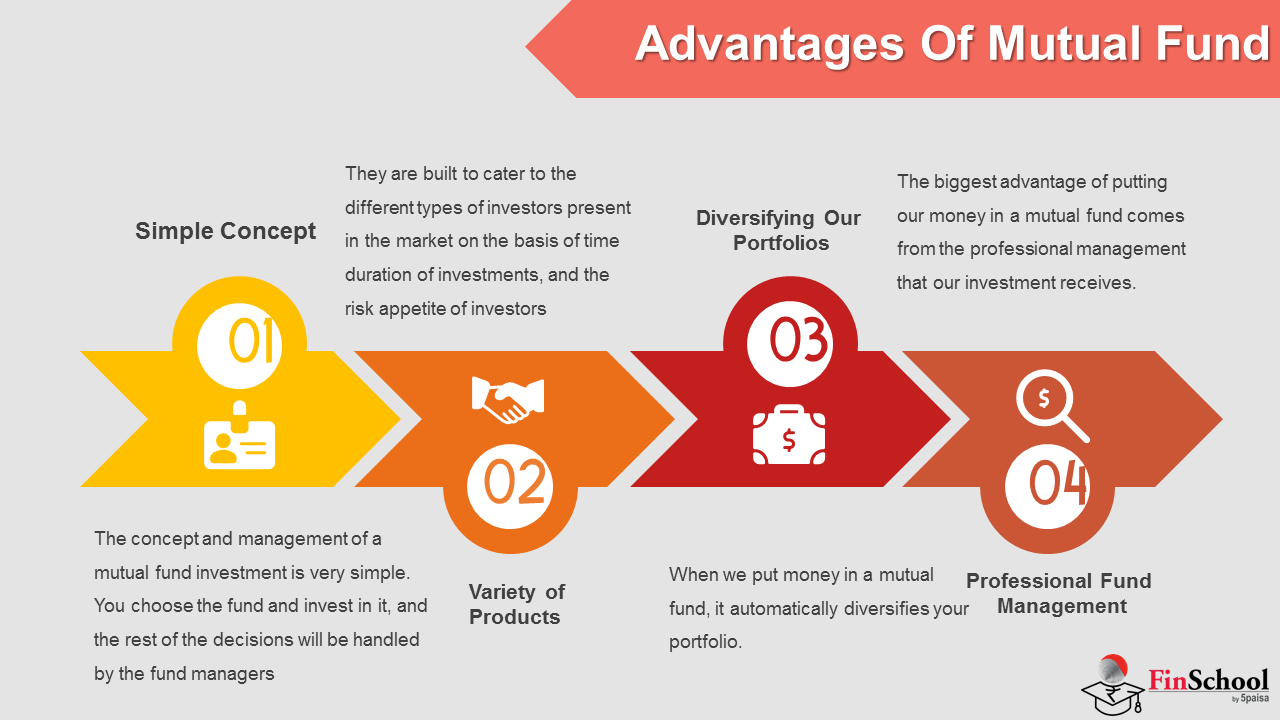
Mutual funds are easy to understand. You do not have to be an expert in the market to invest in a fund. You just have to choose a mutual fund scheme that matches what you want. Like a tax saving ELSS fund or a balanced hybrid fund. Then the mutual fund managers take care of everything. For example a young person who just started working in Pune can start investing in an equity fund with a small amount of money, ₹2,000 every month. She does not have to worry about which stocks to buy or sell.
Mutual funds give you a lot of choices. There are mutual fund schemes for every kind of investor. If you want your money to be safe and easily available you can invest in mutual funds. If you want your money to grow over a time you can invest in equity mutual funds. For instance people who have retired often like to invest in debt funds because they give a steady income. Young people may like to invest in index funds that track the Nifty 50. This means that whether you like to take risks or not there is a mutual fund scheme for you.
Mutual funds also spread your money across investments. This is one of the advantages of mutual funds. Of putting all your money into one companys shares a mutual fund invests in many companies across different sectors. For example an equity mutual fund might invest in shares of companies like Infosys, HDFC Bank, Hindustan Unilever and Sun Pharma. This way if one sector does not do well the gains in another sector can balance it out. The people who manage funds are professionals. They make decisions based on research. For example when interest rates go up in countries a debt mutual fund manager may invest in bonds that mature soon to reduce the risk. This kind of management is hard for individual investors to do on their own.
In short mutual funds are simple give you a lot of choices spread your money across investments and are managed by professionals. This makes mutual funds one of the ways for people, in India to grow their wealth over time
Anand: I have seen ads that say “Mutual funds are subject to market risk” what does that mean?
Ridhima: It means that there are risks involved when you invest in funds such as:
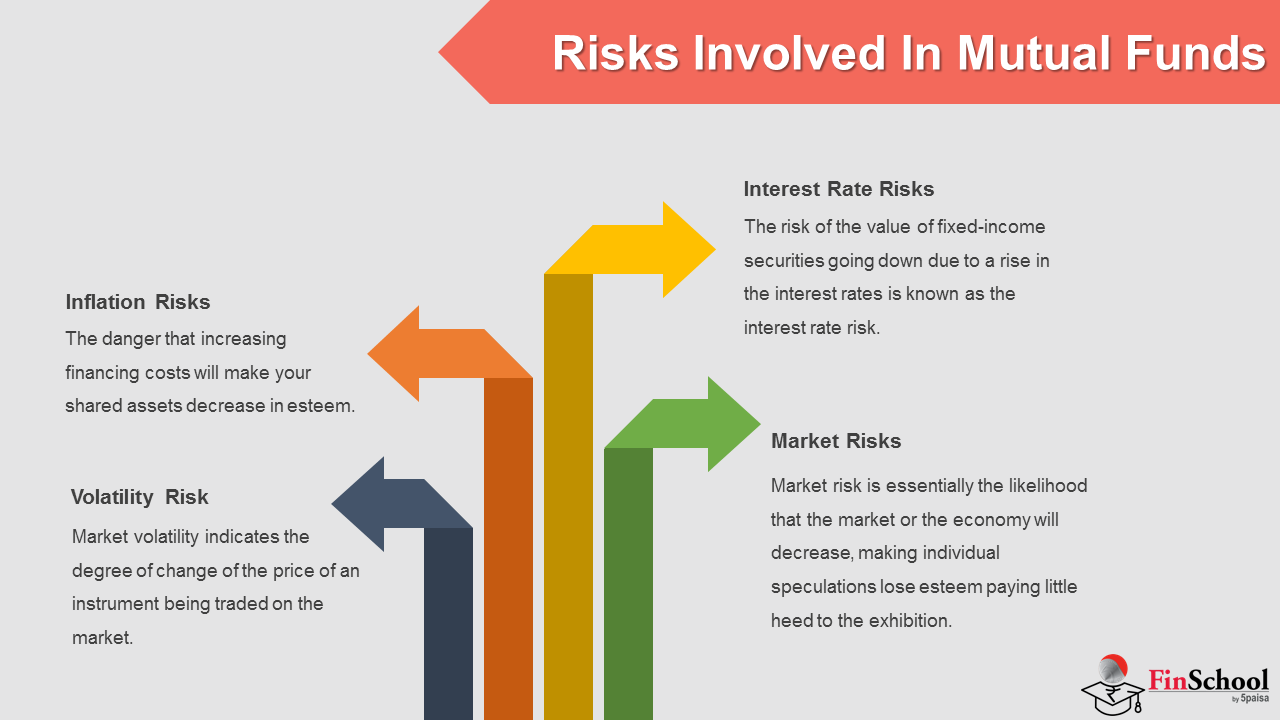
- Market risk, which happens when the economy is not doing well.
- Inflation risk, which happens when prices rise and eat into the returns, on your investment.
- Volatility risk, which happens when the value of your investment goes up and down.
- Interest rate risk, which affects debt funds.
Anand: So investing in funds is not risk-free?
Ridhima: Exactly you need to understand the risks involved before you invest your money in funds.
1.5 Risks Involved In Mutual Funds
That disclaimer. “Mutual Funds are subject to market risk. Read all scheme related documents carefully.”. Is more than a line in advertisements. It is a reminder that while mutual funds can be a way to invest they are not completely safe. Let us look at the types of risks in simple terms with new examples.
Market Risk
Market Risk is the risk where If the economy gets worse or the stock market goes down the value of your mutual fund units will also go down even if the companies in the fund are doing okay. For example during the COVID-19 pandemic in 2020 even strong companies like Infosys or HDFC Bank saw their share prices go down because the whole market was under pressure.
Inflation Risk
Inflation reduces your returns. Imagine your mutual fund gives you 8% in a year but the cost of living goes up by 6%. Your actual gain is 2%. This is very important for debt funds. For example if interest rates go up the value of existing bonds in a debt fund goes down which reduces your returns.
Volatility Risk
Volatility is about ups and downs in prices. It is like a roller coaster ride. Fun for some people. Stressful for others. Equity funds often face this risk. For example tech stocks may go up one quarter. Go down the next. If your fund invests a lot in that sector your portfolio will be affected by those changes.
Interest Rate Risk
This mainly affects funds that invest in things like bonds. When interest rates go up older bonds that pay rates become less valuable. For example if the Reserve Bank of India raises interest rates, debt funds that hold long-term government securities may see their prices go down.
In short mutual funds give you variety and professional management. They also carry risks related to markets, inflation, volatility and interest rates. Understanding funds and these risks helps you make better choices and have realistic expectations, about mutual funds.