

13.1 Monetary Policy – RBI’s Repo Rate and Market Pulse
Nirav: Vedant, markets behave like they’ve got a mood of their own. Some days everything rallies without reason—and other days, even good news doesn’t help. What’s going on?
Vedant: That’s a great observation. Markets aren’t just ruled by facts—they’re shaped by expectations, emotions, and positioning. It’s like reading a crowd: the reaction depends on what people thought would happen, not just what did.
Nirav: So a rate cut could spark a rally one time and barely move the needle another time?
Vedant: Exactly. If the rate cut was already priced in, traders might shrug it off. But a surprise cut can flip sentiment fast—especially in rate-sensitive sectors like banking and real estate.
Nirav: And that explains the wild swings when GDP numbers, inflation data, or even geopolitical events hit the news?
Vedant: Right. These triggers don’t work in isolation. It’s the interplay—event meets perception meets positioning—that moves markets. That’s why event-driven analysis is so crucial for traders and investors alike.
Nirav: Got it. So this chapter is about decoding the market’s reactions—not just tracking the headlines.
Vedant: Spot on. We’ll explore how the RBI’s repo rate, inflation, GDP, corporate earnings, budgets, and even black swan events shape market behavior. Because once you understand what drives the mood, navigating the swings becomes far more strategic.
Financial markets are like living organisms—sensitive, reactive, and often unpredictable. While company-specific news like earnings or management changes can move individual stocks, broader market movements are often driven by macro events. These events—ranging from central bank decisions to geopolitical tensions—can trigger rallies, crashes, or prolonged periods of volatility. Understanding these triggers is essential for investors, traders, and policymakers alike.
Markets don’t just respond to facts—they respond to expectations. A rate hike that was widely anticipated might cause no reaction, while a surprise cut could send stocks soaring. This interplay between event, perception, and positioning is what makes event-driven analysis both fascinating and essential.
Nirav: Vedant, I keep hearing that RBI rate decisions move the market. Why does one announcement have so much impact?
Vedant: Because the repo rate affects the entire credit system—loans, investments, consumption. It’s like the throttle controlling economic speed. A hike cools things down, a cut fuels growth.
Nirav: Vedant, I keep hearing that RBI rate decisions move the market. Why does one announcement have so much impact?
Vedant: Because the repo rate affects the entire credit system—loans, investments, consumption. It’s like the throttle controlling economic speed. A hike cools things down, a cut fuels growth.
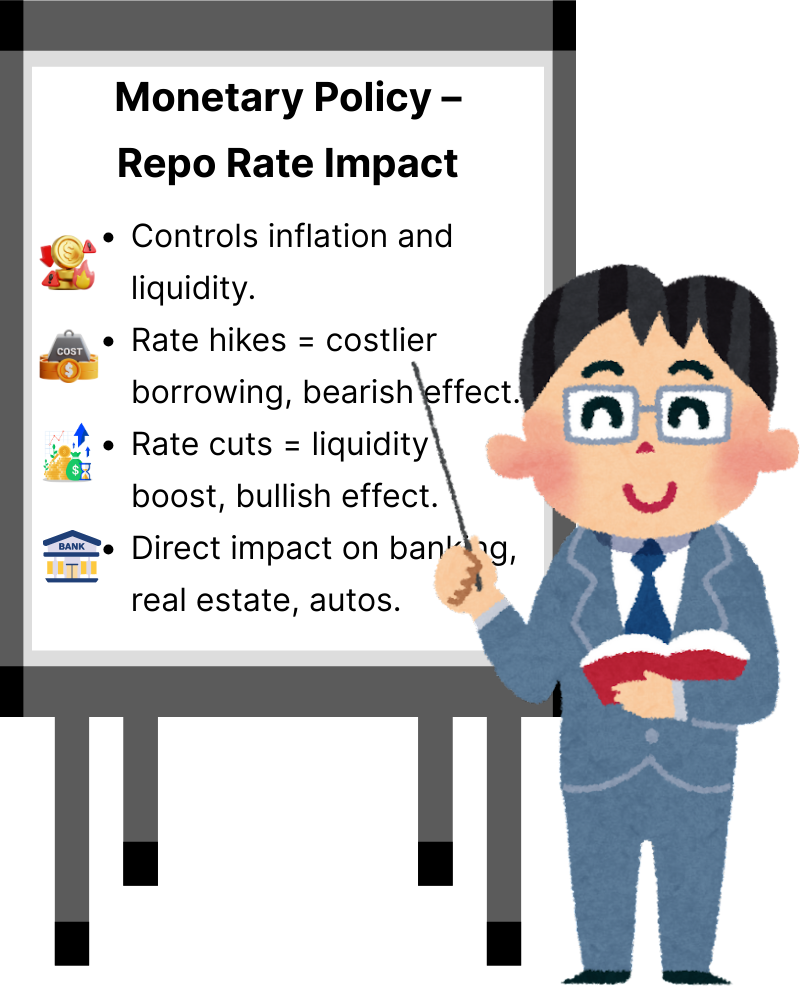
The Reserve Bank of India (RBI) uses the repo rate to control liquidity and inflation. As of June 2025, the repo rate stands at 6.50%, unchanged since February 2023. When the RBI hikes this rate, borrowing becomes costlier, slowing down consumption and investment—typically bearish for equities. Conversely, a rate cut boosts liquidity and often triggers rallies in rate-sensitive sectors like banking, real estate, and autos.
Example: In 2020, the RBI slashed the repo rate from 5.15% to 4.00% to combat COVID-19’s economic impact. This liquidity infusion helped the Nifty 50 recover from its March 2020 lows and enter a sustained bull run.
Nirav: So what exactly is the repo rate?
Vedant: It’s the interest rate at which the RBI lends short-term funds to commercial banks. Think of it as the RBI’s way of managing inflation and liquidity—if prices soar, they hike it to slow spending.
13.2 Understanding the Repo Rate’s Role

The repo rate is the interest rate at which the RBI lends short-term funds to commercial banks. It’s a primary tool in the RBI’s monetary policy arsenal to manage inflation, liquidity, and economic growth. When inflation is high, the RBI may increase the repo rate to make borrowing more expensive, thereby cooling demand. Conversely, during economic slowdowns, it may cut the repo rate to stimulate borrowing, investment, and consumption.
Transmission to the Economy and Markets
When the RBI cuts the repo rate, banks can borrow funds more cheaply. This leads to:
- Lower lending rates for consumers and businesses.
- Cheaper EMIs on home, auto, and personal loans.
- Improved corporate margins, especially for companies with high debt.
- Boosted demand in interest-sensitive sectors like real estate, automobiles, and capital goods.
This ripple effect often results in stock market rallies, particularly in sectors like Bank Nifty, Nifty Realty, and Nifty Auto.
Recent Example: June 2025 Rate Cut
On June 6, 2025, the RBI surprised markets with a 50 basis point cut, bringing the repo rate down to 5.50% from 6.00%. This was the third cut in 2025, totalling a 100 bps reduction. The move was driven by:
- Cooling inflation (CPI at 3.2% in May 2025).
- Strong forex reserves ($691.5 billion).
- A desire to stimulate credit growth and revive private investment.
Market Reaction:
- Sensex surged over 800 points to 82,299.
- Nifty 50 jumped 260 points to cross 25,000.
- Bank Nifty, Nifty Financial Services, and Nifty Realty gained over 3% each.
- India VIX dropped 2%, signalling reduced volatility
Nirav: Inflation feels like a household headache, but why does it shake the markets too?
Vedant: Because rising inflation erodes purchasing power and forces the RBI to hike rates. That impacts company margins, consumer demand, and investor sentiment—all of which move the market.
13.3 Inflation – CPI and WPI as Market Thermometers

Understanding CPI and WPI
The Consumer Price Index (CPI) measures the average change in prices paid by consumers for a basket of goods and services—think food, fuel, housing, clothing, and healthcare. It reflects retail inflation and directly impacts household budgets. The Wholesale Price Index (WPI), on the other hand, tracks price changes at the wholesale level—before goods reach consumers. While WPI influences producer margins, CPI is the RBI’s primary inflation target for monetary policy decisions.
Why Inflation Matters to Markets
Inflation affects purchasing power, interest rates, and corporate profitability. When CPI rises, the RBI may respond with repo rate hikes to cool demand. This makes borrowing costlier for businesses and consumers, slowing down economic activity. Sectors like FMCG, automobiles, and consumer durables—which rely on discretionary spending—are particularly vulnerable. Higher input costs (like raw materials or logistics) also squeeze margins, leading to earnings downgrades and stock price corrections.
Recent Trends: Cooling Inflation in 2025
As of May 2025, CPI inflation eased to 2.82%, a six-year low, thanks to a broad-based decline in food prices—especially vegetables, pulses, and cereals. This cooling trend validated the RBI’s earlier decision to cut the repo rate by 50 bps in June 2025, triggering a rally in rate-sensitive sectors like real estate and banking. The RBI now projects FY26 inflation at 3.7%, well within its 4% target.
Historical Shock: CPI Breaches 7% in 2022
Contrast that with 2022, when CPI inflation surged past 7%, driven by soaring food and fuel prices amid global supply chain disruptions and the Russia-Ukraine conflict. The RBI responded with aggressive rate hikes, raising the repo rate from 4.00% to 6.25% over the year. This tightening cycle led to a 10% correction in the Nifty 50, with FMCG and auto stocks underperforming due to margin pressures and weak demand.
Behavioral Angle: Inflation and Investor Psychology
Inflation also triggers emotional responses in markets. Rising prices often lead to fear of erosion in real returns, prompting investors to shift from equities to gold or fixed income. Conversely, when inflation cools, optimism returns, and equity flows pick up—especially in small- and mid-cap segments.
Nirav: I saw headlines about India’s GDP hitting 7.8%. How does that affect my investments?
Vedant: Strong GDP signals economic health—more jobs, consumption, infrastructure. It gives markets a reason to rally, especially in cyclical sectors that thrive during expansion.
13.4 GDP Growth – India’s Economic Engine

GDP Growth: The Market’s Macro Compass
Gross Domestic Product (GDP) is the most comprehensive measure of a country’s economic activity. It reflects the total value of goods and services produced over a specific period. When GDP growth is strong, it signals rising income levels, robust consumption, and expanding industrial output—all of which are bullish indicators for equity markets.
In Q1 FY24, India clocked a 7.8% GDP growth rate, outpacing most major economies. This was driven by strong performances in construction, manufacturing, and government capital expenditure. The surprise upside beat market expectations, which were hovering around 7.1%–7.3%, and immediately lifted investor sentiment.
Nirav: But sometimes, the data is good, and markets still fall. Why?
Vedant: It’s all about expectations. If the market was already priced for high growth, even great news might not move stocks much. But a surprise upside? That can spark rallies.
13.5 Market Reaction: A Rally Rooted in Optimism

Following the GDP release, the Nifty 50 surged over 3% within a week. The rally was led by cyclical sectors—those that are closely tied to economic growth. Stocks like Larsen & Toubro (L&T), a bellwether for infrastructure and engineering, and State Bank of India (SBI), a proxy for credit growth and public sector banking, saw significant gains. L&T’s order book strength and SBI’s loan growth outlook were seen as direct beneficiaries of the government’s infrastructure push and rising private capex.
This kind of market response isn’t just about numbers—it’s about narrative. A strong GDP print reinforces the belief that India’s growth story is intact, encouraging both domestic and foreign institutional investors to increase exposure to Indian equities.
Nirav: Do all sectors gain equally when GDP rises?
Vedant: Not quite. Infra, banking, and consumer discretionary usually lead. They benefit from rising incomes, credit demand, and government spending. Defensive sectors may lag behind.
13.6 Sectoral Implications: Who Benefits Most?

- Infrastructure & Capital Goods: Higher GDP growth often reflects increased government and private sector spending on roads, railways, and urban development. Companies like L&T, Siemens, and ABB benefit from this momentum.
- Banking & Financial Services:Economic expansion boosts credit demand. Banks like SBI, ICICI Bank, and HDFC Bank see improved loan growth, lower NPAs, and stronger earnings.
- Consumer Discretionary: Rising incomes and employment translate into higher spending on automobiles, appliances, and travel—benefiting companies like Maruti Suzuki, Titan, and Indian Hotels.
Nirav: So it’s not just numbers—it’s mindset?
Vedant: Absolutely. Optimism drives buying, pessimism triggers sell-offs. Investor psychology responds to narratives, not just stats. That’s why understanding market sentiment is crucial.
13.7 Investor Psychology: Confidence Breeds Flows

Strong GDP data also influences foreign portfolio investor (FPI) behaviour. A robust growth outlook makes India an attractive destination for capital, especially when global growth is slowing. In the weeks following the Q1 FY24 data, FPIs turned net buyers after a brief pause, further fuelling the rally.
Union Budget: A Fiscal Barometer for Markets
The Union Budget is more than just an accounting exercise—it’s a strategic blueprint that signals the government’s economic priorities for the year. Investors closely track allocations, tax reforms, and policy directions to gauge which sectors might benefit or face headwinds. In 2024, the Budget was presented against the backdrop of a stable political mandate and a growing economy, giving the government room to focus on long-term growth without resorting to populism.
Capex-Led Growth: ₹11.1 Lakh Crore Push
A standout feature of the 2024 Budget was the record capital expenditure outlay of ₹11.11 lakh crore, amounting to 3.4% of GDP. This signalled a strong commitment to infrastructure-led growth. The government emphasized investments in roads, railways, green energy corridors, and digital infrastructure. This not only boosts demand for cement, steel, and construction equipment but also creates a multiplier effect across the economy—generating jobs, improving logistics, and enhancing productivity.
Sectoral Winners: Infra, PSU, and Green Energy
Markets responded with enthusiasm. Stocks like NTPC, Bharat Electronics Ltd (BEL), and Indian Railway Finance Corporation (IRFC) rallied over 10–15% in the weeks following the Budget. NTPC benefited from the green energy push, BEL from increased defence and electronics procurement, and IRFC from higher railway allocations. The Budget also earmarked ₹2.66 lakh crore for rural infrastructure and ₹1.52 lakh crore for agriculture and allied sectors, further boosting rural demand and logistics plays1.
Tax Tweaks and Sentiment Shifts
While the Budget was largely growth-oriented, it did include some tax-related surprises. The short-term capital gains (STCG) tax was raised to 20%, and long-term capital gains (LTCG) to 12.5%, which initially caused a dip in market sentiment. However, this was offset by the broader fiscal discipline and pro-growth stance. The fiscal deficit was pegged at 4.9% of GDP, reinforcing investor confidence in macro stability.
Investor Takeaway: Reading Between the Lines
The 2024 Budget struck a balance between fiscal prudence and growth ambition. For investors, it offered clear directional cues: infrastructure, public sector undertakings, green energy, and rural development were in focus. While tax changes caused short-term volatility, the long-term narrative remained intact—India is betting on capex and structural reforms to drive its next growth cycle.
Nirav: Earnings season seems exciting, but how do results move markets?
Vedant: Quarterly results reflect how companies navigate the macro climate. Good numbers with strong guidance boost stocks. But even strong profits can disappoint if future outlook is weak.
13.8 Corporate Earnings – Micro Meets Macro

Quarterly earnings are the heartbeat of stock-specific and sectoral momentum. They reflect how companies are navigating macroeconomic conditions, consumer demand, and cost pressures. But markets don’t just react to numbers—they react to expectations and narratives.
Take ICICI Bank’s Q4 FY24 results: it reported a 17.4% YoY rise in net profit to ₹10,708 crore, driven by strong loan growth, improved asset quality (Net NPA at 0.42%), and a ₹10/share dividend. This reinforced confidence in the banking sector, especially in private lenders with clean books and robust credit demand.
In contrast, Infosys posted a 30% YoY jump in net profit to ₹7,969 crore, but its revenue guidance of 1–3% for FY25 disappointed investors. The stock fell despite strong earnings, as the outlook hinted at weak U.S. demand and margin pressures. This shows how forward guidance can outweigh headline numbers.
Nirav: How do global conflicts affect Indian markets?
Vedant: Through oil prices, currency, and investor anxiety. For instance, if the Red Sea crisis spikes crude prices, Indian firms face higher costs—especially in paints, aviation, logistics.
13.9 Geopolitical Events – Oil, Rupee, and Risk-Off

India’s dependence on imported crude (over 80%) makes it highly sensitive to geopolitical shocks. In early 2024, Red Sea shipping disruptions—sparked by Houthi attacks and the Iran-Israel conflict—pushed Brent crude to $95/barrel, raising freight costs and insurance premiums4.
This triggered a risk-off sentiment: the rupee weakened, inflation fears resurfaced, and FIIs turned net sellers. Sectors like aviation, paints, and logistics suffered due to higher input costs, while oil marketing companies faced margin compression.
A historical parallel: during the Russia-Ukraine conflict in February 2022, the Sensex plunged over 2,700 points in a single day, as crude surged and global markets panicked.
Nirav: A falling rupee worries me. Should I be concerned?
Vedant: It’s a mixed bag. Import-heavy sectors suffer, exporters benefit. IT, pharma, and textile gain from dollar inflows. But aviation, autos, and oil marketing get squeezed by costlier imports.
13.10 Currency Movements – USD/INR and Sectoral Impact

The USD/INR exchange rate is a double-edged sword. A weaker rupee (₹83.50/USD in mid-2025) makes imports costlier—hurting sectors like aviation, oil marketing, and auto components. But it boosts exporters, especially IT and pharma, who earn in dollars.
In 2022, when the rupee fell to ₹83/USD, TCS and Sun Pharma gained on improved dollar realizations, while IndiGo and SpiceJet struggled with rising ATF costs.
Currency volatility also affects FII flows. A falling rupee can trigger outflows as foreign investors fear erosion in returns, adding to market pressure.
Nirav: One bad day on Wall Street and our markets panic. Why such dependency?
Vedant: FIIs track global cues, especially U.S. tech and Fed policy. A Nasdaq slide hits Indian IT stocks. A Fed hike triggers outflows. We’re linked via sentiment, capital, and valuations.
13.11 Global Cues – Wall Street’s Shadow on Dalal Street

Indian markets are deeply intertwined with global sentiment. A sharp fall in the NASDAQ, especially in tech-heavy periods, often drags Indian IT stocks. Similarly, U.S. Fed rate hikes lead to capital outflows from emerging markets like India.
In March 2025, the NASDAQ fell 1.7% overnight, and Indian IT stocks like TCS, Infosys, and LTIMindtree dropped 2–4% the next day. Citi Research flagged high valuations and macro uncertainty, further dampening sentiment.
In 2023, when the Fed signalled prolonged high rates, FIIs pulled out ₹28,000 crore in a month, causing a 5% dip in the Nifty. This underscores how U.S. monetary policy and tech sentiment ripple through Indian equities.
Nirav: Elections bring drama—but do they affect my investments?
Vedant: Definitely. Markets favor policy continuity. A clear mandate reassures investors about reforms, infrastructure, and fiscal discipline. Political stability often sparks rallies in PSU and infra sectors.
13.12 Political Events – Elections and Policy Continuity

Markets crave stability and policy continuity. General elections, especially Lok Sabha polls, are high-stakes events. A decisive mandate reassures investors about reform momentum and fiscal discipline.
In 2024, the incumbent government returned with a strong mandate. The Nifty rallied 4% in a week, led by PSU banks, infra, and energy stocks. The Budget’s focus on capex, green energy, and digital infrastructure further reinforced this optimism.
Historically, the 2013 and 2019 elections saw similar rallies. The BJP’s clear wins triggered multi-week uptrends, with L&T, SBI, and NTPC among the top gainers. Elections shape not just sentiment but also sectoral leadership.
Nirav: And then there are shocks like COVID. How do you even prepare for those?
Vedant: You can’t predict black swans, but you can build resilience—diversify, track liquidity, avoid leverage. These events reshape markets long-term, like the digital and healthcare boom post-COVID.
13.13 Black Swan Events – COVID-19 and Beyond

The COVID-19 pandemic was a once-in-a-century shock. In March 2020, the Nifty crashed 38%, its steepest fall ever, as lockdowns halted economic activity. But massive fiscal and monetary stimulus—including RBI rate cuts and global liquidity—sparked a V-shaped recovery.
By early 2021, the Nifty had doubled from its lows. Sectors like IT, pharma, and digital platforms outperformed, while hospitality and aviation lagged. COVID also accelerated structural shifts:
- Digitization of businesses and payments.
- Rise of ESG investing.
- Focus on healthcare infrastructure.
It was a stark reminder that black swan events can reshape market structure, investor behaviour, and sectoral dynamics.
To conclude Indian financial markets are shaped by a dynamic interplay of domestic and global events. From RBI’s policy moves and GDP growth to geopolitical shocks and corporate earnings, each key event sends ripples sometimes waves across investor sentiment and stock prices. But more than the events themselves, it’s the expectations, narratives, and Behavioral responses that determine the market’s reaction.
Nirav: Vedant, I just finished the first module on stock markets. It was super interesting, but I still have so many questions. Is that normal?
Vedant: Absolutely, Nirav! If you’re asking questions, it means you’re thinking like a trader already. The first module is just the warm-up—it’s meant to spark curiosity and give you a practical feel of how markets work.
Nirav: Makes sense. But I noticed there are so many other modules lined up. How do they all fit together?
Vedant: Great observation. Think of each module as a building block. You’ve just laid the foundation. Next, we’ll explore how to analyze stocks using technical and fundamental analysis. Then we’ll move into futures, options, risk management, and even trading psychology.
Nirav: So it’s not just about buying and selling stocks?
Vedant: Exactly. It’s about understanding the tools, strategies, and mindset that go into making smart decisions. For example, if you’re confident about a stock’s long-term growth, you might go for a delivery trade. But if you’re looking at short-term moves, futures or options could be more suitable.
Nirav: Interesting. So the modules help me figure out both what to trade and how to trade it?
Vedant: Spot on. And as you move ahead, you’ll learn how to manage your risk, build discipline, and choose the right instruments based on your goals. It’s all interconnected.
Nirav: I’m excited now. What’s next?
Vedant: Next up: Technical Analysis and Fundamental Analysis. These will help you understand how to read charts, interpret financials, and spot opportunities. Once you’re comfortable with that, we’ll dive into derivatives and strategies.
Nirav: Let’s go! I’m ready to level up.
Vedant: That’s the spirit. Stick with it, and you’ll be making confident, informed trades in no time—with 5paisa by your side.