
12.1 Hedging: A Professional Overview

Hedging is one of the most practical applications of futures contracts. It is a risk management strategy that helps investors and traders protect themselves against adverse price movements. While hedging does not eliminate risk completely, it reduces the impact of unfavourable market conditions and provides stability to portfolios or individual positions.
- Hedging a Portfolio
When you build a portfolio of multiple stocks, you are exposed to overall market risk. Even if you carefully select strong companies, a sudden downturn in the market, caused by global events, policy changes, or economic shocks—can drag down the entire portfolio. To safeguard against this, investors often use index futures such as Nifty Futures. By shorting index futures, you create a counter-position that gains value when the market falls. This gain offsets the losses in your portfolio, thereby reducing the net impact. This approach is widely used by institutional investors like mutual funds and insurance companies to protect large portfolios from systematic risk.
- Hedging Individual Stocks
Hedging is not limited to portfolios; it can also be applied to single stock positions. Suppose you hold shares of Infosys and expect short-term volatility due to upcoming earnings announcements. Instead of selling your shares, you can short Infosys Futures. If the stock price declines, the futures position generates a profit that offsets the loss in your cash holdings. However, hedging individual stocks comes with limitations. Not all stocks have liquid futures contracts, and margin requirements may be higher compared to index futures. Still, for liquid blue-chip companies, single-stock hedging is a practical way to manage unsystematic risk.
- Hedging vs. Speculation
It is important to distinguish between hedging and speculation. Both use futures contracts, but the objectives are entirely different. Speculation is about taking risk to earn profits—for example, shorting futures because you believe prices will fall. Hedging, on the other hand, is defensive. It is about reducing risk and protecting existing investments. A hedger does not aim to maximize profits but to minimize losses. In professional terms, hedging is a risk transfer mechanism, while speculation is a risk-taking activity. Understanding this distinction is crucial for disciplined trading.
- Costs of Hedging
Hedging is not free, it comes with costs. These include margin requirements, brokerage fees, and sometimes opportunity costs. For instance, if you hedge your portfolio with index futures and the market rises, your portfolio gains are reduced because the futures position loses value. In other words, hedging can cap your upside while protecting your downside. This trade-off is similar to buying insurance: you pay a premium to reduce risk. Professional investors accept these costs because the stability and protection offered by hedging outweigh the potential reduction in profits.
- Practical Example – Portfolio Hedge
Consider an investor holding a portfolio worth ₹10 lakh that closely tracks the Nifty Index. The investor fears a short-term decline and decides to short Nifty Futures. If Nifty falls by 5%, the portfolio loses ₹50,000. However, the short futures position gains approximately the same amount, neutralizing the loss. This demonstrates how futures can act as a balancing tool. In practice, institutional investors use such hedges regularly to protect against market downturns while remaining invested in equities for the long term.
- Strategic Importance of Hedging
Hedging plays a critical role in professional risk management. It provides stability in volatile markets, allowing investors to remain invested without panic selling. It also improves capital efficiency, since investors can protect their positions without liquidating them. For institutions, hedging is essential to meet regulatory requirements and maintain predictable returns. For retail traders, hedging can be used during uncertain events such as earnings announcements, policy changes, or global crises. In essence, hedging ensures that investments are not left vulnerable to sudden shocks, making it a cornerstone of disciplined trading.
12.2 Hedge: But Why?

A common question that arises when discussing hedging is: why hedge at all? If you believe in the long-term strength of your investment, why not simply hold through volatility? The answer lies in understanding how losses compound, the difficulty of timing the market, and the practical benefits of risk management.
- Taking No Action – Holding Through Declines
When an investor chooses not to hedge, they expose themselves fully to market volatility. Suppose you buy Tata Steel at ₹100, and the price falls to ₹75. Eventually, the stock recovers back to ₹100, and you break even. At first glance, it seems harmless—you waited out the decline. But mathematically, the drop from ₹100 to ₹75 is a 25% loss, while the recovery from ₹75 to ₹100 requires a 33.3% gain. Recoveries demand more effort than declines, and markets rarely bounce back quickly unless there is a strong bull run. By not hedging, you endure the stress of waiting, tie up capital, and risk missing opportunities elsewhere. Hedging cushions this fall, making the recovery journey smoother.
- Selling the Stock – Timing the Market
Another option is to sell the stock when you expect a decline and buy it back later at a lower price. For example, you hold Infosys at ₹1,500, sell it before results, and hope to re-enter at ₹1,350. While this sounds logical, it requires perfect timing, selling before the fall and buying before the rebound. Even professional traders struggle with timing consistently. Frequent transactions also mean higher brokerage costs, potential short-term capital gains tax, and loss of long-term tax benefits. In addition, you risk missing the rebound if the stock rises unexpectedly. Hedging avoids this problem by protecting your position without forcing you to exit, allowing you to stay invested while reducing risk.
- Hedging the Position – Risk Management
The third option is to hedge using futures. Suppose you hold shares of Reliance Industries worth ₹5 lakh and fear a market correction. Instead of selling, you short Nifty Futures. If the market falls, your portfolio loses value, but the futures position gains, offsetting the loss. This makes you indifferent to short-term volatility. Hedging is not about predicting direction, it’s about ensuring that adverse movements do not damage your holdings. It acts like a financial vaccine: it doesn’t stop volatility, but it shields your investments from its worst effects.
Why Hedging Makes Sense
- Losses are harder to recover than they appear.A 25% fall requires a 33% rise to break even, which is not always easy.
- Timing the market is unreliable.Selling and re-buying requires precision that even seasoned professionals struggle with.
- Transaction costs and taxes erode returns.Frequent trades reduce efficiency and may eliminate long-term capital gains benefits.
- Hedging insulates your position.By using futures, you can remain invested with confidence, knowing that adverse movements are neutralized.
12.3 Risk of Hedging

Before we discuss how hedging works in practice, it is important to clarify what exactly we are trying to hedge. When you invest in stocks or futures, you are automatically exposed to risk. Broadly, there are two categories of risk: unsystematic risk and systematic risk.
Unsystematic Risk – Company-Specific Factors
Unsystematic risk refers to risks that are unique to a particular company. These risks arise from internal or business-specific issues such as:
- Falling sales or revenue
- Shrinking profit margins
- Rising debt or financing costs
- Excessive leverage
- Poor corporate governance or management misconduct
For example, imagine you invest ₹1,00,000 entirely in Tata Motors. A few months later, the company announces weak quarterly sales due to slowing demand in passenger vehicles. Naturally, Tata Motors’ share price will decline. However, this news may not affect competitors like Mahindra & Mahindra or Maruti Suzuki in the same way. Similarly, if a company faces a governance scandal, the damage is confined to that company alone.
This is why unsystematic risk is also called company-specific risk.
Diversification as a Solution to Unsystematic Risk
Unsystematic risk can be reduced through diversification. Instead of investing all your capital in one company, you spread it across multiple companies and sectors.
For instance, instead of putting the entire ₹1,00,000 into Tata Motors, you could invest ₹50,000 in Tata Motors and ₹50,000 in ICICI Bank. If Tata Motors’ price falls due to weak auto demand, the banking stock may remain unaffected, reducing the overall damage.
In fact, research shows that holding a portfolio of around 20–21 different stocks across sectors provides sufficient diversification. Beyond this, adding more stocks does not significantly reduce risk, because company-specific risks are already minimized.
Systematic Risk – Market-Wide Factors
Even after diversification, some risks remain. These are systematic risks, which affect the entire market and cannot be eliminated by holding more stocks. Systematic risks are usually macroeconomic in nature, such as:
- A slowdown in GDP growth
- Rising interest rates by the central bank
- High inflation levels
- Widening fiscal deficit
- Geopolitical tensions or global crises
For example, suppose you hold a diversified portfolio of 20 stocks across IT, banking, FMCG, and auto sectors. If the Reserve Bank of India raises interest rates sharply, borrowing costs increase across the economy. This impacts all companies, regardless of sector, and your entire portfolio is likely to decline.
Systematic risk is inherent in the market. It cannot be diversified away, but it can be hedged using instruments like index futures.
Diversification vs. Hedging
It is important to distinguish between diversification and hedging:
- Diversificationreduces unsystematic risk by spreading investments across companies and sectors.
- Hedgingreduces systematic risk by using futures or other derivatives to protect against market-wide downturns.
In other words, diversification protects you from company-specific shocks, while hedging protects you from broad economic or market shocks.
12.4 Hedging a Single Stock Position
Hedging a single stock position is one of the most straightforward applications of futures contracts. The idea is simple: if you are long in the spot market , you take a short position in the futures market to balance the risk. This ensures that adverse price movements do not affect your overall position.
Example: Reliance Industries
Suppose you buy 300 shares of Reliance Industries at ₹2,450 each. Your total investment is:
300 *2450 = ₹ 7,35,000
You are now long in Reliance in the spot market. Soon after, you realize quarterly results are due, and there is a chance the numbers may disappoint. To protect yourself, you decide to hedge.
- Short Reliance Futures @ ₹2,455
- Lot Size = 300 shares
- Contract Value = ₹7,36,500
Now you are long in the spot market and short in the futures market. Even though the entry prices differ slightly, the direction of risk is neutralized.
How the Hedge Works
Let’s consider different expiry prices for Reliance and see how the combined position behaves:
|
Expiry Price |
Spot P&L (₹) |
Futures P&L (₹) |
Combined P&L (₹) |
|
₹2,400 |
–15,000 |
+16,500 |
+1,500 |
|
₹2,500 |
+15,000 |
–13,500 |
+1,500 |
|
₹2,600 |
+45,000 |
–43,500 |
+1,500 |
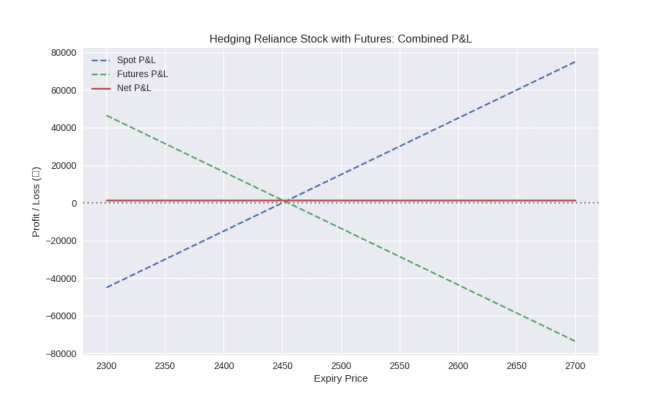
Observation: Regardless of whether the stock falls or rises, the combined P&L remains nearly constant. This demonstrates that the hedge makes the position market-neutral.
Chart: Hedging Neutralizes Risk
The chart below shows how spot and futures P&L move in opposite directions, while the combined P&L line stays flat.
Limitations of Single Stock Hedging
While hedging a single stock position is simple, there are practical limitations:
- Availability of Futures ContractsNot all stocks have futures contracts. For example, smaller banks like South Indian Bank may not have listed futures. In such cases, you cannot directly hedge the spot position. Alternative methods, such as using index futures, may be required.
- Position Size and Lot MatchingFutures contracts have fixed lot sizes. To hedge perfectly, your spot position must match the futures lot size. If you hold fewer shares (say ₹50,000 worth), you cannot create a perfect hedge because the futures contract size may be larger. Partial hedging is possible, but it will not fully neutralize risk.
- Cost of Hedging: Hedging involves margin requirements and transaction costs. For small investors, these costs may outweigh the benefits of hedging.
Professional Insight
- Perfect Hedge:Achieved only when the spot position equals the futures lot size.
- Neutral Position:Once hedged, the investor becomes indifferent to market direction.
- Strategic Use:Hedging is most effective for large positions or institutional portfolios where risk management is critical.
12.4 A Precision in Single-Stock Hedging: Achieving a Perfect Hedge
To achieve a perfect hedge using futures, the spot position value must match the futures contract value exactly. This ensures that gains or losses in the spot market are fully offset by the opposite movement in the futures market, making the overall position market-neutral.
The key to this precision lies in lot sizing. Futures contracts are standardized, meaning each contract represents a fixed number of shares—known as the lot size. For example, if the futures lot size for Reliance Industries is 300 shares, then to hedge perfectly, the investor must hold exactly 300 shares in the spot market. If the spot holding is less than or more than the lot size, the hedge becomes partial and may not fully neutralize risk.
This rigidity in lot sizing is a structural feature of the futures market. It simplifies contract standardization but requires careful position sizing from the trader. For retail investors with smaller holdings, perfect hedging may not be feasible. In such cases, partial hedging can still reduce risk, but it won’t eliminate it entirely.
Cost of Holding the Hedge
Hedging is not cost-free. The trader must maintain a margin with the broker to hold the futures position. This margin typically includes both SPAN and exposure components and varies based on the volatility of the underlying stock. Additionally, brokerage fees apply to both the entry and exit of the futures position. These costs must be weighed against the protection offered by the hedge.
For example, if the margin required to short one lot of Reliance Futures is ₹85,000, the investor must ensure this amount is available and blocked for the duration of the hedge. If the hedge is held for several days or weeks, the opportunity cost of capital also becomes relevant.
In summary, a perfect hedge requires:
- Spot position = Futures lot size
- Margin availability = Broker’s requirement for the futures position
- Awareness of brokerage and opportunity costs
12.5 Understanding beta
Beta (β) is a core measure of how sensitive a stock is to movements in the broader market. It captures the stock’s systematic risk—how much it tends to move when the market index (such as Nifty 50 or Sensex) moves. The market index, by definition, has a beta of +1. Individual stocks can have beta values that are negative, zero, between zero and one, or greater than one.
Beta helps answer practical questions:
- How much might stock returns change if the market jumps or drops tomorrow?
- Is this stock more or less volatile than the index?
- Between two stocks, which carries more market-linked (systematic) risk?
Example with concrete movements
Assume the beta of HDFC Bank is +0.7:
- If the market increases by 1.0%, HDFC Bank is expected to rise by 0.7%.
- If the market increases by 1.5%, the expected move is 1.05%.
- If the market declines by 1.0%, HDFC Bank is expected to fall by 0.7%.
Because 0.7 is below the market beta of 1.0, HDFC Bank is considered 30% less volatile than the market on a systematic basis. If ICICI Bank’s beta is 0.85, HDFC Bank is relatively less volatile compared to ICICI Bank and therefore carries lower systematic risk.
Interpreting beta ranges with expanded explanations
|
Beta range |
What it means |
Practical movement example |
Investor use case |
|
Less than 0 (e.g., -0.4) |
Stock tends to move opposite to the market. Negative beta is uncommon outside certain sectors/strategies. |
Market +1% → stock ≈ −0.4%. Market −1% → stock ≈ +0.4%. |
Potential diversifier; can reduce portfolio swings, but negative correlation may be unstable over time. |
|
Equal to 0 |
Stock movement is largely independent of the market. Rare in listed equities; more typical of certain cash-like or hedged instruments. |
Market ±1% → stock ≈ 0% on average (idiosyncratic drivers dominate). |
Useful when seeking minimal market-linked risk; expect returns driven by company-specific events. |
|
Between 0 and 1 (e.g., 0.6) |
Moves with the market but less aggressively; lower systematic risk than the index. |
Market +1% → stock ≈ +0.6%. Market −1% → stock ≈ −0.6%. |
Suits conservative allocations; can smooth drawdowns while retaining market participation. |
|
Greater than 1 (e.g., 1.2) |
Moves in the same direction as the market but more sharply; higher systematic risk. |
Market +1% → stock ≈ +1.2%. Market −1% → stock ≈ −1.2%. |
Suits aggressive allocations; amplifies gains in bull markets and losses in corrections. |
The table below pairs each beta range with plain-English interpretation and realistic investor implications.
Note: Beta is a statistical estimate based on historical data. It is not a guarantee of future movement and can change over different look-back windows.
Illustrative beta values and how to read them
|
Stock |
Beta |
Interpretation in practice |
|
Tata Motors |
1.35 |
High-beta auto cyclical; tends to magnify market moves—strong upside in rallies, sharper pullbacks in corrections. |
|
ICICI Bank |
1.25 |
Large-cap bank with above-market sensitivity; responsive to macro and rate cycles. |
|
NTPC |
0.55 |
Defensive utility; lower volatility relative to market; often used to stabilize portfolios. |
|
HDFC Ltd. |
0.90 |
Near-market sensitivity but slightly muted; relatively stable vs. high-beta financials. |
|
Adani Enterprises |
1.80 |
Very high beta; large swings; typically for high-risk, momentum-driven strategies. |
|
Infosys |
0.50 |
Lower beta IT; more resilient to broad market swings; moves more on sector and earnings specifics. |
|
Larsen & Toubro |
1.40 |
Capital goods/capex proxy; high sensitivity to economic cycles and investment activity. |
|
Asian Paints |
0.75 |
Consumer staple bias; moderate defensiveness with steady sector dynamics. |
|
Reliance Industries |
1.20 |
Above-market sensitivity due to diversified operations and energy/consumer exposure. |
|
State Bank of India |
1.55 |
High-beta PSU bank; magnified response to credit and macro conditions. |
Using beta for portfolio decisions
- Position sizing:High-beta stocks warrant smaller weights to manage drawdowns; low-beta stocks can carry larger weights without spiking portfolio volatility.
- Hedging:A portfolio’s aggregate beta helps estimate how much index futures or options are needed for a hedge. For example, a ₹10 lakh portfolio with beta 0.8 behaves like ₹8 lakh of index exposure; hedges can be calibrated to this effective exposure.
- Pair comparisons:Between two sector peers, the lower-beta name generally offers a smoother ride; the higher-beta name suits momentum or tactical trades.
- Risk targeting:Investors aiming for a volatility budget can blend low- and high-beta stocks to match their target risk level.
12.6 Calculating Beta in Excel
Beta helps measure how a stock’s returns move relative to the market index. You can calculate it in Excel using the =SLOPE function.
How Beta is Calculated (Example: HDFC Bank)
- Download the last 6 months of daily closing prices for both Nifty and HDFC Bank from the NSE website.
- Compute daily returns for each:
- Formula: (Today’s Closing Price / Previous Day’s Closing Price) – 1
- Apply the SLOPE function in Excel:
- Format:
=SLOPE(known_y's, known_x's) - Here, known_y’s = daily returns of HDFC Bank, known_x’s = daily returns of Nifty
- Format:
- For HDFC Bank, the 6-month beta (e.g., from 1st April 2023 to 30th September 2023) might work out to around 1.05.
How to Interpret Beta
- Beta = 1: The stock tends to move in line with the market — a 1% market move corresponds to roughly a 1% move in the stock.
- Low Beta (<1, e.g., 0.7): The stock moves in the same direction as the market but less sharply. If the market rises 1%, the stock typically rises about 0.7%. Considered relatively less volatile.
- High Beta (>1, e.g., 1.3): The stock moves in the same direction as the market but with larger swings. If the market rises 1%, the stock may rise about 1.3% — and fall by a similar magnified amount if the market falls. Considered more volatile.
- Beta < 0 : The stock tends to move opposite to the market — rare, but possible for certain hedges or gold-mining stocks.
Click on the link for excel sheet to calculate the Beta Values
Sample Beta Values of Indian Stocks
|
Stock Name |
Beta Value |
|
HDFC Bank |
1.05 |
|
ICICI Bank |
1.32 |
|
ITC Limited |
0.85 |
|
Tata Motors |
1.50 |
|
Sun Pharma |
0.65 |
|
NTPC |
0.92 |
|
Adani Enterprises |
1.70 |
|
Hindustan Unilever |
0.55 |
|
Kotak Mahindra Bank |
1.20 |
|
Power Grid Corp |
0.80 |
12.7 Hedging a Stock Portfolio with Nifty Futures

When you hold a diversified portfolio, you’ve already reduced unsystematic risk (company-specific). What remains is systematic risk — the risk of the overall market moving against you. Since Nifty represents the broader market, Nifty futures are the natural instrument to hedge this risk.
Example Portfolio
Assume I have ₹10,00,000 invested across the following stocks:
|
Sl No |
Stock Name |
Beta |
Investment Amount |
|
1 |
HDFC Bank |
1.10 |
₹2,00,000 |
|
2 |
Tata Steel |
1.50 |
₹1,50,000 |
|
3 |
ITC Limited |
0.70 |
₹1,20,000 |
|
4 |
Adani Enterprises |
1.80 |
₹2,30,000 |
|
5 |
Sun Pharma |
0.65 |
₹1,00,000 |
|
6 |
Hindustan Unilever |
0.55 |
₹1,00,000 |
|
7 |
Power Grid Corp |
0.85 |
₹1,00,000 |
|
Total |
— |
— |
₹10,00,000 |
Step 1 – Calculate Portfolio Beta
- Weight of each stock= Investment ÷ Total Portfolio Value
- Weighted Beta= Stock Beta × Weight
|
Stock Name |
Beta |
Investment |
Weight |
Weighted Beta |
|
HDFC Bank |
1.10 |
₹2,00,000 |
20% |
0.22 |
|
Tata Steel |
1.50 |
₹1,50,000 |
15% |
0.225 |
|
ITC Limited |
0.70 |
₹1,20,000 |
12% |
0.084 |
|
Adani Enterprises |
1.80 |
₹2,30,000 |
23% |
0.414 |
|
Sun Pharma |
0.65 |
₹1,00,000 |
10% |
0.065 |
|
Hindustan Unilever |
0.55 |
₹1,00,000 |
10% |
0.055 |
|
Power Grid Corp |
0.85 |
₹1,00,000 |
10% |
0.085 |
|
Total Portfolio |
— |
₹10,00,000 |
100% |
1.148 |
Portfolio Beta = 1.148 This means if Nifty rises 1%, the portfolio is expected to rise 1.148%.
Step 2 – Calculate Hedge Value
Hedge Value =Porfolio Beta * Portfolio Value
=1.148 *10,00,000 = ₹11,48,000
So, to hedge ₹10 lakh worth of stocks, we need to short Nifty futures worth ₹11.48 lakh.
Step 3 – Number of Lots Required
Suppose Nifty futures are trading at ₹18,500 and the lot size is 50.
Contract Value per lot =18,500 * 50 =₹9,25,000
Lots Required =11,48,000/9,25,000 =1.24
Since fractional lots aren’t possible, you can short either 1 lot (under-hedged) or 2 lots (over-hedged).
Step 4 – Hedge Effectiveness
Assume Nifty falls by 5% (≈925 points).
- Nifty Futures Gain:
1.24 *50*925 = ₹57,275
- Portfolio Loss:
Decline =5% *1.148 =5.74% Loss =5.74% *10,00,000 =₹57,400
The gain on futures nearly offsets the loss on the portfolio.
Special Cases
- Stock without futures contract Suppose you hold ₹4,00,000 worth of Bandhan Bank (no futures contract).
- Beta = 0.80
- Hedge Value = ₹4,00,000 × 0.80 = ₹3,20,000
- Divide by Nifty contract value to get lots required.
- Small positions If your stock holding is only ₹50,000, it’s too small compared to Nifty’s contract value. In such cases, options are better suited for hedging.
12.7 Key Takeaways

1. Hedging is risk management, not speculation: Futures aren’t only for profit-seeking trades; they are powerful tools to protect against adverse price moves.
2. Portfolio Hedging with Index Futures: Shorting Nifty Futures can offset losses in a diversified portfolio during market downturns, reducing systematic risk.
3. Single Stock Hedging: Investors can hedge individual holdings (e.g., Infosys, Reliance) by taking opposite positions in stock futures, neutralizing volatility around events like earnings.
4. Hedging vs. Speculation
- Speculation = risk-taking for profit.
- Hedging = risk transfer to minimize losses.
- The objectives are fundamentally different.
5 Costs of Hedging: Margins, brokerage fees, and opportunity costs are the “insurance premium” of hedging. Gains may be capped, but downside protection is achieved.
6. Why Hedging Makes Sense
- Losses are harder to recover (a 25% fall needs a 33% rise).
- Timing the market is unreliable.
- Hedging cushions volatility without forcing investors to exit positions.
7. Types of Risk
- Unsystematic risk:Company-specific (sales decline, debt, governance issues).
- Systematic risk:Market-wide (GDP slowdown, inflation, RBI policy, global crises).
- Diversification reduces unsystematic risk; hedging reduces systematic risk.
8. Neutralizing with Futures: Perfect hedge occurs when spot holdings match futures lot size. Combined P&L remains stable regardless of price direction.
9. Beta as a Risk Thermometer
- Beta measures sensitivity of a stock to market moves.
- <1 = defensive, >1 = aggressive.
- Portfolio beta helps calculate hedge size with Nifty Futures.
10. Portfolio Hedging Example
- A ₹10 lakh portfolio with beta 1.148 behaves like ₹11.48 lakh of market exposure.
- Hedging requires shorting Nifty Futures worth ₹11.48 lakh, aligning futures lots to portfolio risk.
12.8 Fun Activity

You have a ₹10,00,000 portfolio with an average beta of 1.2. Nifty Futures are trading at ₹18,500, lot size = 50 units.
Try to answer these:
- What is your effective market exposure?
- How much value of Nifty Futures should you short to hedge?
- How many lots of Nifty Futures are needed?
Step-by-Step Solution
- Effective Exposure = Portfolio Value × Beta = ₹10,00,000 × 1.2 = ₹12,00,000
- Hedge Value = ₹12,00,000 (this is the amount you need to cover with Nifty Futures).
- Contract Value per Lot = 18,500 × 50 = ₹9,25,000
- Lots required = Hedge Value ÷ Contract Value = 12,00,000 ÷ 9,25,000 ≈ 1.3 lots
Since you can’t trade fractional lots, you must choose:
- 1 lot (slightly under-hedged)
- 2 lots (slightly over-hedged)
12.1 Hedging: A Professional Overview
Hedging is one of the most practical applications of futures contracts. It is a risk management strategy that helps investors and traders protect themselves against adverse price movements. While hedging does not eliminate risk completely, it reduces the impact of unfavourable market conditions and provides stability to portfolios or individual positions.
- Hedging a Portfolio
When you build a portfolio of multiple stocks, you are exposed to overall market risk. Even if you carefully select strong companies, a sudden downturn in the market, caused by global events, policy changes, or economic shocks—can drag down the entire portfolio. To safeguard against this, investors often use index futures such as Nifty Futures. By shorting index futures, you create a counter-position that gains value when the market falls. This gain offsets the losses in your portfolio, thereby reducing the net impact. This approach is widely used by institutional investors like mutual funds and insurance companies to protect large portfolios from systematic risk.
- Hedging Individual Stocks
Hedging is not limited to portfolios; it can also be applied to single stock positions. Suppose you hold shares of Infosys and expect short-term volatility due to upcoming earnings announcements. Instead of selling your shares, you can short Infosys Futures. If the stock price declines, the futures position generates a profit that offsets the loss in your cash holdings. However, hedging individual stocks comes with limitations. Not all stocks have liquid futures contracts, and margin requirements may be higher compared to index futures. Still, for liquid blue-chip companies, single-stock hedging is a practical way to manage unsystematic risk.
- Hedging vs. Speculation
It is important to distinguish between hedging and speculation. Both use futures contracts, but the objectives are entirely different. Speculation is about taking risk to earn profits—for example, shorting futures because you believe prices will fall. Hedging, on the other hand, is defensive. It is about reducing risk and protecting existing investments. A hedger does not aim to maximize profits but to minimize losses. In professional terms, hedging is a risk transfer mechanism, while speculation is a risk-taking activity. Understanding this distinction is crucial for disciplined trading.
- Costs of Hedging
Hedging is not free, it comes with costs. These include margin requirements, brokerage fees, and sometimes opportunity costs. For instance, if you hedge your portfolio with index futures and the market rises, your portfolio gains are reduced because the futures position loses value. In other words, hedging can cap your upside while protecting your downside. This trade-off is similar to buying insurance: you pay a premium to reduce risk. Professional investors accept these costs because the stability and protection offered by hedging outweigh the potential reduction in profits.
- Practical Example – Portfolio Hedge
Consider an investor holding a portfolio worth ₹10 lakh that closely tracks the Nifty Index. The investor fears a short-term decline and decides to short Nifty Futures. If Nifty falls by 5%, the portfolio loses ₹50,000. However, the short futures position gains approximately the same amount, neutralizing the loss. This demonstrates how futures can act as a balancing tool. In practice, institutional investors use such hedges regularly to protect against market downturns while remaining invested in equities for the long term.
- Strategic Importance of Hedging
Hedging plays a critical role in professional risk management. It provides stability in volatile markets, allowing investors to remain invested without panic selling. It also improves capital efficiency, since investors can protect their positions without liquidating them. For institutions, hedging is essential to meet regulatory requirements and maintain predictable returns. For retail traders, hedging can be used during uncertain events such as earnings announcements, policy changes, or global crises. In essence, hedging ensures that investments are not left vulnerable to sudden shocks, making it a cornerstone of disciplined trading.
12.2 Hedge: But Why?
A common question that arises when discussing hedging is: why hedge at all? If you believe in the long-term strength of your investment, why not simply hold through volatility? The answer lies in understanding how losses compound, the difficulty of timing the market, and the practical benefits of risk management.
- Taking No Action – Holding Through Declines
When an investor chooses not to hedge, they expose themselves fully to market volatility. Suppose you buy Tata Steel at ₹100, and the price falls to ₹75. Eventually, the stock recovers back to ₹100, and you break even. At first glance, it seems harmless—you waited out the decline. But mathematically, the drop from ₹100 to ₹75 is a 25% loss, while the recovery from ₹75 to ₹100 requires a 33.3% gain. Recoveries demand more effort than declines, and markets rarely bounce back quickly unless there is a strong bull run. By not hedging, you endure the stress of waiting, tie up capital, and risk missing opportunities elsewhere. Hedging cushions this fall, making the recovery journey smoother.
- Selling the Stock – Timing the Market
Another option is to sell the stock when you expect a decline and buy it back later at a lower price. For example, you hold Infosys at ₹1,500, sell it before results, and hope to re-enter at ₹1,350. While this sounds logical, it requires perfect timing, selling before the fall and buying before the rebound. Even professional traders struggle with timing consistently. Frequent transactions also mean higher brokerage costs, potential short-term capital gains tax, and loss of long-term tax benefits. In addition, you risk missing the rebound if the stock rises unexpectedly. Hedging avoids this problem by protecting your position without forcing you to exit, allowing you to stay invested while reducing risk.
- Hedging the Position – Risk Management
The third option is to hedge using futures. Suppose you hold shares of Reliance Industries worth ₹5 lakh and fear a market correction. Instead of selling, you short Nifty Futures. If the market falls, your portfolio loses value, but the futures position gains, offsetting the loss. This makes you indifferent to short-term volatility. Hedging is not about predicting direction, it’s about ensuring that adverse movements do not damage your holdings. It acts like a financial vaccine: it doesn’t stop volatility, but it shields your investments from its worst effects.
Why Hedging Makes Sense
- Losses are harder to recover than they appear.A 25% fall requires a 33% rise to break even, which is not always easy.
- Timing the market is unreliable.Selling and re-buying requires precision that even seasoned professionals struggle with.
- Transaction costs and taxes erode returns.Frequent trades reduce efficiency and may eliminate long-term capital gains benefits.
- Hedging insulates your position.By using futures, you can remain invested with confidence, knowing that adverse movements are neutralized.
12.3 Risk of Hedging
Before we discuss how hedging works in practice, it is important to clarify what exactly we are trying to hedge. When you invest in stocks or futures, you are automatically exposed to risk. Broadly, there are two categories of risk: unsystematic risk and systematic risk.
Unsystematic Risk – Company-Specific Factors
Unsystematic risk refers to risks that are unique to a particular company. These risks arise from internal or business-specific issues such as:
- Falling sales or revenue
- Shrinking profit margins
- Rising debt or financing costs
- Excessive leverage
- Poor corporate governance or management misconduct
For example, imagine you invest ₹1,00,000 entirely in Tata Motors. A few months later, the company announces weak quarterly sales due to slowing demand in passenger vehicles. Naturally, Tata Motors’ share price will decline. However, this news may not affect competitors like Mahindra & Mahindra or Maruti Suzuki in the same way. Similarly, if a company faces a governance scandal, the damage is confined to that company alone.
This is why unsystematic risk is also called company-specific risk.
Diversification as a Solution to Unsystematic Risk
Unsystematic risk can be reduced through diversification. Instead of investing all your capital in one company, you spread it across multiple companies and sectors.
For instance, instead of putting the entire ₹1,00,000 into Tata Motors, you could invest ₹50,000 in Tata Motors and ₹50,000 in ICICI Bank. If Tata Motors’ price falls due to weak auto demand, the banking stock may remain unaffected, reducing the overall damage.
In fact, research shows that holding a portfolio of around 20–21 different stocks across sectors provides sufficient diversification. Beyond this, adding more stocks does not significantly reduce risk, because company-specific risks are already minimized.
Systematic Risk – Market-Wide Factors
Even after diversification, some risks remain. These are systematic risks, which affect the entire market and cannot be eliminated by holding more stocks. Systematic risks are usually macroeconomic in nature, such as:
- A slowdown in GDP growth
- Rising interest rates by the central bank
- High inflation levels
- Widening fiscal deficit
- Geopolitical tensions or global crises
For example, suppose you hold a diversified portfolio of 20 stocks across IT, banking, FMCG, and auto sectors. If the Reserve Bank of India raises interest rates sharply, borrowing costs increase across the economy. This impacts all companies, regardless of sector, and your entire portfolio is likely to decline.
Systematic risk is inherent in the market. It cannot be diversified away, but it can be hedged using instruments like index futures.
Diversification vs. Hedging
It is important to distinguish between diversification and hedging:
- Diversificationreduces unsystematic risk by spreading investments across companies and sectors.
- Hedgingreduces systematic risk by using futures or other derivatives to protect against market-wide downturns.
In other words, diversification protects you from company-specific shocks, while hedging protects you from broad economic or market shocks.
12.4 Hedging a Single Stock Position
Hedging a single stock position is one of the most straightforward applications of futures contracts. The idea is simple: if you are long in the spot market , you take a short position in the futures market to balance the risk. This ensures that adverse price movements do not affect your overall position.
Example: Reliance Industries
Suppose you buy 300 shares of Reliance Industries at ₹2,450 each. Your total investment is:
300 *2450 = ₹ 7,35,000
You are now long in Reliance in the spot market. Soon after, you realize quarterly results are due, and there is a chance the numbers may disappoint. To protect yourself, you decide to hedge.
- Short Reliance Futures @ ₹2,455
- Lot Size = 300 shares
- Contract Value = ₹7,36,500
Now you are long in the spot market and short in the futures market. Even though the entry prices differ slightly, the direction of risk is neutralized.
How the Hedge Works
Let’s consider different expiry prices for Reliance and see how the combined position behaves:
|
Expiry Price |
Spot P&L (₹) |
Futures P&L (₹) |
Combined P&L (₹) |
|
₹2,400 |
–15,000 |
+16,500 |
+1,500 |
|
₹2,500 |
+15,000 |
–13,500 |
+1,500 |
|
₹2,600 |
+45,000 |
–43,500 |
+1,500 |
Observation: Regardless of whether the stock falls or rises, the combined P&L remains nearly constant. This demonstrates that the hedge makes the position market-neutral.
Chart: Hedging Neutralizes Risk
The chart below shows how spot and futures P&L move in opposite directions, while the combined P&L line stays flat.
Limitations of Single Stock Hedging
While hedging a single stock position is simple, there are practical limitations:
- Availability of Futures ContractsNot all stocks have futures contracts. For example, smaller banks like South Indian Bank may not have listed futures. In such cases, you cannot directly hedge the spot position. Alternative methods, such as using index futures, may be required.
- Position Size and Lot MatchingFutures contracts have fixed lot sizes. To hedge perfectly, your spot position must match the futures lot size. If you hold fewer shares (say ₹50,000 worth), you cannot create a perfect hedge because the futures contract size may be larger. Partial hedging is possible, but it will not fully neutralize risk.
- Cost of Hedging: Hedging involves margin requirements and transaction costs. For small investors, these costs may outweigh the benefits of hedging.
Professional Insight
- Perfect Hedge:Achieved only when the spot position equals the futures lot size.
- Neutral Position:Once hedged, the investor becomes indifferent to market direction.
- Strategic Use:Hedging is most effective for large positions or institutional portfolios where risk management is critical.
12.4 A Precision in Single-Stock Hedging: Achieving a Perfect Hedge
To achieve a perfect hedge using futures, the spot position value must match the futures contract value exactly. This ensures that gains or losses in the spot market are fully offset by the opposite movement in the futures market, making the overall position market-neutral.
The key to this precision lies in lot sizing. Futures contracts are standardized, meaning each contract represents a fixed number of shares—known as the lot size. For example, if the futures lot size for Reliance Industries is 300 shares, then to hedge perfectly, the investor must hold exactly 300 shares in the spot market. If the spot holding is less than or more than the lot size, the hedge becomes partial and may not fully neutralize risk.
This rigidity in lot sizing is a structural feature of the futures market. It simplifies contract standardization but requires careful position sizing from the trader. For retail investors with smaller holdings, perfect hedging may not be feasible. In such cases, partial hedging can still reduce risk, but it won’t eliminate it entirely.
Cost of Holding the Hedge
Hedging is not cost-free. The trader must maintain a margin with the broker to hold the futures position. This margin typically includes both SPAN and exposure components and varies based on the volatility of the underlying stock. Additionally, brokerage fees apply to both the entry and exit of the futures position. These costs must be weighed against the protection offered by the hedge.
For example, if the margin required to short one lot of Reliance Futures is ₹85,000, the investor must ensure this amount is available and blocked for the duration of the hedge. If the hedge is held for several days or weeks, the opportunity cost of capital also becomes relevant.
In summary, a perfect hedge requires:
- Spot position = Futures lot size
- Margin availability = Broker’s requirement for the futures position
- Awareness of brokerage and opportunity costs
12.5 Understanding beta
Beta (β) is a core measure of how sensitive a stock is to movements in the broader market. It captures the stock’s systematic risk—how much it tends to move when the market index (such as Nifty 50 or Sensex) moves. The market index, by definition, has a beta of +1. Individual stocks can have beta values that are negative, zero, between zero and one, or greater than one.
Beta helps answer practical questions:
- How much might stock returns change if the market jumps or drops tomorrow?
- Is this stock more or less volatile than the index?
- Between two stocks, which carries more market-linked (systematic) risk?
Example with concrete movements
Assume the beta of HDFC Bank is +0.7:
- If the market increases by 1.0%, HDFC Bank is expected to rise by 0.7%.
- If the market increases by 1.5%, the expected move is 1.05%.
- If the market declines by 1.0%, HDFC Bank is expected to fall by 0.7%.
Because 0.7 is below the market beta of 1.0, HDFC Bank is considered 30% less volatile than the market on a systematic basis. If ICICI Bank’s beta is 0.85, HDFC Bank is relatively less volatile compared to ICICI Bank and therefore carries lower systematic risk.
Interpreting beta ranges with expanded explanations
|
Beta range |
What it means |
Practical movement example |
Investor use case |
|
Less than 0 (e.g., -0.4) |
Stock tends to move opposite to the market. Negative beta is uncommon outside certain sectors/strategies. |
Market +1% → stock ≈ −0.4%. Market −1% → stock ≈ +0.4%. |
Potential diversifier; can reduce portfolio swings, but negative correlation may be unstable over time. |
|
Equal to 0 |
Stock movement is largely independent of the market. Rare in listed equities; more typical of certain cash-like or hedged instruments. |
Market ±1% → stock ≈ 0% on average (idiosyncratic drivers dominate). |
Useful when seeking minimal market-linked risk; expect returns driven by company-specific events. |
|
Between 0 and 1 (e.g., 0.6) |
Moves with the market but less aggressively; lower systematic risk than the index. |
Market +1% → stock ≈ +0.6%. Market −1% → stock ≈ −0.6%. |
Suits conservative allocations; can smooth drawdowns while retaining market participation. |
|
Greater than 1 (e.g., 1.2) |
Moves in the same direction as the market but more sharply; higher systematic risk. |
Market +1% → stock ≈ +1.2%. Market −1% → stock ≈ −1.2%. |
Suits aggressive allocations; amplifies gains in bull markets and losses in corrections. |
The table below pairs each beta range with plain-English interpretation and realistic investor implications.
Note: Beta is a statistical estimate based on historical data. It is not a guarantee of future movement and can change over different look-back windows.
Illustrative beta values and how to read them
|
Stock |
Beta |
Interpretation in practice |
|
Tata Motors |
1.35 |
High-beta auto cyclical; tends to magnify market moves—strong upside in rallies, sharper pullbacks in corrections. |
|
ICICI Bank |
1.25 |
Large-cap bank with above-market sensitivity; responsive to macro and rate cycles. |
|
NTPC |
0.55 |
Defensive utility; lower volatility relative to market; often used to stabilize portfolios. |
|
HDFC Ltd. |
0.90 |
Near-market sensitivity but slightly muted; relatively stable vs. high-beta financials. |
|
Adani Enterprises |
1.80 |
Very high beta; large swings; typically for high-risk, momentum-driven strategies. |
|
Infosys |
0.50 |
Lower beta IT; more resilient to broad market swings; moves more on sector and earnings specifics. |
|
Larsen & Toubro |
1.40 |
Capital goods/capex proxy; high sensitivity to economic cycles and investment activity. |
|
Asian Paints |
0.75 |
Consumer staple bias; moderate defensiveness with steady sector dynamics. |
|
Reliance Industries |
1.20 |
Above-market sensitivity due to diversified operations and energy/consumer exposure. |
|
State Bank of India |
1.55 |
High-beta PSU bank; magnified response to credit and macro conditions. |
Using beta for portfolio decisions
- Position sizing:High-beta stocks warrant smaller weights to manage drawdowns; low-beta stocks can carry larger weights without spiking portfolio volatility.
- Hedging:A portfolio’s aggregate beta helps estimate how much index futures or options are needed for a hedge. For example, a ₹10 lakh portfolio with beta 0.8 behaves like ₹8 lakh of index exposure; hedges can be calibrated to this effective exposure.
- Pair comparisons:Between two sector peers, the lower-beta name generally offers a smoother ride; the higher-beta name suits momentum or tactical trades.
- Risk targeting:Investors aiming for a volatility budget can blend low- and high-beta stocks to match their target risk level.
12.6 Calculating Beta in Excel
Beta helps measure how a stock’s returns move relative to the market index. You can calculate it in Excel using the =SLOPE function.
How Beta is Calculated (Example: HDFC Bank)
- Download the last 6 months of daily closing prices for both Nifty and HDFC Bank from the NSE website.
- Compute daily returns for each:
- Formula: (Today’s Closing Price / Previous Day’s Closing Price) – 1
- Apply the SLOPE function in Excel:
- Format:
=SLOPE(known_y's, known_x's) - Here, known_y’s = daily returns of HDFC Bank, known_x’s = daily returns of Nifty
- Format:
- For HDFC Bank, the 6-month beta (e.g., from 1st April 2023 to 30th September 2023) might work out to around 1.05.
How to Interpret Beta
- Beta = 1: The stock tends to move in line with the market — a 1% market move corresponds to roughly a 1% move in the stock.
- Low Beta (<1, e.g., 0.7): The stock moves in the same direction as the market but less sharply. If the market rises 1%, the stock typically rises about 0.7%. Considered relatively less volatile.
- High Beta (>1, e.g., 1.3): The stock moves in the same direction as the market but with larger swings. If the market rises 1%, the stock may rise about 1.3% — and fall by a similar magnified amount if the market falls. Considered more volatile.
- Beta < 0 : The stock tends to move opposite to the market — rare, but possible for certain hedges or gold-mining stocks.
Click on the link for excel sheet to calculate the Beta Values
Sample Beta Values of Indian Stocks
|
Stock Name |
Beta Value |
|
HDFC Bank |
1.05 |
|
ICICI Bank |
1.32 |
|
ITC Limited |
0.85 |
|
Tata Motors |
1.50 |
|
Sun Pharma |
0.65 |
|
NTPC |
0.92 |
|
Adani Enterprises |
1.70 |
|
Hindustan Unilever |
0.55 |
|
Kotak Mahindra Bank |
1.20 |
|
Power Grid Corp |
0.80 |
12.7 Hedging a Stock Portfolio with Nifty Futures
When you hold a diversified portfolio, you’ve already reduced unsystematic risk (company-specific). What remains is systematic risk — the risk of the overall market moving against you. Since Nifty represents the broader market, Nifty futures are the natural instrument to hedge this risk.
Example Portfolio
Assume I have ₹10,00,000 invested across the following stocks:
|
Sl No |
Stock Name |
Beta |
Investment Amount |
|
1 |
HDFC Bank |
1.10 |
₹2,00,000 |
|
2 |
Tata Steel |
1.50 |
₹1,50,000 |
|
3 |
ITC Limited |
0.70 |
₹1,20,000 |
|
4 |
Adani Enterprises |
1.80 |
₹2,30,000 |
|
5 |
Sun Pharma |
0.65 |
₹1,00,000 |
|
6 |
Hindustan Unilever |
0.55 |
₹1,00,000 |
|
7 |
Power Grid Corp |
0.85 |
₹1,00,000 |
|
Total |
— |
— |
₹10,00,000 |
Step 1 – Calculate Portfolio Beta
- Weight of each stock= Investment ÷ Total Portfolio Value
- Weighted Beta= Stock Beta × Weight
|
Stock Name |
Beta |
Investment |
Weight |
Weighted Beta |
|
HDFC Bank |
1.10 |
₹2,00,000 |
20% |
0.22 |
|
Tata Steel |
1.50 |
₹1,50,000 |
15% |
0.225 |
|
ITC Limited |
0.70 |
₹1,20,000 |
12% |
0.084 |
|
Adani Enterprises |
1.80 |
₹2,30,000 |
23% |
0.414 |
|
Sun Pharma |
0.65 |
₹1,00,000 |
10% |
0.065 |
|
Hindustan Unilever |
0.55 |
₹1,00,000 |
10% |
0.055 |
|
Power Grid Corp |
0.85 |
₹1,00,000 |
10% |
0.085 |
|
Total Portfolio |
— |
₹10,00,000 |
100% |
1.148 |
Portfolio Beta = 1.148 This means if Nifty rises 1%, the portfolio is expected to rise 1.148%.
Step 2 – Calculate Hedge Value
Hedge Value =Porfolio Beta * Portfolio Value
=1.148 *10,00,000 = ₹11,48,000
So, to hedge ₹10 lakh worth of stocks, we need to short Nifty futures worth ₹11.48 lakh.
Step 3 – Number of Lots Required
Suppose Nifty futures are trading at ₹18,500 and the lot size is 50.
Contract Value per lot =18,500 * 50 =₹9,25,000
Lots Required =11,48,000/9,25,000 =1.24
Since fractional lots aren’t possible, you can short either 1 lot (under-hedged) or 2 lots (over-hedged).
Step 4 – Hedge Effectiveness
Assume Nifty falls by 5% (≈925 points).
- Nifty Futures Gain:
1.24 *50*925 = ₹57,275
- Portfolio Loss:
Decline =5% *1.148 =5.74% Loss =5.74% *10,00,000 =₹57,400
The gain on futures nearly offsets the loss on the portfolio.
Special Cases
- Stock without futures contract Suppose you hold ₹4,00,000 worth of Bandhan Bank (no futures contract).
- Beta = 0.80
- Hedge Value = ₹4,00,000 × 0.80 = ₹3,20,000
- Divide by Nifty contract value to get lots required.
- Small positions If your stock holding is only ₹50,000, it’s too small compared to Nifty’s contract value. In such cases, options are better suited for hedging.
12.7 Key Takeaways
1. Hedging is risk management, not speculation: Futures aren’t only for profit-seeking trades; they are powerful tools to protect against adverse price moves.
2. Portfolio Hedging with Index Futures: Shorting Nifty Futures can offset losses in a diversified portfolio during market downturns, reducing systematic risk.
3. Single Stock Hedging: Investors can hedge individual holdings (e.g., Infosys, Reliance) by taking opposite positions in stock futures, neutralizing volatility around events like earnings.
4. Hedging vs. Speculation
- Speculation = risk-taking for profit.
- Hedging = risk transfer to minimize losses.
- The objectives are fundamentally different.
5 Costs of Hedging: Margins, brokerage fees, and opportunity costs are the “insurance premium” of hedging. Gains may be capped, but downside protection is achieved.
6. Why Hedging Makes Sense
- Losses are harder to recover (a 25% fall needs a 33% rise).
- Timing the market is unreliable.
- Hedging cushions volatility without forcing investors to exit positions.
7. Types of Risk
- Unsystematic risk:Company-specific (sales decline, debt, governance issues).
- Systematic risk:Market-wide (GDP slowdown, inflation, RBI policy, global crises).
- Diversification reduces unsystematic risk; hedging reduces systematic risk.
8. Neutralizing with Futures: Perfect hedge occurs when spot holdings match futures lot size. Combined P&L remains stable regardless of price direction.
9. Beta as a Risk Thermometer
- Beta measures sensitivity of a stock to market moves.
- <1 = defensive, >1 = aggressive.
- Portfolio beta helps calculate hedge size with Nifty Futures.
10. Portfolio Hedging Example
- A ₹10 lakh portfolio with beta 1.148 behaves like ₹11.48 lakh of market exposure.
- Hedging requires shorting Nifty Futures worth ₹11.48 lakh, aligning futures lots to portfolio risk.
12.8 Fun Activity
You have a ₹10,00,000 portfolio with an average beta of 1.2. Nifty Futures are trading at ₹18,500, lot size = 50 units.
Try to answer these:
- What is your effective market exposure?
- How much value of Nifty Futures should you short to hedge?
- How many lots of Nifty Futures are needed?
Step-by-Step Solution
- Effective Exposure = Portfolio Value × Beta = ₹10,00,000 × 1.2 = ₹12,00,000
- Hedge Value = ₹12,00,000 (this is the amount you need to cover with Nifty Futures).
- Contract Value per Lot = 18,500 × 50 = ₹9,25,000
- Lots required = Hedge Value ÷ Contract Value = 12,00,000 ÷ 9,25,000 ≈ 1.3 lots
Since you can’t trade fractional lots, you must choose:
- 1 lot (slightly under-hedged)
- 2 lots (slightly over-hedged)
12.1 Hedging: A Professional Overview
Hedging is one of the most practical applications of futures contracts. It is a risk management strategy that helps investors and traders protect themselves against adverse price movements. While hedging does not eliminate risk completely, it reduces the impact of unfavourable market conditions and provides stability to portfolios or individual positions.
When you build a portfolio of multiple stocks, you are exposed to overall market risk. Even if you carefully select strong companies, a sudden downturn in the market, caused by global events, policy changes, or economic shocks—can drag down the entire portfolio. To safeguard against this, investors often use index futures such as Nifty Futures. By shorting index futures, you create a counter-position that gains value when the market falls. This gain offsets the losses in your portfolio, thereby reducing the net impact. This approach is widely used by institutional investors like mutual funds and insurance companies to protect large portfolios from systematic risk.
Hedging is not limited to portfolios; it can also be applied to single stock positions. Suppose you hold shares of Infosys and expect short-term volatility due to upcoming earnings announcements. Instead of selling your shares, you can short Infosys Futures. If the stock price declines, the futures position generates a profit that offsets the loss in your cash holdings. However, hedging individual stocks comes with limitations. Not all stocks have liquid futures contracts, and margin requirements may be higher compared to index futures. Still, for liquid blue-chip companies, single-stock hedging is a practical way to manage unsystematic risk.
It is important to distinguish between hedging and speculation. Both use futures contracts, but the objectives are entirely different. Speculation is about taking risk to earn profits—for example, shorting futures because you believe prices will fall. Hedging, on the other hand, is defensive. It is about reducing risk and protecting existing investments. A hedger does not aim to maximize profits but to minimize losses. In professional terms, hedging is a risk transfer mechanism, while speculation is a risk-taking activity. Understanding this distinction is crucial for disciplined trading.
Hedging is not free, it comes with costs. These include margin requirements, brokerage fees, and sometimes opportunity costs. For instance, if you hedge your portfolio with index futures and the market rises, your portfolio gains are reduced because the futures position loses value. In other words, hedging can cap your upside while protecting your downside. This trade-off is similar to buying insurance: you pay a premium to reduce risk. Professional investors accept these costs because the stability and protection offered by hedging outweigh the potential reduction in profits.
Consider an investor holding a portfolio worth ₹10 lakh that closely tracks the Nifty Index. The investor fears a short-term decline and decides to short Nifty Futures. If Nifty falls by 5%, the portfolio loses ₹50,000. However, the short futures position gains approximately the same amount, neutralizing the loss. This demonstrates how futures can act as a balancing tool. In practice, institutional investors use such hedges regularly to protect against market downturns while remaining invested in equities for the long term.
Hedging plays a critical role in professional risk management. It provides stability in volatile markets, allowing investors to remain invested without panic selling. It also improves capital efficiency, since investors can protect their positions without liquidating them. For institutions, hedging is essential to meet regulatory requirements and maintain predictable returns. For retail traders, hedging can be used during uncertain events such as earnings announcements, policy changes, or global crises. In essence, hedging ensures that investments are not left vulnerable to sudden shocks, making it a cornerstone of disciplined trading. 12.2 Hedge: But Why?
A common question that arises when discussing hedging is: why hedge at all? If you believe in the long-term strength of your investment, why not simply hold through volatility? The answer lies in understanding how losses compound, the difficulty of timing the market, and the practical benefits of risk management.
When an investor chooses not to hedge, they expose themselves fully to market volatility. Suppose you buy Tata Steel at ₹100, and the price falls to ₹75. Eventually, the stock recovers back to ₹100, and you break even. At first glance, it seems harmless—you waited out the decline. But mathematically, the drop from ₹100 to ₹75 is a 25% loss, while the recovery from ₹75 to ₹100 requires a 33.3% gain. Recoveries demand more effort than declines, and markets rarely bounce back quickly unless there is a strong bull run. By not hedging, you endure the stress of waiting, tie up capital, and risk missing opportunities elsewhere. Hedging cushions this fall, making the recovery journey smoother.
Another option is to sell the stock when you expect a decline and buy it back later at a lower price. For example, you hold Infosys at ₹1,500, sell it before results, and hope to re-enter at ₹1,350. While this sounds logical, it requires perfect timing, selling before the fall and buying before the rebound. Even professional traders struggle with timing consistently. Frequent transactions also mean higher brokerage costs, potential short-term capital gains tax, and loss of long-term tax benefits. In addition, you risk missing the rebound if the stock rises unexpectedly. Hedging avoids this problem by protecting your position without forcing you to exit, allowing you to stay invested while reducing risk.
The third option is to hedge using futures. Suppose you hold shares of Reliance Industries worth ₹5 lakh and fear a market correction. Instead of selling, you short Nifty Futures. If the market falls, your portfolio loses value, but the futures position gains, offsetting the loss. This makes you indifferent to short-term volatility. Hedging is not about predicting direction, it’s about ensuring that adverse movements do not damage your holdings. It acts like a financial vaccine: it doesn’t stop volatility, but it shields your investments from its worst effects. Why Hedging Makes Sense
12.3 Risk of Hedging
Before we discuss how hedging works in practice, it is important to clarify what exactly we are trying to hedge. When you invest in stocks or futures, you are automatically exposed to risk. Broadly, there are two categories of risk: unsystematic risk and systematic risk. Unsystematic Risk – Company-Specific Factors Unsystematic risk refers to risks that are unique to a particular company. These risks arise from internal or business-specific issues such as:
For example, imagine you invest ₹1,00,000 entirely in Tata Motors. A few months later, the company announces weak quarterly sales due to slowing demand in passenger vehicles. Naturally, Tata Motors’ share price will decline. However, this news may not affect competitors like Mahindra & Mahindra or Maruti Suzuki in the same way. Similarly, if a company faces a governance scandal, the damage is confined to that company alone. This is why unsystematic risk is also called company-specific risk. Diversification as a Solution to Unsystematic Risk Unsystematic risk can be reduced through diversification. Instead of investing all your capital in one company, you spread it across multiple companies and sectors. For instance, instead of putting the entire ₹1,00,000 into Tata Motors, you could invest ₹50,000 in Tata Motors and ₹50,000 in ICICI Bank. If Tata Motors’ price falls due to weak auto demand, the banking stock may remain unaffected, reducing the overall damage. In fact, research shows that holding a portfolio of around 20–21 different stocks across sectors provides sufficient diversification. Beyond this, adding more stocks does not significantly reduce risk, because company-specific risks are already minimized. Systematic Risk – Market-Wide Factors Even after diversification, some risks remain. These are systematic risks, which affect the entire market and cannot be eliminated by holding more stocks. Systematic risks are usually macroeconomic in nature, such as:
For example, suppose you hold a diversified portfolio of 20 stocks across IT, banking, FMCG, and auto sectors. If the Reserve Bank of India raises interest rates sharply, borrowing costs increase across the economy. This impacts all companies, regardless of sector, and your entire portfolio is likely to decline. Systematic risk is inherent in the market. It cannot be diversified away, but it can be hedged using instruments like index futures. Diversification vs. Hedging It is important to distinguish between diversification and hedging:
In other words, diversification protects you from company-specific shocks, while hedging protects you from broad economic or market shocks. 12.4 Hedging a Single Stock Position
Hedging a single stock position is one of the most straightforward applications of futures contracts. The idea is simple: if you are long in the spot market , you take a short position in the futures market to balance the risk. This ensures that adverse price movements do not affect your overall position. Example: Reliance Industries Suppose you buy 300 shares of Reliance Industries at ₹2,450 each. Your total investment is: 300 *2450 = ₹ 7,35,000 You are now long in Reliance in the spot market. Soon after, you realize quarterly results are due, and there is a chance the numbers may disappoint. To protect yourself, you decide to hedge.
Now you are long in the spot market and short in the futures market. Even though the entry prices differ slightly, the direction of risk is neutralized. How the Hedge Works Let’s consider different expiry prices for Reliance and see how the combined position behaves:
Observation: Regardless of whether the stock falls or rises, the combined P&L remains nearly constant. This demonstrates that the hedge makes the position market-neutral. Chart: Hedging Neutralizes Risk The chart below shows how spot and futures P&L move in opposite directions, while the combined P&L line stays flat.
Limitations of Single Stock Hedging While hedging a single stock position is simple, there are practical limitations:
Professional Insight
12.4 A Precision in Single-Stock Hedging: Achieving a Perfect Hedge
To achieve a perfect hedge using futures, the spot position value must match the futures contract value exactly. This ensures that gains or losses in the spot market are fully offset by the opposite movement in the futures market, making the overall position market-neutral. The key to this precision lies in lot sizing. Futures contracts are standardized, meaning each contract represents a fixed number of shares—known as the lot size. For example, if the futures lot size for Reliance Industries is 300 shares, then to hedge perfectly, the investor must hold exactly 300 shares in the spot market. If the spot holding is less than or more than the lot size, the hedge becomes partial and may not fully neutralize risk. This rigidity in lot sizing is a structural feature of the futures market. It simplifies contract standardization but requires careful position sizing from the trader. For retail investors with smaller holdings, perfect hedging may not be feasible. In such cases, partial hedging can still reduce risk, but it won’t eliminate it entirely. Cost of Holding the Hedge Hedging is not cost-free. The trader must maintain a margin with the broker to hold the futures position. This margin typically includes both SPAN and exposure components and varies based on the volatility of the underlying stock. Additionally, brokerage fees apply to both the entry and exit of the futures position. These costs must be weighed against the protection offered by the hedge. For example, if the margin required to short one lot of Reliance Futures is ₹85,000, the investor must ensure this amount is available and blocked for the duration of the hedge. If the hedge is held for several days or weeks, the opportunity cost of capital also becomes relevant. In summary, a perfect hedge requires:
12.5 Understanding beta
Beta (β) is a core measure of how sensitive a stock is to movements in the broader market. It captures the stock’s systematic risk—how much it tends to move when the market index (such as Nifty 50 or Sensex) moves. The market index, by definition, has a beta of +1. Individual stocks can have beta values that are negative, zero, between zero and one, or greater than one. Beta helps answer practical questions:
Example with concrete movements Assume the beta of HDFC Bank is +0.7:
Because 0.7 is below the market beta of 1.0, HDFC Bank is considered 30% less volatile than the market on a systematic basis. If ICICI Bank’s beta is 0.85, HDFC Bank is relatively less volatile compared to ICICI Bank and therefore carries lower systematic risk. Interpreting beta ranges with expanded explanations
The table below pairs each beta range with plain-English interpretation and realistic investor implications. Note: Beta is a statistical estimate based on historical data. It is not a guarantee of future movement and can change over different look-back windows. Illustrative beta values and how to read them
Using beta for portfolio decisions
12.6 Calculating Beta in Excel
Beta helps measure how a stock’s returns move relative to the market index. You can calculate it in Excel using the =SLOPE function. How Beta is Calculated (Example: HDFC Bank)
How to Interpret Beta
Click on the link for excel sheet to calculate the Beta Values Sample Beta Values of Indian Stocks
12.7 Hedging a Stock Portfolio with Nifty Futures
When you hold a diversified portfolio, you’ve already reduced unsystematic risk (company-specific). What remains is systematic risk — the risk of the overall market moving against you. Since Nifty represents the broader market, Nifty futures are the natural instrument to hedge this risk. Example Portfolio Assume I have ₹10,00,000 invested across the following stocks:
Step 1 – Calculate Portfolio Beta
Portfolio Beta = 1.148 This means if Nifty rises 1%, the portfolio is expected to rise 1.148%. Step 2 – Calculate Hedge Value Hedge Value =Porfolio Beta * Portfolio Value =1.148 *10,00,000 = ₹11,48,000 So, to hedge ₹10 lakh worth of stocks, we need to short Nifty futures worth ₹11.48 lakh. Step 3 – Number of Lots Required Suppose Nifty futures are trading at ₹18,500 and the lot size is 50. Contract Value per lot =18,500 * 50 =₹9,25,000 Lots Required =11,48,000/9,25,000 =1.24 Since fractional lots aren’t possible, you can short either 1 lot (under-hedged) or 2 lots (over-hedged). Step 4 – Hedge Effectiveness Assume Nifty falls by 5% (≈925 points).
1.24 *50*925 = ₹57,275
Decline =5% *1.148 =5.74% Loss =5.74% *10,00,000 =₹57,400 The gain on futures nearly offsets the loss on the portfolio. Special Cases
12.7 Key Takeaways
1. Hedging is risk management, not speculation: Futures aren’t only for profit-seeking trades; they are powerful tools to protect against adverse price moves. 2. Portfolio Hedging with Index Futures: Shorting Nifty Futures can offset losses in a diversified portfolio during market downturns, reducing systematic risk. 3. Single Stock Hedging: Investors can hedge individual holdings (e.g., Infosys, Reliance) by taking opposite positions in stock futures, neutralizing volatility around events like earnings. 4. Hedging vs. Speculation
5 Costs of Hedging: Margins, brokerage fees, and opportunity costs are the “insurance premium” of hedging. Gains may be capped, but downside protection is achieved. 6. Why Hedging Makes Sense
7. Types of Risk
8. Neutralizing with Futures: Perfect hedge occurs when spot holdings match futures lot size. Combined P&L remains stable regardless of price direction. 9. Beta as a Risk Thermometer
10. Portfolio Hedging Example
12.8 Fun Activity
You have a ₹10,00,000 portfolio with an average beta of 1.2. Nifty Futures are trading at ₹18,500, lot size = 50 units. Try to answer these:
Step-by-Step Solution
Since you can’t trade fractional lots, you must choose:
|