1.1 Introduction To Derivatives
When you plan a trip, you don’t usually wait until the day you travel to buy your train ticket. Buy early and you get a confirmed seat and usually a better price. This helps you as a traveller and helps you to plan better. These early contracts were based on a similar principle to a type of derivative known as a forward contract – an agreement made today to buy or receive something at a future date at a price agreed in advance.
What are Derivatives?
Derivatives are contracts whose value is dependent on the price or behaviour of an underlying asset, index or event. That’s where they get their name from. They are “derived” in value from something else.
Derivatives are commonly believed to have originated as a means for farmers to manage risk, although comparable risk-sharing agreements can be traced back much further in history. Now they are used not only to reduce risk, but by fund managers as part of complex investment strategies . The nature of derivatives and their use has undergone significant changes over time. The derivatives market has grown to be one of the largest in all of finance.
1.2 Meaning Of Derivatives
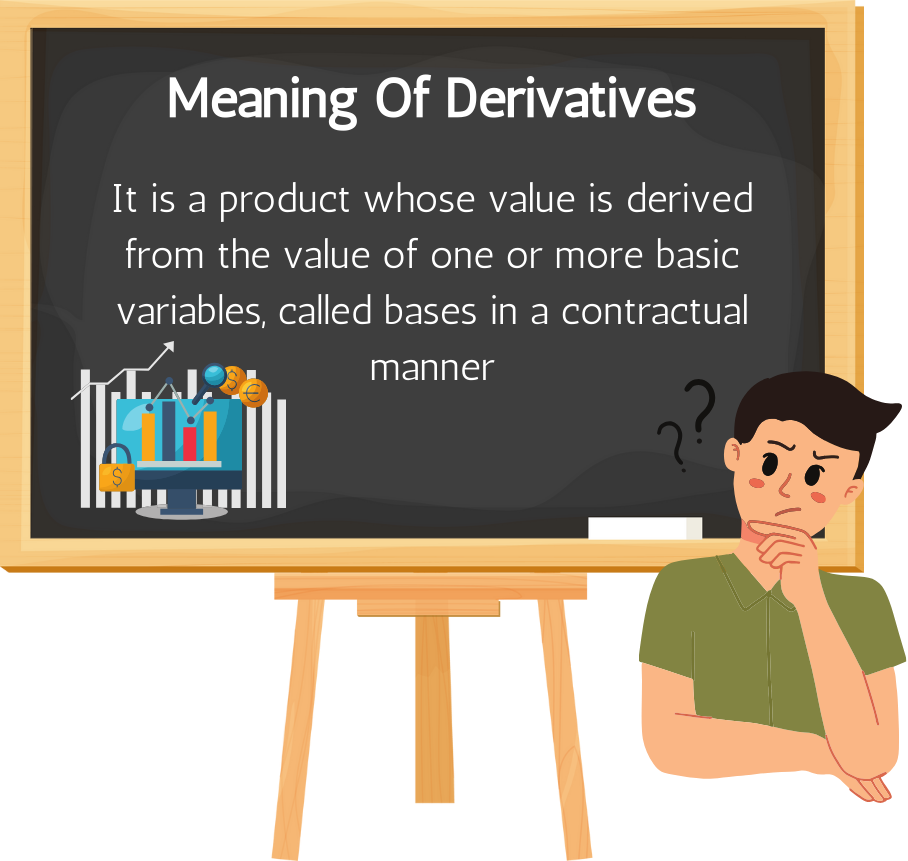
A Derivative is a thing that gets its value from one or more other things that it is connected to. These other things are called Underlying Assets. They can be things like stocks, goods, interest rates or other important numbers in finance. For example a contract to buy gold in the future is a Derivative. The gold itself is the thing that the derivative is based on. The value of this contract goes up and down with the price of gold. This means that the derivative is very sensitive to what happens in the gold market.
It is also important to note that the thing a derivative is based on does not have to be something you can touch. It can be something like the weather or how clean the air is. Over time the market for derivatives has changed to include new and complicated types of derivatives. These can be useful for managing risk and growing a business. They can also be very dangerous if people are not careful and if there is not enough oversight from regulators. The derivatives market is a place and derivatives themselves are financial instruments that need to be understood.
1.3 Uses Of Derivative Contracts?
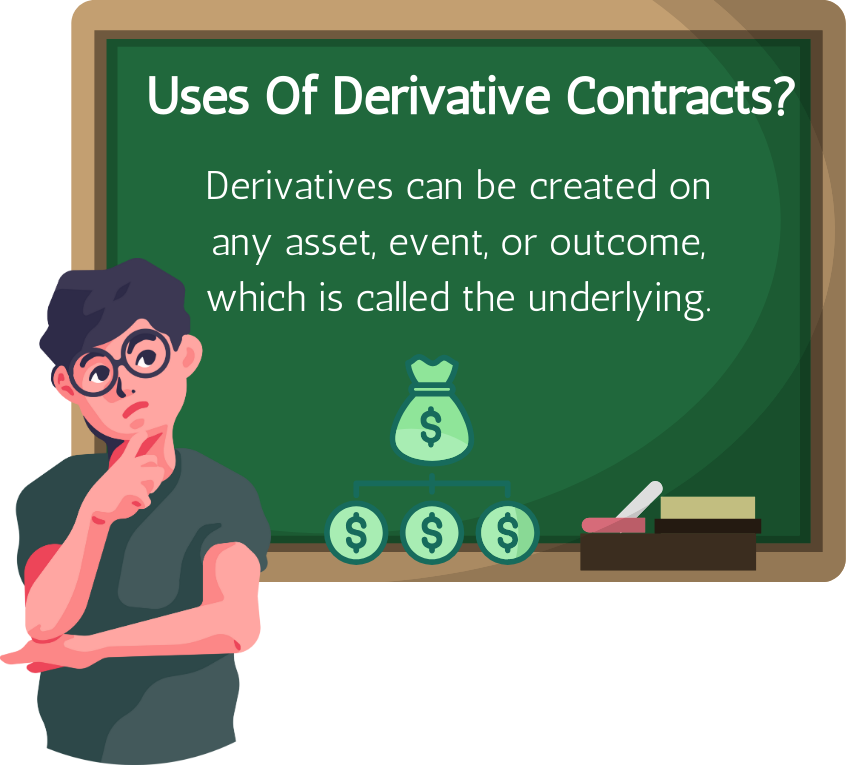
Derivatives are used for a lot of things in many industries and financial markets. One of the things derivatives are used for is to manage risk. This is also called hedging. Companies that have to deal with changes in the cost of materials, product prices, interest rates or exchange rates often use derivatives to fix prices or rates. This helps reduce uncertainty. For example an airline might use fuel futures to keep fuel costs stable or a company that exports goods might use currency forwards to protect against bad exchange rates.
Derivatives are also used for speculation.Speculators buy or sell derivative contracts because they think they can profit from an expected change in the price of the underlying asset buying if they expect the price to rise, and selling (short-selling) if they expect it to fall. . Derivatives are good for this because they usually require less money to get started than buying the asset directly. This means investors can control a lot of assets with a bit of money. This can make their gains bigger. It also means they might lose more money so speculation is really risky.
Derivatives have another advantage. They are Cost efficient. Buying and selling derivatives usually costs less than buying and selling the assets. These features make derivatives an excellent choice for investors that want to change their portfolios quickly and easily.
Derivatives are powerful because they provide leverage and customization . If not handled properly , derivatives can cause major problems . Some derivatives, the complex ones based on things, like weather or credit can be hard to understand and keep track of. If these instruments are used without being careful they can cause financial problems like what happened in the 2008 financial crisis. Derivatives can be really useful if used carefully. Companies have to be careful when they use complex derivatives and make sure they do not cause problems.
1.4 Features Of Financial Derivatives
-
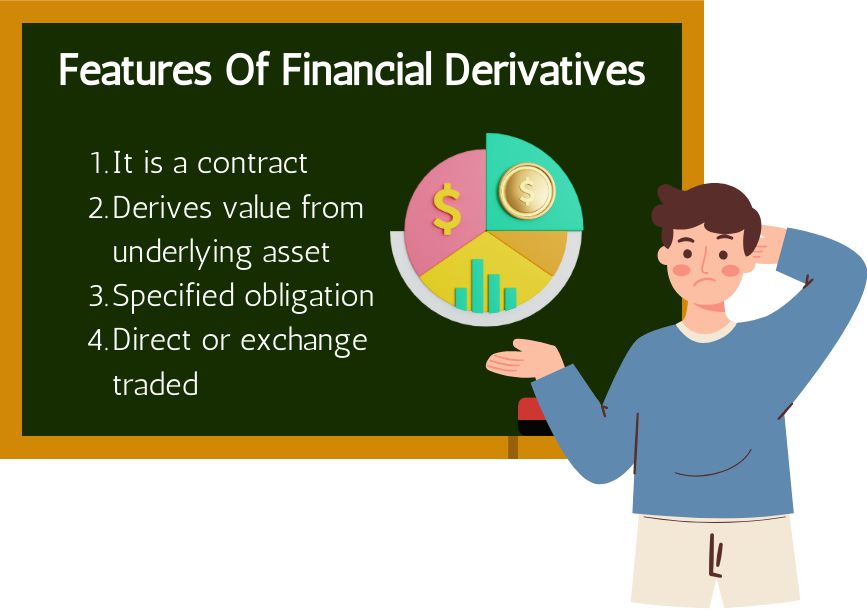
Derivatives are contracts.
A derivative is an agreement between two parties to buy or sell something in the future. This derivative contract is like a promise that you have to keep. You have to do what you said you would do at the time you agreed to do it. This could be in days or months or even years. For example a short term contract might last for three months. A long term contract could last for years.
-
The value of a derivative depends on Underlying asset.
It could be something you can touch like wheat or oil. It could be shares of a company like Infosys. It could even be something you cannot touch like a stock index. For example Nifty 50 or Sensex. If the price of the underlying asset changes the value of the derivative changes too. Sometimes if the underlying asset becomes worthless the derivative may also become worthless.
-
Every derivative contract has rules for each party.
These rules are different for each type of contract. For instance:
- In a Forward contract both parties agree to trade something in the future.
- In a futures contract the rules are the same for everyone. They are traded on special markets.
- In an option contract one party(buyer) can choose to buy or sell something. They do not have any obligations .
- In a swap parties exchange money like fixed interest rates or floating interest rates.
-
Derivatives can be traded in private or on markets.
Private derivatives are called Over-The-Counter or OTC. Special markets are like the NSE or BSE. Derivatives that are traded on markets are more open and easier to buy and sell. They usually cost less too. There are examples from countries like S&P 500 futures in the US or Nikkei 225 options in Japan.
-
Derivative contracts are based on a Notional
It is used to calculate how much money you make or lose. This amount is not always shown on a company’s books. For example in a contract to buy or sell Reliance shares the actual profit or loss may be different from the value of the shares. This is because the payoff depends on how the market price changes, not the size of the contract. Derivative contracts, like this one are based on the Notional amount of Reliance shares.
1.5 Types Of Derivatives
Forward Contracts:
“Basically, a forward is a contract between two parties to buy or sell an asset at a pre-determined price today, for delivery on a date in the future. These contracts are tailored to the needs of the two parties and are traded OTC (i.e., non-standardized and not traded on an exchange, but negotiated privately between the parties). For instance, a jeweller and a gold supplier agree that the jeweller will buy 1 kg of gold at ₹60,000 per 10 grams (i.e., ₹60,00,000 total) after a period of 3 months from today. Forwards are flexible, but they do carry counterparty risk, meaning that if one party defaults, the other could face losses.”
Futures :
These are similar to forwards but these are standardized and are traded on organized exchanges like NSE or BSE. The standardization include the size of the contract, the expiry date and the settlement process. Futures are traded on exchanges and settled daily on a mark-to-market basis, with margins to reduce the risk of default. For this purpose an investor who expects Nifty 50 to go up can buy a Nifty 50 futures contract. Futures are widely used by investors, traders and institutions to hedge or speculate.
Theoretical price of a future contract is calculated by Cost of Carry Model.
Where each letter represents:
- = Fair Future Value (What the futures contract should cost)
- = Spot Price (Today’s market price = ₹1,500)
- = Interest Rate (6% per year = 0.06)
- = Time (3 months out of 12 = 0.25 years)
- = Euler’s Number (, standard constant for continuous compounding)
Step-by-Step Substitution
Step 1: Convert Time into Years
Since the interest rate (6%) is annual, convert 3 months into a fraction of a year:
T=3months/12months =0.25 years
Step 2: Calculate the Interest Factor
Multiply the annual rate by the fraction of the year:
r*t = 0.06 * 0.25 =0.015
(This means over 3 months, the total interest cost is 1.5%)
Step 3: Plug Everything into the Formula
F =1500 * e0.015
Step 4: Solve the Growth Factor (e0.015)
- Using a scientific calculator for e015 :
- e015 ≈ 1.01511
Step 5: Calculate the Final Fair Value
F =1500 *1.01511= ₹ 1,522.67
This fair value is compared with a market price and arbitrage opportunities are found.
Options Contracts:
An option is a contract that grants the buyer the right, but not the obligation, to buy or sell an asset at a fixed price within a set time period. Options come in two flavours: calls (the right to buy) and puts (the right to sell). However, the option seller is committed to executing the contract if the option buyer opts to exercise it. For example, an investor may buy a call option on the Reliance shares at the ₹2,500 level expecting that the price will go past that level. Options are widely used for hedging and risk limiting strategies with upside potential.
Swaps:
A swap is a contract between two parties to exchange cash flows or other financial instruments over time.The most common form is an interest rate swap in which one party pays fixed interest and receives floating rate payments. Large institutions often use them to hedge interest rate or currency risk . For example, an Indian company with a US dollar loan may enter into a currency swap to convert its dollar payments into rupees, and thus reduce exchange rate risk.
1.6 Functions of Derivatives
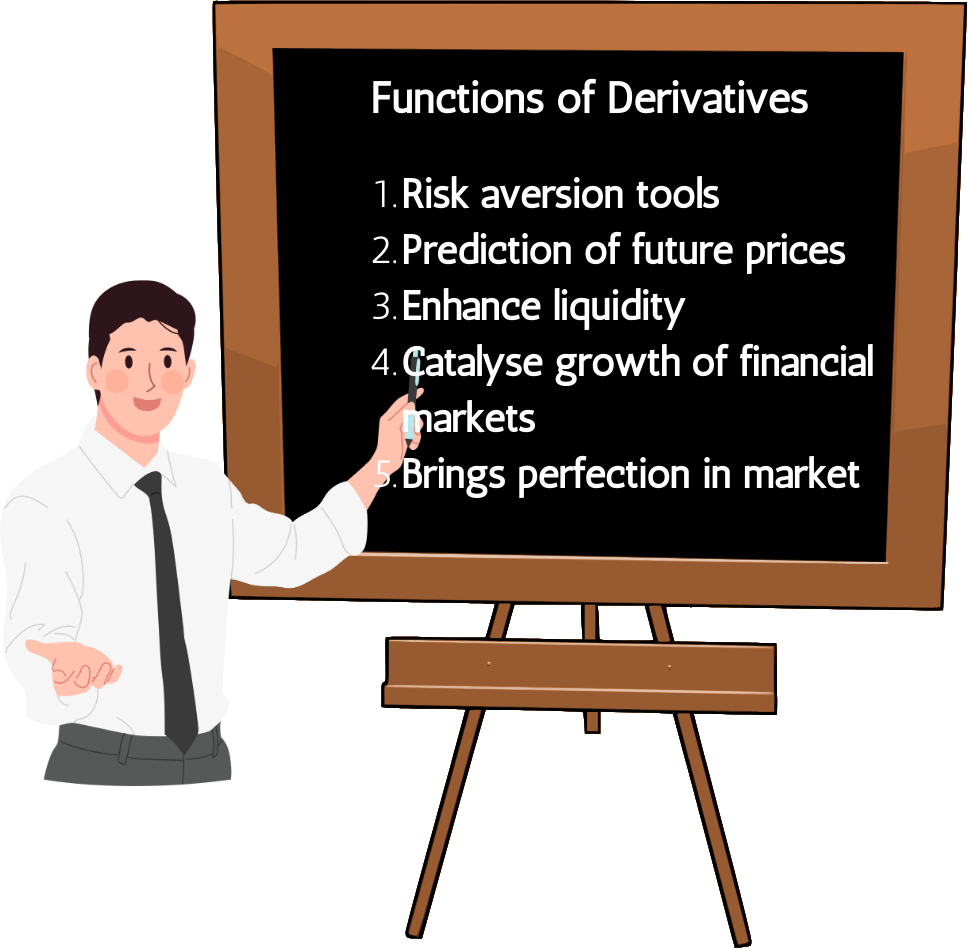
Derivatives are often used as risk management tools such as Hedging, Arbitrage and Spreading to control different types of financial risks.For instance, an Indian airline could hedge its fuel costs with futures in aviation fuel and avoid steep price increases. An exporter expecting to receive dollars can hedge against dollar/rupee movements by currency forwards, for example. Arbitrageurs could make a profit by trading the difference between the gold future price on the MCX and the spot gold price prevailing in the local market. Such strategies are used by companies and investors to cope with uncertainty in volatile environments, such as swings in interest rates, volatile commodity prices or unstable currency markets.
Beta is an important risk management metric that helps measure how sensitive an asset is to market movements. This is the systematic risk that cannot be diversified away. For instance, a stock with a Beta of 1.2 should move 20% more than the market.
When building a hedge with index futures, beta is used to determine the hedge ratio, or what percentage of the portfolio will be hedged. For example a Rs 10 crore equity portfolio with an average Beta of 1.1 will have a hedge ratio of 1.1. This means the portfolio needs Beta × Portfolio Value = 1.1 × Rs 10 crore = Rs 11 crore of Nifty futures to be fully hedged.
Price discovery, market signalling. Futures markets are frequently used as an indicator of where prices are headed. For example, Nifty Futures are generally trading above the Index (spot) level – this premium is mainly the cost of carry (interest cost) explained above and not necessarily bullish sentiment. Traders watch for shifts in this premium or instances where it diverges from the cost-of-carry model, since these can indicate changing sentiment or arbitrage opportunities. This helps the investors and the companies to predict the future movements and take intelligent decisions. Similarly, Agri-commodities like guar seed or chana on NCDEX are futures that give an idea of the expected supply-demand situation, helping farmers and processors plan their production and procurement respectively.
Let us take a real example.
Investors expressed confidence in the company’s performance after Infosys released strong quarterly numbers. Future earnings are expected to be high, and this is reflected in the rising stock price. Traders are buying Infosys futures contracts anticipating further upside The demand for these futures increases and the futures price trades above the spot price. The premium is based on the assumption that the share price will continue to rise short term.
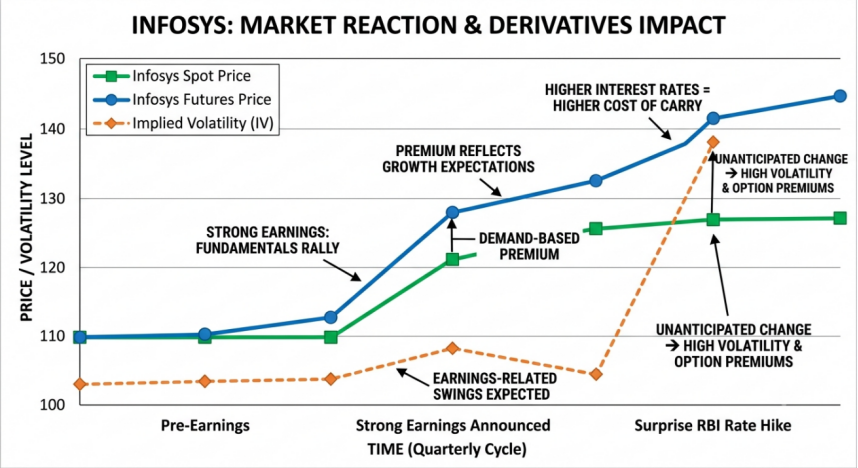
But things can change fast because of external factors. What if Reserve Bank of India unexpectedly hikes the interest rates. Higher interest rates means a higher cost of carry The cost of carry refers to the cost of holding a futures position over time . Includes other charges and financing charges. Here, compared to the earlier Infosys example where the futures premium rose due to strong company earnings, the rise in cost of carry is driven purely by monetary policy, showing that derivative prices can move even when there is no company-specific news at all.
But policy uncertainty can spook traders. The RBI’s surprise move has fueled speculation about its implications for future interest rate moves and the economy. Ambiguity causes Implied volatility – a measure of the stock’s expected swings – to soar. The greater the implied volatility, the more risk the option sellers are taking on, and they want to be compensated more. So, traders who want to buy options have to pay more. Since market uncertainty is greater.
This example illustrates that not only company specific news such as earnings announcements, but also macroeconomic and geopolitical news influence the prices of derivatives. Earnings can push prices higher, monetary policy can affect the cost of carry, and uncertainty can increase volatility and option premiums. The learners will be able to see how the theoretical concepts can be applied to real market behaviour and understand why futures and options prices behave the way they do. It also points out the importance for derivatives analysis of both micro level tracking of company news and macro level economic indicators.
Futures are traded on margin meaning you only need to put up a small percentage of the value of the contract to make trade. Buying an option is different though , the buyer just pays a premium . This is usually much smaller than the value of the underlying position , and you get similar leverage without a margin requirement . For instance, a trader can take a position in Bank Nifty options by paying a relatively small premium. It adds to the overall activity in the market.” A high level of participation is good for liquidity, making it easier to get in and out of positions and reducing the costs of transactions in the underlying markets.
Derivatives, in contrast, permit a variety of trading strategies and risk appetite. This further promotes the growth of financial markets. Hedgers want protection. Speculators want profits. Arbitrageurs want to even out price differences. Such diversity of participants expands the volume of trading and the market infrastructure. The growth of derivatives on NSE – currency futures, interest rate futures and commodity options has broadened India’s financial ecosystem, attracted global investors and enhanced market efficiency.
Towards a Perfect Market: A “complete market” is a market where all possible risks can be traded and priced. Derivatives bring markets closer to this ideal, enabling investors to fine-tune their exposures. Farmers, power companies and other users of weather derivatives need to hedge the risk of either too much or too little rain or temperature. Traditional securities do not offer such coverage. This brings inclusivity to the market and efficiency by covering different risk patterns.
1.7 Key Takeaways

- Derivatives were created to hedge. Farmers first used derivatives to hedge price risk of future crop sales and reduce uncertainty.
- Derivative is based on the value of the underlying asset These can be physical assets, financial assets or even events.
- Derivatives are used for speculation and hedging. They are the tools to make money from price movements for traders and investors and they are the tools of business risk management.
- They are cost effective and leverage Derivatives allow you to take large positions with less capital and transaction costs than buying the underlying asset.
- Futures and options are standardised and traded on exchanges, but forward contracts are between specific buyer and seller and traded between them.
- Specific requirements for forwards, futures, options, swaps and other derivatives Each contract type requires some obligations of the parties concerned.
- OTC or exchange trading Exchange traded derivatives like Nifty options are more liquid and transparent than over the counter contracts.
- Size of notional amount contract Notional value is the value used to calculate gains or losses on derivatives but is not necessarily the actual value of the underlying asset.
- They make markets more efficient. For example they help us discover prices and increase the volume of trading. Derivatives allow us to predict future prices and bring in a wider range of participants and volume of trading.
- They contribute to the development of the financial markets Derivatives are used to transfer risk, to gain strategic exposure, and to make markets more complete and efficient.
1.8 Fun Activity : “Match the Derivative to the Situation”

You are provided with five real life situations. Match each of them with the correct type of derivative, whether Forward, Futures, Options or Swaps.
Scenarios
- The jeweller agrees to buy gold today at 60,000 for 10 grams, delivery in 3 months.
- A trader is bullish on Nifty 50 index and purchases a standardised contract on the exchange.
- An investor wants to have a right ( and not an obligation ) to buy Reliance shares at ₹ 2,500 within a month.
- A company has a loan in US dollar and wishes to hedge the currency risk by converting the future payments into rupees.
- A farmer and a cereal company agree on a price for wheat to be delivered after harvest.
What you must do:
Match the following types of derivatives to one of the following scenarios .
- Future Contract
- Forward Contract
- Swap contract
- Option contract