
9.1 Shorting Made Simple

Most of us are familiar with the idea of buying first and then selling. whether it’s a house or a share or even a cricket ticket. You buy it at one price, wait for it to go up, and then sell it for a profit. This logic of first buying and then selling is intuitive because it mirrors how we transact in our everyday life. But there’s another way to make money in the trading world that reverses this order: short selling, or just shorting.
The opposite is shorting. You sell it first . Then you buy it later, hopefully cheaper . You don’t own it . You sell it at a price , you bought it at a price . The difference is the profit . It might seem strange at first, but the reasoning is straightforward: if you think a stock’s price will fall, you make money by selling high now and buying low later.
To put this in context, let’s use a simple analogy. Imagine you and a friend are watching a tense India vs Australia cricket match. You are sure that India will win so you place a bet on their side. But your friend thinks Australia will win and places a bet against India. Win India, Win Cash. If India loses, your friend wins. Now imagine India is a stock. If the stock goes up you make money . Your bet is like going long . Your friends bet is like shorting , they will make money if the stock drops .
That’s the whole point of shorting. It is a way of making a profit if prices fall. If a stock is overvalued or on the cusp of falling due to weak earnings, poor sentiment or macro factors you can short the stock. This way you sell the stock or futures contract first, then buy them back when the price drops.
If you are new to this concept, do not worry. The mechanics are a bit strange at first, but become obvious with practice. The best way to get a feel for shorting is to try it out in a controlled environment, perhaps with a small intraday position and observe how the profit/loss behaves as prices move.
In the next few chapters we will look more closely at the rules, risks and strategies of short selling. You’ll learn when to do it, how margins work and what to look for when betting against the market.
9.2 Shorting Stocks in the Spot Market
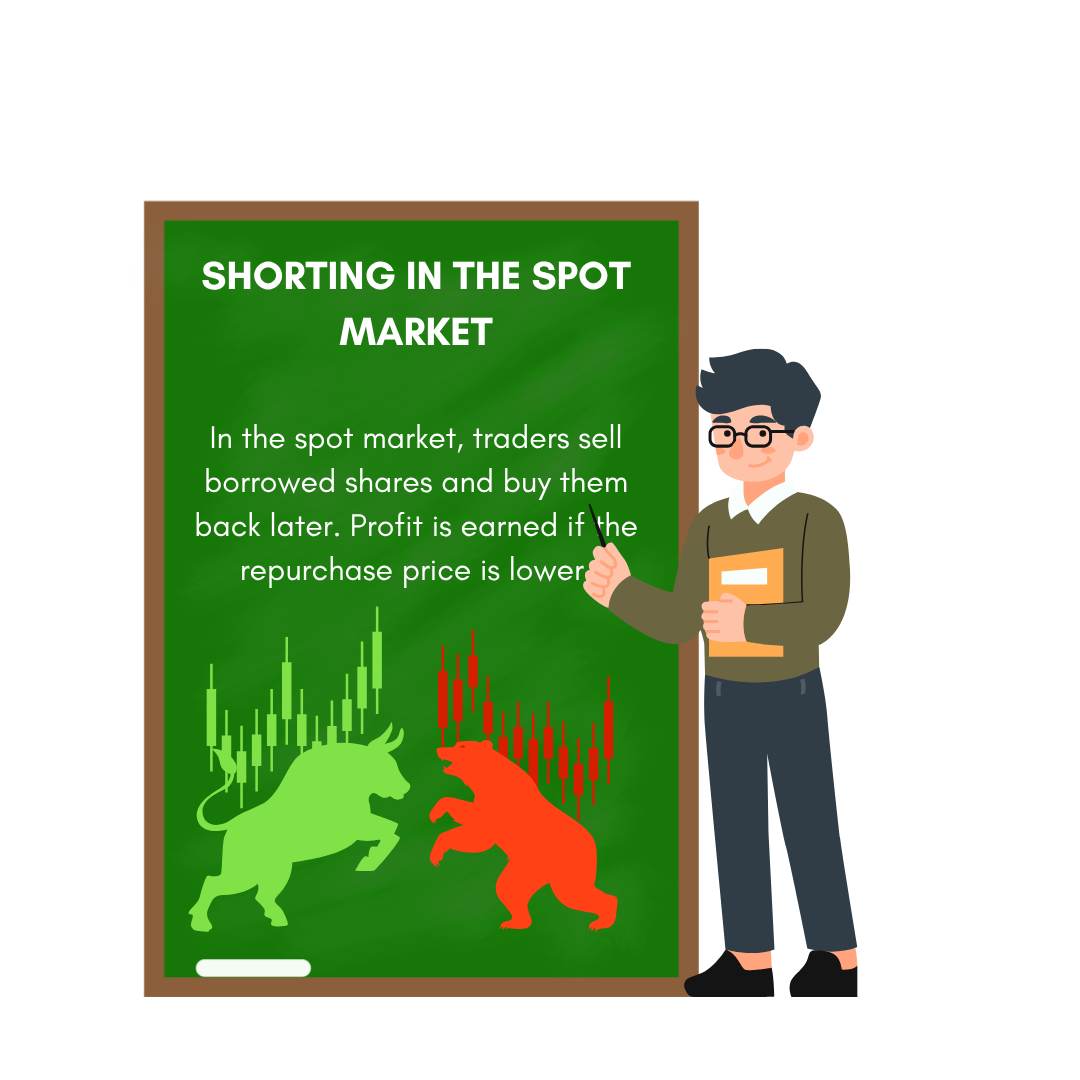
Before we look at shorting in the futures market, it is useful to look at shorting in the spot market first. Let us take a trader looking at the daily chart of HCL Technologies. The chart shows a bearish Marubuzo candlestick pattern, with strong trading volumes, resistance at critical levels and confirming signals from technical indicators. The risk reward ratio is attractive and the trader expects the stock to drop 2% the next day based on this analysis. To take advantage of this expected move, the trader chooses to short the stock.
Shorting is the opposite of the usual buy then sell later transaction. Here, the trader directly sells the stock at ₹2,420 and intends to buy it back at a lower price later. In the trading platform, this is executed by placing a sell order for the required quantity. Once the trade is executed, the trader has gone short.
Let us now discuss how profit and loss unfolds. Short is easy, the stock price should go down. If it does, the trader wins. If it goes up instead then the trade is a loss. Hence the importance of stoploss placement. In short trades the stoploss is always above the entry price, unlike with long trades where the stoploss is below the entry price. Here, the trader puts the stoploss at ₹2,440 which is ₹20 above the entry point.
To illustrate this, we can take two scenarios:
Scenario 1 – Price Falls to Target The stock falls to ₹2,370 from ₹2,420. The target is hit. The trader closes the position by buying back at the lower price . Because the position was opened by selling first . The profit is the difference between the buying and selling price, ₹50 per share. This is equivalent to buying at Rs 2,370 and selling at Rs 2,420, only the order of transactions was reversed.
Scenario 2 – Price moves to stoploss The stock instead of falling, rose to Rs 2,440. This triggers the stoploss and forces the trader to buy back at a higher price to avoid further losses. The loss here is ₹20 per share, which is the short price minus the stoploss level. In normal buy-sell terms, it is the same as buying at Rs 2,440 and selling at Rs 2,420, which obviously results in a loss.
These are the situations that define shorting—you profit if prices fall, and you lose if they rise. The practice of setting a stoploss above the entry price is a discipline that helps limit losses in the event that the market moves against the trader’s expectations.
9.3 Shorting in Spot (The Exchange’s Perspective)

Definition: Spot/Cash Market
The spot market, also known as the cash market, is a financial market where securities or commodities are bought and sold for immediate delivery and settlement. In this market, transactions are conducted at the prevailing market price, known as the spot price, and ownership is transferred instantly, typically within two working days (T+2 settlement cycle in India).
Main Features:
- Instant settlement – buyer pays and receives the asset instantly.
- Real ownership: the investors have the full ownership of the asset (e.g. shares credited to DEMAT account).
- No expiry: Spot trades are not bound by contract duration unlike derivatives.
- Full capital required: Traders pay full value upfront; no leveraged or margin exposure.
For example:
If you buy 100 shares of HDFC Bank in the spot market at Rs 1,650, you will have to pay Rs 1,65,000 upfront. Your shares are credited to your DEMAT account within 2 days and can be held for lifetime.
Shorting on the spot market has a very strict limitation, it can only be done on an intra-day basis. This means that you can open a short position at any time of the trading day but you must cover the short before the end of the trading day. You cannot carry a short position overnight. To understand why, it may be useful to look at how the stock exchange views short sales.
When you short a stock in the spot market, you sell first. And once you place that sell order, the exchange systems record the transaction as a sale of shares. Importantly, the exchange doesn’t differentiate between a normal sale (where you actually own the shares in your DEMAT account) and a short sale (where you don’t). From their standpoint you sold shares and therefore you have to deliver them. Delivery obligations are only checked after the market closes, not during trading hours.
Now imagine this. A trader shorts Reliance Industries at Rs 2,450, hoping to see the price fall. But the decline does not happen and the trader decides to hold on, waiting for a drop the next day. The exchange noted that the trader sold Reliance shares at the end of the trading session. The trader does not have the shares in his DEMAT account and hence cannot fulfil the delivery obligation. This leads to what is called a short delivery.
In a short delivery situation , the exchange steps in and settles in the auction market . Defaulting traders pay stiff penalties that can be as high as 20% above the short price. For example, if the short was at ₹2,450, the settlement cost could be ₹2,940 or more, depending on the penalty. That makes a short delivery very expensive mistake. The moral of the story is simple though, always close your shorts before the market closes or you will be penalised.
Note that the exchange only audits for delivery obligations after trading hours. That means if you close your short position out during the day by buying the shares back you eliminate the obligation altogether. That is why the spot market short is an intraday only thing.
Does this mean that all short positions must be closed the same day? Not always. Shorts cannot be rolled over in the spot market, but shorts in the futures market can be carried overnight and even until expiry. They are also structured differently . The exchange recognises futures contracts as valid instruments to carry forward short trades .
9.4 Shorting in the Futures Market M2M Example
Futures segment shorting is far more flexible than shorting in the spot market. Short sales in the spot market must be covered on the same trading day, while futures contracts allow traders to hold positions overnight and even till expiry. That’s one of the reasons why futures trading is so popular. Futures are derivatives and simply track the performance of the underlying stock. If the underlying stock price goes down, the futures contract will also go down. That makes futures a good instrument for traders that are bearish on a stock and want to make money from its move down.
You need margin to go short in futures . Like you need a margin deposit to go long in futures . The margin rules are the same for long and short positions and are unaffected by direction. However what does change is the profit and loss calculation which is marked to market (M2M) daily.
Let’s go through an example. For example, let’s say a trader sells Infosys futures at ₹1,520 and the lot size is 300. The following table shows how the closing prices move over the next few days and how the M2M adjustments work out.
|
Day |
Reference Price |
Closing Price |
P&L for the Day |
|
01 (Initiate short) |
1520 |
1512 |
(1520 – 1512) × 300 = ₹2,400 |
|
02 |
1512 |
1505 |
(1512 – 1505) × 300 = ₹2,100 |
|
03 |
1505 |
1510 |
(1505 – 1510) × 300 = –₹1,500 |
|
04 |
1510 |
1518 |
(1510 – 1518) × 300 = –₹2,400 |
|
05 |
1518 |
1498 |
(1518 – 1498) × 300 = ₹6,000 |
|
06 (Square off) |
1498 |
1492 |
(1498 – 1492) × 300 = ₹1,800 |
Now, let’s add up the daily M2M values: +2,400 +2,100 –1,500 –2,400 +6,000 +1,800 = ₹8,400 profit
Alternatively, you can calculate directly from the entry and exit prices: (Selling Price – Buying Price) × Lot Size = (1520 – 1492) × 300 = 28 × 300 = ₹8,400

- Total Contract Value:₹1.2 crore
- Buyer:NovaTech Electronics (locks in price to avoid future hikes)
- Seller:PowerCell Traders (secures today’s higher price to avoid future declines)
- Type:Over-the-Counter (OTC) forward contract
What the Chart Shows
- Day 1 & 2:Price falls → Trader earns ₹2,400 and ₹2,100
- Day 3 & 4:Price rises → Trader loses ₹1,500 and ₹2,400
- Day 5 & 6:Price drops sharply → Trader gains ₹6,000 and ₹1,800
Total Profit: ₹8,400
Lot Size: 300 shares
Short Price: ₹1,520
Exit Price: ₹1,492
This example demonstrates that shorting futures is virtually the same as going long, except that profits only occur when prices drop. Same margin requirement and M2M process going one way or the other.
Shorting is a critical skill for active traders. Markets don’t always go up, and being able to profit from falling prices is just as important as riding bullish trends. The more you get used to starting short trades, the more versatile and balanced your trading approach will become.
9.5 Shorting Risk: What’s The Downside?
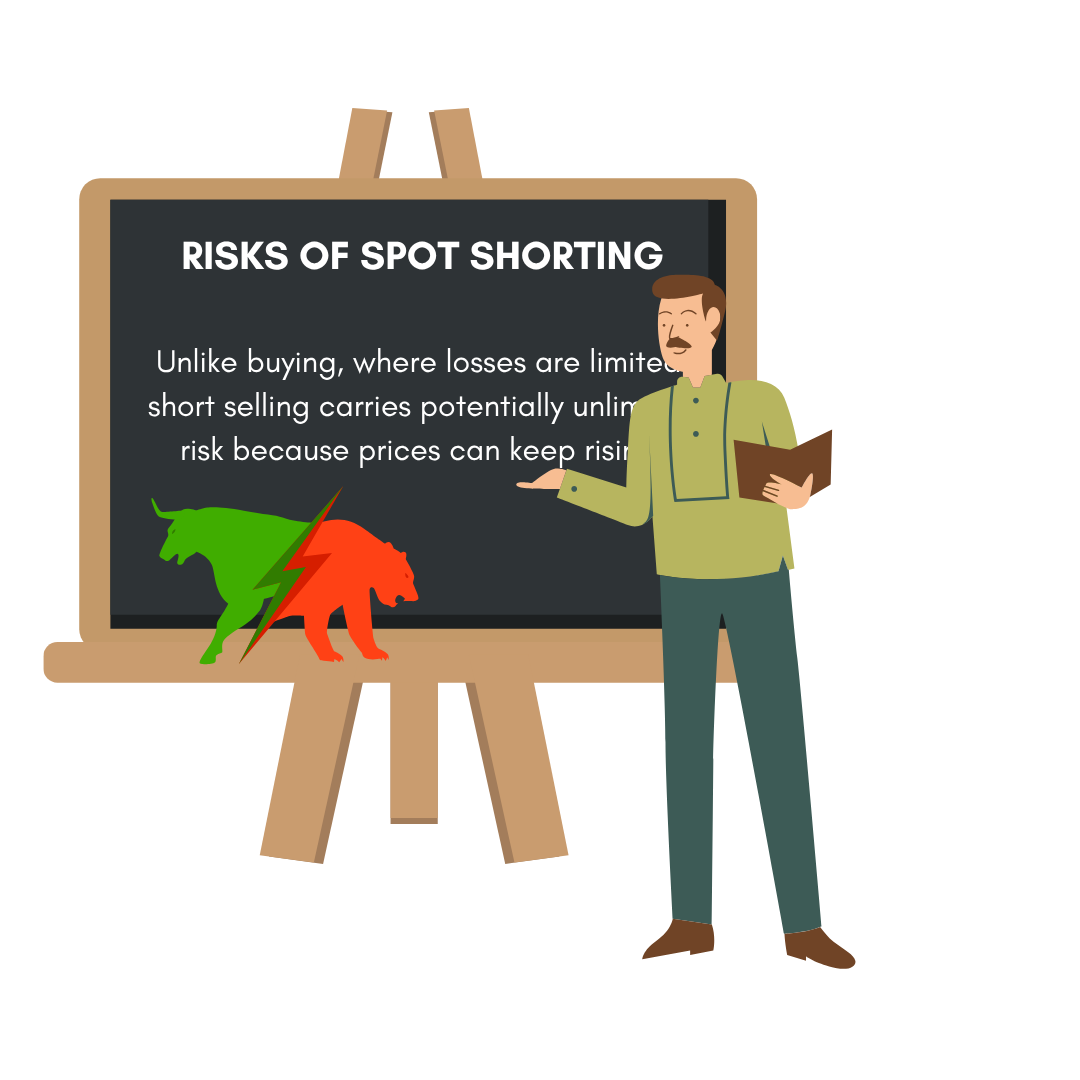
Short selling, or “shorting,” involves a trader selling an asset they do not own, betting the asset will decline in price so they can later buy it back at a lower price. This can be profitable in declining markets, but has a unique and potentially dangerous risk profile, particularly in the spot market.
The losses can be unlimited.
When you buy a stock, your maximum loss is limited to your investment. If the stock goes to zero you lose your capital. But nothing else. On the other hand, if you short a stock, you can lose unlimited amounts. That’s because there’s no limit to how high a stock price can go. Now if the price starts moving against your short, you are forced to buy back at a higher price and the loss keeps increasing as the price goes up.
Suppose you short Infosys at 1500, expecting it to fall Instead it jumps to ₹1,600. Now you have a loss of Rs 100 per share. If it goes up to ₹1,700 or ₹1,800, your losses will go up. There is no ceiling, your margin and risk controls are the limit of your losses.
Margin Calls and Liquidations
To protect themselves against this risk, brokers require margin deposits and constantly monitor your position. If the loss is greater than your margin, you will receive a margin call, a request for a deposit. Otherwise, the broker may forcibly square off your position to prevent more loss. This is especially true in futures where margin systems are tightly regulated.
Spot Market Shorting – Only Intraday
Short selling in Indian spot market is allowed only on intraday basis. You need to flatten out the position before the market closes. If that does not happen, the delivery is short and can be penalised by as much as 20% over the short price. This rule is meant to avoid delivery failures and limit systemic risk.
Shorting Futures – Overnight is Allowed but Risky
Short positions can be held overnight in the futures market. This gives traders more flexibility, but also exposes them to overnight news, gaps and volatility. Sudden good news or policy shifts can cause sharp moves upwards and heavy losses to short sellers.
9.6 Comparing Spot vs Futures Shorting: Risk, Constraints, and P&L Behavior
Shorting is a powerful tool for those traders who expect prices to fall. But the mechanics and the risk profiles of the spot market versus the futures market are quite different. Understanding these differences is important in choosing the right instrument and effectively managing risk.
Spot Shorting Intraday
Shorting in the spot market is strictly limited to intraday trades. Must fill the position prior to market close. That’s because the exchange expects shares to be delivered after the trading session. If you don’t have the shares, and you don’t buy the shares back by the end of the day, it is a short delivery, and there are steep penalties for this, sometimes up to 20% above the short price.
- Constraint: Must close squares before market close
- Risk: Risk of penalty in respect of auction settlement
- Use Case: Tactical intraday trades on technical set-up
Futures Shorting: Allowed Overnight
Futures, on the other hand, allows for the carrying of short positions overnight and even to expiry. This flexibility makes futures a good choice for taking short positions over several days. But it also has overnight risk—the risk that bad news or events could cause a sharp spike in price before the next trading session.
- Constraint: No delivery requirement; position can be held overnight
- Risk: Gap risk, news flow and volatility overnight.
- Use Case: Swing trading, event-driven hedging, or directional trades
Profit and Loss Behaviour Short Position P&L
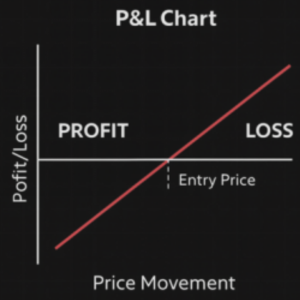
Shorting is profitable when prices decline and loss-making when prices rise. The P&L curve for a short position is the mirror image of a long position.
|
Price Movement |
Short Position Outcome |
|
Price falls |
Profit |
|
Price rises |
Loss |
|
Price flat |
No profit/loss |
In short trades, the stoploss is always placed above the entry price, because rising prices hurt the short seller. This is the opposite of long trades, where the stoploss is placed below the entry.
9.7 Key Takeaways

- Shorting reverses the buy-sell logic. Traders sell first and buy back later at lower price to make profit. They don’t buy up front.
- You make money when prices go down: If you think a stock is going to go down because of weak earnings, sentiment or macro – shorting is a great way to make money.
- Placing critical stop-losses In short trades, stoploss is always put above entry price to limit losses if stock moves up.
- Shorting in the spot market is intraday only: You have to square off your short positions before the market closes. If you take them forward you may be penalised.
- Short delivery has draconian penalties: If you don’t buy the shares back by the close of business, the exchange settles via auction, usually at a punitive price (up to 20% more).
- Futures allow overnight shorting Unlike spot trading, futures contracts allow short positions to be held overnight and until expiry.
- Long and short futures have equal margin. Deposits are required on both sides of the bet. Bullish or bearish, rules are rules.
- Mark-to-market (M2M) Profits / losses on short futures and long position are marked-to-market daily.
- Shorting Balances Trading Style. Markets do not always go up. Traders become flexible and resilient when they can make money in bear markets.
- Risk management is not optional: Margins, stop-losses and discipline are the key guardrails to prevent small mistakes turning into big losses.
9.8 Fun Activity

You decide to short Infosys Futures at ₹1,520 with a lot size of 300 shares.
Try to calculate your profit or loss in each case below:
- Price falls to ₹1,500
- Price rises to ₹1,540
- Price stays flat at ₹1,520
Formula : (Sell Price-Buy Price)*Lot Size
Answers
- ₹1,520 – ₹1,500 = ₹20 × 300 = ₹6,000 profit
- ₹1,520 – ₹1,540 = –₹20 × 300 = ₹6,000 loss
- ₹1,520 – ₹1,520 = ₹0 × 300 = No profit/loss
9.1 Shorting Made Simple
Most of us are familiar with the idea of buying first and then selling. whether it’s a house or a share or even a cricket ticket. You buy it at one price, wait for it to go up, and then sell it for a profit. This logic of first buying and then selling is intuitive because it mirrors how we transact in our everyday life. But there’s another way to make money in the trading world that reverses this order: short selling, or just shorting.
The opposite is shorting. You sell it first . Then you buy it later, hopefully cheaper . You don’t own it . You sell it at a price , you bought it at a price . The difference is the profit . It might seem strange at first, but the reasoning is straightforward: if you think a stock’s price will fall, you make money by selling high now and buying low later.
To put this in context, let’s use a simple analogy. Imagine you and a friend are watching a tense India vs Australia cricket match. You are sure that India will win so you place a bet on their side. But your friend thinks Australia will win and places a bet against India. Win India, Win Cash. If India loses, your friend wins. Now imagine India is a stock. If the stock goes up you make money . Your bet is like going long . Your friends bet is like shorting , they will make money if the stock drops .
That’s the whole point of shorting. It is a way of making a profit if prices fall. If a stock is overvalued or on the cusp of falling due to weak earnings, poor sentiment or macro factors you can short the stock. This way you sell the stock or futures contract first, then buy them back when the price drops.
If you are new to this concept, do not worry. The mechanics are a bit strange at first, but become obvious with practice. The best way to get a feel for shorting is to try it out in a controlled environment, perhaps with a small intraday position and observe how the profit/loss behaves as prices move.
In the next few chapters we will look more closely at the rules, risks and strategies of short selling. You’ll learn when to do it, how margins work and what to look for when betting against the market.
9.2 Shorting Stocks in the Spot Market
Before we look at shorting in the futures market, it is useful to look at shorting in the spot market first. Let us take a trader looking at the daily chart of HCL Technologies. The chart shows a bearish Marubuzo candlestick pattern, with strong trading volumes, resistance at critical levels and confirming signals from technical indicators. The risk reward ratio is attractive and the trader expects the stock to drop 2% the next day based on this analysis. To take advantage of this expected move, the trader chooses to short the stock.
Shorting is the opposite of the usual buy then sell later transaction. Here, the trader directly sells the stock at ₹2,420 and intends to buy it back at a lower price later. In the trading platform, this is executed by placing a sell order for the required quantity. Once the trade is executed, the trader has gone short.
Let us now discuss how profit and loss unfolds. Short is easy, the stock price should go down. If it does, the trader wins. If it goes up instead then the trade is a loss. Hence the importance of stoploss placement. In short trades the stoploss is always above the entry price, unlike with long trades where the stoploss is below the entry price. Here, the trader puts the stoploss at ₹2,440 which is ₹20 above the entry point.
To illustrate this, we can take two scenarios:
Scenario 1 – Price Falls to Target The stock falls to ₹2,370 from ₹2,420. The target is hit. The trader closes the position by buying back at the lower price . Because the position was opened by selling first . The profit is the difference between the buying and selling price, ₹50 per share. This is equivalent to buying at Rs 2,370 and selling at Rs 2,420, only the order of transactions was reversed.
Scenario 2 – Price moves to stoploss The stock instead of falling, rose to Rs 2,440. This triggers the stoploss and forces the trader to buy back at a higher price to avoid further losses. The loss here is ₹20 per share, which is the short price minus the stoploss level. In normal buy-sell terms, it is the same as buying at Rs 2,440 and selling at Rs 2,420, which obviously results in a loss.
These are the situations that define shorting—you profit if prices fall, and you lose if they rise. The practice of setting a stoploss above the entry price is a discipline that helps limit losses in the event that the market moves against the trader’s expectations.
9.3 Shorting in Spot (The Exchange’s Perspective)
Definition: Spot/Cash Market
The spot market, also known as the cash market, is a financial market where securities or commodities are bought and sold for immediate delivery and settlement. In this market, transactions are conducted at the prevailing market price, known as the spot price, and ownership is transferred instantly, typically within two working days (T+2 settlement cycle in India).
Main Features:
- Instant settlement – buyer pays and receives the asset instantly.
- Real ownership: the investors have the full ownership of the asset (e.g. shares credited to DEMAT account).
- No expiry: Spot trades are not bound by contract duration unlike derivatives.
- Full capital required: Traders pay full value upfront; no leveraged or margin exposure.
For example:
If you buy 100 shares of HDFC Bank in the spot market at Rs 1,650, you will have to pay Rs 1,65,000 upfront. Your shares are credited to your DEMAT account within 2 days and can be held for lifetime.
Shorting on the spot market has a very strict limitation, it can only be done on an intra-day basis. This means that you can open a short position at any time of the trading day but you must cover the short before the end of the trading day. You cannot carry a short position overnight. To understand why, it may be useful to look at how the stock exchange views short sales.
When you short a stock in the spot market, you sell first. And once you place that sell order, the exchange systems record the transaction as a sale of shares. Importantly, the exchange doesn’t differentiate between a normal sale (where you actually own the shares in your DEMAT account) and a short sale (where you don’t). From their standpoint you sold shares and therefore you have to deliver them. Delivery obligations are only checked after the market closes, not during trading hours.
Now imagine this. A trader shorts Reliance Industries at Rs 2,450, hoping to see the price fall. But the decline does not happen and the trader decides to hold on, waiting for a drop the next day. The exchange noted that the trader sold Reliance shares at the end of the trading session. The trader does not have the shares in his DEMAT account and hence cannot fulfil the delivery obligation. This leads to what is called a short delivery.
In a short delivery situation , the exchange steps in and settles in the auction market . Defaulting traders pay stiff penalties that can be as high as 20% above the short price. For example, if the short was at ₹2,450, the settlement cost could be ₹2,940 or more, depending on the penalty. That makes a short delivery very expensive mistake. The moral of the story is simple though, always close your shorts before the market closes or you will be penalised.
Note that the exchange only audits for delivery obligations after trading hours. That means if you close your short position out during the day by buying the shares back you eliminate the obligation altogether. That is why the spot market short is an intraday only thing.
Does this mean that all short positions must be closed the same day? Not always. Shorts cannot be rolled over in the spot market, but shorts in the futures market can be carried overnight and even until expiry. They are also structured differently . The exchange recognises futures contracts as valid instruments to carry forward short trades .
9.4 Shorting in the Futures Market M2M Example
Futures segment shorting is far more flexible than shorting in the spot market. Short sales in the spot market must be covered on the same trading day, while futures contracts allow traders to hold positions overnight and even till expiry. That’s one of the reasons why futures trading is so popular. Futures are derivatives and simply track the performance of the underlying stock. If the underlying stock price goes down, the futures contract will also go down. That makes futures a good instrument for traders that are bearish on a stock and want to make money from its move down.
You need margin to go short in futures . Like you need a margin deposit to go long in futures . The margin rules are the same for long and short positions and are unaffected by direction. However what does change is the profit and loss calculation which is marked to market (M2M) daily.
Let’s go through an example. For example, let’s say a trader sells Infosys futures at ₹1,520 and the lot size is 300. The following table shows how the closing prices move over the next few days and how the M2M adjustments work out.
|
Day |
Reference Price |
Closing Price |
P&L for the Day |
|
01 (Initiate short) |
1520 |
1512 |
(1520 – 1512) × 300 = ₹2,400 |
|
02 |
1512 |
1505 |
(1512 – 1505) × 300 = ₹2,100 |
|
03 |
1505 |
1510 |
(1505 – 1510) × 300 = –₹1,500 |
|
04 |
1510 |
1518 |
(1510 – 1518) × 300 = –₹2,400 |
|
05 |
1518 |
1498 |
(1518 – 1498) × 300 = ₹6,000 |
|
06 (Square off) |
1498 |
1492 |
(1498 – 1492) × 300 = ₹1,800 |
Now, let’s add up the daily M2M values: +2,400 +2,100 –1,500 –2,400 +6,000 +1,800 = ₹8,400 profit
Alternatively, you can calculate directly from the entry and exit prices: (Selling Price – Buying Price) × Lot Size = (1520 – 1492) × 300 = 28 × 300 = ₹8,400
- Total Contract Value:₹1.2 crore
- Buyer:NovaTech Electronics (locks in price to avoid future hikes)
- Seller:PowerCell Traders (secures today’s higher price to avoid future declines)
- Type:Over-the-Counter (OTC) forward contract
What the Chart Shows
- Day 1 & 2:Price falls → Trader earns ₹2,400 and ₹2,100
- Day 3 & 4:Price rises → Trader loses ₹1,500 and ₹2,400
- Day 5 & 6:Price drops sharply → Trader gains ₹6,000 and ₹1,800
Total Profit: ₹8,400
Lot Size: 300 shares
Short Price: ₹1,520
Exit Price: ₹1,492
This example demonstrates that shorting futures is virtually the same as going long, except that profits only occur when prices drop. Same margin requirement and M2M process going one way or the other.
Shorting is a critical skill for active traders. Markets don’t always go up, and being able to profit from falling prices is just as important as riding bullish trends. The more you get used to starting short trades, the more versatile and balanced your trading approach will become.
9.5 Shorting Risk: What’s The Downside?
Short selling, or “shorting,” involves a trader selling an asset they do not own, betting the asset will decline in price so they can later buy it back at a lower price. This can be profitable in declining markets, but has a unique and potentially dangerous risk profile, particularly in the spot market.
The losses can be unlimited.
When you buy a stock, your maximum loss is limited to your investment. If the stock goes to zero you lose your capital. But nothing else. On the other hand, if you short a stock, you can lose unlimited amounts. That’s because there’s no limit to how high a stock price can go. Now if the price starts moving against your short, you are forced to buy back at a higher price and the loss keeps increasing as the price goes up.
Suppose you short Infosys at 1500, expecting it to fall Instead it jumps to ₹1,600. Now you have a loss of Rs 100 per share. If it goes up to ₹1,700 or ₹1,800, your losses will go up. There is no ceiling, your margin and risk controls are the limit of your losses.
Margin Calls and Liquidations
To protect themselves against this risk, brokers require margin deposits and constantly monitor your position. If the loss is greater than your margin, you will receive a margin call, a request for a deposit. Otherwise, the broker may forcibly square off your position to prevent more loss. This is especially true in futures where margin systems are tightly regulated.
Spot Market Shorting – Only Intraday
Short selling in Indian spot market is allowed only on intraday basis. You need to flatten out the position before the market closes. If that does not happen, the delivery is short and can be penalised by as much as 20% over the short price. This rule is meant to avoid delivery failures and limit systemic risk.
Shorting Futures – Overnight is Allowed but Risky
Short positions can be held overnight in the futures market. This gives traders more flexibility, but also exposes them to overnight news, gaps and volatility. Sudden good news or policy shifts can cause sharp moves upwards and heavy losses to short sellers.
9.6 Comparing Spot vs Futures Shorting: Risk, Constraints, and P&L Behavior
Shorting is a powerful tool for those traders who expect prices to fall. But the mechanics and the risk profiles of the spot market versus the futures market are quite different. Understanding these differences is important in choosing the right instrument and effectively managing risk.
Spot Shorting Intraday
Shorting in the spot market is strictly limited to intraday trades. Must fill the position prior to market close. That’s because the exchange expects shares to be delivered after the trading session. If you don’t have the shares, and you don’t buy the shares back by the end of the day, it is a short delivery, and there are steep penalties for this, sometimes up to 20% above the short price.
- Constraint: Must close squares before market close
- Risk: Risk of penalty in respect of auction settlement
- Use Case: Tactical intraday trades on technical set-up
Futures Shorting: Allowed Overnight
Futures, on the other hand, allows for the carrying of short positions overnight and even to expiry. This flexibility makes futures a good choice for taking short positions over several days. But it also has overnight risk—the risk that bad news or events could cause a sharp spike in price before the next trading session.
- Constraint: No delivery requirement; position can be held overnight
- Risk: Gap risk, news flow and volatility overnight.
- Use Case: Swing trading, event-driven hedging, or directional trades
Profit and Loss Behaviour Short Position P&L
Shorting is profitable when prices decline and loss-making when prices rise. The P&L curve for a short position is the mirror image of a long position.
|
Price Movement |
Short Position Outcome |
|
Price falls |
Profit |
|
Price rises |
Loss |
|
Price flat |
No profit/loss |
In short trades, the stoploss is always placed above the entry price, because rising prices hurt the short seller. This is the opposite of long trades, where the stoploss is placed below the entry.
9.7 Key Takeaways
- Shorting reverses the buy-sell logic. Traders sell first and buy back later at lower price to make profit. They don’t buy up front.
- You make money when prices go down: If you think a stock is going to go down because of weak earnings, sentiment or macro – shorting is a great way to make money.
- Placing critical stop-losses In short trades, stoploss is always put above entry price to limit losses if stock moves up.
- Shorting in the spot market is intraday only: You have to square off your short positions before the market closes. If you take them forward you may be penalised.
- Short delivery has draconian penalties: If you don’t buy the shares back by the close of business, the exchange settles via auction, usually at a punitive price (up to 20% more).
- Futures allow overnight shorting Unlike spot trading, futures contracts allow short positions to be held overnight and until expiry.
- Long and short futures have equal margin. Deposits are required on both sides of the bet. Bullish or bearish, rules are rules.
- Mark-to-market (M2M) Profits / losses on short futures and long position are marked-to-market daily.
- Shorting Balances Trading Style. Markets do not always go up. Traders become flexible and resilient when they can make money in bear markets.
- Risk management is not optional: Margins, stop-losses and discipline are the key guardrails to prevent small mistakes turning into big losses.
9.8 Fun Activity
You decide to short Infosys Futures at ₹1,520 with a lot size of 300 shares.
Try to calculate your profit or loss in each case below:
- Price falls to ₹1,500
- Price rises to ₹1,540
- Price stays flat at ₹1,520
Formula : (Sell Price-Buy Price)*Lot Size
Answers
- ₹1,520 – ₹1,500 = ₹20 × 300 = ₹6,000 profit
- ₹1,520 – ₹1,540 = –₹20 × 300 = ₹6,000 loss
- ₹1,520 – ₹1,520 = ₹0 × 300 = No profit/loss