2.1 Meaning Of Derivatives Market
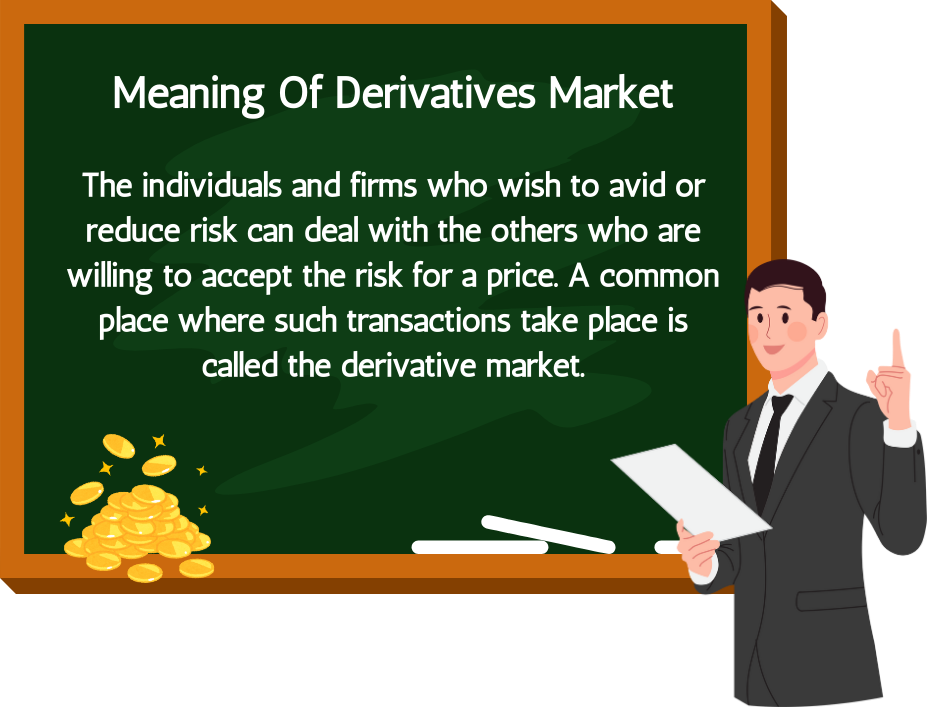
Financial instruments which are used to manage and mitigate risk are known Derivatives. They allow people and companies who want to avoid uncertainty to transfer that risk to others who want to take that risk, often for a potential reward. Derivatives market is a platform on which such risk sharing transactions are transacted. Derivatives were first traded in unregulated, informal markets. But over time, more structured and regulated markets were created.
Derivatives are now traded in two broad ways – on organised exchanges and over-the-counter (OTC) markets. Just because a market is OTC doesn’t mean it is not developed. It means that contracts are negotiated directly between parties or intermediaries and both sides agree on custom terms. The derivatives market is basically the market for trading these financial contracts. It appeals to a wide range of players including hedgers wanting to reduce risk, speculators wanting to make money out of price changes and arbitrageurs profiting from price gaps between markets.
2.2 Functions Of Derivatives Markets
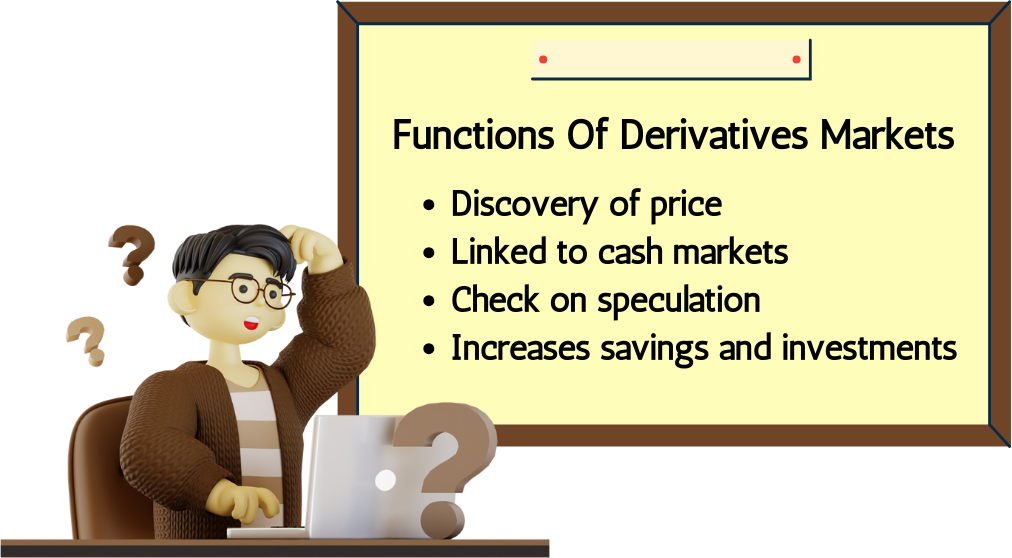
- Price Discovery:
Traders’ expectations of future developments are reflected in prices on organized derivative markets. For instance, if crude oil futures are quoted at ₹7,000 a barrel for next month, it suggests that the market expects prices to rise. The closer the contract gets to expiry the price tends to the true market price of the crude oil. This will help companies and investors to make better decisions about what trends to expect.”
2. Risk transfer
Derivatives are a means for one party ( who does not want to take a risk, such as a farmer who is worried about the price of crops ) to transfer that risk to another party ( who is willing to take that risk, such as a speculator ). Suppose you’re a wheat farmer. So you buy a futures contract to hedge the price of your wheat. Someone else takes on the risk and bets in the futures market. He wants to make money when the price goes up or down.
3. Linkage of Cash Markets:
Derivatives are related to the underlying markets, whether stocks, commodities or currencies. Derivatives bring in other actors not directly involved in the cash market. For example, the introduction of Nifty futures has resulted in an increase in the trading volume of the underlying Nifty 50 index, leading to a more active and efficient market.
4. Speculation control.
Without an organised market in derivatives, speculators would likely operate in cash markets and their actions would be hard to monitor. But on derivatives exchanges there is trade monitoring, there are margins and risk is better controlled. This makes for a more transparent and safer trading environment.
5. More saving, more investment
The risk transfer makes the investor comfortable to be in the market. Mutual funds can use index futures as a way to hedge their portfolios. This allows them to get into larger positions without the fear of sudden losses. This will push more savings into financial products that permit long-term investment to grow over time.
2.3 Participants In The Derivatives Markets

Hedgers use derivatives to protect against adverse price moves. Consider the case of a textile exporter in Surat who expects to be paid in euro three months later. They enter into a currency forward contract that fixes the exchange rate to protect against a falling euro. For example, a dairy company might want to hedge input costs during periods of high demand, using milk futures. Hedgers pay a premium to have certainty of price, and to protect margins.
Speculators: The Risk Takers
A change in price makes speculators willing to take a risk and hope to make money. For example, if a trader believes that crude oil prices will increase due to geopolitical tensions, These buy crude oil futures on MCX, with an eye on selling it at a higher price later. If they are right, they make money; if they are wrong, they take the loss. Day traders in Indian markets can buy and sell bank nifty options and speculate on the price movements of the bank nifty during a day. Position traders can hold the contracts for weeks based on the technical charts or macroeconomic news.
Arbitrageurs – Those who exploit price gaps
Arbitrageurs profit from price differences between markets with little or no risk. For example, if spot price is Rs 72,000 per kg and futures price is Rs 72,500 per kg, an arbitrageur will buy in the spot and sell in the futures market to earn Rs 500 per kg. For example, if the SBI stock is traded at Rs 610 on the NSE and Rs 612 on the BSE then the trader can buy the stock at Rs 610 on NSE and sell the same at Rs 612 on BSE and make a profit of Rs 2. A high frequency arbitrageur could buy and sell at the same time and pocket the difference of ₹2. They are useful for aligning prices and increasing market efficiency .
Margin Traders – Leverage Maximisers
Derivatives enable margin traders to control large positions with a little capital. Suppose a trader has Rs 2 lakh and he wants to get exposure to Tata Motors shares which is trading at Rs 800. They purchase 250 shares in the cash market. But in the derivatives market with a 25% margin requirement they can control 1,000 shares. If the price increases by ₹50 , their profit increases by ₹37,500 due to leverage , from ₹12,500 to ₹50,000 . This increases the gains and the risks, and turns margin trading into a high stakes strategy.
Margin Trader’s Account Under Daily M2M
Example Setup
- Contract: Nifty Futures
- Lot Size: 50 units
- Entry Price: ₹20,000
- Initial Margin (SPAN + Exposure): ₹1,00,000
- Trader: Long 1 lot
- Risk-free rate ignored for simplicity
Table 1: Daily M2M Adjustments
|
Day |
Futures Closing Price |
Daily Price Change |
M2M Gain/Loss (₹) |
Margin Account Balance (₹) |
Remarks |
|
0 |
20,000 |
– |
– |
1,00,000 |
Initial margin deposited |
|
1 |
20,100 |
+100 |
+5,000 |
1,05,000 |
Profit credited |
|
2 |
19,950 |
-150 |
-7,500 |
97,500 |
Loss debited |
|
3 |
19,800 |
-150 |
-7,500 |
90,000 |
Balance falls further |
|
4 |
19,700 |
-100 |
-5,000 |
85,000 |
Near SPAN threshold |
|
5 |
19,600 |
-100 |
-5,000 |
80,000 |
Breach → Margin call |
Table 2: SPAN Limit Breach Illustration
|
Parameter |
Value (₹) |
|
Initial Margin Requirement |
1,00,000 |
|
SPAN Maintenance Margin |
80,000 |
|
Balance After Day 5 |
80,000 |
|
Status |
Margin call triggered |
Explanation
- Day 1:Trader gains ₹5,000 (100 × 50). Balance rises to ₹1,05,000.
- Day 2–4:Consecutive losses erode margin.
- Day 5:Balance exactly equals SPAN maintenance margin (₹80,000). Any further loss breaches the requirement, triggering a margin call.
- If trader fails to replenish funds, the broker may square off the position.
2.4 Difference Between Cash Market and Derivative Market

Ownership in the cash market or derivatives market
For example, if you buy 100 shares of HDFC Bank in the cash market, you are the legal owner of those shares. The shares are in your demat account owned by you. HDFC Bank future is just a speculation on relative movement in price. You have no position and need to close the position before expiry.
Time Period Held
Cash market investments have no holding period. You can buy Marico shares today and donate it to your children years later. But in the derivatives market, contracts have a limited life span, usually one, two or three months You have to close or roll your position before expiration.
Company Benefits and Dividends
As a cash market shareholder you are entitled to dividends, bonus issues and rights offers. For example if Infosys declares a dividend of Rs 20 then you will get it if you are holding the shares. But if you hold futures or options on Infosys you will not get any of these benefits because you are not a shareholder.
Risk Exposure:
Both markets have risk, but derivatives are typically more volatile. If you buy tata steel shares in cash market and price falls you can wait for price to recover. But if you have a futures contract, you may be forced to sell early, for example, from a margin call or expiry pressure if the price has fallen significantly.
Investment Rationale:
Cash market players are generally long term investors looking for ownership and growth. Derivatives traders are usually short term players, taking a hedge or a bet on a price move. For long term appreciation, a mutual fund can buy shares of Asian Paints. * Options – A trader can bet on the quarterly results.
Units Traded:
In cash market you can buy any number of shares like 25 shares of ICICI Bank. In the derivatives market you trade in fixed lot sizes. For instance, one lot of ICICI Bank futures could be 1375 shares. 25 shares will not buy you a future.
2.5 Exchange Traded vs OTC Derivative Market

Derivatives have been around a long time. They began with forward contracts, contracts merchants would use to buy commodities to be delivered at some future time at a certain price. For example, an Indian pepper trader might agree to sell his pepper at one fixed price after the harvest, but then might be able to sell it on the spot at a higher price. This also helped the spice trader not to lose his money if the prices suddenly changed. These ancient contracts were the start of the markets we have today.
People trade derivatives in two ways today:
Exchange Traded & OTC (Over-the-Counter)
Exchange Traded Derivatives are traded on exchanges like NSE, BSE, CME etc. These derivative contracts have a standard size, expiry and conditions. Futures or options on Bank Nifty always have a fixed lot size and a fixed expiry date. SEBI and other regulating bodies in India regulate these derivatives contracts. This regulation is ensuring transparency and less risky for the person not paying.
The difference with OTC Derivatives is they are privately negotiated between two parties. You can adapt these contracts to your own specific needs. Say, for example, you are a corporate treasurer. You might do a currency swap with a bank to hedge yourself against fluctuations in the dollar.” The OTC markets have flourished thanks to globalisation and new digital instruments. OTC derivatives are highly flexible but there is a risk that the counterparty will not honour the deal.
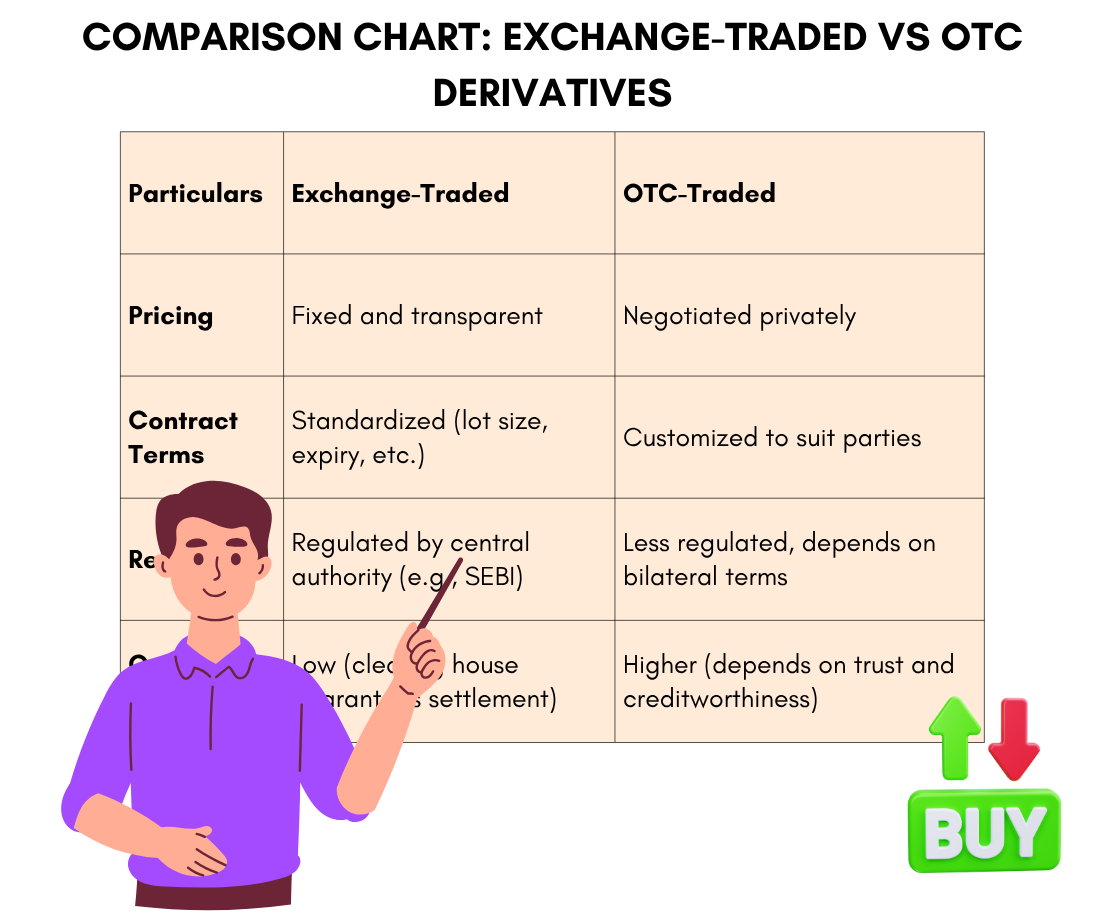
2.6 Comparison Chart: Exchange-Traded vs OTC Derivatives
|
Particulars |
Exchange-Traded |
OTC-Traded |
|
Pricing |
Fixed and transparent |
Negotiated privately |
|
Contract Terms |
Standardized (lot size, expiry, etc.) |
Customized to suit parties |
|
Regulation |
Regulated by central authority (e.g., SEBI) |
Less regulated, depends on bilateral terms |
|
Counterparty Risk |
Low (clearing house guarantees settlement) |
Higher (depends on trust and creditworthiness) |
|
Flexibility |
Limited no changes to contract terms |
High terms can be tailored |
|
Examples |
Nifty futures, gold options on MCX |
Currency swaps, customized interest rate swaps |
2.7 Key Takeaways

- Market for derivatives :The market for derivatives is a market for trading financial contracts whose value is derived from the underlying assets. This includes regulated trading venues and private over-the-counter (OTC) arrangements.
- Pricing and Discovery Role: The prices of derivative contracts reflect the market’s expectations of the future values of the underlying assets. These prices are the current and future prices in the underlying cash markets.
- Risk transfer mechanism: Derivatives allow risk-averse players to transfer their risk exposure to risk-takers, thus setting up an equilibrium system of hedgers and speculators.
- Cash Market Linkage: The underlying cash markets are closely related to the derivatives. They allow for the participation and the volumes of transactions on the spot market.
- Control of Speculation:Organized derivatives markets provide a controlled arena for speculative activity and thus it is easier to monitor and control market behaviour.
- Participants in the derivatives market The key players are:
- Hedge: Protect against price changes.
- Speculators . They put their capital in the hope of profit.
- Arbitragers: Exploit price differences in various markets.
- Margin trading. Control large positions with a small amount of capital.
- Exchange-Traded versus Over-the-Counter Derivatives
Exchange traded derivatives are standardised , regulated and transparent. OTC derivatives are privately negotiated , flexible and customised but also carry a higher counter party risk .
- Standardised vs Customised
Exchange traded contracts are standardised (lot size, expiry, quality) while OTC contracts are tailored to the requirements of the parties involved.
- Regulatory oversight
Exchange traded derivatives are regulated by a central authority (like SEBI in India) OTC contracts may be subject to different regulatory regimes depending on the parties and jurisdictions involved.
2.8 Fun Activity

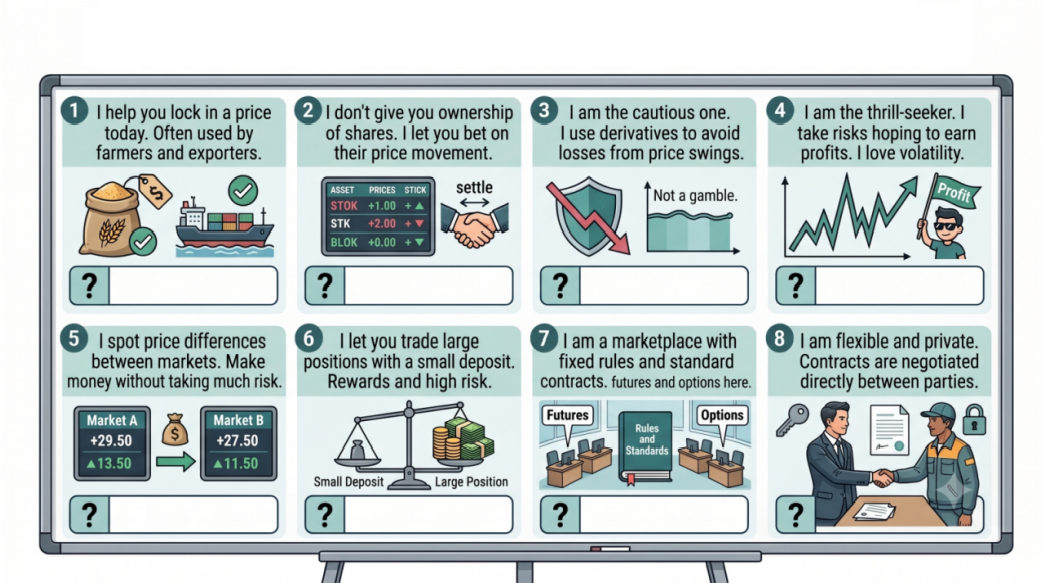
Instructions: Read each clue and select the correct answer from below for each
1.Forward Contract
2.Derivatives Contract
3.Speculator
4.Arbitrageur
5.Margin Trader
6.Hedger
7.Exchange-Traded Market
8.OTC Market