
5.1 Pre-Trade Planning and Execution Mechanics

Before executing the Infosys October Futures trade, the trader’s important decision is to select the product type between NRML and MIS. The choice depends on the expected holding period and margin efficiency.
NRML (Normal) : Multi-day position, full margin (SPAN + Exposure) required.
MIS (Margin Intraday Square-off): s for same day trades and has lower margin requirements.
So how does the trader decide?
They check the Margin Calculator.
The tool shows the margin required for each of the two product types, which allows the trader to align their capital deployment with their strategy. If the trader wants to take the position overnight, he can use NRML. If the view is short term and intraday then MIS helps in capital conservation.
Once you have selected the product type and made the order, four steps are instantly executed behind the scenes:
- Margin check : The broker of the system checks if the trader has enough funds to cover the margin requirement. If not the order is denied.
- Counterparty Swap : The exchange finds a buyer willing to take the other side. This match is required for the trade execution.
- Digital contract: The two parties accept the terms of the contract electronically. This step is symbolic but formalises the trade.
- Block :The margin required is in the trader’s account. It stays blocked until the position is squared off or expires.
These steps take seconds to execute so that the execution on the trading platform is smooth. The trader now has one lot of Infosys October Futures and the product type (NRML or MIS) will determine the margin blocked and the length of the position.
5.2 The Futures Trade

Let’s see the Infosys trade setup. The stock plunged in intra-day trades on a cautious guidance after announcing Q2 FY26 earnings on October 16, 2025. But the strong fundamentals and seasonality lent themselves to a bullish picture. The trader bought the October Futures contract, wanting the price to recover before the contract expired.
The entry price for Infosys October Futures was Rs.1,442.50 a share. The minimum tradable quantity was one lot of 300 shares and the total contract value was ₹432,750. You can buy a futures contract by placing an order with a broker or a trading terminal. In this case the trader added the Infosys Futures to the market watch using the terminal and pressed on the buy key to initiate the trade.
But behind the scenes, a few things happen in a flash:
- Margin check:The broker’s system checks if the trader has enough funds to meet the margin requirement. The margin requirement is a % of the value of the trade. If there is not enough margin , the trade will not be executed .
- Counterparty Match:the exchange finds a seller who has the opposite position. Buyer bets that the share price of Infosys will go up, seller bets that it will either go down or remain constant. The match is required for execution of the contract.
- Digital Agreement:Once the buy and sell match and margin is confirmed, the buyer and seller digitally agree to the contract’s terms. This is a binding symbolic gesture.
- Margin Block:There is a block on margin of trader’s account. It is held until it is squared off or the contract expires.
By doing this the trader has one lot of Infosys October Futures in his hands. They have given formal commitment to buy 300 shares of Infosys at ₹1,442.50 each and will expire on October 31, 2025. If the stock price goes up before the expiration date , the difference is profit for the trader . If it drops, they are out. On a live trading platform this takes seconds.
5.3 Three Possible Outcomes by Expiry
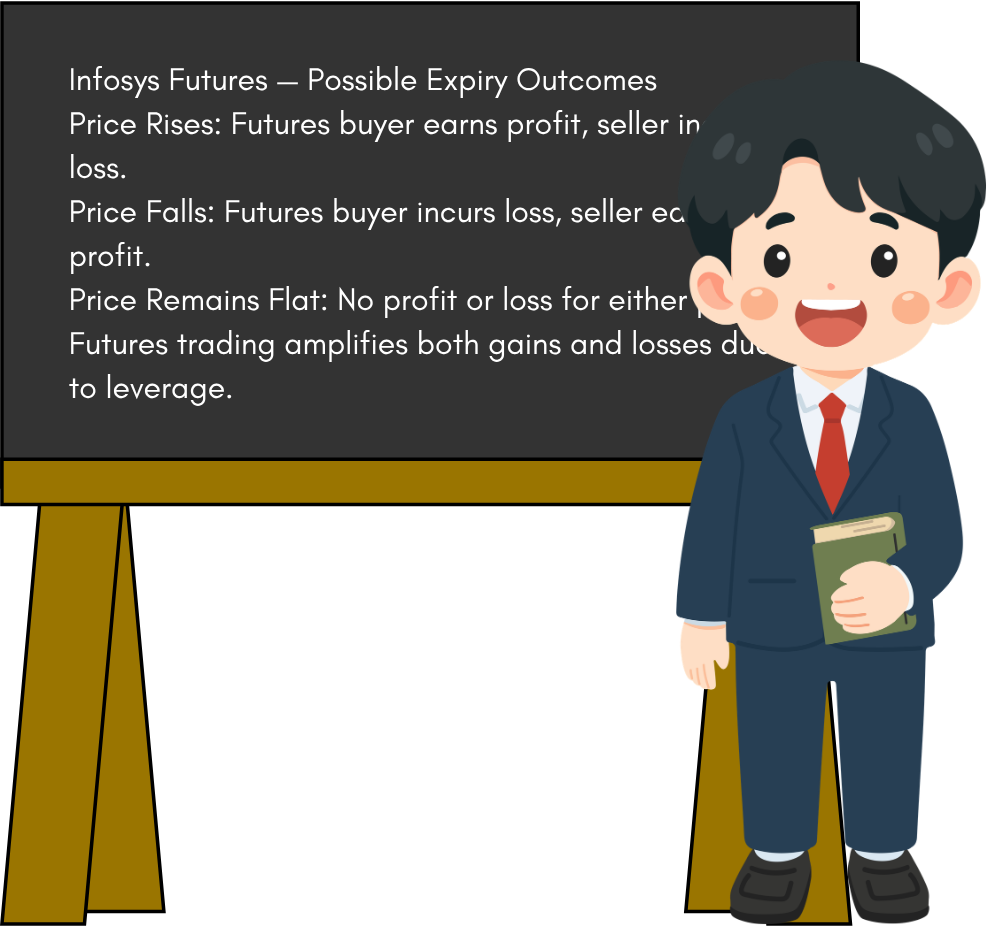
Once a trader goes long on Infosys October Futures contract and buys one lot (300 shares) at ₹1,442.50 per share, he/she has committed to the trade till expiry i.e., 31st October 2025. Till then, there are three possible scenarios, any of which can occur depending on how much the stock price of Infosys rises or falls.
For example, if a trader buys one lot (300 shares) of Infosys October Futures at ₹1,442.50 per share, the trade gets locked-in until expiry on 31 October 2025. Now the trader has three different possibilities depending on what happens to the Infosys stock price over the next few days before expiry.
Scenario 1: Infosys share price soars
That is as good as it gets for the trader who took a bullish view. If the stock of Infosys bounces back from the dip in earnings and price of October Futures rises to ₹1,475 at expiry. The trade was done at ₹1,442.50 and the trader is likely to make a profit of ₹32.50 per share. The total profit (with lot size 300 shares) is:
₹32.50 × 300 = ₹9,750
This profit is earned without taking delivery of shares, as stock futures are cash settled in India. The trader profits from a correct prediction of the bounce. Futures is used to leverage the profits with less cash outlay. Here the counterparty is the seller of the futures contract. The seller loses Rs 9,750. When the market is willing to pay Rs 1,475, they will have to sell at Rs 1,442.50. In this case, futures will pay you for being right on direction and timing.
Scenario 2: Infosys share price drops down
The result is a losing directional view. Lets assume Infosys continues to go down and October Futures closes at ₹1,410. The trader purchased at ₹1,442.50 and is now sitting with a loss of ₹32.50 a share.
Total loss:
₹32.50 × 300 = ₹9,750
Here the trader is effectively buying at a premium to the market price and loses money straight away. This example shows the danger in trading in futures. Leverage can multiply your gains but it can also multiply your losses . Here the buyer has a loss of Rs 9,750 while the seller can lock-in a better selling price than the current market price and earns Rs 9,750.
Scenario 3: Infosys Share Price Stays Flat
In this neutral case, the stock and the futures would be flat at ₹1,442.50 each at expiry. If entry and exit price are same, no one makes profit or loss. The contract expires, and nobody makes any money. This is a common result in low volatility markets or after a big event and a period of consolidation in the market. It points out that profitability in futures trading is not only about direction, but also about timing and momentum.
5.4 Exploiting a Trading Opportunity
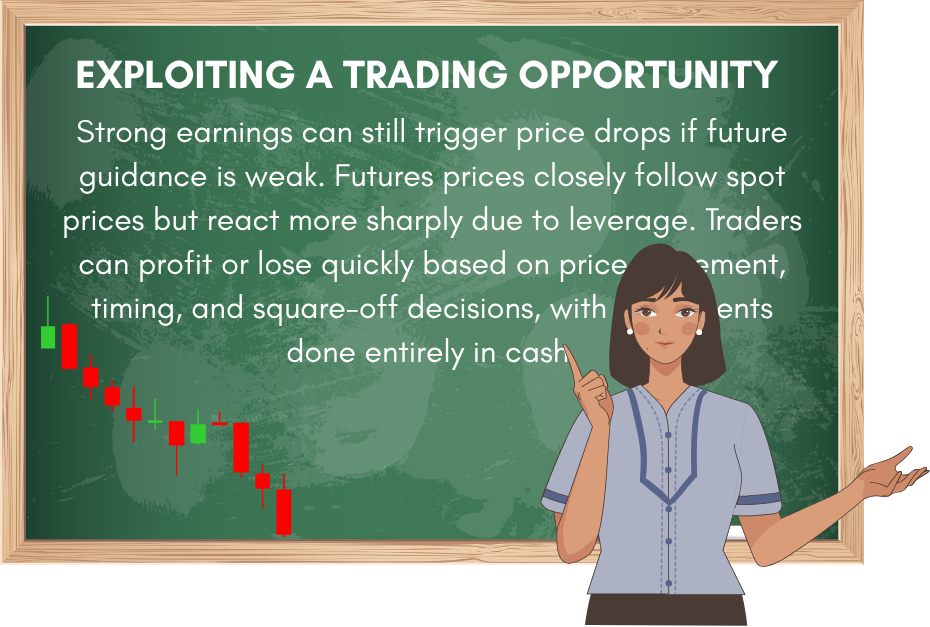
Now, imagine that on October 17, 2025, just a day later, Infosys stock bounces sharply. October Futures are quoting at ₹1,475.00 now. The trader is sitting on a profit of:
- ₹1,475.00 – ₹1,442.50 = ₹32.50 per share
- ₹32.50 × 300 shares = ₹9,750 total profit
Here’s a graphic of that journey of trade:
The trader now has two options:
- Square the position and take the profit of Rs 9,750.
- Hold until expiry (31st October 2025) and hope for further upside.
If the trader is happy with the gain or is no longer bullish they can close the position at any time. Futures contracts are fully transferrable, i.e. the trader can transfer the agreement to another participant in the market. This process is known as a square off.
To exit a long position, the trader sells the same quantity of futures contracts they originally bought. The trading terminal finds a counterparty to take the opposite side. When the trade is made:
- The buy is neutralised by the sell.
- The margin gets released.
- The profit is credited to the trader’s account on the same day.
Here’s a table summing up square off logic:
Square Off Logic – Infosys Futures
|
Serial No |
Initial Leg |
View at Entry |
Square Off Leg |
View at Square Off |
|
1 |
Buy / Long |
Expect price to go higher – Bullish |
Sell |
No longer expect price to rise, or want to exit the position and book profits |
|
2 |
Sell / Short |
Expect price to go lower – Bearish |
Buy |
No longer expect price to fall, or want to exit the position and cut losses |
The table illustrates how traders can enter and exit futures positions as their view of the market changes. In your Infosys example,
You bought at ₹1,442.50 hoping for a rise.
When the price touched ₹1,475, you sold to square off and booked profit of ₹9,750.
Now let’s assume that the trader held the position till 30th October 2025 when Infosys October Futures were trading at ₹1,490.00. Would have been the profit:
₹1,490.00 – ₹1,442.50 = ₹47.50 Per Share
₹47.50 x 300 shares = ₹14,250 Total Profit
Meanwhile the counterparty who bought the contract at 1475.00 on 17 October would also have made money:
₹1,490.00 – `1,475.00 = `15.00 per share
300 shares @ Rs.15.00 = Profit Rs.4,500
This example shows how futures offer flexible entry and exit, and how both parties can profit depending on their timing and outlook.
5.5 Key Takeaways

1) Earnings Are Moving Markets: Infosys Q2 FY26 Results (16 Oct 2025) reported strong revenue growth (+8.55%) and profit growth (+13.18%). But the conservative guidance (2-3% growth) triggered a sell-off in both spot and futures prices.
2) Usually October is a slow month for IT companies, because of client budgets
3) Such patterns are therefore likely to keep investors on a cautious footing regarding short-term fluctuations.
4)Spot vs Futures Reaction Spot down from ₹1,480->₹1,437 (~3%) October Futures at ₹1,442.50 (~3.1%) Futures are usually an amplification of moves in the cash / spot market and tend to trend with them.
5) Leveraging Advantage: Now, if you buy 1 lot (300 shares) of Infosys Futures at Rs 1,442.50 then the value of contracts you will get is Rs 432,750.Also note, you would have paid only a fraction ( ~ 20-25% ) as margin while taking this big position worth nearly 4 lakh rupees!
6) How the trades are made. When you put on a futures order, there’s an instant margin check, a match with a counterparty, a digital agreement, a margin block behind the scenes.
7) Three expiration scenarios
- Gain → Increase (Ex: ₹9,750)
- Fall →Loss (Example: ₹9,750).
- Flat – No loss and no gain. Leverage increases the results of the binary futures.
8) Cash settlement Stock futures are cash settled in India. This means traders do not take delivery of shares. Direct profits / losses credited / debited.
9) .Flexibility to Square-off: Traders can square-off (i.e. sell if long or buy if short) in advance. This allows you to take profits or cut losses before expiry.
10. Timing Matters: Ex: 17 Oct, square off at Rs 1,475 made Rs 9,750 profit. HOLD till 30 Oct at ₹1,490 would have given ₹14,250. ‘Decision making is a function of risk appetite and market view.
11. Potential for profit on both sides: Several participants can profit at different times through Futures. If one trader backs out the other can still profit if prices go further in their favour
5.6 Fun Activity

Scenario: You buy 1 lot of Infosys October Futures at ₹1,442.50. Lot size = 300 shares.
Now, check each expiry price below and calculate whether you make a profit or loss.
Questions
- If the futures settle at ₹1,475, what is your profit/loss?
- If the futures settle at ₹1,410, what is your profit/loss?
- If the futures settle at ₹1,442.50, what is your profit/loss?
Formula
Sell Price-Buy Price * Lot Size
Answers
- ₹1,475 – ₹1,442.50 = ₹32.50 × 300 = ₹9,750 profit
- ₹1,410 – ₹1,442.50 = –₹32.50 × 300 = ₹9,750 loss
- ₹1,442.50 – ₹1,442.50 = ₹0 × 300 = No profit, no loss