
11.1 The Futures Pricing Formula

Most traditional courses in derivatives begin by presenting the formula for pricing futures. But here we have opted to talk about it later. The reason is pretty simple, if you are trading futures mostly using technical analysis, you don’t have to calculate fair values every day. But if you are going to be using quantitative strategies such as calendar spreads or index arbitrage, then it is critical to know how futures are priced. This chapter prepares you for those advanced strategies.
We know that a futures contract derives its value from the underlying asset and typically moves with it. If the underlying goes up, the futures price goes up. If the spot price goes down, the futures price goes down. But the futures price is not the same as the spot price. The difference between the two is known as the spread or basis.
For instance, let’s say the Nifty Index is trading at 19,850 in the spot market while the current month Nifty Futures contract is trading at 19,865. Here the spread is 15 points. This difference is explained by the so-called spot-futures parity which takes into account factors such as interest rates, dividends and time to expiration.
The general formula for futures pricing is:
Futures Price =Spot Price*[1+rf * x/365 – d]
Where:
- = risk-free rate (annualized)
- = dividend yield expected during the contract period
- = number of days to expiry
The risk-free rate is often taken from short-term government securities, such as the RBI’s 91-day Treasury bill yield.
Example: Calculating Fair Value
Let us assume Reliance Industries trading at the spot market at 2,450 and there are 10 days to expiry. The risk-free rate is 7% per annum, and no dividend is expected during this period.
Futures Price = 2450 * [1+0.07*10/365]
=2450 *(1+0.0019)=2454.65
So the fair value of Reliance Futures is ₹2,454.65. .If the actual market price of the futures contract is ₹ 2,456, the small difference can be attributed to transaction cost, taxes or short term supply demand imbalance.
Mid-Month and Far-Month Contracts
The longer the time to expiry, the larger the spread between spot and futures. For example:
- Mid-month contract (30 days to expiry):
2450 * [1+0.07*30/365] =2464.10
- Far-month contract (75 days to expiry):
2450 *[1+0.07 *75/365]=2485.24
Notice how the futures price increases with more days to expiry,(₹2,454.70 for 10 days → ₹2,464.10 for 30 days → ₹2,485.24 for 75 days), reflecting the cost of carry.
Discount & Premium
- If futures trade above the spot price, the market is said to be at a premium. This is what is often called a contango in commodity markets.
- If futures trade below the spot price, the market is said to be at a discount i.e. in commodities, backwardation.
When Nifty Futures across the series are continuously trading at a higher price than the Nifty spot, the Futures are said to be trading at a premium. But futures and spot prices will always converge as expiry approaches. The futures contract expires and is closed out at the spot price.
Things to Remember
- The spot-futures spread is wider at the start of the series and narrows as expiry approaches.
- Futures and spot prices always converge on expiry day.
- Premium and discount are natural consequences of cost of carry and market forces.
Fair value is a theoretical yardstick and the actual market price reflects real world frictions such as taxes, margins and liquidity.
11.2 Practical Application of the Futures Pricing Formula

Before we finish this chapter, let’s see how we can apply the futures pricing formula in practice. This is particularly useful when you move beyond simple directional trades and get into quantitative strategies, such as calendar spreads or index arbitrage, as discussed before. What follows is merely a preview – later modules on trading strategies will cover these techniques in greater depth.
Example: Reliance Industries
Suppose the following data is available:
- Reliance Spot Price = ₹2,450
- Risk-Free Rate (Rf) = 7%
- Days to Expiry (x) = 20
- Dividend (d) = 0
Using the futures pricing formula:
Futures Price = 2450 * [1+0.07 *20/365]-0
=2450 * (1+0.0038)= 2459.3
So, the fair value of Reliance Futures should be around ₹2,459.
Market Imbalance
The actual futures contract is trading at 2,490 and the difference between the spot and futures should be 9 points but here the gap has widened to 40 points.
This is an opportunity to put on a spread trade.The futures are trading above their fair value and are considered to be expensive relative to the spot. The spot price looks cheap relative to the futures.
Executing the Trade
The thumb rule in spread trading is simple: buy the cheaper asset and sell the expensive one.
- Buy Reliance in the spot market at ₹2,450
- Sell Reliance in the futures market at ₹2,490
On expiry, both spot and futures prices will converge to the same level. Let’s assume a few possible convergence points:
- If both converge at ₹2,470 → Profit = (Futures Sell – Futures Buy) + (Spot Sell – Spot Buy) = (2490 – 2470) + (2470 – 2450) = ₹40
- If both converge at ₹2,430 → Profit = (2490 – 2430) + (2430 – 2450) = ₹60 – ₹20 = ₹40
- If both converge at ₹2,510 → Profit = (2490 – 2510) + (2510 – 2450) = –₹20 + ₹60 = ₹40
No matter where the market settles, the spread of 40 points is locked in.
Cash & Carry Arbitrage
This type of trade, where you simultaneously buy in the spot market and sell in the futures market to capture the spread, is known as Cash & Carry Arbitrage. The beauty of this strategy is that once executed, the profit is essentially guaranteed, provided you hold the positions until expiry.
Of course, in practice, it is wise to square off just before expiry to avoid settlement complexities. But the principle remains the same: arbitrage opportunities arise when futures prices deviate significantly from their fair value, and traders can exploit this by balancing positions in both spot and futures markets.
Example: Cash & Carry
To get a real sense of the mechanics of arbitrage, we’ll walk through the full cycle of a Cash & Carry trade, from identifying the mispricing to unwinding the positions at expiry.
- Recognising Mispricing
- Spot price of Reliance Industries is at Rs 2,450.
- Fair Value (Based on formula) : ₹2,459
- Actual Futures Price in market: ₹2,490
The futures are 31 points above fair value here. This gap is much bigger than expected indicating a mispricing. Here the arbitrageur sees an opportunity: futures are high, spot looks low.
- Trade Execution
The thumb rule: Buy the cheap one, sell the expensive one.
- Buy Reliance in the Spot Market: Buy 250 shares (lot size) @ ₹2,450.
- Sell Reliance Futures: Sell one futures contract at Rs 2,490.
- This locks in the 40 point (2,490 – 2,450) spread.
- Period of Holding
- The arbitrageur holds the Reliance shares in the demat account during the contract period.
- Simultaneously the futures short position is still open.
- No hidden risk as carrying cost (interest on capital used to buy spot shares) is already incorporated in the fair value calculation.
- Maturity Convergence
Futures and spot prices are expected to converge on expiry day. The captured spread is intact no matter where Reliance lands.
Scenario A: Settlement of ₹ 2,470
- Spot: Sell shares @ ₹2,470 → Profit = ₹20 x 250 = ₹5,000
- Futures Bought back at Rs. 2,470 (after selling at Rs. 2,490) Profit = Rs. 20 × 250 = Rs. 5,000
- Total Profit = Rs.10,000
Scenario B: Settlement at Rs 2,430
Spot: Sell shares @ ₹2,430 * Loss = ₹20 × 250 = –₹5,000
Futures – Sell at ₹2,490 and buy at ₹2,430 → Profit = (₹2,490 – ₹2,430) x 250 = ₹15,000
Total profit = Rs. 10,000
Scenario C: Settlement at Rs. 2,510
- Spot: Sell shares at ₹2,510 → Profit = ₹60 × 250 = ₹15,000
Futures: Sell at ₹2,490, Buy back at ₹2,510 → Loss = ₹20 × 250 = –₹5,000
Total Profit = Rs.10,000
The arbitrageur makes a risk-free ₹10,000, no matter where Reliance settles.
- Changing the Position
When that expires (or just before to avoid settlement problems) the arbitrageur unwinds both legs:
- Sell the shares at spot.
- Square off short futures.
The realised profit is the locked-in spread.
Why It’s Risk Free
- Convergence principle Futures and spot prices must converge at expiry
- Hedged Position: The long spot and short futures position hedges the directional risk.
- Guaranteed Spread: The first mispricing guarantees a profit regardless of the direction of the market.
- This is the perfect example of the beauty of Cash & Carry Arbitrage. When done properly, you lock in the profit and it is not affected by the market movements.
11.3 Calendar Spreads
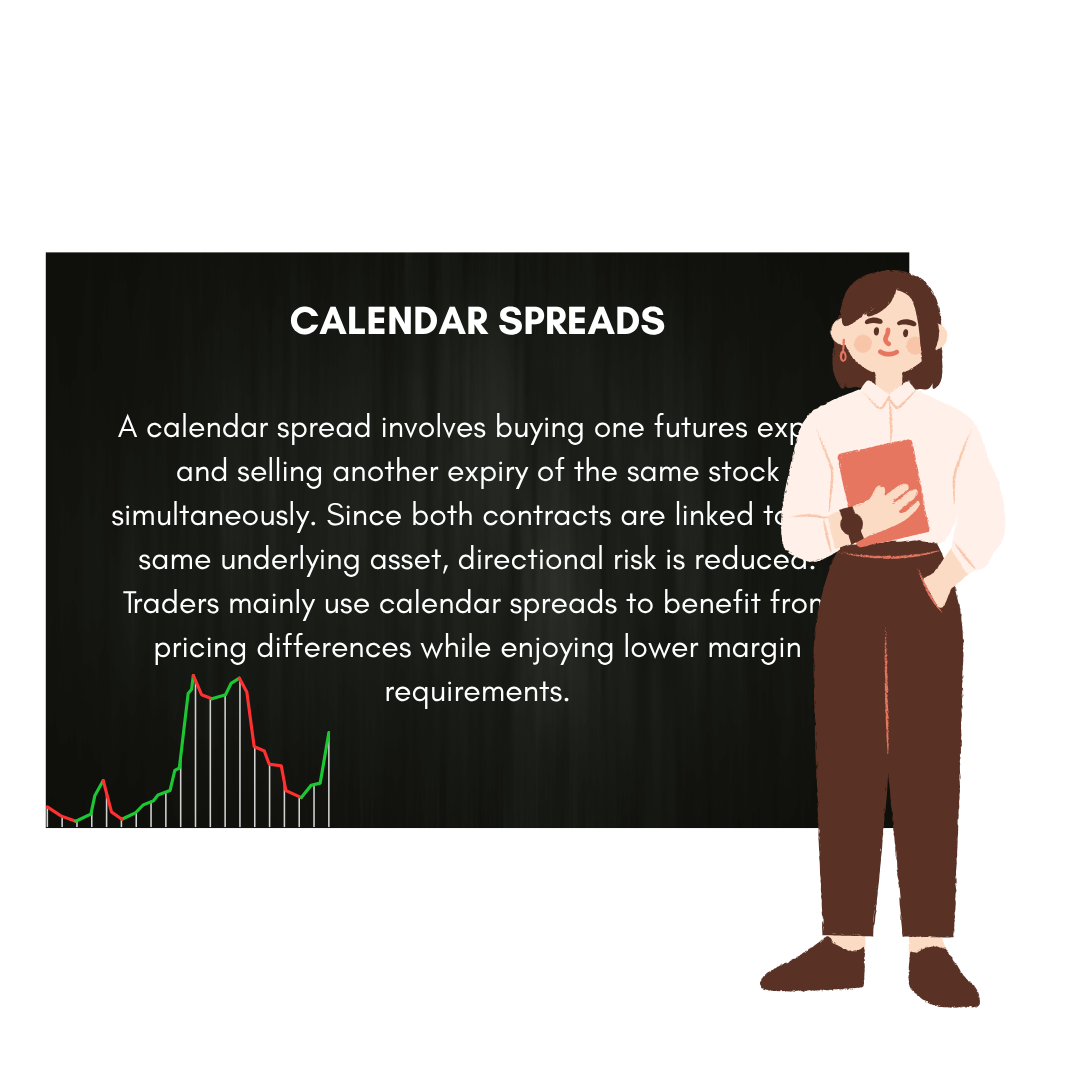
A calendar spread is a strategy where a trader buys and sells futures contracts on the same underlying asset with different expirations. The idea is to make money in the difference in prices between the near month contract and the mid/far month contract. It’s seen as safer than outright directional bets because it’s hedged—you are long one contract and short another.
Why Calendar Spreads Work
In pricing futures contracts, things like interest rates, dividends and time to expiry are considered. Therefore, longer-dated contracts tend to trade at slightly higher prices than near-term contracts. But market imbalances can sometimes lead to one contract diverging significantly from its fair value, while the other remains close to theoretical pricing. This lets you capture the spread.
For example, Infosys Future
Spot Price of Infosys= Rs 1,480
Current Month Futures (25 days to expiry) – Fair Value= Rs 1,485
Current Month Futures – Market Price (Actual) = ₹1,510
Mid-Month Futures (60 days to expiry) – Fair Value = ₹1,492
Mid-Month Futures – Actual Market Price = ₹1,493
The current month contract is trading well above its fair value here and the mid-month contract is trading in line with its estimate. This imbalance indicates that the current month contract is overpriced and the mid-month contract is fairly priced.
Trade Set-up Explained
The principle of spread trading is simple, buy the cheaper contract and sell the expensive one.
Sell Infosys Current Month Futures @ Rs 1510
Infosys Mid-Month Futures Buy @ ₹1,493
The difference between the two contracts is:
1510-1493=17 pts
This is the spread that the trader is trying to capture. This is a trade on the same underlying stock but with different expiries so it is considered hedged and the margin requirement is lower.
The locking in of profits
At expiration, current month futures and spot prices converge. The mid-month contract however will remain close to its fair value. Here are some expiry scenarios to consider:
If Infosys settles at ₹1,500:
- Mid-Month Long = 1,500 – 1,493 = +7
- Current Month Short = 1,510 – 1,500 = +10
- Net Profit = +17
If Infosys settles at ₹1,470:
- Mid-Month Long = 1,470 – 1,493 = –23
- Current Month Short = 1,510 – 1,470 = +40
- Net Profit = +17
If Infosys settles at ₹1,520:
- Mid-Month Long = 1,520 – 1,493 = +27
- Current Month Short = 1,510 – 1,520 = –10
- Net Profit = +17
The spread is fixed at 17 points. The spot price will be whatever it is. That is the beauty of calendar spreads, the profit is not dependent on the direction of the underlying but the relative pricing between contracts.
- Hedged Position– You are long and short on the same underlying asset. This lowers the risk relative to outright futures trading.
- Smaller Margins: Exchanges consider calendar spreads to be hedged, so the margin requirements are much smaller.
- Buy an asset that is mispriced: You don’t need to predict if the stock is going up or down. It takes advantage of price inefficiencies between contracts, instead.
- Convergence Principle: At expiry, near month futures converge to the spot price, realising the spread.
- Practical Exit: You can hold the trade to expiration, but most traders close out before expiration to avoid the problems of settlement.
- Market Realities:Trading is near fair value for most mid-month contracts, so the assumption is not unreasonable.
11.4 Spread as a Trading Signal
In earlier sections, we defined the spread (also called the basis) as the difference between the spot price and the futures price. Traditionally, this is explained as a result of the cost of carry—interest rates, dividends, and time to expiry. But for active traders, the spread is more than just an accounting detail. It’s a real-time signal that can reveal arbitrage opportunities and market inefficiencies.
What Is the Spread Telling You?
The spread should ideally reflect the fair value difference between spot and futures. But when it deviates significantly from this theoretical value, it signals one of two things:
- Market imbalance: Excess demand or supply in either spot or futures.
- Arbitrage opportunity: A chance to lock in risk-free profits by exploiting mispricing.
Trading the Spread: Basis as a Signal
Let’s revisit the Reliance example:
- Spot Price = ₹2,450
- Fair Value (via formula) = ₹2,459
- Actual Futures Price = ₹2,490
- Spread = ₹40 (actual) vs ₹9
This ₹31 excess spread is not just a pricing anomaly—it’s a trading signal.
Strategy: Cash & Carry Arbitrage
- Buy Reliance in the spot market (cheaper asset)
- Sell Reliance Futures (expensive asset)
- Hold both positions untill expiry
- Profit = Locked-in spread, independent of market direction
This strategy works because of the convergence principle: futures and spot prices always meet at expiry.
When the Spread Narrows or Reverses
A narrowing spread may indicate:
- Approaching expiry
- Reduced volatility
- Market normalization
A negative spread (futures below spot) may signal:
- Bearish sentiment
- Dividend expectation
- Liquidity crunch in futures
In each case, the spread offers directional clues and timing signals for traders.
11.5 Key Takeaways

- Futures get their value from the underlying asset: The price changes are generally similar to the spot market, but not identical.
- Pricing is governed by spot–futures parity: Futures Price = Spot Price × [1 + (Risk-Free Rate × Days to Expiry / 365) – Dividend Yield].
- Basis/Spread is the difference between spot and futures: This spread reflects cost of carry (interest rates, dividends, time to expire).
- Fair Value vs Market Price: Fair value is a theoretical value whereas actual future prices may differ due to taxes, transaction costs, imbalances in supply and demand.
- Premium and Discount • Futures trading above spot = premium (contango).
- üPremium (contango) = futures trading above spot.
- Convergence Principle: Futures and spot prices always converge on the expiry day (theoretical and practical).
- Longer expiry = larger spread: Mid-month and far-month contracts are trading at higher prices than near-month due to cost of carry.
- Arbitrage Opportunities: A price difference between spot and futures creates cash-and-carry arbitrage opportunities.
- Calendar Spreads lower risk: Traders buy one expiry and sell another expiry of same stock. They make money from cash and carry arbitrage and not directional moves.
- Hedged & Margin Efficient Strategy: Calendar spreads are known as hedged trades and hence require lower margins and offer safer exposure.
11.5 Fun Activity

Reliance Industries is trading at ₹2,450 in the spot market.
- Risk-Free Rate = 7% per annum
- Dividend = 0
- Days to Expiry = 15
- Lot Size = 250 shares
Your task: Calculate the fair value of the futures contract using the formula:
Futures Price =Spot Price *
Step-by-Step
- Plug in the values:
=2450 * (1+ 0.07 *15/365)
- Simplify:
=2450 * (1+0.0029)=2450 *1.0029
- Result: Fair Value ≈ ₹2,457.10
- Profit/Loss Check
- If actual futures trade at ₹2,470, they are expensive (possible arbitrage opportunity).
- If they trade at ₹2,450, they are cheap (discount).
11.1 The Futures Pricing Formula
Most traditional courses in derivatives begin by presenting the formula for pricing futures. But here we have opted to talk about it later. The reason is pretty simple, if you are trading futures mostly using technical analysis, you don’t have to calculate fair values every day. But if you are going to be using quantitative strategies such as calendar spreads or index arbitrage, then it is critical to know how futures are priced. This chapter prepares you for those advanced strategies.
We know that a futures contract derives its value from the underlying asset and typically moves with it. If the underlying goes up, the futures price goes up. If the spot price goes down, the futures price goes down. But the futures price is not the same as the spot price. The difference between the two is known as the spread or basis.
For instance, let’s say the Nifty Index is trading at 19,850 in the spot market while the current month Nifty Futures contract is trading at 19,865. Here the spread is 15 points. This difference is explained by the so-called spot-futures parity which takes into account factors such as interest rates, dividends and time to expiration.
The general formula for futures pricing is:
Futures Price =Spot Price*[1+rf * x/365 – d]
Where:
- = risk-free rate (annualized)
- = dividend yield expected during the contract period
- = number of days to expiry
The risk-free rate is often taken from short-term government securities, such as the RBI’s 91-day Treasury bill yield.
Example: Calculating Fair Value
Let us assume Reliance Industries trading at the spot market at 2,450 and there are 10 days to expiry. The risk-free rate is 7% per annum, and no dividend is expected during this period.
Futures Price = 2450 * [1+0.07*10/365]
=2450 *(1+0.0019)=2454.65
So the fair value of Reliance Futures is ₹2,454.65. .If the actual market price of the futures contract is ₹ 2,456, the small difference can be attributed to transaction cost, taxes or short term supply demand imbalance.
Mid-Month and Far-Month Contracts
The longer the time to expiry, the larger the spread between spot and futures. For example:
- Mid-month contract (30 days to expiry):
2450 * [1+0.07*30/365] =2464.10
- Far-month contract (75 days to expiry):
2450 *[1+0.07 *75/365]=2485.24
Notice how the futures price increases with more days to expiry,(₹2,454.70 for 10 days → ₹2,464.10 for 30 days → ₹2,485.24 for 75 days), reflecting the cost of carry.
Discount & Premium
- If futures trade above the spot price, the market is said to be at a premium. This is what is often called a contango in commodity markets.
- If futures trade below the spot price, the market is said to be at a discount i.e. in commodities, backwardation.
When Nifty Futures across the series are continuously trading at a higher price than the Nifty spot, the Futures are said to be trading at a premium. But futures and spot prices will always converge as expiry approaches. The futures contract expires and is closed out at the spot price.
Things to Remember
- The spot-futures spread is wider at the start of the series and narrows as expiry approaches.
- Futures and spot prices always converge on expiry day.
- Premium and discount are natural consequences of cost of carry and market forces.
Fair value is a theoretical yardstick and the actual market price reflects real world frictions such as taxes, margins and liquidity.
11.2 Practical Application of the Futures Pricing Formula
Before we finish this chapter, let’s see how we can apply the futures pricing formula in practice. This is particularly useful when you move beyond simple directional trades and get into quantitative strategies, such as calendar spreads or index arbitrage, as discussed before. What follows is merely a preview – later modules on trading strategies will cover these techniques in greater depth.
Example: Reliance Industries
Suppose the following data is available:
- Reliance Spot Price = ₹2,450
- Risk-Free Rate (Rf) = 7%
- Days to Expiry (x) = 20
- Dividend (d) = 0
Using the futures pricing formula:
Futures Price = 2450 * [1+0.07 *20/365]-0
=2450 * (1+0.0038)= 2459.3
So, the fair value of Reliance Futures should be around ₹2,459.
Market Imbalance
The actual futures contract is trading at 2,490 and the difference between the spot and futures should be 9 points but here the gap has widened to 40 points.
This is an opportunity to put on a spread trade.The futures are trading above their fair value and are considered to be expensive relative to the spot. The spot price looks cheap relative to the futures.
Executing the Trade
The thumb rule in spread trading is simple: buy the cheaper asset and sell the expensive one.
- Buy Reliance in the spot market at ₹2,450
- Sell Reliance in the futures market at ₹2,490
On expiry, both spot and futures prices will converge to the same level. Let’s assume a few possible convergence points:
- If both converge at ₹2,470 → Profit = (Futures Sell – Futures Buy) + (Spot Sell – Spot Buy) = (2490 – 2470) + (2470 – 2450) = ₹40
- If both converge at ₹2,430 → Profit = (2490 – 2430) + (2430 – 2450) = ₹60 – ₹20 = ₹40
- If both converge at ₹2,510 → Profit = (2490 – 2510) + (2510 – 2450) = –₹20 + ₹60 = ₹40
No matter where the market settles, the spread of 40 points is locked in.
Cash & Carry Arbitrage
This type of trade, where you simultaneously buy in the spot market and sell in the futures market to capture the spread, is known as Cash & Carry Arbitrage. The beauty of this strategy is that once executed, the profit is essentially guaranteed, provided you hold the positions until expiry.
Of course, in practice, it is wise to square off just before expiry to avoid settlement complexities. But the principle remains the same: arbitrage opportunities arise when futures prices deviate significantly from their fair value, and traders can exploit this by balancing positions in both spot and futures markets.
Example: Cash & Carry
To get a real sense of the mechanics of arbitrage, we’ll walk through the full cycle of a Cash & Carry trade, from identifying the mispricing to unwinding the positions at expiry.
- Recognising Mispricing
- Spot price of Reliance Industries is at Rs 2,450.
- Fair Value (Based on formula) : ₹2,459
- Actual Futures Price in market: ₹2,490
The futures are 31 points above fair value here. This gap is much bigger than expected indicating a mispricing. Here the arbitrageur sees an opportunity: futures are high, spot looks low.
- Trade Execution
The thumb rule: Buy the cheap one, sell the expensive one.
- Buy Reliance in the Spot Market: Buy 250 shares (lot size) @ ₹2,450.
- Sell Reliance Futures: Sell one futures contract at Rs 2,490.
- This locks in the 40 point (2,490 – 2,450) spread.
- Period of Holding
- The arbitrageur holds the Reliance shares in the demat account during the contract period.
- Simultaneously the futures short position is still open.
- No hidden risk as carrying cost (interest on capital used to buy spot shares) is already incorporated in the fair value calculation.
- Maturity Convergence
Futures and spot prices are expected to converge on expiry day. The captured spread is intact no matter where Reliance lands.
Scenario A: Settlement of ₹ 2,470
- Spot: Sell shares @ ₹2,470 → Profit = ₹20 x 250 = ₹5,000
- Futures Bought back at Rs. 2,470 (after selling at Rs. 2,490) Profit = Rs. 20 × 250 = Rs. 5,000
- Total Profit = Rs.10,000
Scenario B: Settlement at Rs 2,430
Spot: Sell shares @ ₹2,430 * Loss = ₹20 × 250 = –₹5,000
Futures – Sell at ₹2,490 and buy at ₹2,430 → Profit = (₹2,490 – ₹2,430) x 250 = ₹15,000
Total profit = Rs. 10,000
Scenario C: Settlement at Rs. 2,510
- Spot: Sell shares at ₹2,510 → Profit = ₹60 × 250 = ₹15,000
Futures: Sell at ₹2,490, Buy back at ₹2,510 → Loss = ₹20 × 250 = –₹5,000
Total Profit = Rs.10,000
The arbitrageur makes a risk-free ₹10,000, no matter where Reliance settles.
- Changing the Position
When that expires (or just before to avoid settlement problems) the arbitrageur unwinds both legs:
- Sell the shares at spot.
- Square off short futures.
The realised profit is the locked-in spread.
Why It’s Risk Free
- Convergence principle Futures and spot prices must converge at expiry
- Hedged Position: The long spot and short futures position hedges the directional risk.
- Guaranteed Spread: The first mispricing guarantees a profit regardless of the direction of the market.
- This is the perfect example of the beauty of Cash & Carry Arbitrage. When done properly, you lock in the profit and it is not affected by the market movements.
11.3 Calendar Spreads
A calendar spread is a strategy where a trader buys and sells futures contracts on the same underlying asset with different expirations. The idea is to make money in the difference in prices between the near month contract and the mid/far month contract. It’s seen as safer than outright directional bets because it’s hedged—you are long one contract and short another.
Why Calendar Spreads Work
In pricing futures contracts, things like interest rates, dividends and time to expiry are considered. Therefore, longer-dated contracts tend to trade at slightly higher prices than near-term contracts. But market imbalances can sometimes lead to one contract diverging significantly from its fair value, while the other remains close to theoretical pricing. This lets you capture the spread.
For example, Infosys Future
Spot Price of Infosys= Rs 1,480
Current Month Futures (25 days to expiry) – Fair Value= Rs 1,485
Current Month Futures – Market Price (Actual) = ₹1,510
Mid-Month Futures (60 days to expiry) – Fair Value = ₹1,492
Mid-Month Futures – Actual Market Price = ₹1,493
The current month contract is trading well above its fair value here and the mid-month contract is trading in line with its estimate. This imbalance indicates that the current month contract is overpriced and the mid-month contract is fairly priced.
Trade Set-up Explained
The principle of spread trading is simple, buy the cheaper contract and sell the expensive one.
Sell Infosys Current Month Futures @ Rs 1510
Infosys Mid-Month Futures Buy @ ₹1,493
The difference between the two contracts is:
1510-1493=17 pts
This is the spread that the trader is trying to capture. This is a trade on the same underlying stock but with different expiries so it is considered hedged and the margin requirement is lower.
The locking in of profits
At expiration, current month futures and spot prices converge. The mid-month contract however will remain close to its fair value. Here are some expiry scenarios to consider:
If Infosys settles at ₹1,500:
- Mid-Month Long = 1,500 – 1,493 = +7
- Current Month Short = 1,510 – 1,500 = +10
- Net Profit = +17
If Infosys settles at ₹1,470:
- Mid-Month Long = 1,470 – 1,493 = –23
- Current Month Short = 1,510 – 1,470 = +40
- Net Profit = +17
If Infosys settles at ₹1,520:
- Mid-Month Long = 1,520 – 1,493 = +27
- Current Month Short = 1,510 – 1,520 = –10
- Net Profit = +17
The spread is fixed at 17 points. The spot price will be whatever it is. That is the beauty of calendar spreads, the profit is not dependent on the direction of the underlying but the relative pricing between contracts.
- Hedged Position– You are long and short on the same underlying asset. This lowers the risk relative to outright futures trading.
- Smaller Margins: Exchanges consider calendar spreads to be hedged, so the margin requirements are much smaller.
- Buy an asset that is mispriced: You don’t need to predict if the stock is going up or down. It takes advantage of price inefficiencies between contracts, instead.
- Convergence Principle: At expiry, near month futures converge to the spot price, realising the spread.
- Practical Exit: You can hold the trade to expiration, but most traders close out before expiration to avoid the problems of settlement.
- Market Realities:Trading is near fair value for most mid-month contracts, so the assumption is not unreasonable.
11.4 Spread as a Trading Signal
In earlier sections, we defined the spread (also called the basis) as the difference between the spot price and the futures price. Traditionally, this is explained as a result of the cost of carry—interest rates, dividends, and time to expiry. But for active traders, the spread is more than just an accounting detail. It’s a real-time signal that can reveal arbitrage opportunities and market inefficiencies.
What Is the Spread Telling You?
The spread should ideally reflect the fair value difference between spot and futures. But when it deviates significantly from this theoretical value, it signals one of two things:
- Market imbalance: Excess demand or supply in either spot or futures.
- Arbitrage opportunity: A chance to lock in risk-free profits by exploiting mispricing.
Trading the Spread: Basis as a Signal
Let’s revisit the Reliance example:
- Spot Price = ₹2,450
- Fair Value (via formula) = ₹2,459
- Actual Futures Price = ₹2,490
- Spread = ₹40 (actual) vs ₹9
This ₹31 excess spread is not just a pricing anomaly—it’s a trading signal.
Strategy: Cash & Carry Arbitrage
- Buy Reliance in the spot market (cheaper asset)
- Sell Reliance Futures (expensive asset)
- Hold both positions untill expiry
- Profit = Locked-in spread, independent of market direction
This strategy works because of the convergence principle: futures and spot prices always meet at expiry.
When the Spread Narrows or Reverses
A narrowing spread may indicate:
- Approaching expiry
- Reduced volatility
- Market normalization
A negative spread (futures below spot) may signal:
- Bearish sentiment
- Dividend expectation
- Liquidity crunch in futures
In each case, the spread offers directional clues and timing signals for traders.
11.5 Key Takeaways
- Futures get their value from the underlying asset: The price changes are generally similar to the spot market, but not identical.
- Pricing is governed by spot–futures parity: Futures Price = Spot Price × [1 + (Risk-Free Rate × Days to Expiry / 365) – Dividend Yield].
- Basis/Spread is the difference between spot and futures: This spread reflects cost of carry (interest rates, dividends, time to expire).
- Fair Value vs Market Price: Fair value is a theoretical value whereas actual future prices may differ due to taxes, transaction costs, imbalances in supply and demand.
- Premium and Discount • Futures trading above spot = premium (contango).
- üPremium (contango) = futures trading above spot.
- Convergence Principle: Futures and spot prices always converge on the expiry day (theoretical and practical).
- Longer expiry = larger spread: Mid-month and far-month contracts are trading at higher prices than near-month due to cost of carry.
- Arbitrage Opportunities: A price difference between spot and futures creates cash-and-carry arbitrage opportunities.
- Calendar Spreads lower risk: Traders buy one expiry and sell another expiry of same stock. They make money from cash and carry arbitrage and not directional moves.
- Hedged & Margin Efficient Strategy: Calendar spreads are known as hedged trades and hence require lower margins and offer safer exposure.
11.5 Fun Activity
Reliance Industries is trading at ₹2,450 in the spot market.
- Risk-Free Rate = 7% per annum
- Dividend = 0
- Days to Expiry = 15
- Lot Size = 250 shares
Your task: Calculate the fair value of the futures contract using the formula:
Futures Price =Spot Price *
Step-by-Step
- Plug in the values:
=2450 * (1+ 0.07 *15/365)
- Simplify:
=2450 * (1+0.0029)=2450 *1.0029
- Result: Fair Value ≈ ₹2,457.10
- Profit/Loss Check
- If actual futures trade at ₹2,470, they are expensive (possible arbitrage opportunity).
- If they trade at ₹2,450, they are cheap (discount).