
7.1 Things You Should Know by Now
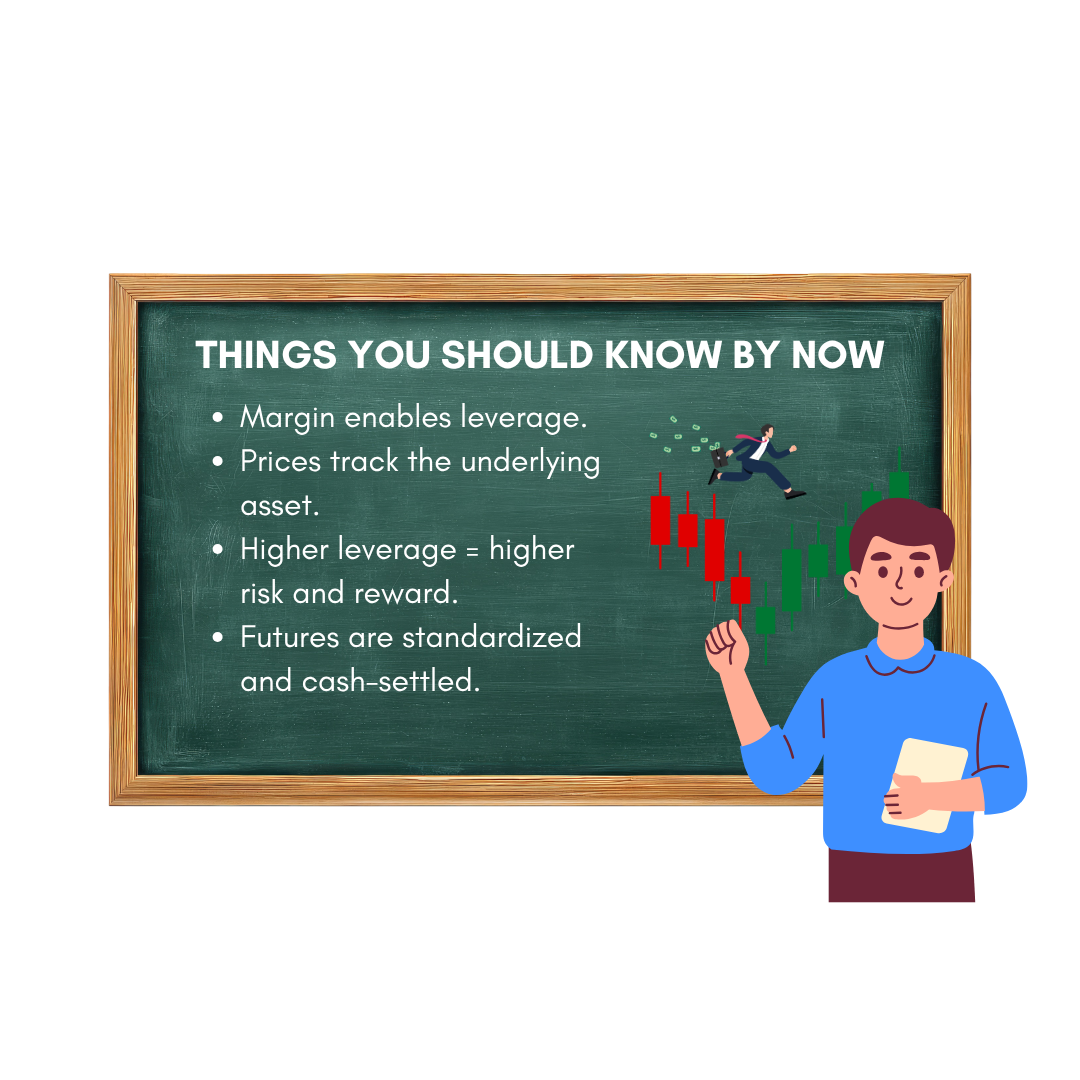
Margins are the lifeline of Futures Trading. They are the reason why a futures contract is quite different from a simple spot market transaction. By deploying only a fraction of the contract value as margins, one can take a much bigger position in the stocks which is the essence of leverage which in turn is the hallmark of derivatives trading. However, before discussing margins and mark-to-market let us quickly recap some of the important concepts that you now know about Futures Trading.
- Futures Vs. Forwards – Futures contracts are basically standardized forward contracts which are meant to be traded in an organized manner on the stock exchanges by following certain guidelines and regulations.
- Structure Inheritance – Futures basically inherit the structure of their parent contracts viz. forwards.
- View Deposition –If someone has a view on say HDFC Bank and has a correct view, he can actually profit out of it using Futures Contracts by taking a long position.
- Value Derivation – As we know forwards derive their value from their underlying asset and so do futures. In fact, the value of HDFC Bank Futures Contract is related to the spot price of HDFC Bank. Price Differential – The spot price and futures price are different because of the pricing mechanism of futures which would be discussed later.
- StandardizedContract The futures contracts have standardized quantity of underlying asset along with expiry date. For example, the lot size of HDFC Bank is 550 shares. Contract Value = Futures Price 550 Expiry Date = Last working day for which the contract is valid
- Margins – In order to buy or sell futures contracts one has to pay margins to broker which is a certain percentage (say 15%) of the total contract value. For Example, If the futures price of HDFC Bank = Rs.1,650 Contract Value = 1,650550 = Rs.9,07,500 Margin Value = 15% of 9,07,500 = Rs.1,36,125
- Digital Agreement cum Obligations – Upon entering into a futures contract you are basically digitally signing an agreement with your counterparty which binds both of you to honour it till the time you square off your position or the expiry date of the contract whichever comes earlier.
- Tradability – Futures contracts are basically tradable instruments. That is one need not buy it till the expiry date; he can sell off his position any time he wishes to. For Example, Buying 550 shares of HDFC Bank Futures contract at say Rs.1,650 at 9:15 AM and selling it at Rs.1,652 at 9:17 AM would make one earn Rs.1,100 in just 2 minutes. It can be quite different if one is confident enough about his view to hold on to his position till expiry date.
- Cash Settlement – Cash settlement for settlement of profits and losses is the hallmark feature of Equity Futures and Options contracts in India. That is for equity futures there is no actual settlement of shares, only cash is settled.
- Leverage –Leverage of derivatives makes even small movements in the price of underlying asset to have a big impact on the profit and loss of the underlying derivative contract.
- Zero-Sum Game – Derivatives market is a zero-sum game where one’s profit is another’s loss and vice versa; there is hardly any creation or destruction of wealth in the process, there is just a transfer of wealth from one party to the other.
- High Risk Higher the leverage higher the risk; higher the risk higher the reward.
- Linear Payoff –The change in value of a futures contract for a given change in value of its underlying asset is linear in nature which is evident from the following equation.
- Payoff = (Spot Price of HDFC Bank – Futures Price) Lot Size
- Regulation –Futures market in India is regulated by SEBI which keeps a watch on the functioning of the trading system as well as the counterparty risk default management system which is crucial for such a market to function smoothly.
7.2 Why Are Margins Charged?
To understand why there are margins in the futures market, let us remember how a simple forward contract works. A jeweller agrees to buy 15 kilograms of gold from a dealer at $2,450 a gramme, with delivery three months later.
And if now the price of gold goes up the dealer suffers a loss, the jeweller makes a gain. If the price falls the loser is the dealer and the gainer the jeweller. A forward contract is nothing but an agreement to trust each other. If the dealer gets into a tight spot, because prices have moved against him, he can just refuse to honour the deal. This would lead to fights and probably long court cases. That is, forwards are risky because there is no way of enforcing the agreement, so there is a high risk of defaulting.
That was the problem futures contracts were meant to address. Futures, unlike forwards, are traded on an exchange . The exchange guarantees settlement. It means that if you owe money the exchange makes sure it will be collected and if you are owed money the exchange guarantees you will be paid. This is a system built to make default impossible.
So how does the exchange accomplish this? It’s using two mechanisms:
1.Margins – Traders have to pay a percentage of the contract value in advance. This is a buffer of security.
2. Mark-to-Market (M2M) – The profits and losses are calculated and adjusted on a daily basis in a trader’s account and the obligations are fulfilled continuously instead of at expiry.
Margins are the crux of this process. As soon as you open a futures position, part of your capital is blocked in margin. The blocked amount is called Initial Margin and it consists of two parts:
- SPAN Margin – This is a protection against adverse price Movement.
- Exposure Margin – Provides a safety net against volatility.
So the formula goes: Initial Margin = SPAN Margin + Margins for Exposures
This margin sits in your account for as long as you hold the futures position. It is a percentage of the contract value The contract value depends on the futures price , so it changes from day to day . The futures price fluctuates daily and the lot size is fixed so the margin requirement fluctuates daily as well.
For now, keep these things in mind. Then we’ll go all in on Mark to Market (M2M), and after that we’ll revisit margins one last time – this time with the big picture of how margins and M2M work together to make futures trading safe and reliable.
7.3 Mark to Market (M2M)
You are trading a contract that will have a different price from day to day . It means you are never standing still, but always gaining or losing value. The exchange does not wait for expiry to settle this but settles it day to day in your account through a process called Mark to Market (M2M).
M2M is pretty much an accounting adjustment every day. The exchange looks at the closing price of the futures contract every day, and compares it with the closing price the day before. Any profit you make is added to your account, and any loss is taken from your account. This means that the two parties are square at the end of each day, and this reduces dramatically the risk of default.
Example: HDFC Bank Futures
Suppose on 1st December 2025, you buy HDFC Bank Futures at ₹1,650. The lot size is 550 shares. A few days later, you square off at ₹1,670. Let’s see how M2M works step by step.
- Buy Price= ₹1,650
- Sell Price= ₹1,670
- Profit per share= ₹20
- Total Profit= 550 × 20 = ₹11,000
But since the trade was held for several days, the profit wasn’t given to you all at once. It was settled daily through M2M.
Daily Price Movements
|
Date |
Closing Price (₹) |
Reference Price (₹) |
Daily M2M (₹) |
|
1st Dec 2025 |
1,655 |
1,650 |
+2,750 |
|
2nd Dec 2025 |
1,662 |
1,655 |
+3,850 |
|
3rd Dec 2025 |
1,658 |
1,662 |
-2,200 |
|
4th Dec 2025 |
1,670 (square off) |
1,658 |
+6,600 |
|
Total |
|
|
+11,000 |
How it works – Your daily guide
Day 1: Buy at Rs 1,650, close at Rs 1,655. This is an increase of Rs 5 a share, or Rs 2,750. This amount is added to your account immediately. Your new reference price from accounting perspective is ₹1,655.
Day 2: Contract closes at Rs 1,662. It comes to ₹7 or ₹3,850 from the previous close (₹1,655) in terms of earnings per share. Again this is credited to your account and the reference price is reset to $ 1,662 .
Day 3: Contract closes at 1,658 rupees. That’s a loss of ₹4 a share, or ₹2,200 on the previous day’s close (₹1,662). ₹1,658 has been debited from your account and the reference price has been updated to ₹1,658.
Day 4 – You are at Rs. 1,670 That is an increase of ₹12 a share or ₹6,600 from the previous day’s close of ₹1,658. This will be charged to your account. You are out of the trade and don’t need to make any more adjustments.
M2M Highlights
- Daily Settlement: Profits and losses are settled daily, not just on expiry.
- Reference Price Reset:The reference price of each day is the previous day’s close.
- Cash Flow:Daily cash flow is credited and debited and both parties are on the same side.
- Risk Reduction: The exchange decreases the probability of default with daily settlement.
- Transparency – Traders always know what is going on – no surprises at expiry
Why M2M is needed?
Without M2M, losses could accumulate in silence until expiry, when one party cannot pay. The exchange settles on a daily basis so that obligations are met on an ongoing basis. This makes futures safer and more reliable than forwards which have high risk of default.
7.4 Margins, the Bigger Perspective
Margins are the backbone of risk management and trade integrity in the futures markets. That is, you do not pay the whole value of the contract when you open a futures trade. Instead a part of the value is paid in the form of a margin. This margin provides the exchanges with the assurance that the money is available to cover any losses from adverse price movements and to help facilitate settlements.
The First Margin is the SPAN Margin, which is the first component of the Initial Margin. The SPAN margin is the minimum margin determined by the exchanges to be deposited by the trader in his trading account. The calculation is based on complex risk assessment methodologies which take into account the volatility of the scrip, directional and non-directional risk, historical volatility, and other factors. This margin must be maintained at all times and is non-negotiable. If your account falls beneath this level, you may be asked to provide more margin or your position may be liquidated.
Exposure margin is a top up margin of around 4-5 percent of the total value of the contract. This is a protection against daily price fluctuations. The SPAN offers protection against volatility and risk, and the margin of exposure protects the risk to the broker and exchanges against intra-day price changes.
Now let us take the example of Reliance Industries Futures Contract to understand how the margins and marking to market works.
Trade Setup: Reliance Futures
- Buy Date: 5th March 2025
- Buy Price: ₹2,400 per share
- Lot Size: 250 shares
- Contract Value: ₹6,00,000
- SPAN Margin (8%): ₹48,000
- Exposure Margin (5%): ₹30,000
- Initial Margin (IM): ₹78,000
- Sell Date: 12th March 2025
- Sell Price: ₹2,460 per share
- Profit per share: ₹60
- Net Profit: ₹15,000
When you take this trade, ₹78,000 is blocked in your trading account. This is the initial margin and it stays locked until you close the position. Your account balance will, however, change on a daily basis depending on how the futures price moves. This is where Mark-to-Market (M2M) comes in.
How M2M Works On A Day To Day Basis
The exchange looks at the closing price of the futures contract against the closing price of previous day every day. You multiply the difference with the lot size and you have your profit or loss in a day. This amount is added to or deducted from your trading account. The new close price then becomes the reference price and the cycle continues.
Let’s look at the daily breakdown:
|
Date |
Closing Price (₹) |
Previous Close (₹) |
Daily Change (₹) |
M2M (₹) |
Cash Balance (₹) |
|
5-Mar-2025 |
2,400 |
— |
— |
0 |
1,00,000 |
|
6-Mar-2025 |
2,410 |
2,400 |
+10 |
+2,500 |
1,02,500 |
|
7-Mar-2025 |
2,390 |
2,410 |
-20 |
-5,000 |
97,500 |
|
8-Mar-2025 |
2,425 |
2,390 |
+35 |
+8,750 |
1,06,250 |
|
9-Mar-2025 |
2,435 |
2,425 |
+10 |
+2,500 |
1,08,750 |
|
10-Mar-2025 |
2,450 |
2,435 |
+15 |
+3,750 |
1,12,500 |
|
11-Mar-2025 |
2,440 |
2,450 |
-10 |
-2,500 |
1,10,000 |
|
12-Mar-2025 |
2,460 (exit) |
2,440 |
+20 |
+5,000 |
1,15,000 |
What Is Behind the Curtain:
- If the futures price goes up, your account is credited with the profit.
- If the price goes down , the loss is credited to your account.
Cash balance = total of your M2M adjustments.
- Margin requirement is revised on a daily basis on contract value basis. · Your position is safe as long as your cash balance is greater than the SPAN margin. · If your account balance falls below the SPAN margin, your broker might send you a margin call, which is a demand for you to deposit more money to keep your position open.
This system ensures that the financial responsibilities of both sides of the trade are accountable on a daily basis. It prevents the accumulation of risk on one side and guarantees the market stability.
Final Profit Calculation – Multiple Methods
Let’s now calculate the total profit using four different approaches. All methods should lead to the same result:
|
Method |
Calculation |
Result (₹) |
|
Sum of M2M |
All daily M2M adjustments |
15,000 |
|
Cash Balance Growth |
Final cash balance − Starting cash balance |
1,15,000 – 1,00,000 = 15,000 |
|
Contract Value |
₹6,15,000 – ₹6,00,000 |
15,000 |
|
Futures Price Difference |
(2,460 – 2,400) × 250 |
15,000 |
The ₹1,00,000 here is the trader’s starting account cash balance, not to be confused with the Initial Margin (₹78,000 = SPAN + Exposure) that stays blocked with the exchange for the duration of the trade — these are two separate figures.
This result is achieved due to the consistent implementation of the described mechanism within the M2M (Mark to Market) accounting methodology, which further confirms its correctness. It can be concluded that it is an essential derivative that regulates the functioning of the futures market.
The Importance Of Margins and M2M accounting for market participants
In essence, these two mechanisms are vital for futures trading as they ensure the stability and safety of the system. They serve to prevent the seller from facing losses greater than their initial margin, which allows protecting both traders and brokers from excessive risks. This regulation creates conditions for a safe and stable transaction environment that ensures the sustainability of market functioning.
7.5 A Real-World Case of Margin Call
Let us suppose a trader has purchased a long position in Reliance Industries Futures. The trade was started at Rs 2,460 per share with lot size of 250 shares. The trader had the opportunity to square off the position on 12th March 2025, but he carried it forward to the next trading day.
Now let’s assume that on 13th March, Reliance Industries falls sharply – maybe due to some unexpected news or some panic in the market and the futures price drops by 8% from ₹2,460 to ₹2,263. Now what?
Let’s do it step by step.
- What is meant by a mark-to-market (M2M) loss?
- The M2M loss is calculated as the difference between the previous day closing price and the current day closing price:
- M2M Loss = (2,460-2,263) × ₹250 = ₹49,250
- At the end of the day this sum is deducted from the trader’s account.
- What is the cash amount?
- Suppose the trader had cash balance of ₹65,000 on 12th March (after previous M2M credits) After loss on M2M deduction:
- New Cash Balance=₹15,750 (₹65,000-₹49,250)
- The cash balance plunges, laying bare the trader.
- What Is New Margin Requirement?
- The new contract value is now Futures at ₹ 2,263 Contract Value=2,263×250=Rs. 5,65,750
- If the margin structure is the same:
- SPAN Margin (8%)= ₹45,260
- Exposure Margin (5%) = Rs. 28,287 l
- Total Margin Required ₹ 73,547
- What is the broker’s role?
Trader’s cash balance. (₹15,750) < SPAN margin (₹45,260). The balance is well below the minimum required so the broker has to act.
Depending on the risk policy of the broker, one of two things will happen:
- The trader gets a margin call, a notice to immediately put up more money to bring the margin back to the required level.
- The trader may not respond and the broker may consider the risk too high and automatically close the position to prevent further losses.
This is a good example of how leverage, volatility and margin requirements play off each other in real time. A good trade can turn ugly, if the market moves aggressively against the position and there isn’t enough buffer.
7.6 Visualizing M2M and Margin Call
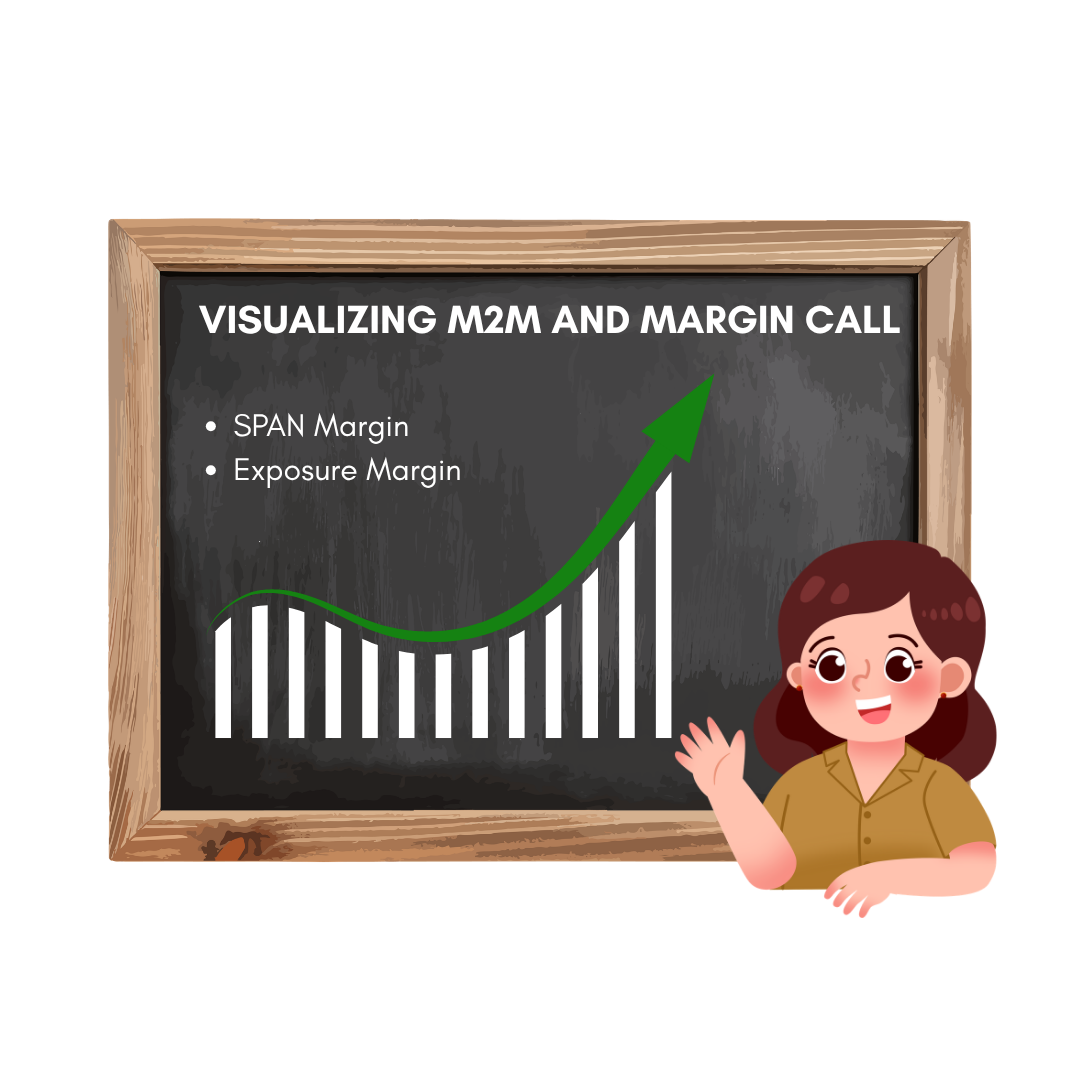
The financial safety in futures trading can be understood in the context of how the daily profit and loss (M2M) impacts your cash balance and how that is directly related to margin requirements.
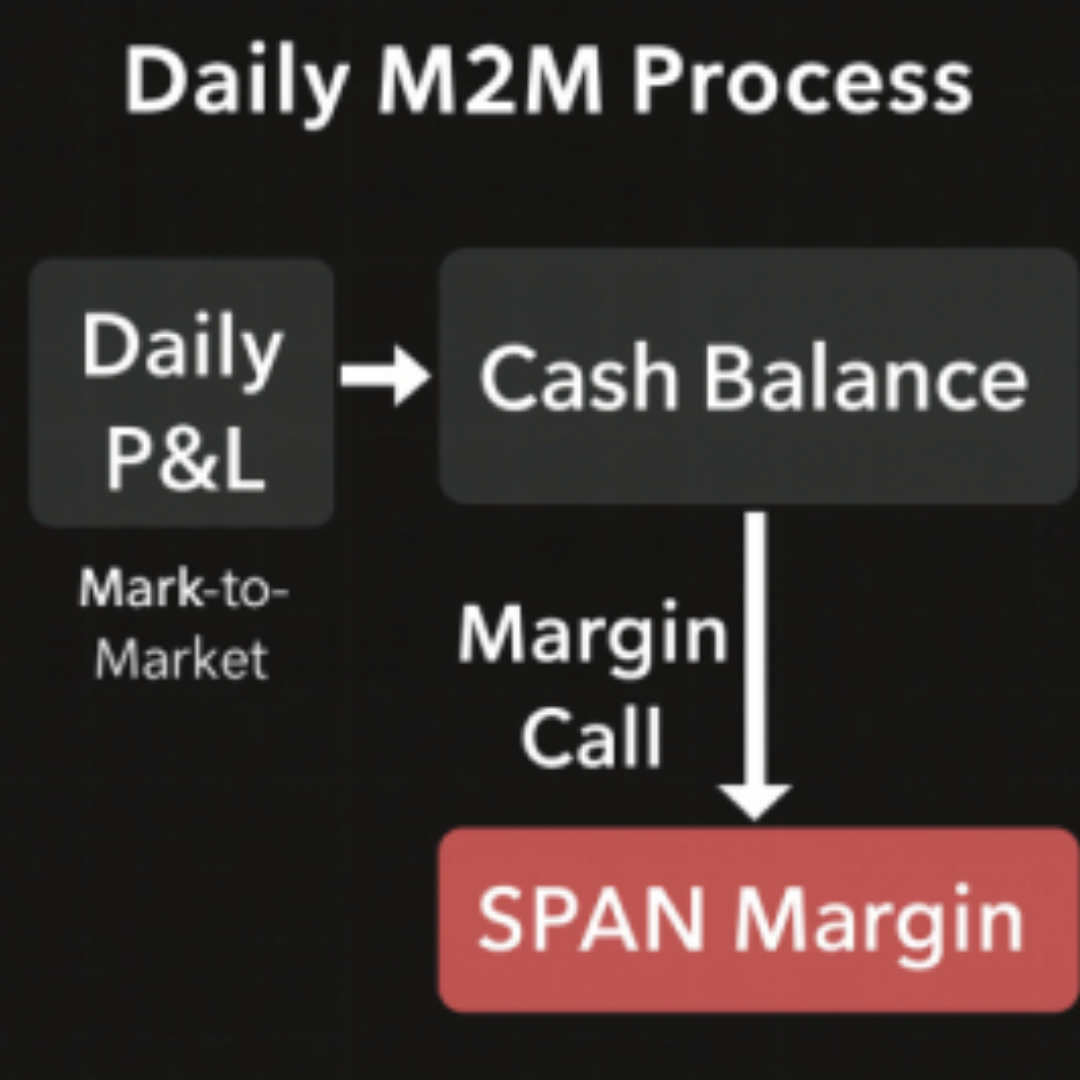
This flow is shown in the image above:
Daily P&L (profit/loss) is calculated daily based on change in futures price.
This amount is credited or debited to your Cash Balance account.
Your SPAN Margin is a minimum threshold.
- Margin Call When your Cash Balance is less than the SPAN Margin.
- If you don’t respond, the broker can initiate a Forced Square-Off to avoid further losses.
How This Works In Real Life
Assume you have ₹1,00,000 in your trading account and you decide to take a long position in Reliance Futures. Each day the futures price changes and your account is adjusted.
Day 1: Price goes up → Credit Profit → Cash Balance Increase
Day 2 Price falls => Loss debited => Cash Balance decreases
Day 3 – Price rises again -> Profit credited -> Cash Balance recovers
Day 4: sharp fall -> large loss debited -> cash balance falls below SPAN Margin
Outcome: Margin Call given. Broker may square off your position if not met.
What This Means
This daily adjustment system includes:
- Transparency: Traders are always conscious of their financial position.
- Risk Control: losses are cleared daily, avoiding accumulation
- System Integrity: Brokers and exchanges can take prompt action to prevent defaults
7.7 Key Takeaways

- Margin is the foundation of futures trading: traders only need to pay a fraction of the contract value (initial margin) in order to leverage their position and meet their obligations.
- Futures vs. forwards: confidence vs. execution. Forwards are risky and may default. Trust was necessary. Futures are fully collateralised and settled by the exchange.
- Initial Margin = SPAN + Exposure SPAN margin is for risk of adverse movement & Exposure margin is for buffer against volatility .
- Daily Margin Adjustments. The contract value will go up and down with the future price and the margin requirements will also go up and down.
- Daily accountability Gains and losses are realised at the end of each day, not at expiration.
- Reference price resets daily: Closing price of each day is the reference price for the calculation of profit/loss of the next day.
- M2M reduces default risk : Daily settlement prevents loss from accumulating silently, and keeps both parties financially even;
- Margin calls are system friendly: If your account falls below the SPAN margin, your broker will either require you to put in more cash or force you to close out your positions to save you from going bankrupt.
- How would you reconcile cash balance to profits/losses in the daily M2M reconciliation? Answer is the same whichever way you work it out.
- Equitable & Stable Margins + M2M Together they create a robust, scalable, transparent and secure architecture for futures trading, even in volatile markets.
7.8 Fun Activity

Suppose you bought Reliance Futures at ₹2,400 with a lot size of 250 shares. Now, track your profit/loss as the price changes each day.
Price Movements
- Day 1: ₹2,410
- Day 2: ₹2,390
- Day 3: ₹2,425
- Day 4: ₹2,435
Calculate the daily M2M adjustment and keep a running balance.
Formula
(Today’s Close-Previous Close)* Lot Size
Answers
- Day 1: (2,410 – 2,400) × 250 = +₹2,500
- Day 2: (2,390 – 2,410) × 250 = –₹5,000
- Day 3: (2,425 – 2,390) × 250 = +₹8,750
- Day 4: (2,435 – 2,425) × 250 = +₹2,500
Total Profit = ₹8,750