
6.1 A Quick Recap
In the last chapter, we saw how futures trade works using the example of Infosys Oct 2025 contract. The setup was easy: Infosys had just released Q2 FY26 results. The stock price fell sharply intraday from ₹1,480 to ₹1,437, on the back of a cautious guidance even as revenue and profit growth was solid. The October futures fell to Rs 1,442.50.
This was seen as an overreaction and a bullish view was formed. The trader felt that Infosys would gain in the coming days and decided to buy one lot of October Futures at ₹1,442.50. The trade was later squared off for a profit as the price moved up to ₹1,475
But this raises an important question. If the expectation is that Infosys will go up, why not simply buy the stock in the spot market and hold? Why deal with the complexity of a futures contract?
Let us walk through this.
When you buy futures , you are entering into a time-bound agreement with a counterparty . You are committing to a price and a date. If your view doesn’t work out before expiry, you could lose money. If, on the other hand, you buy shares on the spot market, you own them outright. You can hold them in your DEMAT account for as long as you want, without worrying about expiry or margin requirements.
Then why do traders still go for futures?
The answer is Financial leverage .
Infosys Futures are available at a margin of ₹11,000 and not the full contract value (₹432,750 for 300 shares) upfront. All you need to do is put down a margin, typically 20-25%. That means you can control a position of over ₹4 lakh with an investment of about ₹86,000-₹1,08,000.
This leverage can work for you to earn more. In our example, Infosys moved up by ₹32.50, leading to a profit of ₹9,750. That’s a return of more than 10 percent on margin in just a few days. Spot buying would be full capital and the same absolute gain but a lower percentage.
Leverage is a double-edged sword, of course. If the price falls, losses are multiplied as well. And that’s why futures are best used when you have a strong directional view, and a clear timeframe.
In short, futures are fast, flexible and capital efficient. They’re not a replacement for long term investing – but they’re powerful tools for short term opportunities when used with discipline.
6.2 Leverage in Perspective

Leverage is something we use in day to day life, often without realising we are using it. Far too often we will spend a little of our capital to gain access to a much larger asset or opportunity – be it buying a car, booking a holiday or investing in a business. That principle is formalised and magnified in the financial markets in instruments such as futures.
Let us draw on a familiar analogy.
Suppose, someone want’s to buy a car which costs Rs.10 Lakhs. They don’t pay the full amount in cash. They take a loan and pay only 1.5 lakhs as down payment. ₹8.5 lakhs is financed as balance amount. They pay 15% of the total value of the car and get full access to it. Now say the resale value of the car increases to ₹ 12 lakhs, due to demand or scarcity. If they sell it, they will make a gain of ₹ 2 Lakh. That’s a leverage return of 133% on an initial investment of ₹1.5 lakh.
That’s exactly how futures trading is done.
6.3 Leverage Example

Suppose you have Rs 1 lakh and you are very optimistic about HDFC Bank. You think the stock will go up in the next few days. Now you have two choices — buy HDFC Bank shares in the Spot Market or buy HDFC Bank Futures from the Derivatives segment. Both let you act on your view, but the mechanics and the results are very different.
Option 1: Buying HDFC Bank on the spot market
Let’s assume HDFC Bank is trading at ₹1,650 per share on December 1, 2025. For Rs 1,00,000 you get:
1,00,000 / 1,650 = Approximately 60 shares
Actual amount spent = 60 × ₹1,650 = ₹99,000 (₹1,000 remains uninvested)
Now think by 10th December 2025, HDFC Bank goes up to ₹1,710 per share. You decide to sell your 60 shares.
Sell Value = 60 × ₹1,710 = ₹1,02,600
Profit = ₹1,02,600 − ₹99,000 = ₹3,600
Return = ₹3,600 / ₹1,00,000 = 3.6%
Option 2: Buy HDFC Bank Futures
You decide to buy 1 lot of HDFC Bank Futures instead of buying shares. Lot size is 550 shares. Futures price is also ₹1,650. The contract value is in total:
- ₹1,650 × 550 = ₹9,07,500
But you don’t have to shell out Rs 9 lakh upfront. Just need to put up a margin, say 15% which is:
- Margin = 15% of 9, 07, 500 = 1, 36, 125
You don’t have the money to buy a full lot (₹1,00,000) but you can buy a fractional lot or trade in mini contracts (if available). For simplicity, let’s say you buy half a lot (275 shares) requiring:
- Margin = 275 × ₹1,650 × 15% = ₹68,062.50
Now, let’s say that on expiry HDFC Bank Futures closes at ₹1,710. Your reward is :
Gain per share = Rs 1,710 – Rs 1,650 = Rs 60
Total profit = 275 × ₹ 60 = ₹ 16,500
- Return on margin = Rs. 16,500 Rs. 68,062.50 = 24.24%
That’s a much higher return than the spot market, even though the price movement is the same. That is the power of leverage.
Comparison Table – Spot vs Futures (HDFC Bank Example)
|
Particulars |
Spot Market (HDFC Bank) |
Futures Market (HDFC Bank) |
|
Capital Available |
₹1,00,000 |
₹1,00,000 |
|
Buy Price |
₹1,650 |
₹1,650 |
|
Quantity Purchased |
60 shares |
275 shares (half lot) |
|
Contract Value |
₹99,000 |
₹4,53,750 |
|
Margin Required |
Not applicable |
₹68,062.50 |
|
Sell Price |
₹1,710 |
₹1,710 |
|
Sell Value |
₹1,02,600 |
₹4,70,250 |
|
Profit |
₹3,600 |
₹16,500 |
|
Return on Capital |
3.6% |
24.24% |
Points to remember
- The capital you put to work is the limit of your return in the spot market.
- Futures market allows you to have exposure to a larger position with less money up front as margin.
- Leverage amplifies returns when you are right.
- But leverage can also amplify losses if the price moves against you.
- Futures good for directional trading in short term, spot investment for long term holding
This example clearly illustrates why short-term traders often favour futures. Used with discipline and an awareness of risk, futures can be very profitable. They are a powerful tool because they allow you to control a large position with limited capital.
Convergence of HDFC Bank Spot and Futures Price
Concept
In the derivatives trading, convergence means the futures price and the spot price of the underlying asset must converge to the same price at the expiry date of the contract. Arbitrage opportunities and settlement rules enforce this principle.
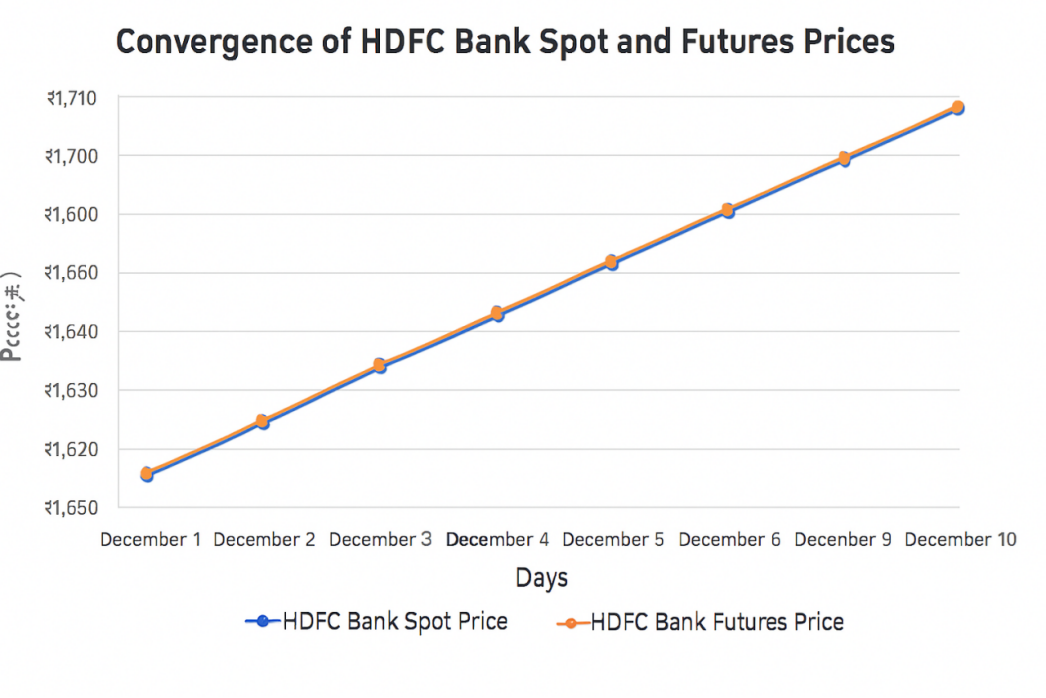
One of the basic principles while trading futures & options is that on the expiry date, the future’s price converges to the spot price of the underlying asset. This is not only because of arbitrage but settlement and marking to market also contribute to this convergence. On 1 st December 2025, the spot and future price of HDFC Bank was ₹1,650.
The trader anticipated the price to increase further thus he decided to take a long position in HDFC Bank Futures. Over the coming ten days, the spot price increased gradually reaching ₹1,710 on 10th December implying a bull run in the market. Similarly, the future’s price also gradually increases converging to the spot’s price to mark the expiry of the contract on 10th December.
The reason why future’s price converges to the spot’s price can be explained by the fact that any deviation from the spot price creates an arbitrage opportunity which gets exploited by the traders until the prices are back in line leaving no scope for further exploitation. Secondly, the future’s contract gets settled on expiry at the spot price, thus converging the two.
The convergence of future’s and spot’s price is well depicted by the graph shown below. The graph shows a long position taken by the trader. The two lines represent the increase in price (from ₹1,650 to ₹1,710) of the spot and the future’s contract. On 10th December (expiry date), the two lines meet indicating that the future’s price has converged to the spot’s price. In this way, the graph explains how the future’s price may deviate from the spot’s during the contract period but eventually converges to it on expiry.
6.4 Leverage Calculation

When traders talk about leverage, a common question is: “How many times leverage are you exposed to?” The answer matters because higher leverage means higher profit potential, but also higher risk.
Let’s revisit the HDFC Bank Futures trade. On 1st December 2025, HDFC Bank Futures were trading at ₹1,650 per share. The lot size was 550 shares, so the contract value was: Assuming the margin requirement was 15%, the margin deposit would be:
Now, let’s calculate the leverage:
This means every ₹1 in your trading account gives you exposure to ₹6.67 worth of HDFC Bank stock. This is a moderate leverage ratio, and relatively manageable.
But what happens if the margin requirement drops?
Suppose the margin required was only ₹25,000.
Then:
This is a very high leverage ratio. At 36.3x leverage, even a small adverse move in the stock can wipe out your entire margin.
To calculate the percentage fall that would wipe out your capital:
So if HDFC Bank falls by just 2.75%, you lose your entire ₹25,000 margin.
On the flip side, if the stock rises by 2.75%, you double your money. That’s the dual nature of leverage—it amplifies both gains and losses.
Summary Table – Leverage Scenarios
|
Scenario |
Contract Value |
Margin Required |
Leverage (x) |
Risk Threshold (%) |
|
Standard Margin (15%) |
₹9,07,500 |
₹1,36,125 |
6.67 |
15.0% |
|
Aggressive Margin (₹25,000) |
₹9,07,500 |
₹25,000 |
36.3 |
2.75% |
6.5 The Futures Payoff

Let us suppose that you have bought one lot (550 shares) of HDFC Bank Futures on the basis of your research expecting that the price of shares of the company will rise in the market. The price of shares of HDFC Bank is currently ₹1,650 per share on 1st December 2025.
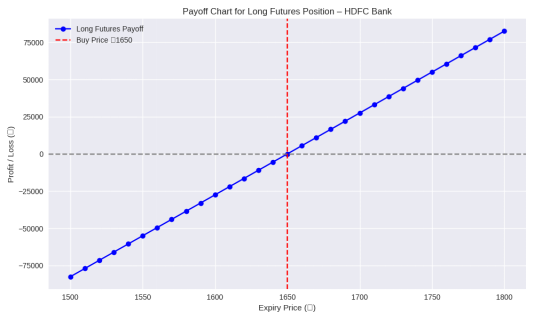
You are expecting the price to rise further from today’s closing price of ₹1,650 per share. If your expectations come true, you will make profits, otherwise, you will be posting losses on your trade. For every conceivable price of the share on expiry, you will either be making profits or losses. This is what is called a futures payoff structure, which shows the profits or losses for a given range of expiry prices. Let us make a payoff structure assuming that the price on expiry day (10 th Dec 2025) may vary from ₹1,500 to ₹1,800 in increments of ₹10 for both upwards and downwards movements. In this payoff structure we will indicate the following information for each expiry price:
P&L = (Expiry Price – Buy Price) × Lot Size
Since the buy price is ₹1,650 and lot size is 550 shares, every ₹1 move in price results in a ₹550 change in profit or loss.
Payoff Table – HDFC Bank Futures (Buy Price ₹1,650, Lot Size 550)
|
Expiry Price (₹) |
Buyer P&L (₹) |
|
1,500 |
-82,500 |
|
1,510 |
-77,000 |
|
1,520 |
-71,500 |
|
1,530 |
-66,000 |
|
1,540 |
-60,500 |
|
1,550 |
-55,000 |
|
1,560 |
-49,500 |
|
1,570 |
-44,000 |
|
1,580 |
-38,500 |
|
1,590 |
-33,000 |
|
1,600 |
-27,500 |
|
1,610 |
-22,000 |
|
1,620 |
-16,500 |
|
1,630 |
-11,000 |
|
1,640 |
-5,500 |
|
1,650 |
0 |
|
1,660 |
5,500 |
|
1,670 |
11,000 |
|
1,680 |
16,500 |
|
1,690 |
22,000 |
|
1,700 |
27,500 |
|
1,710 |
33,000 |
|
1,720 |
38,500 |
|
1,730 |
44,000 |
|
1,740 |
49,500 |
|
1,750 |
55,000 |
|
1,760 |
60,500 |
|
1,770 |
66,000 |
|
1,780 |
71,500 |
|
1,790 |
77,000 |
|
1,800 |
82,500 |
Payoff Chart – It is a straight line that goes up suggesting that these are linear payoff instruments. This suggests that for every point we go up on the X-axis (price), we make ₹550 profit. Similarly, for every point we go down on the X-axis, we lose ₹550.
6.6 Key Takeaways

1.Futures: Leverage is the biggest attraction in futures. Futures enable the trader to take a much bigger position with a given quantum of capital thus enhancing the returns potential.
2.Spot vs Futures – Capital Utilization: In order to buy shares in the spot market, the trader has to pay full amount while with futures he needs to put in only 15-25% as margin.
3.Leverage: For HDFC Bank, while a ₹60 jump in prices would result in 3.6% return on the spot, it would generate a whopping 24.24% return on the future
4.Leverage is a double-edged sword: While it magnifies the gains, it also magnifies the losses. Any adverse fluctuation in the prices can lead to a quick wipe out of the margin money
5.Calculation of Leverage
Leverage = Value of contract / Margin
₹9,07,500 / ₹1,36,125 = 6.67X
Risk Threshold
The % by which the price of the underlying would drop to wipe out the margin is given by: 1/Leverage
So, for the example above, it would be: 1/36.3 = 2.75%
6.Regulatory Protections: SEBI has mandated margin guidelines to protect the interests of the traders as well as investors. These guidelines ensure that neither the broker nor the trader takes undue risks
7.Linearity of Payoff: The profits/losses on the futures contract are linear in nature and change in direct proportion to the change in price of the underlying. For every ₹1 up/down movement in the price of HDFC Bank, the trader makes/losses ₹550
8.Zero Sum Game: In a zero-sum game the gains of one are offset by the losses of the other. The futures markets are a zero-sum game with no wealth being created
9.Futures Are Excellent for Short-Term Directional Views: For traders with a short-term view on the market, it is always better to buy futures.
10.While long-term investors might benefit more from buying in the spot market, the traders benefit immensely by using futures contracts.
6.7 Fun Activity

You have ₹1,00,000 and want to trade HDFC Bank at ₹1,650. Lot size in futures = 550 shares.
Answer these quick questions:
- If you buy 60 shares in the spot market and the price rises to ₹1,710, what is your profit and return %?
- If you buy half a lot (275 shares) in futures with margin ₹68,062.50, and the price rises to ₹1,710, what is your profit and return %?
- Which option gave you a higher percentage return?
Answers:
1.Spot Market → Profit = (₹1,710 – ₹1,650) × 60 = ₹3,600. Return = ₹3,600 ÷ ₹1,00,000 = 3.6%.
2.Futures Market → Profit = (₹1,710 – ₹1,650) × 275 = ₹16,500. Return = ₹16,500 ÷ ₹68,062.50 ≈ 24.2%.
3.Futures gave the higher return because of leverage.