
IPO - Initial Public Offering
With just a few clicks, invest in upcoming IPOs!
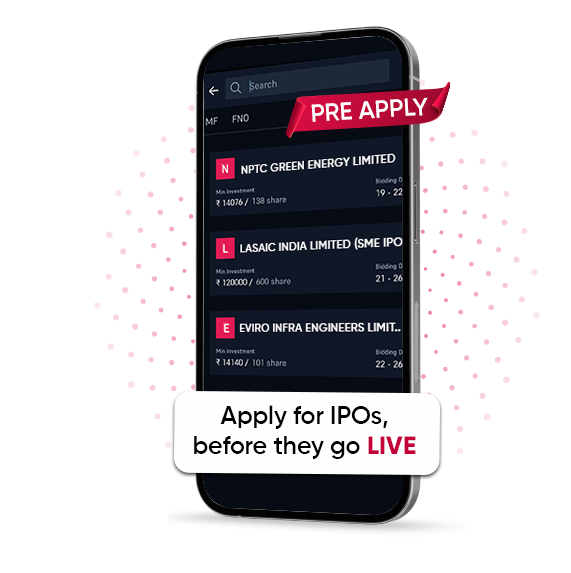
Complete guide to all IPO-related information!
How to Apply for an IPO on 5paisa?
About Mainboard & SME IPOs
What is an IPO
An Initial Public Offering (IPO) is the process by which a private company makes its shares available to the public for the first time, allowing investors to acquire ownership of the firm. Companies frequently use the move from private to public to obtain funds for expansion, debt repayment, and other economic operations. Investing in an IPO can give prospects for early involvement in a company's growth, but it is not without risk.
How Does an IPO Work
- A private company may decide to go public when it seeks to raise capital from public investors and meets the applicable regulatory requirements.
- In India, the process of IPO is regulated by the Securities and Exchange Board (SEBI), so the first step is to register with SEBI.
- After submitting all the required documents and on receiving approval from SEBI, the company is required to determine the share price and the number of shares it plans to issue.
- Following this, the company must choose between the two types of IPO issues- Fixed price IPO and Book Building IPO.
- After IPO valuation, the company’s shares are made public.
Procedure for Investing in IPO
- Acquire the application form, either physically from a broker, a distributor, or from an online portal like 5paisa
- Fill the form with all the required details including personal, bank, and Demat account details.
- Provide details about the total investment amount.
- Shares are allotted and credited to the investor’s Demat account within 2 working days of the issue closing, and list on the exchange on T+3 (three working days after close), as per SEBI’s current timeline.
Who is Eligible to Apply for an IPO?
An adult who is capable of entering into a legal contract is considered eligible for investing in a mainboard IPO or an SME IPO. The individual can be a qualified institutional investor, anchor investor, retail investor or a high net-worth individual. Apart from this, some basic criteria for eligibility are:
- The individual should have a pan card issued by the income tax department.
- A valid Demat account
- It is not mandatory to have a trading account for investing in an IPO but it is advisable to have one. A trading account will help an investor sell the stocks present on the IPO listings, in near future.
Steps to Apply for an IPO from 5paisa
There are five steps to apply for an IPO from 5paisa
- Login to the 5paisa account and select the issue from the current IPO section, under mainboard & SME IPOs.
- Based on the individual’s preference, one can select the number of lots and price for the desired mainboard IPO or SME IPO.
- Enter the UPI ID, check all the details, and select submit. With this, the process is completed and the bid will be placed with the exchange.
- Finally, the individual needs to approve a mandate notification received in their UPI app.
Open a demat account with 5paisa now!
FAQs
When it comes to an IPO, there are 4 types of investors who can bid, as per SEBI guidelines. They are –
1. Qualified institutional investors (QIIs)
2. Anchor investors
3. Retail investors and
4. High net-worth individuals (HNIs)/Non-institutional investors (NII).
IPO subscription period is the period of time during which investors can promise to purchase shares of a security to be issued as initial public offering (IPO).
To invest in IPOs, you can check our List of Upcoming IPO here at 5paisa.
Before applying for an IPO, it’s important to read the Red Herring Prospectus (RHP) carefully. It provides key details about the company’s business model, financials, risks, and how the IPO proceeds will be used. Also, assess the company's fundamentals, industry outlook, and valuation to make an informed decision.
Investors can use an IPO registrar to check the status of their subscription. The investor will need his PAN card number, IPO application number, and Demat account number in order to verify the status of his IPO subscription. The investor will get the information under the search button on the registrar's or BSE's website if the shares are allocated.
Investors receive information from BSE, NSE, CDSL, and NSDL via shared Email and SMS.
When reading the prospectus of an IPO, begin by paying close attention to some parts of the document such as the "Business Overview" section that can help you know more about how the company operates and its future market opportunities, the "Financial Statements" that will reveal its ability to make earnings, the "Risk Factors" to show you the possible problems that might occur, and the "Use of Proceeds" that shows how the funds will be used. Lastly, see the "Management Discussion and Analysis" for information about future plans and development opportunities.
An Initial Public Offering (IPO) is the process through which a private company offers its shares to the public for the first time and becomes a listed company.
IPO allotment status shows whether an investor has received shares after applying for an IPO. It can be checked using the registrar's website or the stock exchange.
Grey Market Premium (GMP) is the estimated premium at which IPO shares may trade in the unofficial market before listing. It is not an official exchange price.
An IPO can generally be applied for through a registered broker or banking platform using the Application Supported by Blocked Amount (ASBA) facility or Unified Payments Interface (UPI), where applicable.
IPO allotment is carried out after the issue closes. If applications exceed the available shares, allotment is generally done according to the applicable regulatory process.
Resident individuals, eligible Non-Resident Indians (NRIs), companies, and other eligible investors can apply for an IPO, subject to applicable regulations and eligibility requirements.