
Gold Import Duty Hiked to 15%: What it Means for Buyers and the Indian Economy
 Indrashish Mitra
- 0 min read
Indrashish Mitra
- 0 min read
Last Updated: 13th May 2026 - 11:47 am

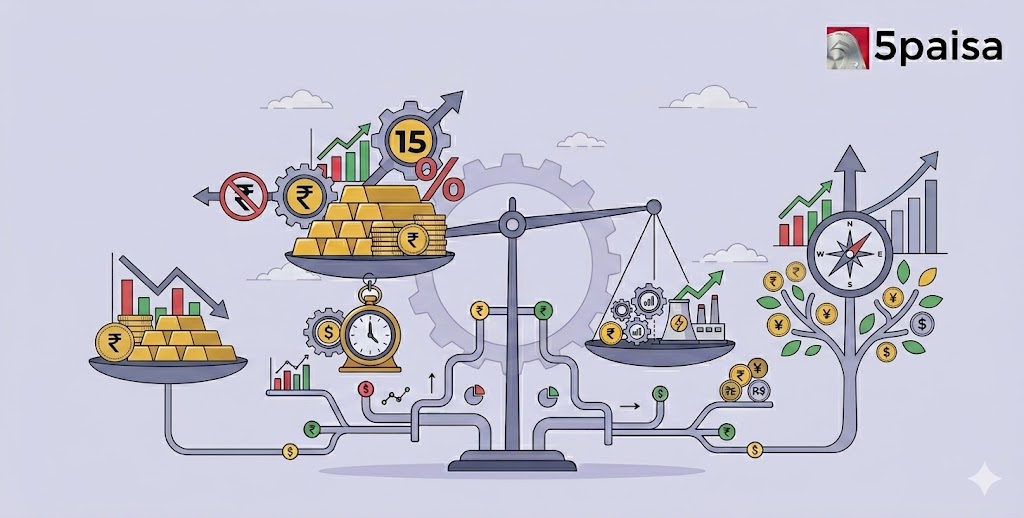
A couple of days after Prime Minister Narendra Modi urged citizens to avoid buying gold for a year, the government has followed it up with a firm policy move. India has raised the effective import duty on gold and silver from 6% to 15%, in an attempt to curb imports, protect foreign exchange reserves and reduce pressure on the rupee.
May 13 onwards gold shall now attract 10% Basic Customs Duty and 5% Agriculture Infrastructure and Development Cess, compared with 5% and 1% earlier, resulting in a 900-bps hike in the duty for the precious metal. The key reason for hiking the import duty is to curb gold buying. It is a clear macroeconomic signal at a time when India is dealing with higher crude oil price, rupee trading near all-time low and uncertainty linked to the West Asia crisis.
 Invest in Indian Markets and Unlock Future Potential With 5paisa!
Gold Import Duty Hiked to 15%: What Has Changed in Comparison to Earlier
| Component | Earlier | Now |
| Basic Customs Duty | 5% | 10% |
| AIDC | 1% | 5% |
| Effective Import Duty | 6% | 15% |
The notification also revises duties on jewellery findings and some industrial inputs. More importantly, it provides concessional rates for recycling and recovery categories such as spent catalysts and ash containing precious metals. This indicates that the government wants to encourage recycling of precious metals rather than fresh imports.
Why There Was a Need for India to Raise Import Duty On Gold and Silver
India does not produce enough gold to meet domestic demand. Almost all demand is met through imports, and these imports are paid for in US dollars. That makes gold a direct pressure point for India’s trade deficit and foreign exchange reserves.
Gold imports rose to a record $71.98 billion in 2025-26, up more than 24% from the previous year. Gold also accounted for more than 9%of India’s total import bill, making it a meaningful drain on foreign exchange.
The timing is important. India’s rupee has been under pressure, crude oil prices have remained firm due to the Iran war and broader West Asia tensions, and economists have warned that India’s current account deficit could widen if energy prices stay elevated. The current account deficit could reach around 2% of GDP by March 2027 if the stress continues.
The government’s calculation is straightforward. If gold imports fall, fewer dollars move out of the country. Even a meaningful reduction in gold purchases can help preserve foreign exchange for essential imports such as crude oil, machinery and key industrial inputs.
Understanding How the Duty Hike Impacts Gold Prices for Buyers in India
The immediate impact for the domestic gold price is visible. With the duty rising from 6% to 15%, imported gold becomes costlier at the landed cost level itself. Retail jewellery prices are likely to absorb this increase quickly, especially because GST, jeweller margins and making charges are added over and above the import cost.
Indian gold futures jumped after the announcement, with gold futures rose 7.2% to ₹1,64,497 per 10 grams, while silver futures climbed 8% to ₹3,01,429 per kg on May 13.
Here is a simple example:
| Scenario | Duty Rate | Duty Amount on Rs 1,54,750 | Landed Value After Duty |
| Earlier structure | 6% | ₹9,285 | ₹1,64,035 |
| New structure | 15% | ₹23,212 | ₹1,77,962 |
This increase comes before adding 3% GST, jeweller margins and making charges. For buyers, the final price at the store level could therefore rise even further.
Gold Demand in India: Why Buyers May Pause
Gold buying in India has two strong drivers. One is cultural, linked to weddings, festivals and family traditions. The other is financial, where gold is seen as a safe haven during uncertain times like the ongoing geopolitical issue.
The government’s move targets both. Higher prices can discourage investment led buying, while the Prime Minister’s appeal may influence ceremonial and discretionary purchases. This is especially relevant at a time when gold prices have already surged sharply.
Investors may respond in three ways. Some may shift to gold ETFs or other paper gold formats. Some may postpone jewellery purchases. Others may exchange old gold for new jewellery instead of buying fresh gold.
Why The Gold Import Duty Hike Helps the Economy
For the economy, the duty hike serves four purposes.
First, it helps conserve foreign exchange. India imports a large share of its crude oil requirement, and every dollar saved on gold can support more essential imports.
Second, lower gold imports can help reduce the current account deficit. Since gold is one of India’s major import items, any cooling in demand can ease pressure on the trade balance.
Third, the move may support the rupee by reducing dollar demand from bullion importers.
Fourth, concessional rates for recycling related categories suggest a policy push toward recovering precious metals from existing sources. This can support domestic value chains and reduce dependence on fresh imports over time.
The Other Side of The Duty Hike
The move may help the economy, but it also comes with side effects. A sharp rise in duty can increase the gap between domestic and international gold prices. If that gap becomes too wide, it may encourage unofficial channels and smuggling, a risk that industry officials have already flagged.
Jewellery demand may also soften in the near term, especially among price sensitive buyers. This could impact jewellers during wedding and festival led buying periods. However, for the government, the larger priority appears to be protecting the external account rather than supporting near term consumption.
Conclusion
The objective of hiking the import duty of gold and silver is not to make jewellery costlier. It is part of a larger attempt to manage India’s external pressure at a time when crude oil, the rupee, foreign exchange reserves and the current account deficit are all under watch.
For consumers, gold has become more expensive after the hike in import duty. For investors, the move may push more interest toward paper gold. For the economy, the message is clear: when global stress rises, non-essential dollar outflows come under scrutiny first.
In simple terms, the government is asking households to pause before buying gold so that the country can save dollars where they matter more.
- Flat ₹20 Brokerage
- Next-gen Trading
- Advanced Charting
- Actionable Ideas
Trending on 5paisa
Disclaimer: Investment in securities market are subject to market risks, read all the related documents carefully before investing. For detailed disclaimer please Click here.