
Growth vs IDCW in Mutual Funds: Which Option Should You Choose?
 5paisa Capital Ltd
- 0 min read
5paisa Capital Ltd
- 0 min read
Last Updated: 26th February 2026 - 10:11 am

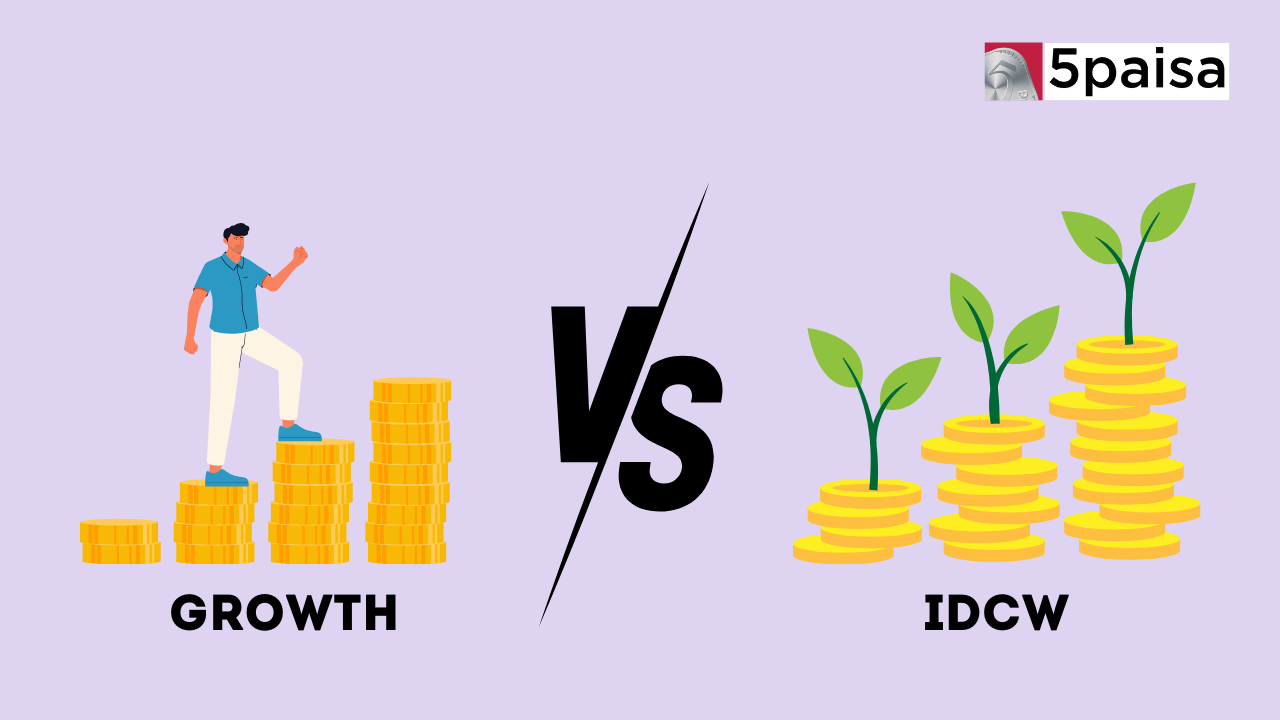
When it comes to investing in mutual funds, one of the most common dilemmas investors face is choosing between Growth and IDCW (Income Distribution cum Capital Withdrawal) options. While both belong to the same mutual fund scheme, the way returns are distributed to investors differs significantly. For Indian traders and long-term investors, understanding these differences is crucial to making the right decision depending on financial goals, tax implications, and cash flow needs.
In this article, let’s simplify the comparison between Growth vs IDCW in mutual funds, highlight the pros and cons of each, and help you decide which option might suit your investment journey best.
What is the Growth Option in Mutual Funds?
In the Growth option, the fund does not pay out dividends or periodic income. Instead, any profit made by the fund is reinvested back into the scheme. This reinvestment allows the Net Asset Value (NAV) of the mutual fund to grow over time.
For example, if you invest ₹1 lakh in a Growth option mutual fund and the fund earns profits, those profits are reinvested into the scheme. The NAV (unit price) of your fund rises accordingly. You do not receive any payout until you redeem your units.
Key Features of Growth Option:
- Profits are reinvested to compound returns.
- NAV reflects the overall growth of the scheme.
- No regular payouts or income.
- Best suited for long-term wealth creation.
What is the IDCW (Income Distribution cum Capital Withdrawal) Option?
The IDCW option, previously known as the Dividend option, distributes a part of the profits to investors periodically. This payout is not guaranteed and depends on the fund house declaring it. Investors can receive IDCW as cash payouts (direct transfer to bank) or opt for reinvestment, where dividends are used to purchase more units of the scheme.
For example, if your mutual fund declares an IDCW of ₹10 per unit and you hold 1,000 units, you will receive ₹10,000 credited to your account (before tax).
Key Features of IDCW Option:
- Provides periodic income in the form of dividends.
- NAV reduces after the dividend payout.
- Suitable for investors seeking regular cash flow.
- Dividend payout depends on fund performance and declaration.
Growth vs IDCW: Key Differences
| Feature | Growth Option | IDCW Option |
|---|---|---|
| Returns | Compounded growth of NAV | Regular payouts in form of IDCW |
| Cash Flow | No periodic cash flow | Periodic income available |
| NAV Impact | NAV grows over time | NAV drops after IDCW payout |
| Wealth Creation | Higher in long term | Moderate (less compounding) |
| Tax Treatment | Capital gains tax at redemption | IDCW taxed as per slab rate |
| Best For | Long-term wealth builders | Retirees or income seekers |
Tax Implications: Growth vs IDCW
Growth Option Taxation:
Returns are taxed only when you redeem your investment. If you hold equity mutual funds for more than 1 year, gains above ₹1 lakh are taxed at 10% (LTCG). Short-term gains (<1 year) are taxed at 15% (STCG).
IDCW Option Taxation:
As per current income tax rules, dividends or IDCW payouts are taxed at the investor’s income tax slab rate. So, if you fall in the 30% tax bracket, your IDCW will be taxed at 30%.
This makes the Growth option more tax-efficient for investors in higher tax brackets.
Which Option is Better for Investors?
The answer depends on your financial goals:
Choose Growth Option if:
- You want to create long-term wealth through compounding.
- You do not need regular payouts.
- You fall under a higher income tax slab.
- Your investment horizon is 5 years or more.
Choose IDCW Option if:
- You need regular income, such as retirees or homemakers.
- You prefer cash flow over reinvestment.
- You fall under a lower tax bracket.
- You are investing with a short-to-medium-term outlook.
Practical Example: Growth vs IDCW
Let’s assume you invest ₹5 lakh in an equity mutual fund.
- Growth Option: After 10 years at 12% CAGR, your investment grows to approx. ₹15.5 lakh (compounded growth).
- IDCW Option: You might receive periodic payouts, say ₹50,000 over the years, but the NAV will not compound as strongly. Final corpus after 10 years might be significantly lower than the Growth option.
Clearly, compounding in the Growth option works more efficiently over the long term.
What Experts Say
According to AMFI (Association of Mutual Funds in India), most retail investors now prefer the Growth option for wealth creation. IDCW remains popular among retirees and conservative investors who value income stability.
Wealth advisors often recommend that young investors should stick with Growth, while IDCW can act as a supplementary income tool for individuals who already have sufficient corpus but want regular inflows.
Conclusion
When deciding between Growth vs IDCW in mutual funds, there is no one-size-fits-all answer. Growth is ideal for long-term wealth creation through compounding and tax efficiency, while IDCW is better for those who prefer regular income.
As an investor, always align your choice with your goals, tax bracket, and cash flow needs. If your priority is building wealth for the future, Growth is the way forward. If you’re looking for steady income in retirement, IDCW may suit you better.
In the end, the key is to choose the right option based on your financial plan, and not just short-term preferences.
Frequently Asked Questions
How Do the Returns Differ Between Growth and IDCW Options?
How Are Growth and IDCW Options Taxed?
Is There a Tax Advantage in Choosing the Growth Option Over IDCW?
Who Should Opt for the IDCW Option?
What Is the Impact of Market Fluctuations on Growth and IDCW Options?
How Does the IDCW Option Affect My Overall Returns?
- 0 Transaction Cost
- Curated Fund Lists
- 4000+ MF Schemes
- Start SIP with Ease
Trending on 5paisa
Disclaimer: Investment in securities market are subject to market risks, read all the related documents carefully before investing. For detailed disclaimer please Click here.