
RBI’s First Bi-Monthly Monetary Policy for FY27: RBI Holds Repo Rate; FY27 GDP Growth Seen at 6.9%
 5paisa Capital Ltd
- 0 min read
5paisa Capital Ltd
- 0 min read
Last Updated: 8th April 2026 - 04:24 pm

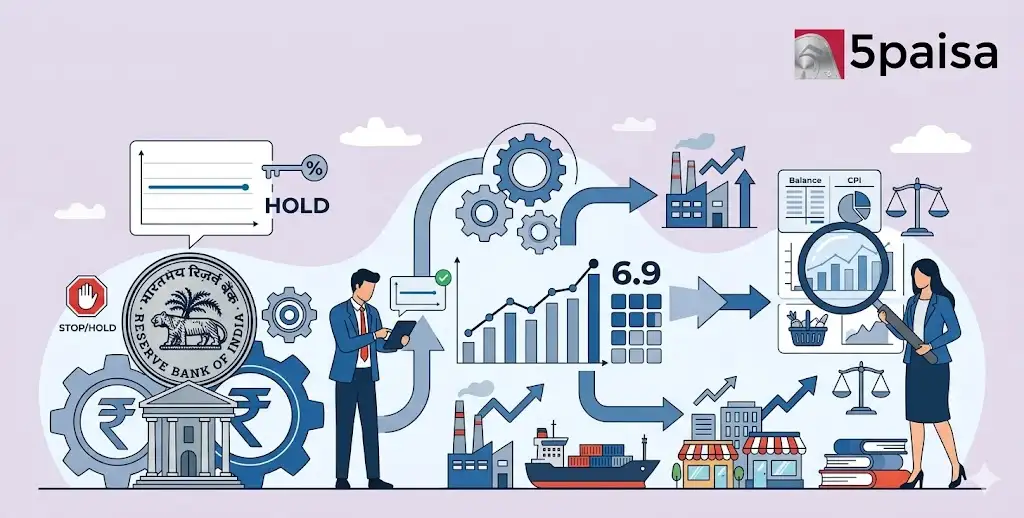
In a unanimous decision today, i.e., April 08, 2026, the Reserve Bank of India's Monetary Policy Committee (MPC) kept the policy repo rate unchanged at 5.25%, in its first bi-monthly monetary policy meeting of FY27. The standing deposit facility (SDF) rate remains at 5.00%. The marginal standing facility (MSF) rate and Bank Rate continue at 5.50%. A neutral stance was also maintained by the MPC. This shows a cautious approach while balancing strong domestic fundamentals with rising global uncertainties.
 Invest in Indian Markets and Unlock Future Potential With 5paisa!
GDP Growth
RBI Governor Sanjay Malhotra said that India’s economy performed well in 2025-26. Real GDP growth is estimated at 7.6% year-on-year under the new GDP series (base year 2022–23). Growth was supported by private consumption, fixed investment, the services sector, and manufacturing. Real gross value added (GVA) growth is estimated at 7.7%. Net external demand remained soft.
Looking ahead, growth is expected to moderate in 2026-27. The RBI has projected real GDP growth at 6.9%. Quarterly estimates show Q1 at 6.8%, slightly lower than the earlier 6.9%. Q2 is at 6.7%, revised down from 7%. Q3 and Q4 are expected to pick up to 7.0% and 7.2%, respectively.
Why were Growth Numbers Revised?
The changes to the numbers going down are because of the political tensions in the Middle East since March 2026. Possible disruptions in the Strait of Hormuz could have an effect on energy supplies and trade around the world. Higher prices for energy and goods, supply shocks, and rising costs for shipping and insurance are all expected to hurt domestic production and exports. India may also be affected by changes in the global financial market.
CPI Inflation Projected at 4.6%: West Asia and El Nino Effect
Inflation is still under control, but it is being watched closely. In February 2026, the headline CPI went up from 2.7% in January to 3.2%. Most of the rise is because of base effects. Food prices went up a little, but core inflation, which doesn't include food and fuel, stayed the same. Excluding precious metals, core inflation is thought to be 2.1%.
For 2026-27, CPI inflation is projected at 4.6%. The quarterly path shows that Q1 is at 4.0%, Q2 is at 4.4%, Q3 is at 5.2%, and Q4 is at 4.7%. If you ignore precious metals, core inflation is expected to be 4.4%.
The RBI warned of risks to inflation. High energy prices from West Asia and possible El Niño effects on the southwest monsoon could push prices higher. Domestic factors such as GST rationalisation, rising manufacturing capacity, healthy corporate balance sheets, and strong services growth may ease the pressure.
Governor Malhotra noted that growth momentum was strong before March. However, external shocks now pose risks to growth and may add pressure on inflation, even as headline figures remain below target. The central bank is watching the situation closely and will act as needed to maintain stability.
Conclusion
In conclusion, the West Asia conflict has made the world's economy and sentiments weak. This has raised concerns over inflation due to rise in crude oil prices and supply disruptions. As reiterated earlier, the RBI will keep a close eye on these changing risks and remain vigilant.
Frequently Asked Questions
- Flat ₹20 Brokerage
- Next-gen Trading
- Advanced Charting
- Actionable Ideas
Trending on 5paisa
 Indrashish Mitra
Disclaimer: Investment in securities market are subject to market risks, read all the related documents carefully before investing. For detailed disclaimer please Click here.