
What Is The Riskometer In Mutual Funds And Why Should Investors Care?
 5paisa Capital Ltd
- 0 min read
5paisa Capital Ltd
- 0 min read
Last Updated: 8th May 2026 - 03:08 pm

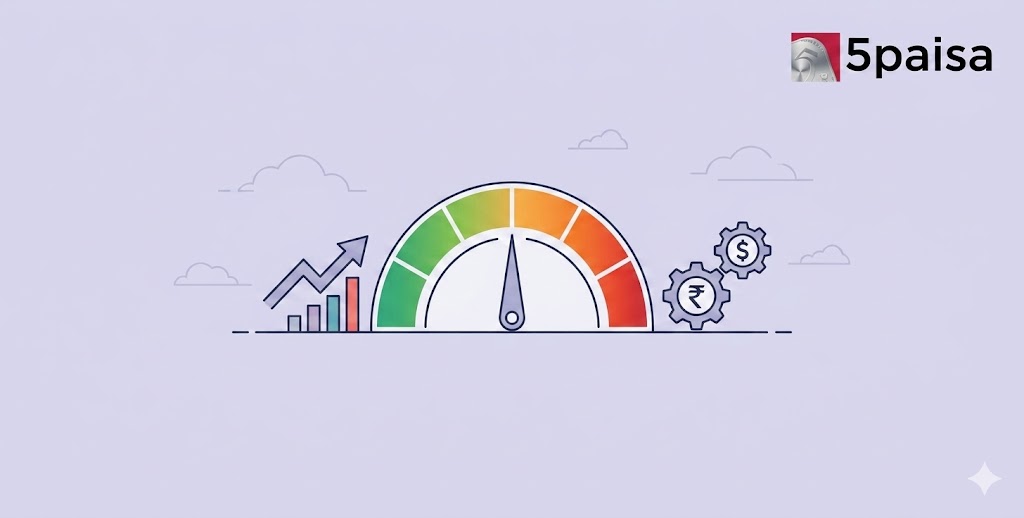
Pick up any mutual fund fact sheet, scroll through any fund listing on a broker app, or open any scheme-related document, somewhere on that page, you will find a small dial. It looks a bit like a speedometer, with colours running from green to red. That is the Riskometer, and while it is easy to scroll past, it carries more useful information than most investors give it credit for.
 Invest in Indian Markets and Unlock Future Potential With 5paisa!
Understanding The Concept of Riskometer In Mutual Fund
When people invest in mutual funds, the conversation usually centres on returns, what the fund gave last year, how it has performed against its benchmark, and so on. What gets less attention is risk. But returns and risk are always connected. A fund that has delivered high returns likely took on higher risk to get there. Understanding that relationship, before putting in money, is what the Riskometer is designed to help with.
The Riskometer is a risk-measuring tool used in the mutual fund industry to depict the risk level of a mutual fund scheme. It is mandatory for asset management companies to display it on their schemes as per guidelines issued by SEBI. The aim is to give every investor, regardless of financial background or experience, a quick, standardised way to understand what they are getting into in terms of risk.
History Of Riskometer
The current version of the meter was introduced on July 1, 2015 by SEBI. The earlier model for product labelling, introduced in March 2013, demonstrated the risk involved with investing in a fund through three colours:
Blue - Low Risk
Yellow - Medium Risk
Brown - High Risk
However, this model was considered to be inadequate to classify the correct risk level of a mutual fund. Moreover, several funds would fall into the same risk category, thereby making it difficult to assess the difference between them. The Riskometer prepared through new guidelines classifies risk into broader levels, making it easier for investors to choose a mutual fund as per their appetite.
The Six Risk Levels Of Riskometer of Mutual Fund
The Riskometer has six levels of risk, each with a colour code to make the tool more detailed and investor friendly, Low, Low to Moderate, Moderate, Moderately High, High, and Very High.
These are not arbitrary labels. The classification is based on the nature of the underlying assets, market volatility, credit risk, and interest rate sensitivity. In practical terms, this means a liquid fund, which holds short-duration government securities, might sit at Low risk, while a small-cap equity fund investing in newer, less-established companies could sit at Very High risk. Both are mutual funds, but they are very different in nature.
The colour coding matters too, the dial moves from green on the low-risk end to red at the very high end, making the risk level visible at a glance even before reading any numbers.
| Risk Level | Colour | Products under the category | Suitable for |
| Low | Green | Income funds, gilt funds, and fixed maturity plans with a maturity of less than 90 days come under this category as these carry the lowest risk. | Those who are risk-averse and give priority to the safety of their investment. |
| Moderately Low | Light green | Short and medium-term bonds with a maturity period of 91 days to 3 years come under this category. These also bear minimal risk. | Those who prefer to take nominal risks but also prioritise the safety of their investment. |
| Moderate | Yellow | Hybrid debt-oriented funds, monthly investment plans (MIPs), and arbitrage funds come under this category as these are somewhat risky. | Those who prefer to invest for longer than short term and are ready to undertake a certain degree of risk. |
| Moderately High | Orange | Gold ETFs, index funds, diversified equity funds, and balanced equity-oriented funds with equity exposure of up to 20% of the portfolio. | Those who prefer long-term investment and are ready to be exposed to some degree of risk. |
| High | Red | Micro-cap funds, international funds, thematic funds, and sectoral funds are classified under this category. | These are ideal for aggressive investors or those willing to take the risk of losses for long-term investing. |
How The Risk Level Is Actually Decided?
The risk assigned to a fund is not a one-time exercise done at launch and forgotten. For equity schemes, the assessment is based on market capitalisation, volatility, and liquidity. For debt schemes, it is based on credit risk, interest rate risk, and liquidity risk. Because portfolio composition may change over time, fund houses are required to review the risk level every month. If there is any change in the Riskometer, investors of that particular scheme must be informed as per regulatory timelines.
This monthly review matters because a fund's risk can genuinely shift. If a debt fund starts buying lower-rated bonds to improve yield, the credit risk goes up. If an equity fund moves its holdings toward mid-caps, the volatility exposure increases. The Riskometer is meant to indicate that reality.
What The Riskometer Does Not Tell You?
The Riskometer is useful, but it has limits that are worth knowing.
It only tells you how risky a particular fund is, not whether it is suitable for you.
A fund marked as Moderately High risk may work well for someone with a long investment horizon, but may not be appropriate for someone who needs the money in the near term. It also does not consider your overall portfolio. If you already have significant exposure to equity, adding another high-risk fund increases your overall risk, even if each individual fund appears acceptable on its own.
In simple terms, the Riskometer is a helpful starting point, but it does not give the complete picture, and should be used along with your own financial situation and goals.
Using The Riskometer In Practice
The most practical use of the Riskometer is matching it to your own circumstances. Short-term goals may be better suited to lower to moderate-risk schemes, while long-term wealth-creation goals may justify higher-risk equity funds.
A few things worth doing when you look at a fund's Riskometer, first, check whether it has changed recently. A fund that has moved from Moderate to Moderately High in the past few months is worth examining more closely to understand why. Second, compare it across funds in the same category. If two large-cap equity funds have different risk levels on the Riskometer, it suggests their portfolio construction is meaningfully different. Third, use it alongside other information, expense ratios, portfolio concentration, fund manager track record, rather than as a standalone decision-making tool.
A Small Dial With A Clear Purpose
India had crossed total folios over 27 crore, indicating a large and growing base of investors, many of them first-time participants navigating a wide and sometimes confusing range of schemes. The Riskometer does not make investing simple, but it does make one important piece of information, how risky is this fund, immediately accessible to anyone.
It is one of those small regulatory requirements that, when taken seriously, can prevent a fairly common mistake, investing in something that carries more risk than you realised and finding out only when markets fall. Spending ten seconds looking at the Riskometer before investing is time well spent.
Frequently Asked Questions
- 0 Transaction Cost
- Curated Fund Lists
- 4000+ MF Schemes
- Start SIP with Ease
Trending on 5paisa
 Varda Khade
Disclaimer: Investment in securities market are subject to market risks, read all the related documents carefully before investing. For detailed disclaimer please Click here.