
What is Nifty Midcap 150?
 Indrashish Mitra
- 0 min read
Indrashish Mitra
- 0 min read
Last Updated: 15th May 2026 - 06:47 pm

If you have done any research on the Indian stock market, chances are you have come across the term “Nifty Midcap 150” and wondered what it actually means. Just another stock market index? Why does it matter? And most importantly, should investors pay attention to it? The answer is yes.
Knowing what is nifty midcap 150 helps investors tap into a fast-growing space in the Indian stock market with major long-term potential. While large-cap firms grab the headlines, midcap companies are frequently where some of the most amazing growth stories begin.
 Invest in Indian Markets and Unlock Future Potential With 5paisa!
In this article, we will look at nifty midcap 150 meaning, how the index works, why investors monitor it attentively and how you may invest in it smartly.
What is Nifty Midcap 150?
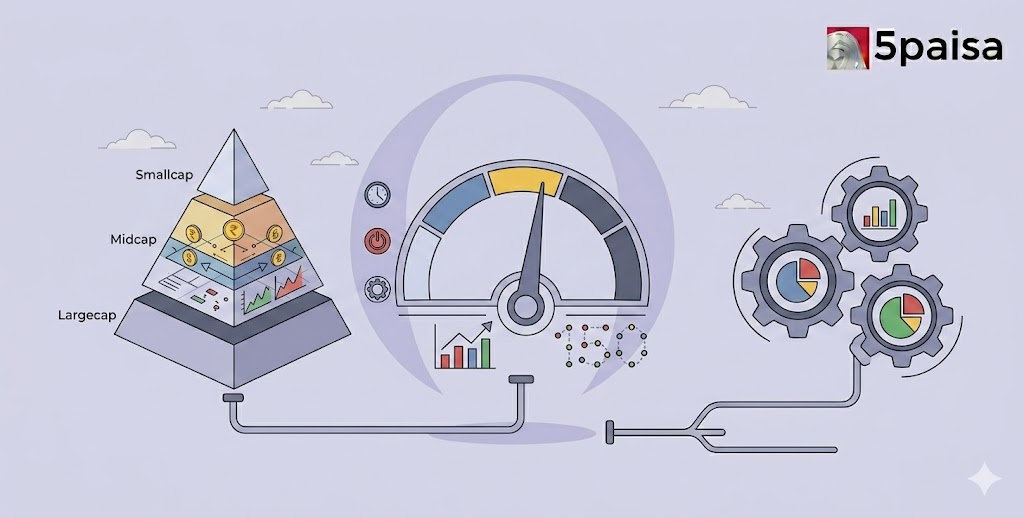
To understand what is nifty midcap 150, imagine the stock market as a ladder of firms ranked by size.
The top includes mega-cap companies like Reliance Industries, TCS and HDFC Bank, basically the OG corporate heavyweights with stable performance and massive market presence. At the bottom are small-cap enterprises in their early stages of growth.
The midcap lies in the middle. The Nifty Midcap 150 is a stock market index maintained by NSE Indices Limited, tracking the performance of 150 mid-sized firms listed on the National Stock Exchange (NSE) of India.
These companies are classified as medium-sized based on their market capitalisation, and often have better growth potential than large-cap companies. Many of these companies are growing fast and may be future market leaders.
How Are Companies Selected in the Nifty Midcap 150?
The selection approach of Nifty Midcap 150 is systematic and transparent. The companies are selected on the basis of:
1. Market capitalisation
The companies should be ranked between 101 and 250 in terms of overall market capitalisation among NSE-listed companies.
2. Liquidity
Stocks should be sufficiently traded so investors can buy and sell easily.
3. Free Float Market Capitalisation
The index employs free-float market capitalisation, counting only those shares that are available to the public to trade.
4. Periodic Rebalancing
The index is revised twice a year to ensure it appropriately reflects the midcap market segment at the time.
If a firm grows substantially and joins the top 100, it will move into the large-cap space and leave the index. Likewise, developing midcaps could replace weaker corporations.
Benefits of Investing in Nifty Midcap 150
There are many reasons why investors want to have exposure to midcap indices:
1. Building Wealth for the Long Term
Historically, midcap companies have been known to generate strong returns over long investment periods.
2. Diversify Your Portfolio
The index invests in 150 companies in diverse areas.
3. India’s Growth Story: Participation
Midcap companies frequently have a strong link to expanding domestic demand and industrial expansion.
4. Opportunities for Higher Returns
Midcap indices may produce higher returns compared to large-cap indices during economic expansion phases.
How Can You Invest in the Nifty Midcap 150?
Exposure is available without buying all 150 stocks individually. Here are the most popular ways to invest:
1. Index Funds
Several asset management companies (AMCs) offer mutual fund schemes that passively track the Nifty Midcap 150. These funds replicate the index composition, giving you exposure to all 150 companies without having to pick stocks yourself.
2. Exchange-Traded Funds (ETFs)
ETFs that track the Nifty Midcap 150 are listed on the NSE and can be bought and sold like stocks during market hours. However, liquidity can vary, and during volatile periods, ETF prices may deviate from their net asset value (NAV).
3. Direct Stock Investment
If you have a demat account, you can buy individual stocks that are part of the Nifty Midcap 150 index. This gives you full control but requires research into each company.
Who Should Invest in the Nifty Midcap 150?
The Nifty Midcap 150 can be a good option for investors who:
- Adopt a long-term investment horizon
- Want greater growth possibilities
- Believe in the long-term growth of India’s economy
Young investors and long-term wealth builders usually have midcap exposure in their portfolios as a way of balancing growth and diversification.
A Note on Risk
Midcap investing isn't for everyone. The segment tends to experience sharper drawdowns during market downturns compared to large caps, and recovery can take longer. Since it can get super volatile in the short term, having a long-term mindset usually makes the ride way less stressful.
Wrapping Up
The Nifty Midcap 150 is not just another stock market index. It is home to some of the fastest-growing and most promising enterprises of India.
By understanding what is nifty midcap 150, investors may move away from investing only in large-cap companies and be a part of India’s growing economic story. For individuals aiming to grow their wealth over a period of time, the Nifty Midcap 150 might be a great complement to a diversified investment portfolio.
Frequently Asked Questions
How does a company get removed from the Nifty Midcap 150?
Can a midcap company eventually become part of the Nifty 50?
What is free float market capitalisation, and why does it matter for the index?
Is there a minimum investment amount to gain exposure to the Nifty Midcap 150 through mutual funds?
- Flat ₹20 Brokerage
- Next-gen Trading
- Advanced Charting
- Actionable Ideas
Trending on 5paisa
Disclaimer: Investment in securities market are subject to market risks, read all the related documents carefully before investing. For detailed disclaimer please Click here.