What is Cut-Off Price in IPO?

5paisa Capital Ltd

Cut Off Price In IPO

IPO Investing made simple!

+91
By proceeding, you agree to all T&C*
hero_form

Content

Cut-off price is the offer price at which shares get allotted to investors. It plays an important role in price discovery, helping underwriters gauge the demand for the offering and the right price from within the predetermined range.

This is usually involved in a book building issue instead of a fixed price mechanism. The company announces the price band or the floor price in its prospectus, and the actual discovered price is within the price range, or any figure above the floor price, called the 'Cut-off' price.

For example, if a company's IPO is priced between INR 100 and INR 105, and you bid INR 103 for ten shares, but the price is determined to be INR 102, you will receive allotment at INR 102 per share, whereas, if the price is determined at INR 104, you will fail to receive any allotment.

By selecting the cut off option, you stand to gain allotment no matter what the final price of the IPO is, so long as it doesn't extend beyond the established price range.

Cut-Off Price Meaning In An IPO

Without a fixed price in place, lead managers of an IPO determine the final price based on the weighted average figure of all the bids received. The final price determined through this process is the cut-off price.

In the case of popular offerings that often get oversubscribed many times over, the cut-off price is almost always the ceiling price of the price band, which usually results in significant gains following the listing. 

Types of IPO Pricing

1. Fixed Price IPO

In a fixed price issue, the company announces a single price per share ahead of opening the IPO. Everyone who applies pays the same amount — no bidding, no price discovery. It may sound simpler, but because the price is predetermined, the market’s real reaction remains hidden until the listing.
From an investor’s perspective this means less guessing about “what’s the right bid”. But it also means less flexibility, and if market sentiment is strong you may miss out on upside, or if it’s weak you might be paying too much.

2. Book Building IPO

Most large-scale IPOs today follow the book­-building route. Here the company issues shares within a price band (for example, ₹100-₹120). Investors place bids indicating how many shares they want and at what price (within the band). At the end of the subscription window, the final issue price i.e. the “cut-off price”, is chosen where demand meets supply. 

The book-building method tends to reflect market sentiment more accurately and provides better price discovery but you’ll also see far more competition when demand is high.

Selecting Cut-off Price While Applying

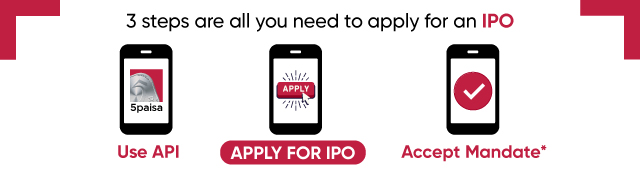
Brokerages allow investors to select the 'cut-off' option while applying for the IPO, through which investors can indicate their willingness to pay any amount for the shares within the price-band advertised. You will be eligible for allotment at any discovered issue price by selecting a cut-off option.

By selecting the cut-off option, you say that you are okay with any price within the respective ranges, even the ceiling price offered in the prospectus. This can significantly increase the chances of getting an allotment, especially in popular issues.

If you are confident about a particular company or IPO and would like to get an allotment of the stock at any price within the range, this is a great feature to make use of. Without opting for this feature, investors who bid lower than the final price fail to receive any allotment and refund their amount. In contrast, investors who bid an amount higher than the final price receive a refund of the difference amount.

ipo-steps

Factors Affecting Cut-Off Prices in IPOs

1. Market Conditions

When the overall market is positive - rising indices, strong investor sentiment - IPOs tend to fare better and final cut-off prices often gravitate toward the higher end of the band. Conversely, in a sluggish market you’ll see more conservative pricing. 

2. Demand and Supply

Ultimately it’s a matter of numbers: how many people applied versus how many shares are on offer. If applications far outstrip supply, bids will push the price up; if demand is weak, the cut-off might settle at or near the floor. 

3. Company Fundamentals

Investors look at revenue growth, profit margins, business model, competitive strength. A company that shows strength here often gets stronger bids, which can push the final price upward. Weak fundamentals may limit the upside.

4. Industry Trends

If the IPO firm happens to be in a trending industry - say, tech, green energy, e-commerce — that tailwind counts. Industry momentum can amplify demand and affect how aggressively investors bid.

5. Peer Comparison

How does the company stack up against listed peers? If similar companies trade at high valuations, the IPO may price accordingly. If it looks overvalued relative to peers, investor caution can drag down the cut-off.

6. Speculative Interest

Sometimes the hype factor kicks in. Media buzz, influential backers, or recent IPO success stories in the same sector can trigger speculative demand. This tends to raise the final price.

7. Promotional Strategies

How well the company and its underwriters market the IPO matters. Clear communication of the business story, transparency in the prospectus, proactive investor outreach - all these can boost investor confidence and affect pricing.

8. Economic Indicators

Macro factors like interest rates, inflation, GDP growth and currency strength can influence risk appetite among investors. If the economic backdrop is shaky, even a good IPO can settle at a conservative price. 
Kotak Securities

Improving The Chances of Getting An Allotment

If an IPO is oversubscribed, there are no chances of getting an allotment if an investor bids anything lower than the top end of the price range. Even after selecting the higher end of the price range, the chances of getting an allotment are still slim, especially with popular offerings.

With the raging IPO markets today, getting an allotment is quite similar to a lucky draw, and opting for a 'cut-off' is one way to improve the odds in your favour. Apart from this, there are a few other options, such as only bidding for one lot or using the Demat account of friends and family to apply, increasing your chances to get an allotment.

You can also try applying on the first day of the IPO or stating that you own shares in the parent company, such as being a shareholder of SBI while applying for the SBI Cards IPO. These are a few other ways of improving the odds in your favour. Overall, there is no way to guarantee allotments when applying for an IPO that has been oversubscribed multiple times over.

Retail investors are also stacked against qualified institutional investors (QIIs), foreign portfolio investors, and public pension funds. But SEBI requires 50% of the securities to be reserved for retail investors, still leaving individual investors with an opportunity to get in on hot IPO opportunities.

Final Verdict

The book-building process is perfect for determining the cut-off price IPO and comes with flexibility that makes it perfect for companies stepping onto the bourses. A few companies also follow the process of partial book building, where only qualified institutional investors are invited to send bids, which are then used to determine the price.  

In the competitive IPO market, selecting the 'cut-off' option is one of the IPO cut-off prices. The ways of shifting the odds are no guarantee but are almost as essential to stand any chance of getting an allotment.
 

Disclaimer: Investment in securities market are subject to market risks, read all the related documents carefully before investing. For detailed disclaimer please Click here.

Verify Your Details

Apply IPO “Hassle Free” even without opening a Demat Account with 5Paisa.

Verify Your Details

Please enter valid email
Please enter valid PAN

We have sent an OTP on your mobile number .

Resend otp
Please enter valid otp

Krishca Strapping Solutions Limited

sme
  • Date Range 23 Oct- 27 Oct’23
  • Price 23
  • IPO Size 200
Open Free Demat Account

Be a part of 5paisa community - The first listed discount broker of India.

+91

By proceeding, you agree to all T&C*

footer_form