
How the Stock Market Helps Beat Inflation Over Time
 5paisa Capital Ltd
- 0 min read
5paisa Capital Ltd
- 0 min read
Last Updated: 11th September 2025 - 11:18 am

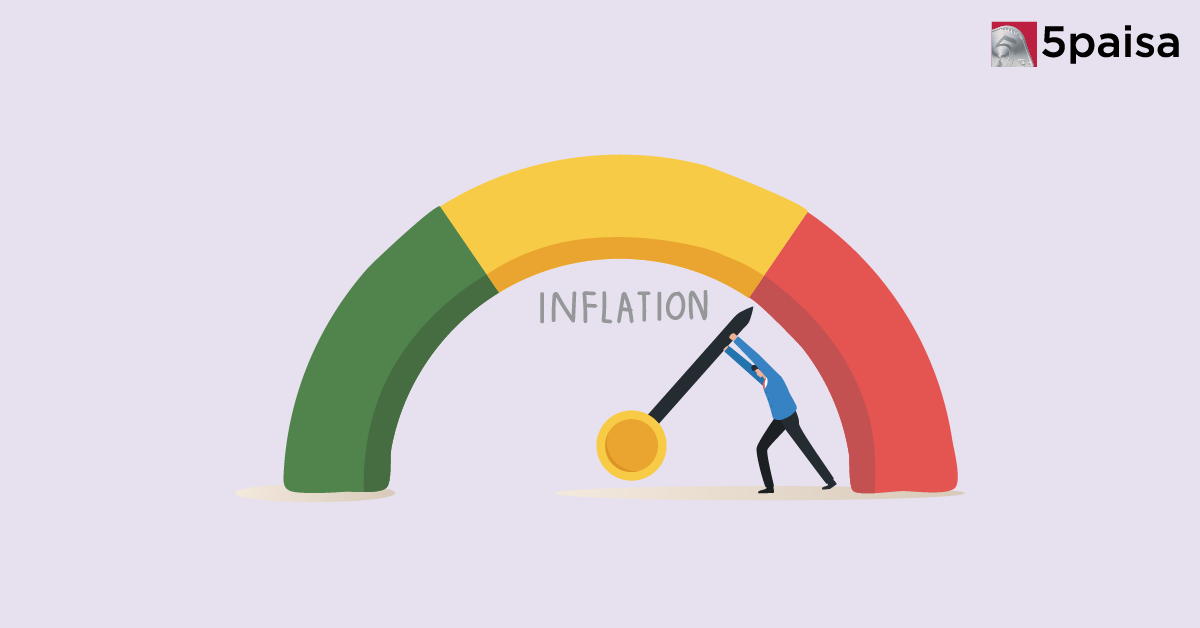
Inflation might sound like an economics textbook term, but its effects show up every time you shop for groceries, refill your petrol tank, or renew your insurance. It’s the gradual increase in the price of goods and services—so gradual, in fact, that many don’t realise how much it erodes the value of money until it’s too late.
Let’s say you stash away ₹1 lakh under your mattress today. Ten years from now, that same ₹1 lakh might only buy you what ₹60,000 or ₹70,000 could today, depending on inflation. In other words, while the number stays the same, its worth silently declines. That’s the invisible cost of inflation.
This is precisely why it’s not enough to save—you have to grow your money. And over the long run, very few financial avenues have managed to outpace inflation the way the stock market has.
 Invest in Indian Markets and Unlock Future Potential With 5paisa!
The Slow Burn: How Inflation Eats Into Savings
Inflation rarely announces itself with a bang. It's a slow burn—an invisible force that quietly chips away at your purchasing power. The effect compounds over time, and before you know it, your carefully saved-up money doesn’t stretch as far as it once did.
Consider this: if inflation averages around 6% per year, something that costs ₹1,000 today will cost nearly ₹1,800 a decade later. This may not seem like much at first glance, but when applied to essentials like food, education, healthcare, or even retirement, the implications are serious.
The problem becomes even more stark when your money is lying idle or earning interest lower than the inflation rate. For instance, a savings account typically offers around 3–4% interest—clearly insufficient to maintain your money’s real value over time.
Fixed Returns Have Their Limits
Indian investors have traditionally gravitated towards fixed return instruments. Fixed deposits, recurring deposits, and small savings schemes like the PPF or NSC are household staples. They offer stability and a guaranteed return—which is great for preserving capital, especially in the short term or for conservative goals.
But the trouble begins when you look at the real return—that is, the return after adjusting for inflation.
Let’s say your fixed deposit yields 6% per annum. With inflation running at 5.5% that year, your real gain is just 0.5%. In some years, when inflation spikes—as it did post-pandemic—your returns could even be negative in real terms. That means you’re technically losing purchasing power, even though your account balance is growing.
So while fixed income products are useful, they’re not designed to help you grow wealth over the long term. For that, you need an investment that doesn’t just match inflation—it consistently beats it.
Equities: A Long-Term Hedge Against Inflation
Enter the stock market. Unlike fixed-income instruments, equity investments represent ownership in businesses. And good businesses tend to grow their earnings, expand operations, and increase prices over time. This natural growth cycle means that the value of the company, and hence its stock, also tends to rise.
Let’s simplify it. Imagine you invested ₹1 lakh in the Nifty 50 index 20 years ago. Even accounting for occasional dips and crashes, that investment would now be worth over ₹12 lakh (assuming a CAGR of ~13%). During this same period, inflation would have turned ₹1 lakh into around ₹3 lakh in purchasing power. The contrast is striking.
In other words, equities don’t just protect against inflation—they can significantly outpace it.
And it’s not just capital gains. Many companies also pay out dividends, which are periodic cash payments to shareholders. These dividends can be reinvested or used as a source of income—another way to stay ahead of rising costs.
Historical Proof: What the Data Tells Us
Let’s put numbers to the theory. Over the past 30 years, the average inflation rate in India has hovered between 5% and 7%. Meanwhile, the Sensex has delivered an average annualised return of about 12–14% over the same time period.
Even after accounting for taxes and inflation, equity returns remain comfortably positive. What’s more, the longer your investment horizon, the smoother your returns tend to be. While the stock market can be choppy in the short term, it tends to reward patience.
Take 2008, for example. The global financial crisis sent markets tumbling. But within five years, most indices had not only recovered but surged past their pre-crisis levels. Those who stayed invested came out ahead, while those who pulled out likely locked in losses.
SIPs and the Power of Compounding
If you’re new to investing or worried about timing the market, Systematic Investment Plans (SIPs) offer a simple and effective solution.
With an SIP, you invest a fixed amount regularly—say ₹1,000 or ₹5,000 a month—into a mutual fund. Over time, this disciplined approach builds a sizeable corpus.
What makes SIPs powerful is rupee cost averaging. When markets are high, you buy fewer units; when they’re low, you buy more. This helps average out the purchase cost and reduces the impact of volatility.
Add compounding to the mix, and the results can be dramatic. Compounding is essentially earning interest on interest. Over the years, this snowballs into significant wealth, especially when combined with the inflation-beating potential of equities.
For instance, a ₹5,000 monthly SIP earning a 12% annual return over 20 years can grow to over ₹50 lakh. Had you kept that same amount in a fixed deposit at 6%, you’d end up with around ₹26 lakh—nearly half.
What About the Risks?
No investment is without risk, and the stock market is no exception. Prices fluctuate, sentiment shifts, and there will be corrections and bear markets. However, it’s important to distinguish between volatility and loss. Volatility is temporary; loss becomes permanent only if you panic and exit during a downturn.
That’s why having a long-term horizon is so important. The longer you stay invested, the more likely you are to ride out market cycles and emerge with strong returns. It’s also wise to invest based on your risk appetite and financial goals. Not everyone needs to be fully in equities—but ignoring them altogether could mean falling behind inflation.
Diversification: Your Safety Net
One of the easiest ways to manage risk in equity investing is to diversify. That means not putting all your money into one stock or one sector. Mutual funds, especially index funds and exchange-traded funds (ETFs), offer instant diversification.
When you invest in a Nifty 50 or Sensex fund, for example, you’re effectively investing in the top companies across various industries—banks, IT, pharmaceuticals, consumer goods, and more. This spreads out your risk and ensures that poor performance in one area is balanced out by gains in another.
For beginners, mutual funds are a great starting point. They’re managed by professionals, require no stock-picking skills, and allow you to benefit from market growth without needing to monitor it daily.
Final Thoughts: Inflation Is Unavoidable, But Falling Behind Doesn’t Have to Be
Inflation is baked into the economy—it’s not something you can avoid. But you can prepare for it. And if you’re serious about building wealth that retains its value (or grows beyond it), ignoring equities may be a costly mistake.
The stock market, for all its ups and downs, remains one of the most reliable tools to stay ahead of rising prices over the long term. By starting early, investing regularly, and staying the course, you give yourself the best shot at financial freedom—one that keeps pace with a changing world.
It’s not about chasing the highest returns. It’s about being smart, patient, and focused on the big picture.
Frequently Asked Questions
- Flat ₹20 Brokerage
- Next-gen Trading
- Advanced Charting
- Actionable Ideas
Trending on 5paisa
 Indrashish Mitra
Disclaimer: Investment in securities market are subject to market risks, read all the related documents carefully before investing. For detailed disclaimer please Click here.