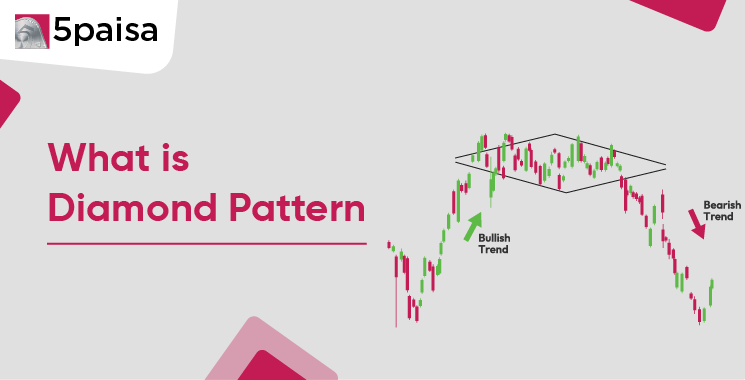
What is Diamond Pattern?

5paisa Capital Ltd

Diamond Pattern: A Guide to Trading This Chart

Want to start your Investment Journey?

+91
By proceeding, you agree to all T&C*
hero_form

Content

If you’ve spent enough time looking at trading charts, you know they can be full of strange shapes. Some are obvious, like a double top. Others take a bit more skill to notice. One of those is the diamond pattern — a formation that doesn’t show up often, but when it does, traders pay attention.

So, what is diamond pattern exactly? In simple terms, it’s a chart formation shaped like a diamond that can signal a big shift in market direction. It’s not just pretty geometry on a screen; it’s a visual story of how market sentiment changes.

 

Meaning of Diamond Pattern in Trading

The diamond pattern in trading is a reversal pattern. That means it tends to show up when the current trend is running out of steam and a new one might be about to start. In the diamond pattern in stock market setups, you’ll see prices first swing wider, then start pulling closer together, forming that unmistakable diamond-like outline.

Think of it this way: the market’s enthusiasm is expanding and contracting, like a deep breath before something happens. Sometimes that “something” is a rally, sometimes it’s a drop. The challenge is figuring out which.

The diamond chart pattern is relatively rare. You might not see it every month, but when you do, it can be a game changer, especially for swing traders who look for trend reversals.
 

Formation of Diamond Chart Pattern

A diamond shape chart pattern doesn’t appear out of nowhere. It builds in two distinct phases:

1. The Widening Phase – Prices start making higher highs and lower lows. The chart looks messy, almost chaotic. This is where market participants are pushing the price in both directions, trying to take control.

2. The Narrowing Phase – After all that volatility, the price range begins to shrink. Highs get lower, lows get higher. The diamond takes shape.

By the time you can see the full outline, the market is often coiling up for a breakout. If it’s a diamond top chart pattern — forming at the end of an uptrend — the breakout is usually downward. If it’s a diamond bottom pattern — appearing after a long downtrend — the breakout is usually upward.
Importance of Diamo
 

Importance of Diamond Pattern in Trading

Here’s why the diamond pattern trading strategy gets so much attention: when it breaks, it can break hard.

A diamond pattern breakout often leads to a strong and decisive move. Traders like it because it’s not about guessing during the pattern’s formation — the real action comes after the breakout confirms the direction. That means you can wait for proof before risking your capital.

The diamond pattern meaning also goes beyond just shape recognition. It’s about understanding the shift in power between buyers and sellers. When you spot that shift early, you can position yourself ahead of the crowd.
 

Interpretation of Diamond Chart Patterns

Reading a diamond chart pattern is a bit like solving a puzzle. The key pieces are:

Breakout Direction:

  • A diamond top pattern breaking below support? Bearish signal.
  • A diamond bottom pattern breaking above resistance? Bullish signal.

Volume: Often, you’ll see higher volume during the chaotic widening phase, a dip in volume during the narrowing phase, and then a sudden surge when the breakout happens.

Trend Context: A diamond top after a long rally carries more weight than one that appears in the middle of a sideways market.

The goal isn’t to jump in as soon as you see something diamond-shaped — it’s to wait for confirmation. That’s the difference between smart trading and gambling.
 

Psychology Behind Diamond Chart Pattern

The diamond pattern in trading is more than lines on a chart — it’s a snapshot of trader psychology.

At first, there’s excitement or fear driving large swings in price. Then comes hesitation, as both bulls and bears wait to see who will blink first. This tug-of-war creates the widening and narrowing that forms the diamond.

When the breakout finally happens, it’s like a dam breaking. One side wins, the other rushes to exit, and the price moves sharply in the winner’s direction. That’s why the diamond pattern breakout can be so dramatic.
 

Types of Diamond Patterns: Top and Bottom

There are two main varieties of diamond chart pattern you need to know:

Diamond Top Pattern: Appears after a strong uptrend. It’s the market’s way of saying “enough” before heading lower. Breakouts here tend to be bearish.

Diamond Bottom Pattern: Forms after a prolonged downtrend. It often signals the bears are losing control and the bulls are stepping in. Breakouts here tend to be bullish.

Both can occur on different timeframes. You might see a diamond pattern in stock market daily charts, or you might spot one on a 15-minute chart for short-term trades.
 

How to Identify Diamond Patterns on Trading Charts

Spotting a diamond shape chart pattern takes practice, but here’s a practical approach:

  • Check the Trend: Make sure it’s following a clear uptrend or downtrend.
  • Look for Symmetry: First an expanding price range, then a contracting one.
  • Draw Your Lines: Connect highs and lows to see if they form a diamond outline.
  • Watch Volume: Expanding in the beginning, shrinking in the middle, and then spiking at the breakout.
  • Wait for Confirmation: Don’t act on the shape alone. Let the breakout confirm the trade direction.

Some traders combine this with indicators like RSI or MACD to filter out false patterns.
 

Conclusion

The diamond chart pattern is a rare but powerful reversal signal. It’s not something you’ll see every day, but when it forms clearly and breaks with strong volume, it’s worth paying attention to.

Whether you’re looking at a diamond top pattern that warns of an upcoming drop or a diamond bottom pattern hinting at a rally, the same rule applies: wait for confirmation. The diamond pattern breakout can be explosive, but it’s patience that turns that potential into profit.

If you’re serious about trading, it’s worth adding the diamond pattern meaning to your mental library of chart setups. Because when this formation appears, it’s the market’s way of saying change is coming.
 

Disclaimer: Investment in securities market are subject to market risks, read all the related documents carefully before investing. For detailed disclaimer please Click here.

Open Free Demat Account

Be a part of 5paisa community - The first listed discount broker of India.

+91

By proceeding, you agree to all T&C*

footer_form